
Imagine a customer walks into a physical store. They ask to see a product, and the salesperson says, “Sure, just a moment,” then disappears into the back room for what feels like an eternity. How long does the customer wait before walking out?
Online, that “eternity” is about three seconds.
The research is clear: 53% of mobile site visitors will leave a page that takes longer than three seconds to load. For e-commerce brands, this isn’t just a bounce rate statistic—it’s a cash register closing. In fact, for every 100ms improvement in load time, Walmart saw up to a 1% increase in revenue.
The most critical part of this three-second window is what loads above the fold—the part of your product page visible without scrolling. And what’s the heaviest, most important element in that space? Your product images.
This guide breaks down two powerful but often overlooked technical fixes for this very problem: next-gen image formats and Content Delivery Networks (CDNs). Think of it as giving your online store an express lane for its most valuable assets.
The High Cost of a Slow First Impression
“Above the fold” is an old newspaper term, but in the digital world, its meaning is just as straightforward: it’s the first impression your website makes. On a product page, this area is prime real estate, usually containing the product name, hero image, price, and the “Add to Cart” button.
If that hero image is slow to appear, the entire user experience grinds to a halt. The customer can’t see what they’re buying, can’t evaluate the quality, and their patience wears thin with every passing millisecond. A study by Akamai found that a two-second delay in web page load time can increase bounce rates by over 100%.
The problem is that high-quality product photos are, by nature, large files. For most websites, images make up nearly 50% of the total page weight. It’s a classic e-commerce dilemma: you need stunning visuals to sell, but those same visuals can kill your page speed and drive customers away.
The Unseen Culprit: Outdated Image Formats
For years, JPEG and PNG have been the workhorses of the web. While familiar and widely supported, they’re also decades-old technology. Using them for a modern e-commerce site is like trying to run a streaming service on a dial-up modem.
The images on your product pages are likely heavier than they need to be, slowing down the critical rendering of your above-the-fold content without you even realizing it.
A Smarter Way to Serve Images: Next-Gen Formats
That’s where “next-gen” image formats like WebP and AVIF come in. Developed by tech giants like Google and Netflix, these formats were designed specifically for the modern web.
Their magic lies in superior compression algorithms. They can display an image that looks identical—or even better—than an old JPEG or PNG, but at a fraction of the file size.
Here’s what that means in practice:
- WebP: This format, developed by Google, typically produces images that are 25-34% smaller than comparable JPEGs and 26% smaller than PNGs.
- AVIF: A newer format, AVIF offers even more impressive compression, often resulting in files that are around 50% smaller than JPEGs of similar quality.
Switching from JPEG to WebP is like swapping a bulky hardcover book for a lightweight e-reader. You get the exact same story, but it’s much easier and faster to carry. For your website, this means crisper images that load almost instantly, improving the user experience and your page’s performance metrics.
The Delivery System Upgrade: Content Delivery Networks (CDNs)
Okay, so you’ve optimized your images into a lightweight, next-gen format. The next question is, how do you deliver them to your customers as quickly as possible, no matter where they are in the world?
The answer is a Content Delivery Network, or CDN.
What is a CDN and How Does It Work?
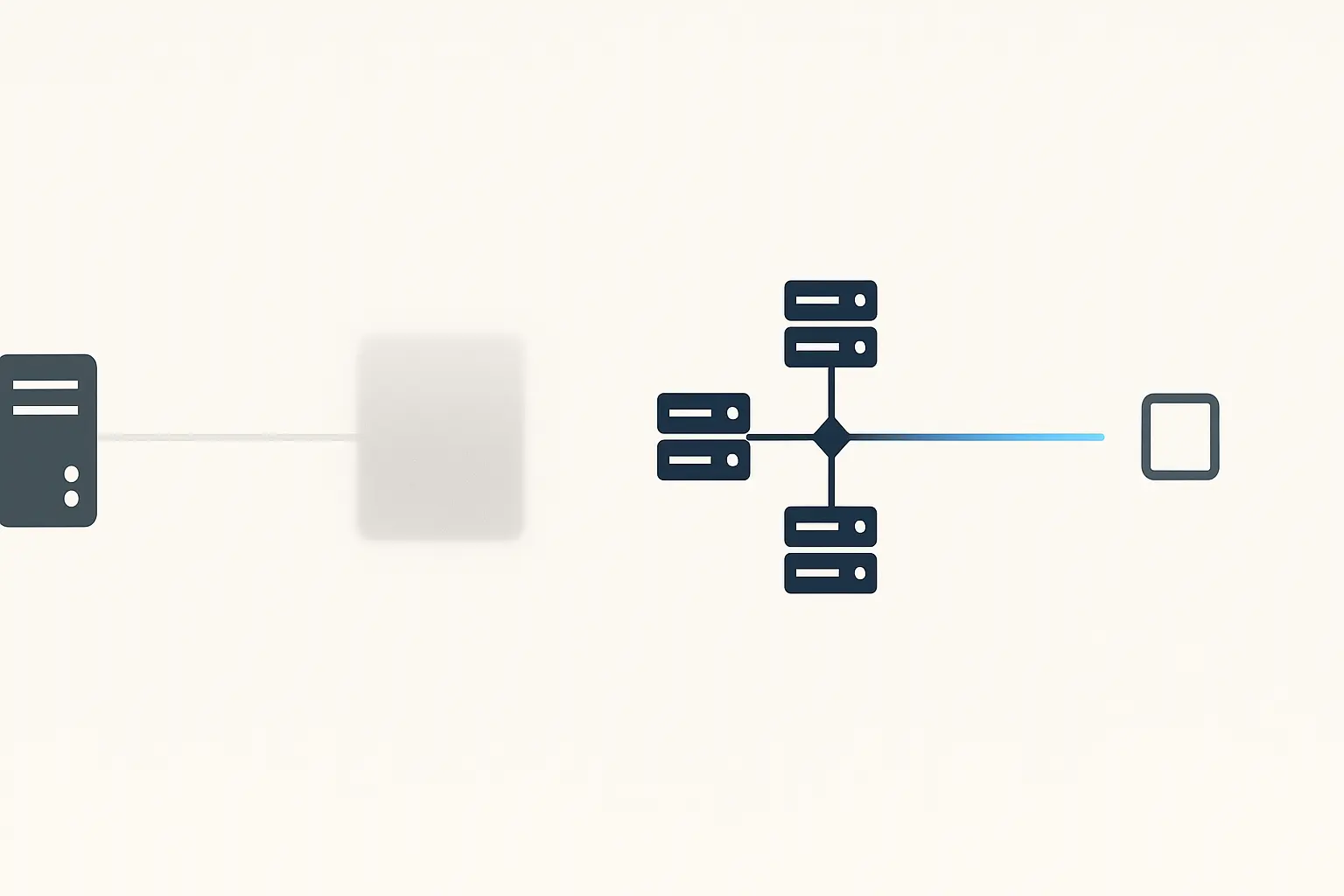
Imagine your website’s server is a single, central warehouse in New York. When a customer from California requests a product image, that digital file has to travel all the way across the country. If a customer from Japan requests it, the file has to journey across the globe. This travel time is called latency, and it adds precious milliseconds—or even seconds—to your load time.
A CDN is like having a network of mini-warehouses all over the world. It takes copies of your static files (like images) and stores them on servers in dozens or hundreds of global locations.
When that customer from California visits your site, the CDN automatically serves the product image from the closest server—say, in Los Angeles—instead of from New York. The shorter travel distance means a dramatically faster load time.
For an e-commerce business with a global or even national audience, a CDN is no longer a luxury; it’s a foundational piece of a fast, reliable user experience.
Bringing It All Together: A Two-Step Playbook for Speed
Optimizing your above-the-fold performance isn’t about a dozen complex fixes. It starts with this simple, high-impact strategy:
- Convert Your Images: Use tools or plugins to automatically convert your product images from JPEG/PNG to a next-gen format like WebP. Most modern platforms have simple ways to do this.
- Serve Through a CDN: Implement a CDN to cache those optimized images and deliver them from a server located as close to the user as possible. Many web hosts and e-commerce platforms now include CDN services in their plans.
By combining smaller file sizes (thanks to WebP) with a shorter delivery distance (thanks to a CDN), you directly attack the two biggest causes of slow-loading product images. You give customers the rich visual experience they demand, without the wait they hate.
Frequently Asked Questions (FAQ)
What exactly is “above the fold”?
“Above the fold” refers to the portion of a webpage that is visible to a user without having to scroll down. It’s the very first thing people see, making its performance critical for engagement and conversions.
Is it difficult to convert my images to WebP?
Not at all. Many modern CMS platforms like Shopify and WordPress (with plugins) can handle this conversion automatically. There are also standalone online tools and software that can convert images in bulk.
Do I really need a CDN for a small online store?
Even if your audience is primarily local, a CDN offers benefits beyond geography. CDNs are built for high performance and can handle traffic spikes better than a single server, reducing the risk of your site slowing down or crashing during a promotion.
How does this affect my Core Web Vitals?
Optimizing above-the-fold images has a massive positive impact on your Core Web Vitals. Specifically, it directly improves Largest Contentful Paint (LCP), which measures how quickly the main content (usually your hero image) loads. A better LCP score is a strong signal to Google that your site provides a good user experience.
Your Next Step: From Awareness to Action
Understanding why this matters is the first step. You’ve seen how seemingly small technical details—like file formats and server locations—have a direct and measurable impact on your revenue. A slow-loading image above the fold isn’t just a nuisance; it’s a leaky bucket in your sales funnel.
The next logical step is to identify where these issues exist on your or your clients’ websites. Pinpointing which images are slowing things down and whether a CDN is properly configured is the foundation of any effective optimization strategy. A comprehensive technical SEO audit is designed to uncover these and other hidden opportunities, turning technical insights into tangible business growth.