
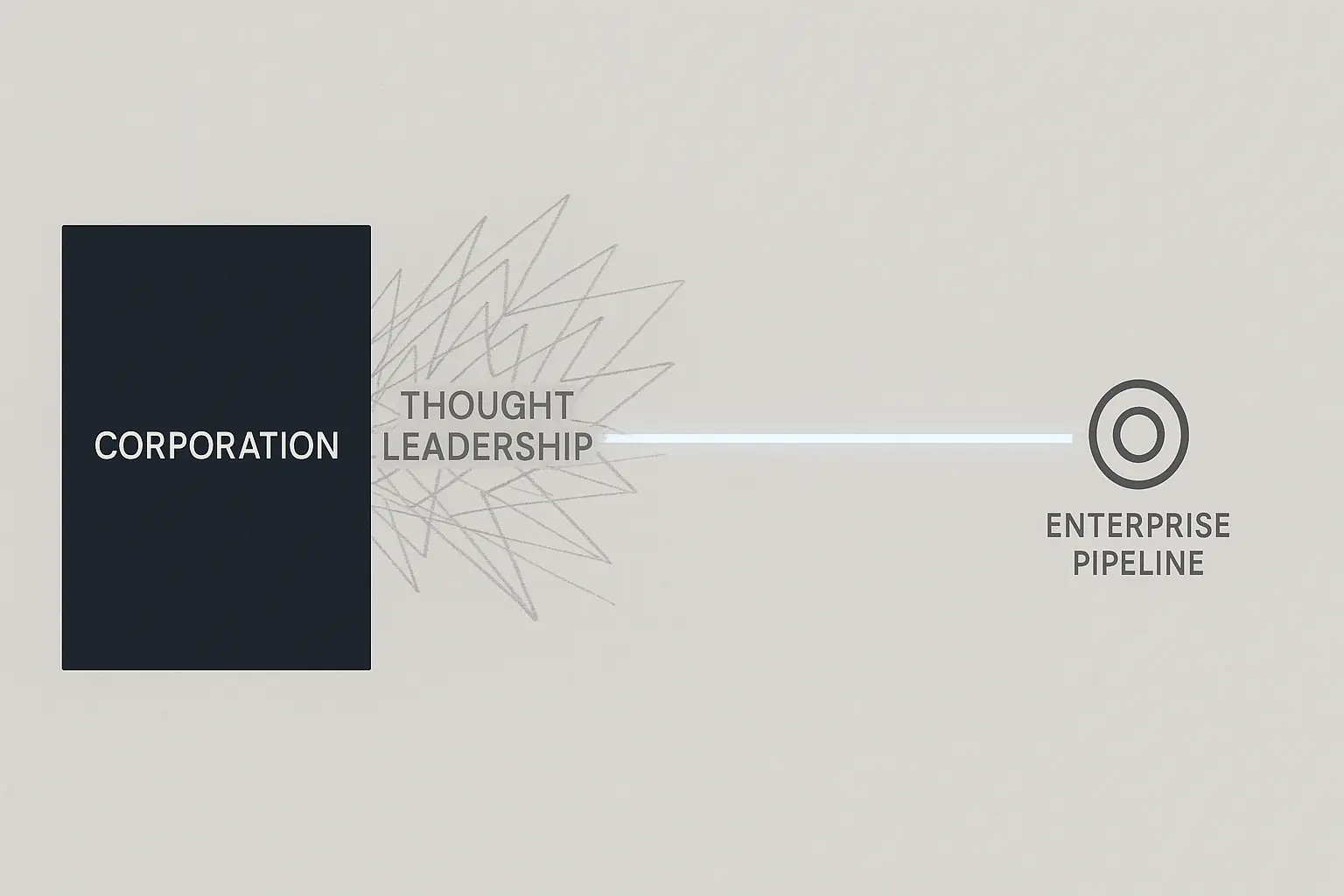
You’ve done everything right. You invested in a high-end content team, approved a significant budget, and built a production engine that publishes polished thought leadership articles, case studies, and LinkedIn posts every week.
Yet the C-suite pipeline remains empty. Your team is creating content, but it isn’t starting conversations with the people who can actually sign a six-figure deal.
This is the Corporate Content Paradox: the more you spend on polished, brand-safe content, the less it seems to resonate with senior decision-makers.
The internet is flooded with guides on measuring content ROI. While competitors like Semrush and Sitecore offer comprehensive formulas and tactical advice, they’re answering the wrong question—helping you measure the impact of a broken model.
The problem isn’t your spreadsheet; it’s your strategy. The reason your content fails to generate enterprise pipeline isn’t a lack of measurement. It’s a fundamental misunderstanding of how trust is built with executive buyers on platforms like LinkedIn.
Why the Corporate ‘Thought Leader’ Factory is Failing
The typical approach to corporate content is built on brand awareness and top-of-funnel metrics. It’s a volume game designed to capture search traffic and blanket social media. This model, while effective for broad-based marketing, breaks down completely when your target is a specific, time-poor, and skeptical senior executive.
Here’s why the factory approach fails:
-
It Lacks a Human Voice: Corporate content is written by committee, filtered through legal, and published under a brand logo. It’s impersonal and sterile. Decision-makers don’t build relationships with logos; they connect with people whose expertise they trust.
-
It Broadcasts, It Doesn’t Engage: The goal of most corporate content is to be published and promoted—a one-way broadcast. But on LinkedIn, the real value isn’t in the initial post; it’s in the nuanced, insightful conversations that happen in the comments. Corporate accounts are notoriously bad at this.
-
It’s Platform-Agnostic: The advice in most ROI guides is generic. It doesn’t account for the unique social fabric of LinkedIn, where personal authority trumps corporate messaging. Content that might work for a blog post targeting SEO keywords feels hollow and self-serving in a professional social feed.
While B2B content marketing can achieve a staggering 844% average ROI over three years, most companies never see it because their strategy is misaligned with the executive buyer’s journey. They’re creating noise that decision-makers have become experts at ignoring.
![A diagram showing a corporate megaphone broadcasting generic messages like ‘Innovation’ and ‘Synergy’ towards unimpressed C-suite executives who are instead engaged in a one-on-one conversation with a human expert.]
This disconnect is why only 36% of marketers feel they can accurately measure their content ROI: they’re trying to attribute revenue to assets that were never designed to build the deep trust a complex sale requires.
Revenue is a Lagging Indicator of Trust: The New ROI Formula
To fix this problem, you have to redefine the goal. The objective of enterprise-focused content isn’t immediate lead generation—it’s building credible authority that opens doors for your sales team. Revenue is simply a lagging indicator that you’ve successfully built trust.
Forget complex attribution models for a moment and embrace a simpler, more powerful formula:
Trust x Credibility x Consistency = Pipeline
This equation shifts the focus from vanity metrics like impressions and clicks to the leading indicators of revenue:
-
Trust: Does your audience believe you have their best interests at heart?
-
Credibility: Do they see you as a genuine expert with a valuable point of view?
-
Consistency: Are you showing up reliably over time to reinforce that trust and credibility?
When you optimize for these three variables, pipeline becomes a natural outcome. This is the mindset required to win, and it’s a long-term play. Research shows it takes 7-9 months for a strategic content program to break even, which is why a focus on short-term, campaign-based metrics is so destructive. You’re quitting the game before you’ve had a chance to score.
![A clean, modern graphic illustrating the formula ‘Trust x Credibility x Consistency = Pipeline’ with icons representing each element leading to a dollar sign icon.]
The Playbook: From Corporate Megaphone to Trusted Advisor
Shifting from a content factory to a trust-building engine requires a deliberate change in tactics. This means empowering your internal experts to become the face of your company’s knowledge and moving from a centralized, brand-first model to a decentralized, human-first approach.
Here is the playbook to make that transition.
Step 1: Kill the Corporate ‘We’
The single most powerful word in corporate content is ‘I.’ When a subject matter expert shares a specific, personal insight—’I worked on a project where we faced this exact challenge, and here’s what I learned’—it carries 100x more weight than a generic blog post that says, ‘Our company is a leading provider of innovative solutions.’
Empower your senior strategists, engineers, and consultants to speak for themselves. This isn’t about abandoning the brand; it’s about channeling its expertise through its most credible assets: its people. This is the foundation of building real authority—a critical factor in how your expertise is understood not just by people, but by the AI systems that now control discovery.
Step 2: Solve, Don’t Sell
Your executive audience doesn’t care about your product’s features. They care about their multimillion-dollar problems. Your content should obsessively focus on solving a small piece of their problem for free.
Instead of a post that says, ‘Our New Platform Streamlines X,’ try one that says, ‘Here are three non-obvious operational bottlenecks I see in 90% of companies in your industry, plus a framework for solving them.’
This approach demonstrates expertise without asking for anything in return. It builds credibility and attracts the right audience by signaling that you understand their world deeply. This principle is the core of our approach to [White-Label AI Visibility Execution]—we focus on structuring your knowledge to solve problems, which in turn makes you more visible and authoritative.
Step 3: Engage, Don’t Broadcast
The post is the start of the conversation, not the end. The real trust-building happens in DMs and comment threads. When a CTO comments on your expert’s post, that’s not a metric—it’s an opportunity. That’s how relationships begin: with a thoughtful, non-salesy reply that adds further value.
Train your experts to spend as much time engaging with the right people as they do creating the initial content. This is the manual, unscalable work that opens doors to the enterprise accounts you can’t reach with ads or cold emails. This deep engagement creates powerful signals of authority that are increasingly important for discovery in [AI Overviews and conversational search].
Conclusion: Stop Measuring the Noise, Start Creating the Signal
The pressure to prove content ROI is real. But by focusing on traditional metrics, we’ve incentivized the creation of low-impact, high-volume ‘thought leadership’ that executives ignore. We’ve built efficient factories for producing noise.
The path to generating real enterprise pipeline is to stop acting like a media company and start acting like a trusted advisor. It’s about prioritizing depth over reach, credibility over clicks, and conversations over conversions.
By empowering your people to share their genuine expertise, you create a clear, powerful signal that cuts through the corporate noise. You start building the only currency that matters in an enterprise sale: trust. And when you have that, the pipeline will follow.
Frequently Asked Questions
Q: This sounds like personal branding. How does this scale for a large enterprise?
A: It’s not about turning every employee into an influencer. It’s about strategically identifying 5-10 key subject matter experts whose knowledge is critical to your buyers. By focusing their efforts, you create concentrated points of authority that represent the entire organization’s expertise. It’s a scalable model of ‘expert-led growth’ rather than a chaotic free-for-all.
Q: Our compliance and legal teams would never approve of employees speaking so freely.
A: This isn’t about going rogue. It’s about establishing a framework for authentic, expert-driven communication. You can create clear guidelines, provide media training, and establish a review process that ensures compliance without sterilizing the expert’s voice. The goal is to manage risk, not eliminate the human element that builds trust.
Q: How do you actually measure the ROI of ‘trust’?
A: You measure it through leading indicators that are much closer to revenue. Track metrics like inbound connection requests from target accounts, DMs that reference a specific piece of content, increases in C-level profile views after a post, and, most importantly, the number of sales conversations initiated directly from these interactions. These are tangible pipeline metrics, not soft brand awareness numbers.
Q: Is traditional content marketing and SEO no longer important?
A: They are more important than ever, but their role has changed. Foundational SEO and a well-structured content library are the price of entry. They build the technical and informational bedrock of your digital presence. Our [AI-powered visibility automation] is designed to optimize this foundation.
However, to activate that foundation and engage the enterprise decision-makers who don’t search for basic keywords, you need the trust-building layer this playbook provides. The two work together: one ensures you’re discoverable, the other ensures you’re credible.