Imagine this: your client is a genius. A leading expert in sustainable architecture, a master luthier, or a financial wizard who sees market trends before anyone else. They can talk for hours, dropping invaluable insights, unique methodologies, and stories that can’t be found anywhere online.
But when you try to capture that brilliance for their website, it falls flat. The blog posts sound generic. The service pages lack their distinctive spark. Their expertise remains trapped in their head, invisible to Google and potential customers.
This gap between an expert’s true knowledge and their online presence is a massive missed opportunity for agencies. In a world saturated with generic, AI-generated content, the most valuable asset you can build for a client is a digital version of their unique brain.
The tool for this? A proprietary knowledge graph.
What is a Knowledge Graph (and Why Should Your Agency Care)?
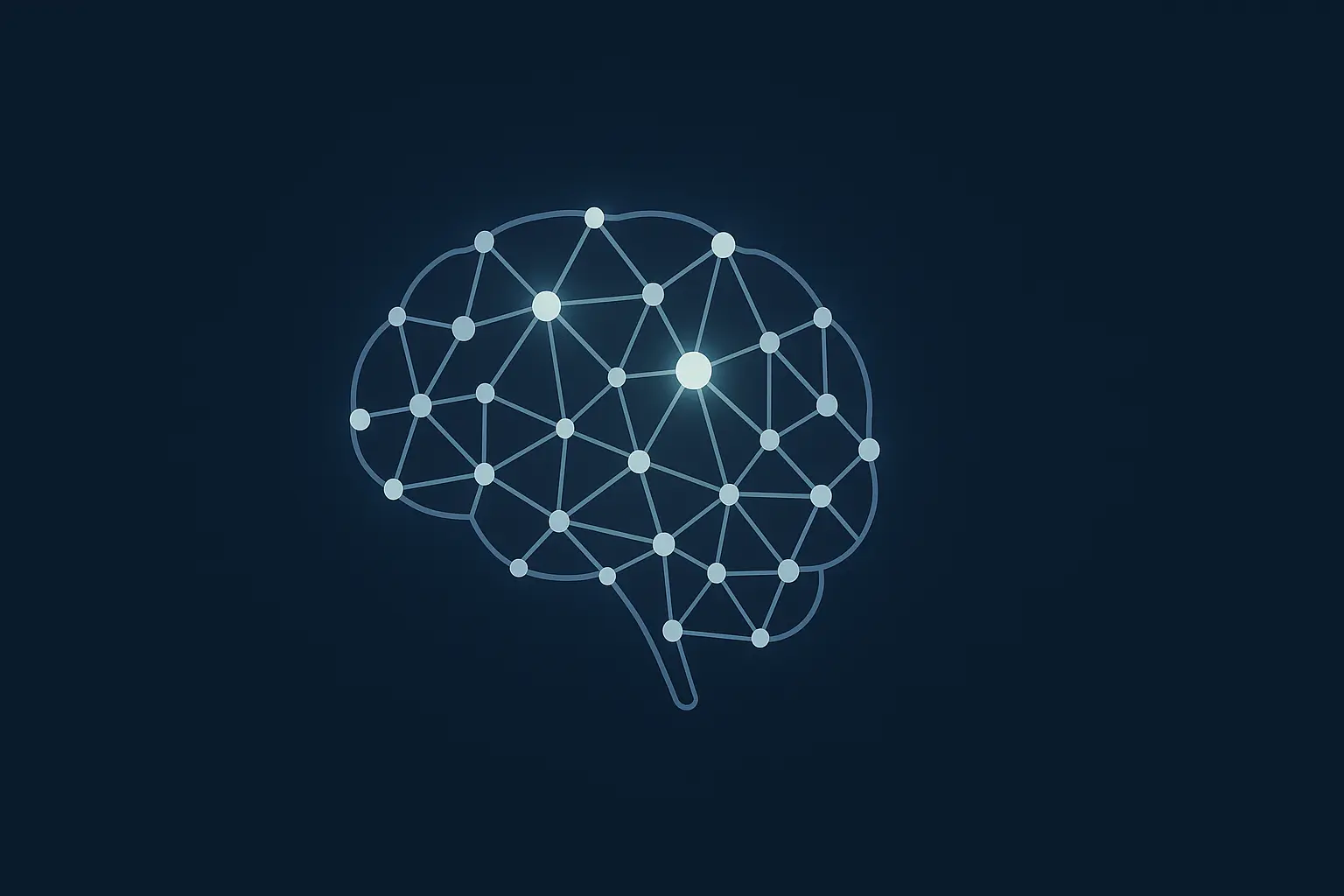
Forget complex data science for a moment. Think of a knowledge graph as a mind map for a machine. It doesn’t just list facts; it understands the relationships between them.
A simple database knows: ‘Jane Smith’ is a ‘CEO.’
A knowledge graph knows: ‘Jane Smith’ (person) is the ‘CEO of’ ‘Acme Innovations’ (company), which ‘specializes in’ ‘AI-driven logistics’ (concept), and she ‘wrote the book’ ‘Future Forward’ (creative work).
This interconnected web of information is how search engines like Google are evolving. They are moving beyond keywords to understand the contextual relationships between entities—a core principle of semantic search. A knowledge graph speaks this language fluently, turning your client’s expertise into structured data that machines can understand, trust, and ultimately reward with visibility.
It’s your defense against the biggest risk in the new era of AI: irrelevance. As AI-generated content floods the internet, true authority will be defined by unique, verifiable knowledge.
The Problem with Off-the-Shelf AI
Large Language Models (LLMs) like ChatGPT are trained on the public internet. They are very good at summarizing what’s already known, but they can’t access the private, nuanced expertise locked in your client’s head.
Worse, they can suffer from ‘AI hallucinations,’ where the model confidently states incorrect information. These systems are known to ‘confabulate’ or invent details when they lack a solid source of truth. Relying on them alone for expert content is a recipe for generic, and potentially inaccurate, results.
A proprietary knowledge graph acts as a “grounding mechanism.” It gives your AI tools a private, fact-checked library of your client’s unique insights. This ensures the content you create is original, accurate, and infused with their genuine expertise. It’s the difference between asking a random person for directions and asking the person who drew the map.
The 4-Step Process to Mine Client Expertise
Building a knowledge graph sounds intimidating, but the process begins with something agencies already do: talking to clients. Here’s how to turn those conversations into a powerful digital asset.
Step 1: The Expert Unpacking Interview
The goal here isn’t a simple Q&A; it’s a guided storytelling session. Your job is to get the subject-matter expert (SME) to talk naturally about what they know.
Key Questioning Techniques:
-
‘Walk me through…’: Ask them to explain a core process from start to finish. ‘Walk me through how you diagnose a failing foundation.’ This reveals steps, tools, and decision points.
-
‘What’s a common mistake people make?’: This uncovers counterintuitive insights and ‘enemy-focused’ content angles.
-
‘Tell me about a time when…’: Stories are packed with entities and relationships. A story about a challenging project reveals problems, solutions, and unique outcomes.
-
‘Why do you do it that way?’: This gets to their unique methodology and philosophy—the secret sauce competitors can’t replicate.
Record the entire conversation—with permission. This raw, unstructured audio is your gold mine.
Step 2: Extracting Entities and Relationships
Now, you’ll need to transcribe the interview. Once you have the text, it’s time to start thinking like a machine. Read through the transcript and highlight three key elements:
-
Entities: These are the ‘nouns’ of their world. People, products, services, concepts, places, events, companies. (e.g., ‘The Helios solar panel,’ ‘John Carter,’ ‘LEED certification’).
-
Relationships: These are the ‘verbs’ that connect the entities. (e.g., designed by, is a feature of, prevents, is located in).
-
Attributes: These are the properties or facts about an entity. (e.g., ‘The Helios panel has a 25% efficiency rating,’ ‘LEED certification has four levels’).
You’re essentially deconstructing their sentences into a simple ‘Entity 1’ -> ‘Relationship’ -> ‘Entity 2’ format.
The sentence, ‘Our lead engineer, Sarah Jones, developed our proprietary ‘Hydro-Lock’ sealant to prevent water damage in basements,’ becomes:
‘Sarah Jones’ -> ‘is the lead engineer at’ -> ‘Your Client’s Company’
‘Sarah Jones’ -> ‘developed’ -> ‘Hydro-Lock sealant’
‘Hydro-Lock sealant’ -> ‘prevents’ -> ‘Basement water damage’
Step 3: Structuring the Knowledge
You don’t need complex software for this. Start with a simple spreadsheet with three columns: Subject, Predicate, Object.
Subject: Sarah Jones, Predicate: developed, Object: Hydro-Lock sealant
Subject: Hydro-Lock sealant, Predicate: prevents, Object: Basement water damage
Subject: Basement water damage, Predicate: is a common problem in, Object: Older homes
As you build this list, you’ll see a network forming. This structured list is the foundational layer of your client’s knowledge graph. For agencies looking to expand their offerings, building these assets is a key part of providing comprehensive white-label SEO services for agencies that deliver long-term value.
Step 4: Activating Your Knowledge Graph
This structured data is now a powerful, reusable asset. Here’s how you can put it to work immediately:
-
Fine-Tune AI Content Generation: Feed these facts into your AI content prompts to ground them in a source of truth. Instead of asking, ‘Write a blog post about basement waterproofing,’ you can ask, ‘Using the fact that our ‘Hydro-Lock’ sealant was developed by Sarah Jones to prevent water damage, write a section explaining its unique application process.’
-
Create Authoritative Content Clusters: Visualize the graph to see how concepts connect. You might discover that a specific client methodology is linked to three different customer pain points, giving you a perfect outline for a pillar page and its supporting articles.
-
Power FAQ Schemas and ‘People Also Ask’: Your graph is a literal database of questions and answers. Use it to programmatically generate FAQ schema, helping you dominate the ‘People Also Ask’ sections in search results.
-
Prepare for Google’s SGE: The shift toward AI-driven answers, known as the Search Generative Experience (SGE), will prioritize sources that provide clear, structured, and verifiable information. Analysis of SGE patterns shows that it synthesizes information from multiple authoritative sources. A knowledge graph is precisely the kind of asset future search engines are being designed to consume.
This approach transforms your agency from a content creator into an architect of your client’s digital authority, using AI-driven omnichannel strategies to build a defensible competitive advantage.
Frequently Asked Questions (FAQ)
Q1: How is a knowledge graph different from a mind map or a brand style guide?
A mind map is a visual brainstorming tool for humans. A knowledge graph is a machine-readable database of interconnected facts. While a style guide dictates tone and voice, a knowledge graph provides the underlying factual substance and expertise that powers your content.
Q2: Do I need to be a data scientist to build one?
Not at all. The process starts with a simple conversation and a spreadsheet. While advanced tools exist for visualizing and querying large knowledge graphs, the foundational work requires curiosity and attention to detail, not a degree in data science.
Q3: How does this help with Google’s E-E-A-T (Experience, Expertise, Authoritativeness, Trustworthiness)?
A knowledge graph is a direct way to codify and demonstrate E-E-A-T. It captures your client’s unique Experience through stories and case studies. It documents their Expertise in methodologies and concepts. It builds Authoritativeness by connecting their knowledge to the wider industry. And it fosters Trust by serving as a consistent source of truth for all your content.
Q4: How much client time does this take?
The initial ‘Expert Unpacking Interview’ might take 60-90 minutes. The beauty of this process is that a single, deep conversation can yield enough raw material to fuel your content strategy for months. It’s a high-leverage investment of your client’s time.
From Expert to Asset: Your Next Move
The internet is getting louder and more generic. The only way to win is to be more specific, more authoritative, and more helpful than anyone else. Your client’s unique expertise is the raw material for that victory.
By learning to capture, structure, and activate that knowledge, your agency can build a defensible asset for your clients. It’s an asset that feeds smarter AI, satisfies modern search engines, and resonates deeply with customers.
You don’t just build websites or run campaigns; you build a digital legacy of their expertise.
Ready to explore how to scale this process for your clients? Discover how JVGLABS helps agencies implement advanced, growth-focused SEO without the in-house overhead.