

Imagine this: your client’s e-commerce site has a category page for “Men’s Trail Running Shoes.” The technical SEO is flawless. Titles are optimized, meta descriptions are crisp, and the product grid loads in a flash. Yet, it’s stuck on page two of Google, and the visitors who do find it bounce faster than a pogo stick.
What’s missing?
While the page excels at listing products, it fails at guiding a purchase. It lacks context, authority, and the crucial “why.” This is the silent conversion killer haunting thousands of e-commerce sites: the category page that’s treated like a digital warehouse shelf instead of a knowledgeable salesperson.
The Problem with the Traditional Product Grid
For years, the standard e-commerce category page has been a simple, two-dimensional grid of products. It’s functional, but it’s rarely inspirational or helpful. This approach fundamentally misunderstands how modern customers shop.
According to research from the Baymard Institute, 34% of users on large e-commerce sites try to navigate using the main product categories. Those users are “overwhelmingly reliant on the quality of the product categories” to find what they need. When that page is just a wall of products with no guidance, you create a dead end for a third of your potential customers.
These users aren’t just browsing; they have intent. They’ve moved past a broad query like “shoes” and are now looking for something specific. Your category page is the first real handshake, and a simple product grid is a limp, uninspiring one.
This model fails because it forces the user to do all the work. It assumes they already know the difference between a neutral and a stability shoe, or which pair is best for rocky terrain versus muddy trails. It’s an approach that serves the search engine crawler better than the human customer.
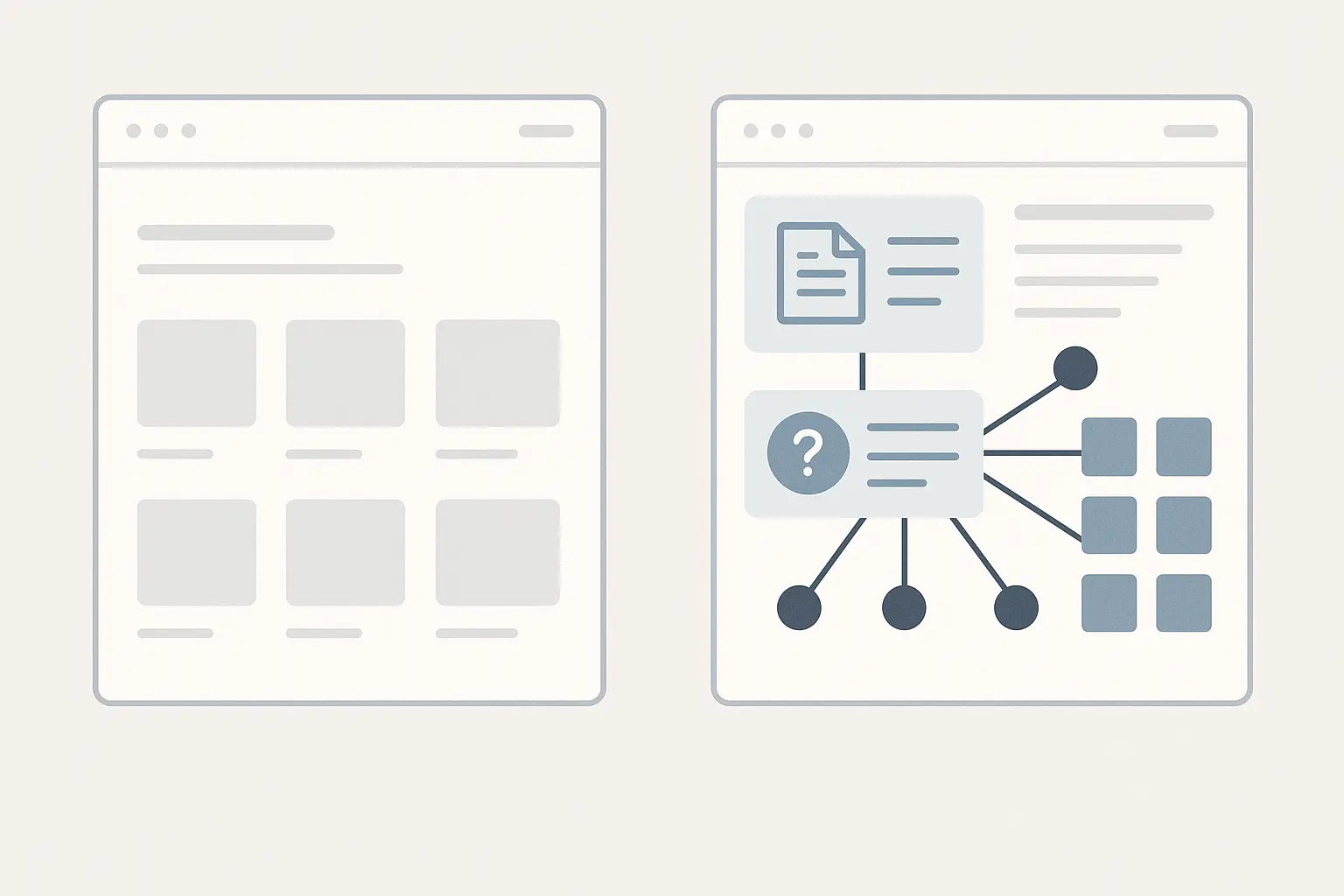
A Fundamental Shift: From Product Listing to Authoritative Hub
To win in today’s competitive landscape, we need to evolve the category page from a passive product listing into an active Category Hub.
A Category Hub is a strategically enhanced category page that merges product listings with rich, educational content. It acts as the central pillar—or “silo”—for a specific topic on your site, establishing deep authority in the eyes of both users and search engines. It stops being just a page about trail running shoes and becomes the ultimate resource for trail running shoes.
This isn’t about sprinkling a few keywords into a paragraph at the bottom of the page. It’s about fundamentally rethinking the page’s purpose. It addresses the user’s explicit need to see products and their implicit need to understand which product is right for them.
By building a hub, you send a powerful signal to Google that your site possesses comprehensive expertise on a topic. As research from Backlinko highlights, the number one result in Google gets 27.6% of all clicks. A content-rich Category Hub is your best shot at earning that click by proving your page is the most deserving result.
The Anatomy of a High-Performing Category Hub
Transforming a standard page into a hub involves weaving together three core elements: educational content, smart internal linking, and conversion-focused design.
1. Educational, Product-Led Content
This is the heart of the hub. Instead of forcing users to open fifteen tabs to research their purchase, you bring the research directly to them. This isn’t just generic blogging; it’s content designed to solve problems and guide decisions.
Elements of great hub content include:
-
A “Getting Started” Guide: A brief, welcoming intro that explains the key considerations for buying within this category. For our running shoes, this might be a section on “How to Choose the Right Trail Shoe.”
-
Mini Buying Guides: Short, scannable content that addresses common questions. Think “Best Shoes for Wide Feet” or “Waterproof vs. Breathable: What’s Right for You?”
-
Comparison Tools & Charts: Allow users to easily compare key features of your top-selling products.
-
Answers to FAQs: A dedicated section that answers the most common questions customers have before purchasing.
The Content Marketing Institute found that 70% of marketers are actively investing in content marketing. The Category Hub strategy ensures that investment isn’t stuck on a separate blog; it’s integrated directly into the path to purchase, where it can have the greatest impact.
2. Strategic Internal Linking & Authority Flow
A hub doesn’t stand alone; it organizes your site’s knowledge. The main category page links down to specific subcategories (e.g., “Minimalist Trail Shoes,” “Max Cushion Trail Shoes”) and individual product pages. Crucially, it also links to—and is linked from—supporting blog posts, guides, and articles.
This creates a “silo” where link equity flows logically through the topic, reinforcing the authority of the central hub page. Executing this at scale can be complex, which is why many businesses seek expert white-label SEO services to architect these structures efficiently. This interconnectedness helps Google understand the depth of your content, leading to higher rankings for the entire topic cluster.
3. Conversion-Focused User Experience
The goal of the hub isn’t just to educate; it’s to drive revenue. Every piece of content should naturally lead the user toward a product.
-
Link directly from guides to products: When you mention “best shoes for wide feet,” link to the filtered product results for those shoes.
-
Use visual callouts: Highlight best-sellers, new arrivals, or staff picks within the product grid.
-
Guide, don’t just list: A user on a category page has high commercial intent. Forrester research shows that on-site searchers are 2-3x more likely to convert. A Category Hub helps guide that intent, turning a question (“Which shoe is for me?”) into a confident click on “Add to Cart.”
For agencies, this strategy is a game-changer. It shifts the conversation with clients from “we’re trying to rank for this keyword” to “we’re building a revenue-driving asset that captures customers at every stage of their journey.” It demonstrates a sophisticated understanding of how content and commerce intersect, setting your agency apart. This level of integration is a hallmark of modern omnichannel SEO strategies, tying search directly to business growth.
Frequently Asked Questions (FAQ)
What’s the real difference between a category page and a Category Hub?
A traditional category page is a passive directory of products. A Category Hub is an active, educational resource that guides the user’s buying journey with integrated content, making the page the central authority on that topic.
How much content is too much? Will it distract from the products?
The key is balance and user experience. Content should be helpful and scannable, placed strategically above or within the product grid. Use accordions or “read more” toggles for longer sections. The goal is to assist, not overwhelm.
Will adding all this content slow down my page speed?
It’s a valid concern, as page speed is critical. Images should be optimized, and content should be loaded efficiently. Using modern web development practices and lazy loading for images can ensure your hub is both rich in content and fast to load. Managing this at scale can benefit from AI-powered SEO automation that monitors performance across hundreds of pages.
Can I apply the Category Hub strategy to any e-commerce platform?
Absolutely. Whether you’re on Shopify, Magento, BigCommerce, or a custom build, the principles are the same. It’s about the strategic use of content and design, not a specific technical feature.
How do I measure the success of a Category Hub?
Look beyond just rankings. Track metrics like:
- Time on page: Are users engaging with your content?
- Bounce rate: Are users finding what they need and staying on the site?
- Conversion rate: Is the page more effective at turning visitors into buyers?
- Keywords: Is the page ranking for more long-tail, informational keywords in addition to its primary commercial term?
Your Next Competitive Edge
E-commerce category pages are arguably the most valuable, underutilized assets on any retail website. By transforming them from simple product grids into authoritative Category Hubs, you create a powerful competitive advantage that drives organic traffic, builds trust, and directly increases revenue.
It’s time to move beyond the grid and start building destinations that don’t just show products—they sell solutions.