

Your B2B and SaaS clients aren’t just buying clicks or rankings; they’re buying pipeline. They expect their SEO investment to translate directly into demos, trials, and monthly recurring revenue (MRR). But delivering that level of sophisticated, revenue-focused SEO is a major challenge for most agencies.
The old playbook of chasing high-volume keywords and celebrating traffic spikes just doesn’t work here. The B2B sales cycle is longer, the buying committees are more complex, and the stakes are far higher.
This isn’t a strategy problem—it’s an execution problem. You know what needs to be done, but scaling the specialized content creation, technical precision, and revenue-centric reporting needed to win and retain these high-value clients is a constant struggle.
This playbook bridges that gap. It’s a framework for agencies ready to move beyond generic SEO and deliver the strategic results B2B and SaaS clients demand. More importantly, it shows you how to execute this strategy at scale, without the cost and complexity of building out a specialized in-house team.
Part 1: Adopting the B2B & SaaS SEO Mindset
The first and most critical shift is moving from a B2C to a B2B mindset. In B2C, success is often measured by volume; in B2B, it’s measured by value. One perfect-fit enterprise lead is worth more than a thousand unqualified visitors.
This shift requires a fundamental change in how you approach every aspect of SEO:
From Vanity Metrics to Business Outcomes: Your reporting must focus on pipeline growth, lead quality, and customer acquisition cost, not just keyword positions. The goal is to prove tangible value. Research confirms that SEO leads convert at a staggering 14.6%, compared to just 1.7% for outbound marketing.
From Individuals to Buying Committees: You aren’t targeting a single consumer. You’re creating content for multiple stakeholders—the end-user, the IT manager, the CFO, the CEO—each with different questions and priorities at various stages of their journey.
From High Volume to High Intent: Many of the most valuable keywords in B2B and SaaS have low search volume. A query for “ERP integration for multi-site manufacturing” might only get 10 searches a month, but the user behind it is a high-value decision-maker on the verge of a major purchase.
Winning in this space means embracing complexity and focusing relentlessly on the metrics that matter to the C-suite. With B2B SaaS businesses seeing an average 702% ROI from organic search, agencies that master this approach can secure long-term, high-value retainers.
Part 2: The Funnel-Based Keyword Mapping Framework
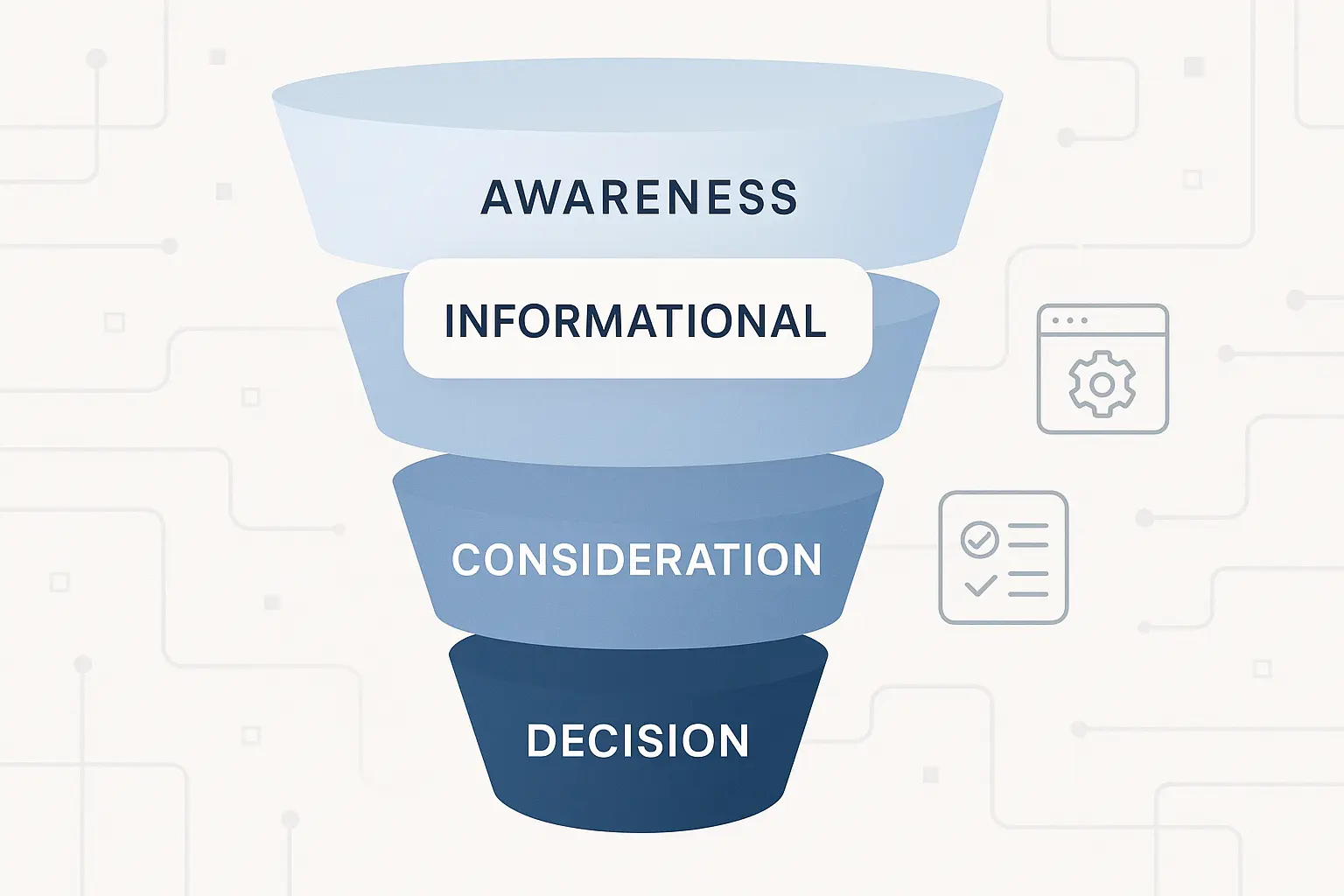
In B2B, the sales funnel is everything. A prospect might spend months moving from initial awareness to a final purchase decision. Your keyword strategy must mirror this journey, with content that answers critical questions at every stage.
Standard keyword research tools often fail here because they prioritize search volume over user intent. The key is to manually map low-volume, high-intent keywords to each stage of the buyer’s journey.
Here’s a simplified framework:
Top of Funnel (TOFU) – Problem Aware
The prospect knows they have a problem but doesn’t yet know the solution.
Keywords: Target broad problems and questions. Examples: “how to reduce employee churn,” “project management workflow issues,” “what is a customer data platform.”
Goal: Educate and build brand awareness.
Middle of Funnel (MOFU) – Solution Aware
The prospect is actively researching different types of solutions to their problem.
Keywords: Focus on solution categories and comparisons. Examples: “best project management software,” “HubSpot vs. Marketo,” “[competitor] alternatives.”
Goal: Position your client’s solution as the best option and build consideration.
Bottom of Funnel (BOFU) – Product Aware
The prospect is evaluating your client’s specific product or service and is close to making a decision.
Keywords: Target branded terms, features, and buying-intent modifiers. Examples: “[product name] pricing,” “[product name] demo,” “implementation guide for [product name].”
Goal: Convert the prospect into a lead or customer.
Funnel-based keyword mapping clarifies complex B2B SaaS search intent, enabling agencies to target decision-makers effectively and prioritize low-volume, high-intent keywords.
By structuring your keyword strategy this way, you create a comprehensive content plan that nurtures prospects from their first Google search to the final sales call. It’s the foundation of an effective B2B SEO content strategy.
Part 3: The BOFU Content Playbook for Converting Decision-Makers
While a full-funnel approach is crucial, the bottom of the funnel (BOFU) is where SEO directly generates high-quality leads. This is where you answer the final questions that stand between a prospect and a demo request.
Creating this content is often the biggest bottleneck for agencies. It requires deep product knowledge and a clear understanding of the buyer’s final evaluation criteria. A white-label SEO partner with B2B expertise can be invaluable here, handling the execution while you focus on strategy.
Here are the essential BOFU content assets every B2B and SaaS website needs:
- Comparison Pages: Pit your client’s product directly against top competitors (e.g., “Product A vs. Product B”). These pages capture high-intent searchers who are actively making a decision. Be honest and focus on key differentiators.
- Alternative Pages: Target users searching for “[Competitor] alternatives.” This allows you to intercept dissatisfied customers of your rivals and present your client’s solution.
- Use Case & Industry Pages: Create dedicated pages showing how the product solves specific problems for specific industries (e.g., “Inventory Management for Ecommerce Brands”). These pages speak directly to niche audiences and demonstrate relevance.
- Pricing & ROI Calculators: B2B buyers are obsessed with ROI. Interactive tools that help them build a business case for their purchase are incredibly powerful conversion assets.
- Implementation & Integration Guides: These assets address practical concerns and build confidence that the solution will fit seamlessly into the prospect’s existing tech stack.
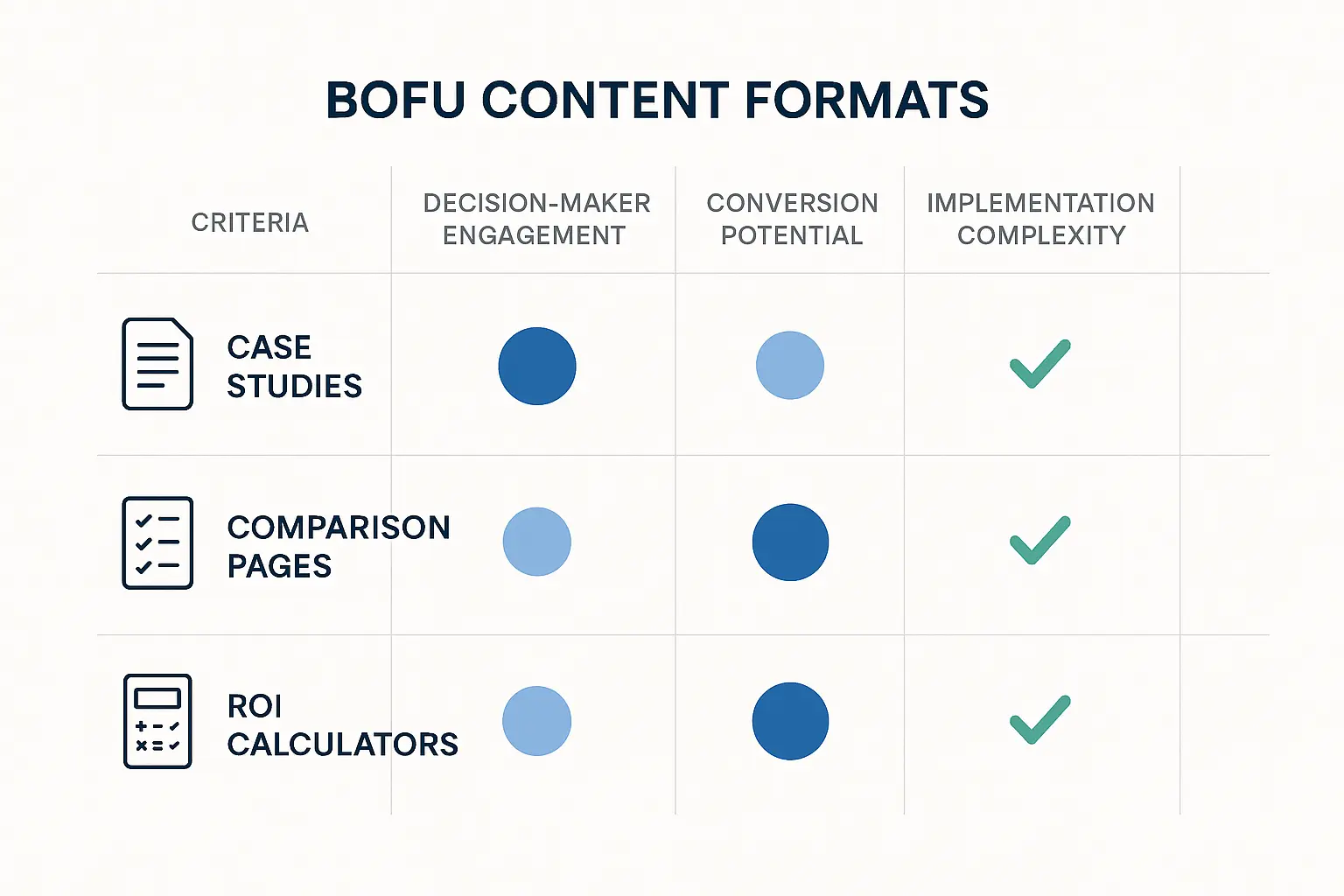
This content format matrix simplifies BOFU content decisions, enabling agencies to select the right assets that maximize conversion while balancing complexity and scalability.
Executing this playbook for one client is a challenge; scaling it for ten is nearly impossible without a robust system. This is where an AI-powered execution partner can transform your agency’s capacity, delivering expert-level content under your brand.
Part 4: Building a Content Moat with Topical Authority
To dominate a B2B or SaaS niche, you need to go beyond targeting individual keywords and build topical authority. This means creating a “content moat”—a comprehensive ecosystem of content so deep and valuable that competitors can’t easily replicate it.
The hub-and-spoke model is key here: you create a central pillar page on a core topic (the hub) and surround it with detailed articles on related sub-topics (the spokes).
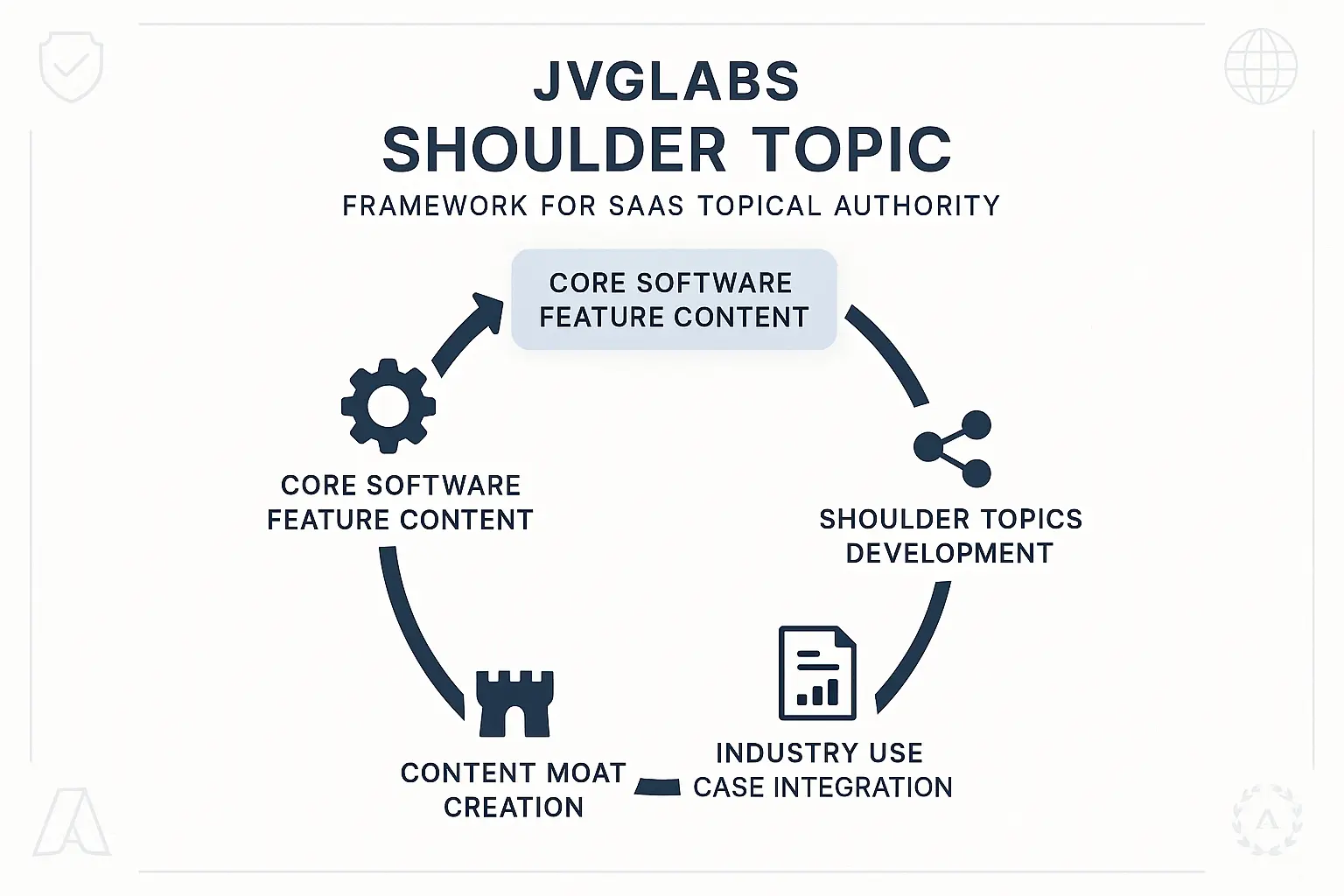
A powerful but underutilized tactic is using “Shoulder Topics.” These are subjects that your ideal customer cares about but that aren’t directly related to your client’s product. For a project management tool, shoulder topics could include “team productivity strategies,” “how to run effective meetings,” or “remote work policies.”
This strategy allows you to:
- Attract a wider audience at the top of the funnel.
- Build E-E-A-T (Experience, Expertise, Authoritativeness, and Trustworthiness) by demonstrating broad industry knowledge.
- Create natural internal linking opportunities to guide users from educational content to product-focused pages.
The ‘Shoulder Topic’ framework helps agencies build a content moat by targeting related subjects your audience cares about, establishing broader authority.
Building this kind of authority requires a significant, ongoing content investment. By partnering with a white-label provider that combines AI-driven workflows with human strategic oversight, you can execute these ambitious content plans without burning out your team.
Part 5: The MRR-Driven Reporting Model
The final piece of the puzzle is proving your impact. Standard SEO reports filled with ranking charts and traffic graphs won’t cut it. B2B and SaaS clients need to see a clear line connecting your work to their revenue.
An MRR-driven reporting model connects SEO performance to real business outcomes. This requires integrating data from your SEO tools, Google Analytics, and the client’s CRM (like HubSpot or Salesforce).
Your report should answer these key questions:
- Traffic to Leads: Which organic keywords and pages are generating the most qualified leads (e.g., demo requests, free trial sign-ups)?
- Leads to Pipeline: How many of those leads have been accepted by the sales team and converted into qualified sales opportunities? What is the total pipeline value generated from organic search?
- Pipeline to Revenue: How many of those opportunities have closed, and what is the resulting MRR? What is the customer lifetime value (CLV) from the SEO channel?
This reporting model proves SEO’s direct impact on MRR and pipeline growth, helping agencies confidently demonstrate value and secure high-value retainers.
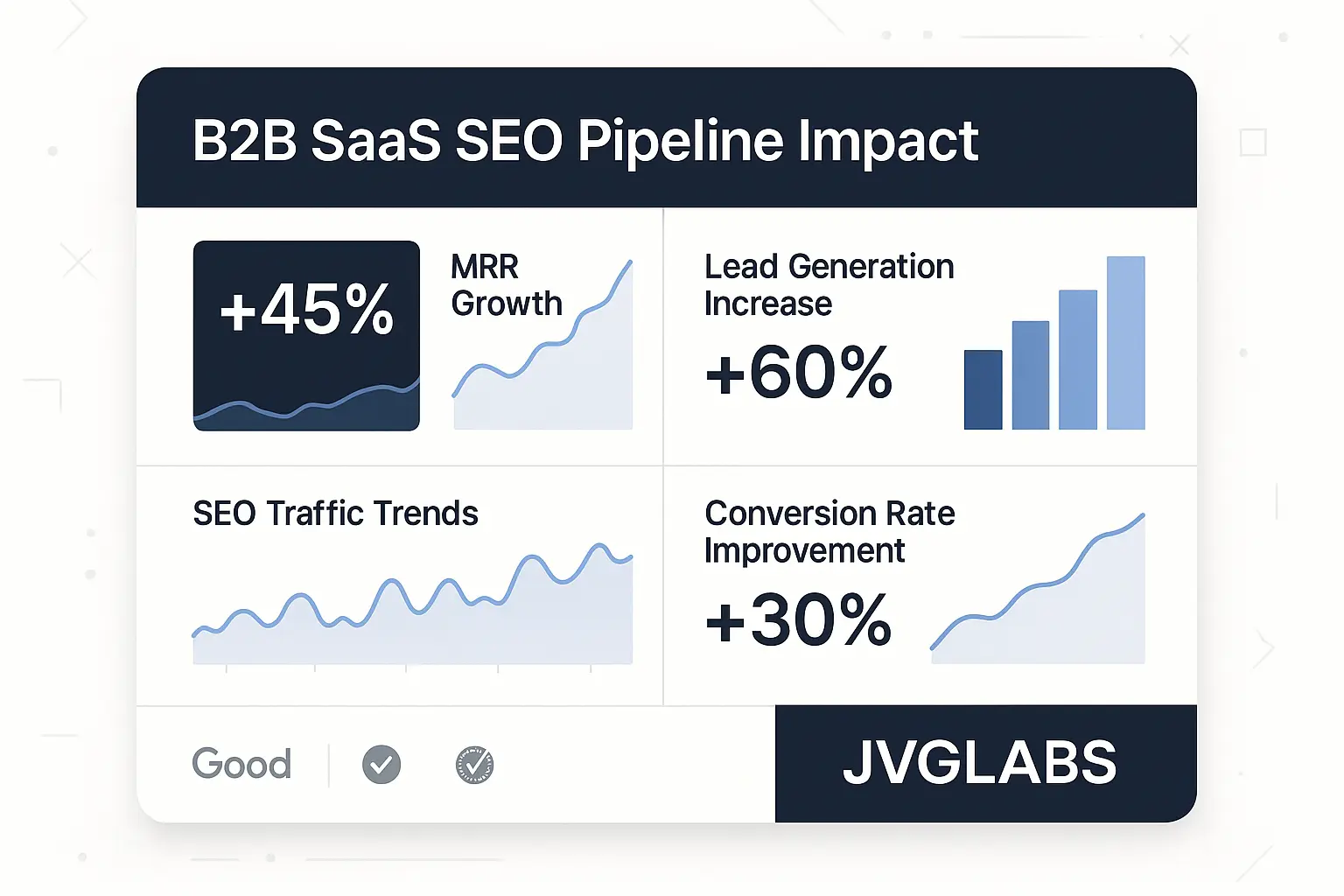
Presenting this level of data transforms your client conversations. You’re no longer justifying an expense; you’re demonstrating a return on investment. This is how you win and keep six-figure retainers. A dedicated partner like JVGLABS can provide this reporting under your brand, giving you the data to prove your value without the manual burden.
The Agency Execution Gap: Strategy vs. Scalable Delivery
This playbook provides the strategy. But for agencies, the real challenge is execution. How do you deliver this level of specialized work across multiple B2B and SaaS clients without hiring an army of expensive, hard-to-find experts?
This is the execution gap where most agencies get stuck, forcing them to:
- Try to do it all in-house, leading to team burnout and inconsistent quality.
- Hire freelancers, resulting in a disjointed process and lack of brand control.
- Avoid B2B/SaaS clients altogether, leaving significant revenue on the table.
There’s a better way. A dedicated white-label SEO partner built for agencies can act as your invisible execution arm. We handle up to 90% of the complex, time-consuming tasks—from technical audits and funnel-based content creation to MRR-driven reporting—all under your brand. You maintain the client relationship and strategic oversight while we deliver the results.
Frequently Asked Questions (FAQ)
How can my agency offer SaaS SEO without hiring a team of expensive specialists?
Partnering with a white-label provider gives you instant access to a team of B2B and SaaS SEO experts. You can confidently sell and deliver sophisticated SEO services from day one while your partner works invisibly in the background. It’s the fastest, most cost-effective way to scale your capabilities.
Our clients want to see a direct link between SEO and sales. How can we prove it?
The key is the MRR-Driven Reporting Model we covered earlier. It requires integrating data from analytics and the client’s CRM to trace the customer journey from a search query to a closed deal. A specialized partner like JVGLABS can build and manage these reports for you—branded with your agency’s logo—so you can clearly demonstrate ROI in every client meeting.
We’re a PPC/web design agency. How can we add SEO services without derailing our core business?
A white-label SEO solution is the perfect model for this. It allows you to expand your service offerings and create a new revenue stream without the distraction of building a new department from scratch. You focus on what you do best—client strategy and relationships—while your partner seamlessly handles the SEO execution.
How is B2B SEO different from B2C SEO?
The core differences come down to the buying cycle, keyword intent, and content focus. B2B involves long sales cycles with multiple decision-makers, requiring content that addresses complex business problems. B2C typically has shorter cycles and targets individual consumers with more straightforward, emotionally driven content. The metrics also differ, with B2B focusing on lead quality and pipeline value over raw traffic volume.
Your Execution Partner for Scalable B2B & SaaS SEO
Winning high-value B2B and SaaS clients requires more than just a good strategy—it demands flawless, scalable execution. That means being able to produce expert-level content, perform deep technical analysis, and deliver revenue-focused reporting consistently across your entire client portfolio.
JVGLABS was built to be that execution engine for agencies. We combine AI-powered automation with expert human oversight to function as your invisible, white-label SEO department. Whether you’re an established SEO firm looking to scale capacity or a full-service agency ready to add a profitable new service line, we provide the backend power you need to grow.
Stop letting execution bottlenecks limit your agency’s potential. Let’s talk about how we can help you deliver the B2B and SaaS SEO results that win long-term clients.