

You’ve mastered using AI tools to brainstorm topics, draft outlines, and speed up production. But a nagging question keeps you up at night: are you just doing the old things faster, or are you preparing your clients for what comes next?
The market is saturated with tactical advice on using AI as an assistant. Competitors like Semrush and Orbit Media provide excellent guides for integrating AI into existing workflows. But these guides operate within today’s paradigm, teaching you how to use AI, not how to build for an AI-native world.
This is the strategic gap that leaves agencies vulnerable. While 81% of B2B marketers are already using generative AI tools, most are simply layering new technology over old strategies. The real opportunity isn’t just to rank in a search engine, but to become the foundational source of truth for the AI systems that will soon answer most of the world’s questions.
This requires a fundamental shift in thinking from content creation to asset building—one that calls for an AI-First Content Framework.
The Generational Shift: From SEO to Generative Engine Optimization (GEO)
For two decades, Search Engine Optimization (SEO) has been the definitive path to discoverability. The goal was simple: align your content with search engine algorithms to appear at the top of the results page.
That era is closing.
The new discipline is Generative Engine Optimization (GEO). With GEO, the goal is not just to be visible to a user, but to be the primary, verifiable source ingested and cited by Large Language Models (LLMs) and generative AI answer engines.
Why does this matter? Because while ranking #1 is still valuable, having your client’s data, perspective, and brand woven into an AI-generated answer is exponentially more powerful. It’s the difference between being an option on a list and being the accepted truth. This is the future of digital authority, and it calls for a new framework for building content.
The AI-First Content Framework: The Three Pillars of Future-Proof Content
An AI-First Content Framework isn’t about replacing human creativity; it’s about structuring it for machine interpretation. This framework ensures that the expert insights you develop for your clients are not only compelling for human readers but also perfectly structured to feed, train, and influence AI systems. It’s built on three core pillars.
Pillar 1: Semantic Content Modeling: From Keywords to Entities
For years, we’ve been obsessed with keywords—the specific queries users type into a search bar. In an AI-first world, the focus shifts from keywords to entities.
An entity is a distinct, well-defined thing or concept—a person, place, product, topic, or organization. While a keyword is just a string of text, an entity has relationships and attributes that provide context. LLMs think in terms of these interconnected entities, not isolated keywords.
Semantic content modeling is the practice of structuring your content around these entities and their relationships. According to Graphwise.ai, this move toward semantic structure is the key to making content AI-readable, enabling more reliable, context-rich responses from LLMs. It means using schema markup, structured data, and clear definitions to tell machines exactly what your content is about, removing all ambiguity.
By modeling your content semantically, you’re no longer just hoping an algorithm understands you. You’re handing it a blueprint.

Pillar 2: Fact-Based & Verifiable Authoring: Building a Source of Truth
LLMs are prone to “hallucinations”—inventing facts when they don’t have reliable data. The antidote is content that is rigorously fact-based, clearly sourced, and easily verifiable.
Fact-based authoring builds trust with both humans and machines. It involves:
- Making Assertions, Not Just Statements: Every major claim is treated as a distinct piece of data.
- Citing Internal and External Sources: Linking claims to original data, research, or established authorities.
- Establishing Clear Provenance: Making it easy for an AI to trace where a piece of information originated.
This process transforms your client’s content from a collection of articles into a referenceable library of facts and insights, making it a prime source for an LLM seeking to provide accurate answers.
Pillar 3: Creating a Proprietary Knowledge Base: Your Client’s Competitive Moat
This is the ultimate goal of the AI-First Framework. When you combine semantic modeling with fact-based authoring, you move beyond just publishing content to building a proprietary knowledge base.
This knowledge base is a structured, machine-readable asset that encapsulates your client’s unique expertise, data, and market position. It’s a competitive moat in the age of AI. While your competitors are busy publishing blog posts, you are systematically building a defensible asset that can:
- Train custom AI models on your client’s specific domain knowledge.
- Power internal and external chatbots with accurate, branded information.
- Become the definitive source for generative AI systems answering questions in your client’s niche.
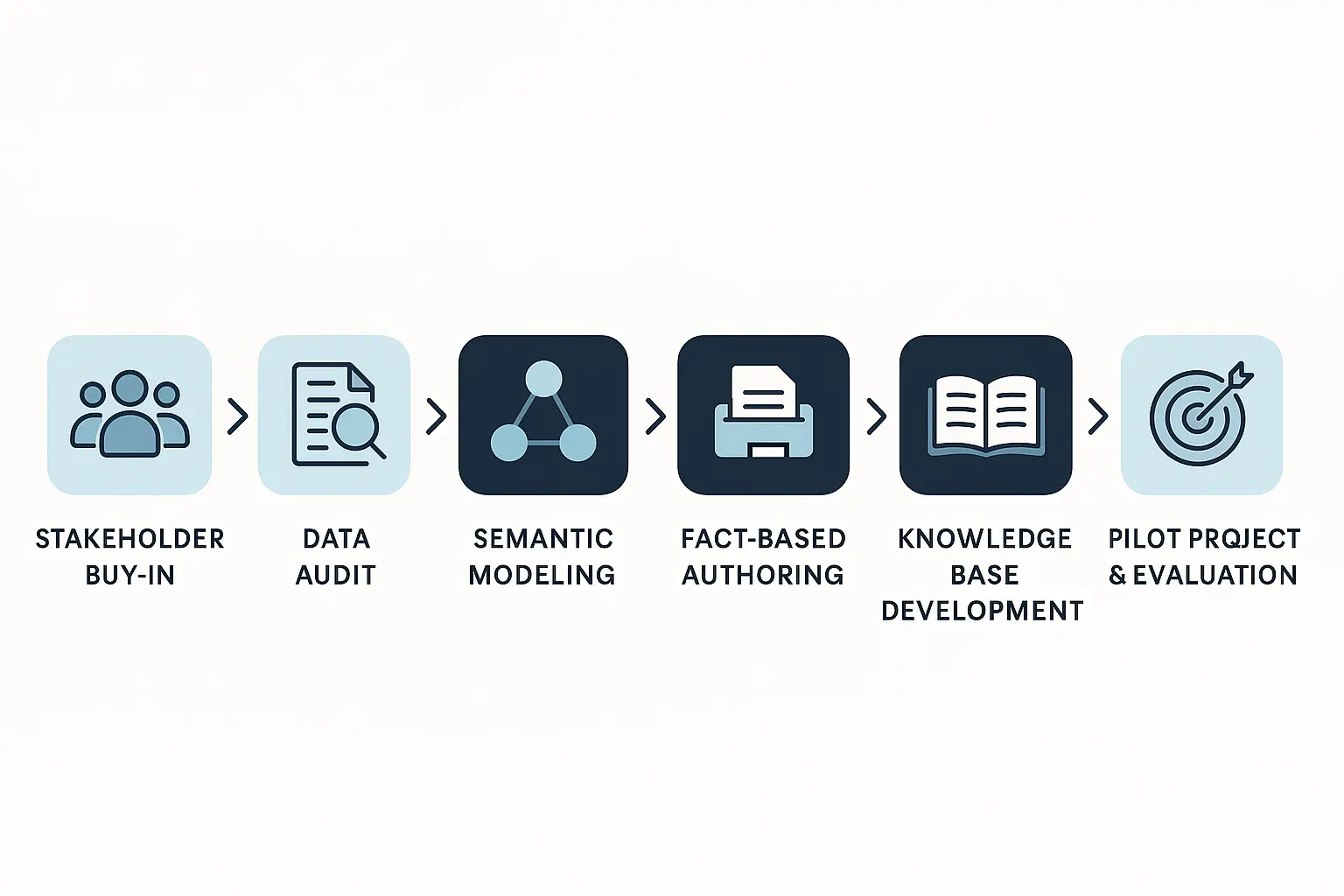
An Actionable Roadmap: How Your Agency Can Transition to an AI-First Strategy
Adopting this framework feels like a significant undertaking because it is. Research from Netsergroup.com and Moveworks.com confirms that enterprises face major challenges with outdated infrastructure and internal skills gaps when implementing AI strategies. But the transition is manageable with a clear, phased approach.
- Phase 1: Knowledge Audit & Assessment: Analyze your client’s existing content. Identify core entities, expert interviews, case studies, and proprietary data that can serve as the foundation of their knowledge base.
- Phase 2: Pilot Program: Select one core business topic or service line and restructure its content according to the three pillars: model the entities, enforce fact-based authoring, and build a mini-knowledge base.
- Phase 3: Scale & Structure: Apply the learnings from the pilot across all of the client’s core topics. This is where a scalable execution partner becomes critical, handling the technical implementation of schema and structured data so your team can focus on strategy.
- Phase 4: Automate & Integrate: Connect the proprietary knowledge base to internal and external AI tools, turning your client’s structured content into an active business intelligence asset.
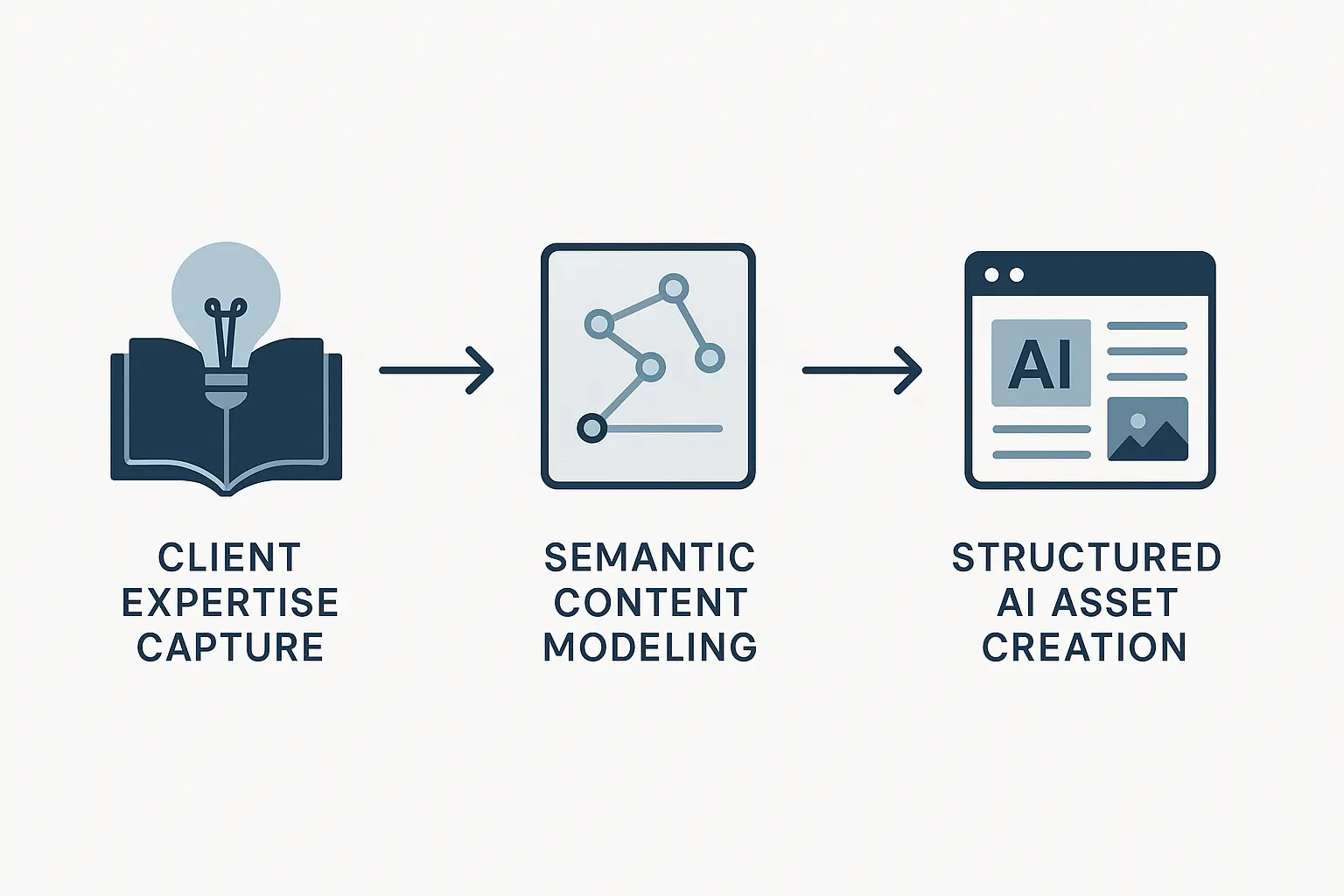
Agency-Ready Execution: Semantic Optimization in Practice
Theory is one thing; execution is another. For agencies, the power of this framework lies in its ability to be productized and delivered as a high-value service that transforms your client’s raw expertise—the interviews, webinars, and whitepapers—into structured, AI-ready assets.
The process involves deep collaboration, where the agency leads client strategy and a white-label partner like JVGLABS handles the technical execution.
This partnership model allows you to offer a sophisticated, future-proof service without the cost and complexity of hiring data architects and semantic SEO specialists in-house. You maintain full control over the client relationship and strategy while we operate invisibly in the background, executing up to 90% of the technical tasks with our AI-powered platform.
Case Study: The ROI of an AI-First Asset
Let’s consider a B2B SaaS client in the cybersecurity space. Before, their content strategy focused on ranking for keywords like “enterprise data protection.” After implementing an AI-First Framework, they built a knowledge base around the core entity of “Zero-Trust Architecture.”
The results went far beyond traditional SEO metrics.
They became the primary source for AI chatbots answering complex questions about zero-trust security. The sales team saw a 75% increase in lead quality, as prospects arrived pre-educated by AI-powered summaries built from their content. The knowledge base had become a revenue-generating asset, not a marketing expense.

Frequently Asked Questions about the AI-First Framework
Q: Does this framework replace human writers and strategists?
A: No. It elevates them. This model requires deep human expertise to identify core knowledge and shape the strategic narrative. It frees strategists from repetitive tasks and empowers writers to become true subject matter experts whose work builds a lasting asset.
Q: How can we get client buy-in for a more complex strategy like this?
A: Frame it as a shift from renting attention to building a permanent asset. You’re not just proposing more blog posts; you’re proposing the creation of a proprietary intelligence engine that will give them a competitive advantage for the next decade. The ROI is tied to defensibility and authority, not just traffic.
Q: What is the real difference between this and just using AI writing tools?
A: AI writing tools are tactical assistants that help you create content faster within the old paradigm. The AI-First Framework is a strategic architecture for your content. One is about the process of creation; the other is about the structure of the final product.
Q: Can our agency implement this ourselves?
A: While you can start by adopting the principles, full implementation at scale requires a blend of content strategy, data architecture, and technical SEO—a skillset rarely found in one team. The most efficient path for most agencies is to focus on the client strategy—their core strength—while leveraging a specialized white-label SEO execution partner to handle the complex, technical backend.
Your Agency’s Next Move: From Strategy to Scalable Execution
The conversation around AI and content is changing. The agencies that thrive will be those that move beyond tactical efficiency and guide their clients toward building true, defensible digital assets.
The AI-First Content Framework is your blueprint. It provides a new, high-value service to offer clients, future-proofs their results against technological shifts, and establishes your agency as a forward-thinking strategic leader.
But you don’t have to build the execution engine yourself. JVGLABS is designed to be your invisible SEO department, translating your strategic vision into structured, AI-ready content. We handle the technical complexity of semantic modeling and knowledge base construction, all under your brand. You own the client relationship; we deliver the results.
Explore our partnership models for agencies and let’s discuss how to build your AI-first content offering today.