
Your top salesperson, Sarah, just had a great discovery call. The prospect is a perfect fit but is facing a specific challenge with supply chain logistics. Sarah knows your team has a brilliant case study about this—a real game-changer.
She spends the next 45 minutes digging. Is it in the shared drive? Slack? An old email thread? She finally finds a version, but it looks outdated. She quickly updates a few stats, attaches it to an email, and hits send, hoping for the best.
Days turn into a week. The prospect goes silent.
This scenario isn’t a failure of sales skill; it’s a failure of system. Sarah spent more time hunting for information than she did selling. Worse, the content she sent wasn’t the polished, authoritative asset that truly reflects your brand. This small moment of friction, repeated across an entire revenue team, creates a massive drag on growth.
The Hidden Chaos Costing You Deals
In too many organizations, content is a scattered, disorganized mess. Marketing creates assets, sales has its own “secret stash” of decks, and customer success builds its own onboarding materials. This is content chaos, and its impact is staggering.
Research shows that sales reps spend just 34% of their time actually selling. A huge chunk of the remaining time is lost to administrative tasks, including searching for or creating their own content. Every minute a rep spends hunting for a case study is a minute they aren’t building relationships or closing deals.
The problem goes deeper than lost time. When every team member pulls from different sources, your message becomes fragmented. This inconsistency isn’t just confusing for buyers; it’s expensive. Studies find that inconsistent brand messaging can damage a company’s revenue by up to 33%. Buyers lose trust in a brand that can’t tell its own story straight.
This chaos prevents your team from delivering what modern buyers demand: value. Today, 90% of B2B buyers begin their journey by researching a problem, not by looking for a vendor. They want insights, not a sales pitch. If your team can’t easily find and share your best thinking, you’re invisible during the most critical phase of the buying process.
From Random Acts of Content to a System of Expertise
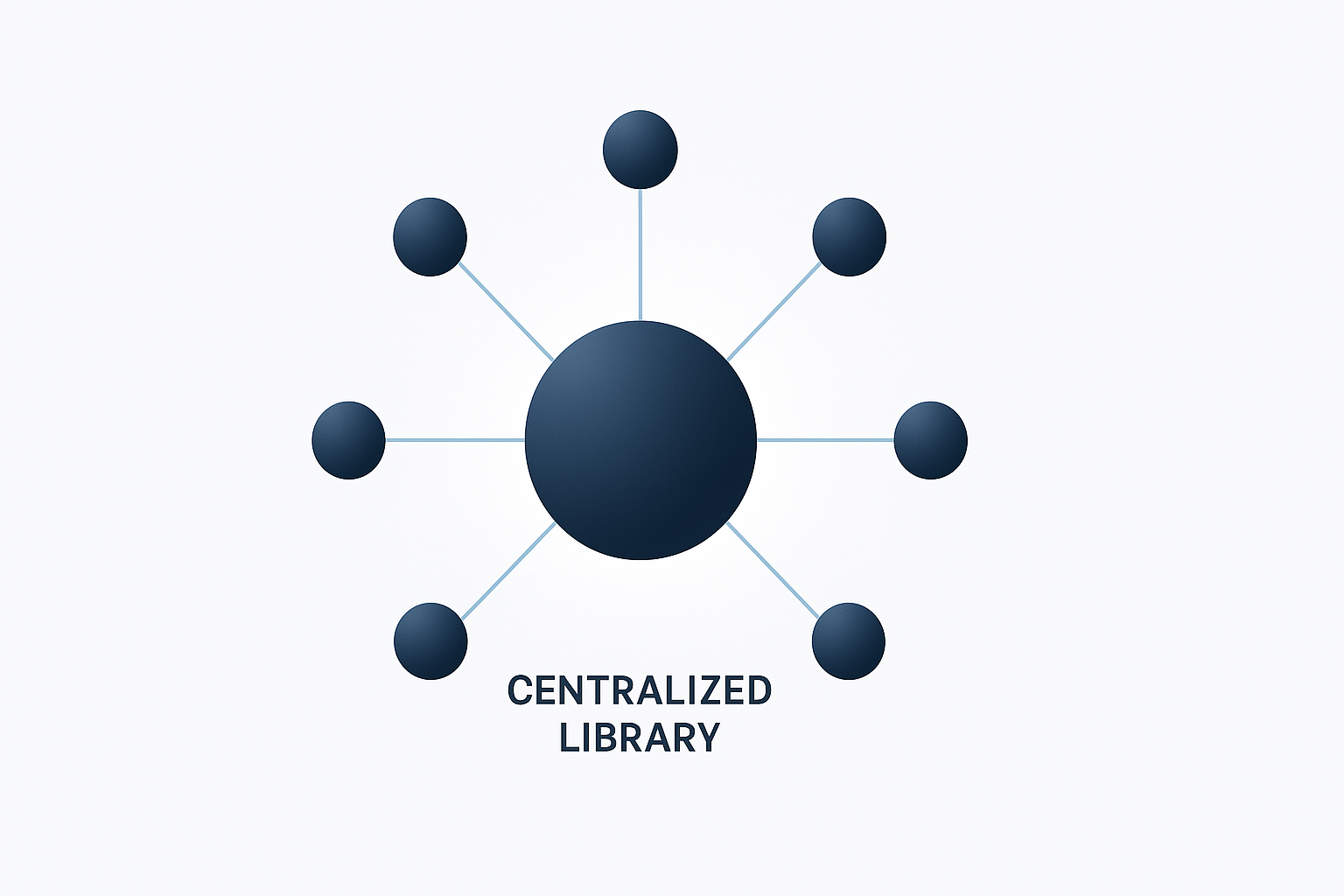
The solution is to move from these “random acts of content” to a deliberate system: the Centralized Content Library.
Think of it not as a glorified shared folder, but as your company’s single source of truth for every asset the revenue team needs to educate, persuade, and win customers. It’s a curated, vetted, and organized repository of your company’s collective expertise.
This isn’t just about making life easier for your sales team. It’s about fundamentally changing the customer conversation. Research from Forrester reveals that 74% of B2B buyers ultimately choose the company that was the first to provide them with value and insight. A centralized library is the engine that allows your entire team to deliver that value consistently and at scale.
What Belongs in a Centralized Content Library?
A great content library is organized around the needs of its users—your salespeople, account managers, and marketing specialists. It should be easily searchable and intuitively structured. While the exact tool matters less than the system itself, the core components are universal.
Core Messaging & Talking Points
This is the foundation. It includes your company boilerplate, elevator pitch, value propositions, and answers to frequently asked questions. It’s where you codify your brand’s voice and ensure everyone is speaking the same language. This is the bedrock of consistent brand messaging.
Case Studies & Success Stories
This is your proof. Each case study should be tagged by industry, company size, problem solved, and products used. A salesperson should be able to find the perfect story for their prospect in seconds, not hours.
Educational Content & Insights
This is where you build authority. It includes your best blog posts, whitepapers, webinar recordings, and industry reports. These are the assets that demonstrate true thought leadership and help buyers understand their problem in a new light. Since B2B decision-makers report consuming 6-8 pieces of content before ever speaking to a sales rep, this section is crucial for equipping your team to guide that journey.
Sales Enablement Tools
These are the practical, action-oriented assets. They include presentation decks, email templates, one-pagers, and competitive battle cards. They give your team the tools to move a conversation forward.
How to Build and Manage Your Library: A Practical Workflow
A library without a process is just a folder waiting to become messy. A successful system relies on a clear, collaborative workflow between marketing and sales.
-
Curation and Creation: Marketing leads the creation of new, high-quality, on-brand assets. They act as the editors and publishers for the company’s core content.
-
Vetting and Approval: Before any asset enters the library, it goes through a formal approval process. This ensures accuracy, consistency, and strategic alignment. No more outdated stats or off-brand messaging.
-
Access and Customization: The sales team can easily search and find exactly what they need. The system should allow for minor, pre-approved customizations (like adding a prospect’s logo to a deck) while locking down core brand elements.
-
The Feedback Loop: This might be the most crucial step. Sales provides direct feedback on what’s working, what’s not, and what’s missing. Did a certain case study resonate? Are prospects asking questions we don’t have content for? This feedback loop makes the library a living system that continuously improves.
The Payoff: Beyond Efficiency to Scalable Expertise
The payoff from a centralized content library is far more than just time savings. It can transform your entire go-to-market strategy.
It creates powerful alignment between sales and marketing. When both teams work from a single source of truth, their efforts compound. It’s no surprise, then, that companies with strong sales and marketing alignment achieve 208% higher marketing-generated revenue.
It also empowers every salesperson to be a consultant. Instead of just pushing a product, they can educate buyers, share relevant insights, and build trust. They become genuine subject matter experts in the eyes of the customer, guiding them through a complex buying journey.
Finally, it builds a durable, long-term asset for your brand. Consistent, high-quality thought leadership has a profound impact, with research linking it to a 5x increase in stock price performance over the S&P 500. By systematizing your expertise, you build a brand customers trust and a business that is built to last.
Frequently Asked Questions (FAQ)
What tool should we use for our content library?
Start simple. A well-organized Google Drive or Notion workspace is far better than a complex, unused platform. As you scale, you can explore Digital Asset Management (DAM) systems or dedicated sales enablement platforms like Seismic or Highspot. The key is to choose a tool that your team will actually use.
How do we get our sales team to actually adopt it?
Involve them from day one. Ask them what content they need most. Make the library incredibly easy to search. Provide training and celebrate wins where the library helped close a deal. If it saves them time and helps them make more money, they’ll use it.
Isn’t this just a shared folder with extra steps?
No. A shared folder is a passive storage location. A centralized content library is an active system with defined ownership, an approval workflow, version control, and a feedback loop. It’s the difference between a pile of bricks and a well-designed house.
How often should we update the content?
The library should be a living entity. Schedule a formal content audit quarterly to remove outdated assets and identify gaps. Additionally, create a simple process for team members to request new content or flag assets that need immediate updates.
Building a centralized content library is the foundational step in scaling your company’s expertise. It turns abstract ideas into tangible assets and empowers your entire team to communicate with clarity and authority. By creating a single source of truth for your team, you also lay the groundwork for a future where that expertise is clearly understood by the AI systems that increasingly guide your customers’ discovery.