
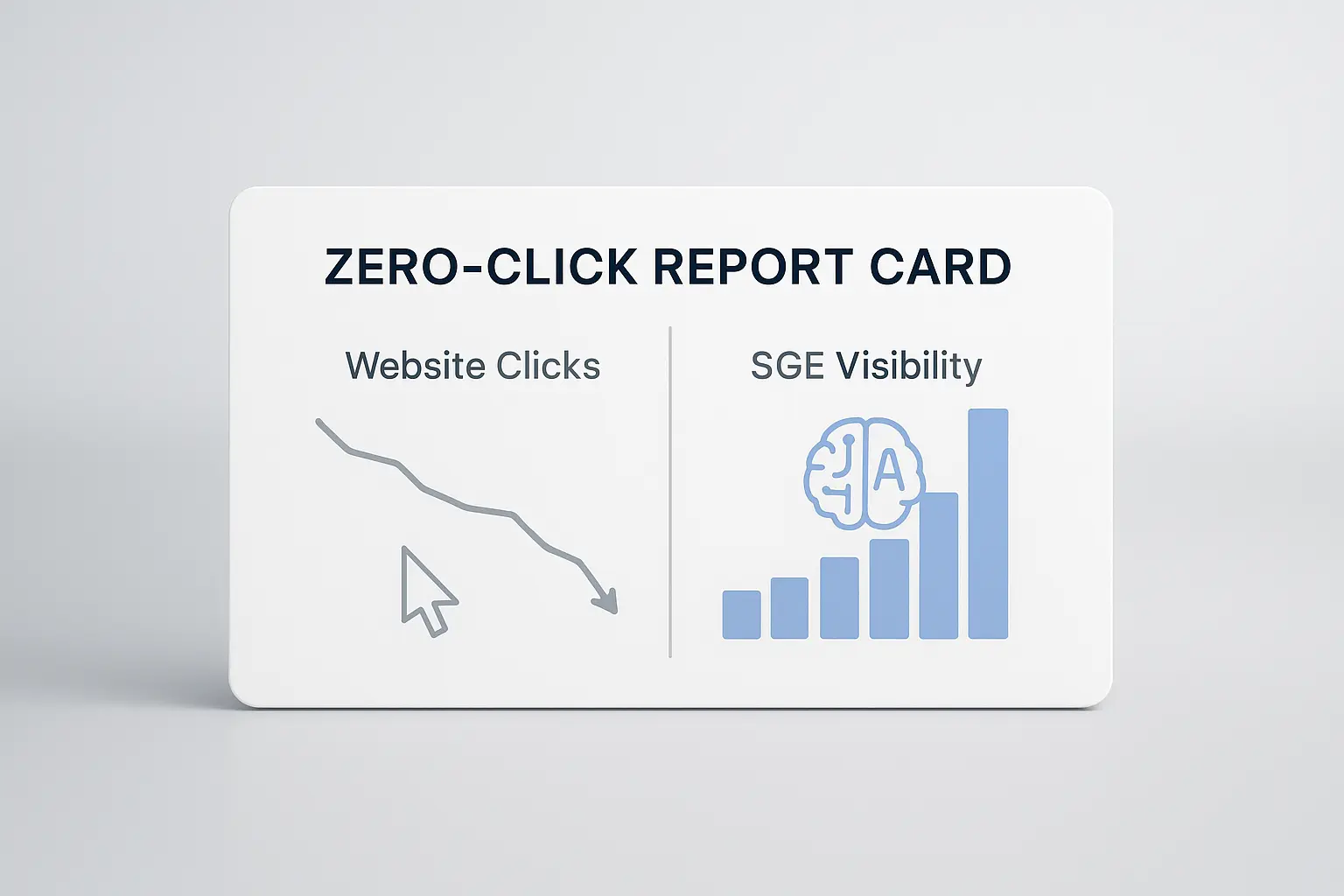
You’re on a monthly reporting call with your client. You pull up the dashboard, and their face tightens.
“Our organic traffic is down 8% this month,” they say, concern in their voice. “Is the SEO not working?”
You take a deep breath. You know you’ve been doing great work. You’ve secured their brand as a primary source in Google’s new AI-generated answers for their most important keywords. They are dominating the top of the search results.
The problem? That dominance isn’t showing up in the one metric the client has been trained to value above all others: website clicks.
If this scenario feels familiar, you’re not alone. Welcome to the new era of search, where success isn’t just about driving traffic—it’s about commanding attention in a world of zero-click answers.
The New Search Landscape: What Are AI Overviews?
For years, the goal of SEO was simple: get the number one spot. That spot meant clicks. But Google’s Search Generative Experience (SGE), now officially called AI Overviews, has changed the game.
AI Overviews are AI-generated summaries that appear at the very top of the search results page (SERP), designed to answer a user’s query directly without them needing to click on a link. And they’re showing up frequently. Recent research shows that nearly 87% of all queries on Google now trigger AI Overviews, reshaping how users find information.
This shift creates a massive challenge for agencies. The old report card, graded on traffic and rankings, is becoming obsolete. When Google answers the question for the user, the click you worked so hard to earn often never happens.
Why Your Old Report Card Is Failing
Relying solely on traditional metrics like organic traffic, click-through rates (CTR), and keyword rankings is like trying to navigate a new city with an old map. You’re missing the most important new landmarks.
These metrics are now lagging indicators of success because they fail to capture the immense brand value of being featured in an AI Overview. Being the trusted source cited by Google’s AI builds authority and awareness at the very first touchpoint—a touchpoint that happens before a potential click.
If your reporting doesn’t account for this, you’re telling an incomplete story—one that leaves your clients to believe your efforts aren’t paying off when the opposite is true.

So, how do you prove the value of your work? You need a new report card.
Introducing the Zero-Click Report Card
The Zero-Click Report Card is a new framework for measuring and communicating SEO success that shifts the focus from traffic acquisition to informational influence. It helps you show clients that even without a click, your strategy is positioning them as the go-to authority in their space.
This new reporting model has three core KPIs.
KPI 1: Share of Voice (SoV) in AI Overviews
Think of this as the new market share for the SERP. Instead of just tracking your rank, you track how often your client’s brand, products, or expertise appear within AI-generated answers for a set of target keywords.
What it is: The percentage of times your brand is present in AI Overviews for your most important search queries.
Why it matters: High SoV means your client is shaping the narrative in their industry. They become the primary source of information for potential customers at the very beginning of their journey. This is top-of-funnel branding at its most powerful.
How to track it: You can do this manually by tracking key queries in an incognito browser or use enterprise tools that are starting to offer automated tracking for SGE visibility.
KPI 2: Brand Mention Frequency and Sentiment
AI Overviews pull information from a wide variety of sources. Your client doesn’t always have to be the primary citation to benefit. Simply being mentioned as a reputable option or example is a huge win.
What it is: A count of how many times your client’s brand name is mentioned in AI Overviews, along with the context (e.g., “a leading provider like [Client Brand]…”).
Why it matters: Each mention reinforces brand recognition and credibility. It positions your client as a key player in the ecosystem. To achieve this, you need comprehensive content strategies that establish authority across multiple platforms, not just on your client’s own website.
How to track it: This often requires manual tracking, but the insights are invaluable for demonstrating widespread brand presence.
KPI 3: Citation Link Quality and Prominence
When a link is included in an AI Overview, it’s a super-charged click. The user has already received their answer and is now clicking for deeper information, making them a highly qualified lead. The placement of that link matters.
What it is: An evaluation of where your link appears in the AI Overview. Is it the first citation? Is it attached to a compelling piece of data? Is it featured in a product carousel?
Why it matters: A prominent citation is a powerful endorsement from Google itself, acting as a trusted referral. A user clicking this link is much further down the consideration path than someone clicking a traditional blue link.
How to track it: Take screenshots. Documenting these prominent placements provides concrete, visual proof of your success that clients can easily understand.
How to Communicate This New Value to Clients
Adopting this new report card requires re-educating your clients. You need to shift the conversation from “how much traffic did we get?” to “how much influence do we have?”
Here’s how to frame it:
-
Start with the “Why”: Begin your reporting calls by explaining the shift in the search landscape. Use the 87% statistic to underscore that this isn’t a small trend—it’s the new reality.
-
Tell a Story with Data: Present your Zero-Click Report Card alongside traditional metrics. Show them screenshots of their brand featured prominently. Say, “While organic traffic dipped, our Share of Voice in AI answers increased by 30%. We are now the first answer potential customers see for our top 5 keywords.”
-
Use an Analogy: Equate SGE visibility to getting a positive mention in a major news article. You don’t get a direct website visit from every person who reads the paper, but the brand credibility and awareness it builds are immense. That’s the kind of brand-building happening on Google right now.
-
Connect It to the Bottom Line: Explain that this top-of-SERP authority builds trust, which shortens the sales cycle when users do decide to visit the site. This pre-qualification is a critical, but often invisible, part of the customer journey. Using automated SEO reporting can help you build dashboards that visualize this new funnel for clients.
FAQ: Navigating the SGE Landscape
What exactly is Google SGE / AI Overviews?
It’s a feature in Google Search that uses generative AI to provide a direct, summarized answer to a user’s query at the top of the results page. It synthesizes information from various web pages to create a concise overview.
Will AI Overviews completely replace traditional organic results?
No. For now, the traditional “10 blue links” still appear below the AI Overview. However, the overview commands the most prominent position, meaning it will capture a significant portion of user attention.
How do I get my content featured in AI Overviews?
There’s no magic button, but the principles are rooted in good SEO: create high-quality, expert-driven content (E-E-A-T), answer questions clearly and concisely, structure your data logically (using schema markup helps), and build a strong backlink profile from other authoritative sites.
Is link building still important for SGE?
Absolutely. The AI models rely heavily on Google’s core ranking systems, and authority (largely determined by backlinks) is a huge factor in deciding which sources to trust and cite.
Can I track SGE performance in Google Search Console?
Currently, Google Search Console does not offer a specific filter or report to isolate performance within AI Overviews. This is why manual tracking and new reporting frameworks like the Zero-Click Report Card are so essential for agencies.
A New Playbook for a New Game
The rise of AI in search isn’t a threat—it’s an opportunity for agencies to demonstrate a deeper, more strategic value. Clicks and traffic are still important, but they are no longer the whole story.
By adopting the Zero-Click Report Card, you can move the conversation beyond simple metrics and show clients what truly matters: becoming the definitive answer for their customers. It’s about proving that even without a click, you are building the most valuable asset of all—authority.
Ready to learn more about how to build a modern SEO offering? Explore how to start integrating your SEO with a broader growth strategy and deliver results that resonate in the age of AI.