
Remember the first time you created a “Zap”?
It felt like magic. A new form submission on your website instantly created a contact in your CRM and sent a Slack notification. You had connected two apps that didn’t speak the same language, automating a manual task forever.
For a while, this digital duct tape is all you need. But then, your business grows.
You now have a dozen multi-step Zaps. When one breaks, a whole sequence of events fails silently. Your sales team mentions that while leads arrive instantly, they lack context; they have no idea if the person downloaded a whitepaper an hour ago or has visited the pricing page five times this week.
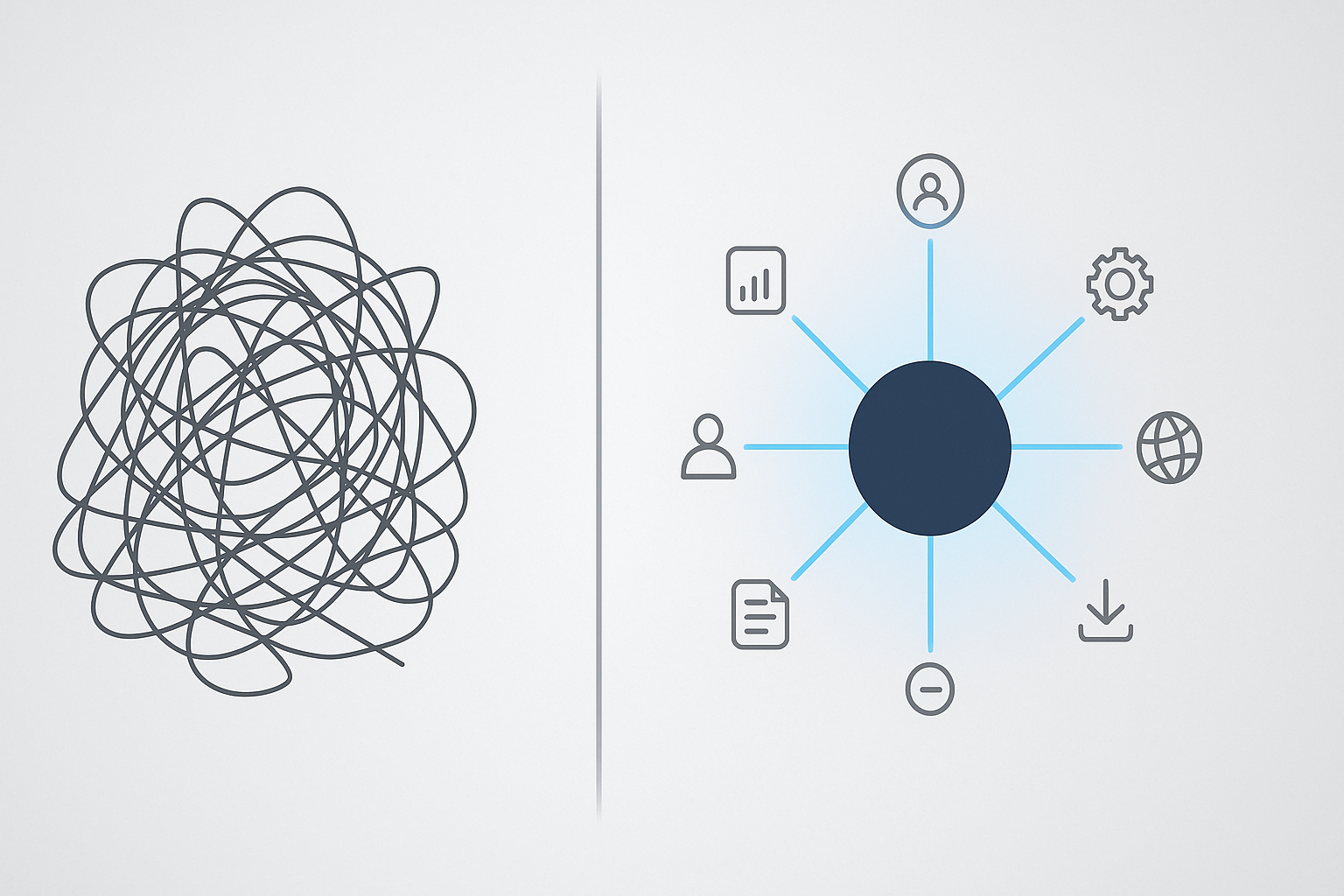
Your simple, elegant automation has become a tangled, brittle web. You’ve hit the ceiling of rule-based automation.
The Simple Magic of Rule-Based Automation (And Its Hidden Ceiling)
Tools like Zapier, Make, and other IFTTT (If-This-Then-That) platforms are brilliant for linear tasks. They operate on a simple, powerful principle: when a specific trigger happens (If This), a specific action occurs (Then That).
- If a new user signs up, then add them to a Mailchimp list.
- If a customer pays an invoice, then log it in a Google Sheet.
- If a calendar event is created, then send a reminder email.
This approach is perfect for automating the predictable, point-A-to-point-B parts of your business. It saves countless hours and eliminates human error in repetitive tasks.
But business, especially in sales and marketing, is rarely linear. It’s complex, contextual, and messy. Rule-based automation breaks down here because it can’t handle variables, make judgments, or act on patterns instead of simple triggers.
When you try to force IFTTT logic onto complex scenarios, you end up with what engineers call “brittle” systems—rigid, hard to maintain, and quick to snap when business needs change.
Welcome to the “Messy Middle”
Most of your potential customers don’t move in a straight line from “new lead” to “closed-won.” They live in the “messy middle”—a complex journey of evaluation, comparison, and consideration.
They might read three blog posts, ignore four emails, attend a webinar, and then visit your pricing page twice in one day.
A simple rule-based system sees these as isolated events:
- Trigger: Visited pricing page. Action: Notify sales.
But which salesperson gets the lead? Is this lead hotter than the one who just downloaded an ebook? Should they get a call, or a personalized email sequence about the specific features they viewed?
Zapier can’t answer these questions because it lacks context. It sees the what but not the why or the what next. It can’t navigate the messy middle, which is precisely where your most valuable opportunities are hiding.
Making sense of this complexity requires a system that understands nuance and the relationships between different data points. This is where a proper semantic and entity-based strategy becomes crucial, not just for external search but for your internal business intelligence. You need a system that understands a “user” on your site is the same “entity” as a “contact” in your CRM and a “subscriber” on your email list.
What Is an AI Infrastructure? More Than Just Automation
An AI infrastructure isn’t just a more powerful version of Zapier. It’s a fundamental shift from automating tasks to orchestrating intelligence.
Think of it this way:
- Rule-Based Automation (Zapier) is like a light switch. You flip it, the light turns on. You flip it again, it turns off. The switch doesn’t know if it’s day or night, or if anyone is even in the room.
- AI Infrastructure is like a smart home system. It connects the lights, thermostat, security cameras, and your calendar. It knows who is home, what time of day it is, and what your preferences are. It doesn’t just turn things on; it proactively creates the perfect environment.
An AI infrastructure acts as a central brain for your business. It connects all your data sources—CRM, website analytics, product usage data, support tickets—and uses AI models to:
- Unify Data: It sees that the anonymous user on your website is the same person as the contact in HubSpot and the open support ticket in Zendesk.
- Understand Context: It analyzes patterns of behavior over time to understand intent and predict what’s next.
- Make Intelligent Decisions: Instead of firing off a static action, it can score leads based on hundreds of data points, recommend the “next best action” for a salesperson, or trigger a hyper-personalized nurturing campaign.
This system provides true operational intelligence. It doesn’t just tell you what happened; it suggests what you should do about it. The same large language models that power conversational search are now used to analyze business data and surface these recommendations, giving your entire operation better AI visibility into the customer journey.
5 Signs You’re Ready to Upgrade to an AI Infrastructure
How do you know if you’ve outgrown rule-based tools? Here are five clear signs it’s time to consider a more intelligent approach.
1. Your “Zaps” Are a Tangled Web
If your automation map looks like a plate of spaghetti and changing one workflow means updating five others, you’ve hit the complexity ceiling. An AI infrastructure centralizes this logic, making it far easier to manage and scale.
2. Your Team Spends More Time Fixing Automation Than Benefiting From It
When your team’s daily stand-up includes “figuring out why the CRM sync Zap failed again,” your automation is creating more work than it saves. A robust infrastructure is built for reliability, with clear monitoring to prevent silent failures.
3. You Can’t Personalize at Scale
You want to send a follow-up email that references the specific blog category a user reads most. A rule-based tool can’t easily do this. An AI system can analyze browsing history, identify primary interests, and trigger a workflow with that exact context.
4. Your Data Lives in Disconnected Silos
Your sales team lives in the CRM, marketing in the email platform, and product in the usage analytics tool. If these systems aren’t feeding a central intelligence hub, you’re making critical decisions with only a fraction of the available information.
5. You’re Making Strategic Decisions With Incomplete Information
You find yourself relying on gut feelings or isolated reports to decide where to focus sales efforts. An AI infrastructure can surface proactive insights, like “leads from this industry are 40% more likely to close when they attend a webinar first.”
Frequently Asked Questions (FAQ)
Q1: Does this mean I should get rid of Zapier?
Not at all. Zapier is an excellent tool for what it does: simple, linear task automation. Many companies use an AI infrastructure for complex, decision-based workflows while continuing to use Zapier for straightforward tasks like sending Slack notifications or creating calendar events. They solve different problems.
Q2: Is building an AI infrastructure expensive and complicated?
It used to be a massive undertaking reserved for enterprise companies with data science teams. Today, a new generation of operational intelligence platforms and expert partners makes it accessible for growing businesses. It’s an investment in a scalable foundation for growth, not just an IT cost.
Q3: What’s the first step to exploring this?
Start by auditing your data and processes. Identify the most critical customer journey touchpoints and ask yourself, “What question could we answer here if all our data were connected?” For example, “Which combination of user actions most accurately predicts a qualified lead?” Answering that question is the starting point for designing an intelligent system.
Q4: Can’t I just use the “AI by Zapier” features?
Those features are a fantastic step forward. They allow you to embed a layer of AI—like summarizing text or classifying sentiment—into a linear workflow. However, it’s still operating within the IFTTT framework. It enriches a single step in the process, but it doesn’t act as a central, context-aware brain connecting all your data sources to make predictive decisions.
The Next Step: From Automating Tasks to Orchestrating Intelligence
Moving from rule-based automation to an AI infrastructure isn’t just a technical upgrade; it’s a strategic evolution. It’s about shifting from asking, “How can we make this task happen automatically?” to “How can we make the best possible decision at every step of the customer journey?”
Understanding this difference is the first step. The next is to look at your own business and identify where simple, rule-based logic is holding back your growth. Where is the “messy middle” in your customer journey, and what opportunities could you unlock by navigating it with intelligence?