
Imagine your client’s new sales hire asks an internal chatbot, “What’s our key differentiator for enterprise customers in the finance sector?”
Instead of a generic answer or a link to a messy internal drive, they get a perfect, concise response, synthesized from the latest case studies and service pages your agency just published. The data is accurate, the tone is on-brand, and the answer is instant.
This isn’t a far-off feature for Fortune 500 companies. It’s a high-value, achievable service that forward-thinking agencies can start building for their clients today. The secret lies in transforming the high-quality content you’re already creating into a powerful, private knowledge API.
Your client’s website is no longer just a digital brochure; it’s a structured, proprietary knowledge base waiting to be activated.
The Problem with Public AI and the Rise of Private Knowledge
Generative AI is transforming business. A recent Gartner survey found that 55% of organizations increased their AI investments in the past year. But as companies rush to integrate tools like ChatGPT, they’re hitting a wall. Public large language models (LLMs) don’t know your client’s specific pricing, recent product updates, or internal sales frameworks.
Worse, feeding sensitive client data to public models is a significant risk. In fact, data privacy and security are consistently cited as the top barriers to AI adoption. This creates a powerful opportunity for agencies. You can solve this problem by building a ‘walled garden’ for your client’s knowledge: a system where their AI applications query their own approved content.
And it’s all made possible by creating a Topic Graph API.
From Content to Conversation: What is a Topic Graph API?
Let’s break down this seemingly complex term into three simple parts. It’s less about code and more about a new way of thinking about content.
-
Content: The articles, case studies, service pages, and FAQs you meticulously research and write for your client. This is the ‘knowledge.’
-
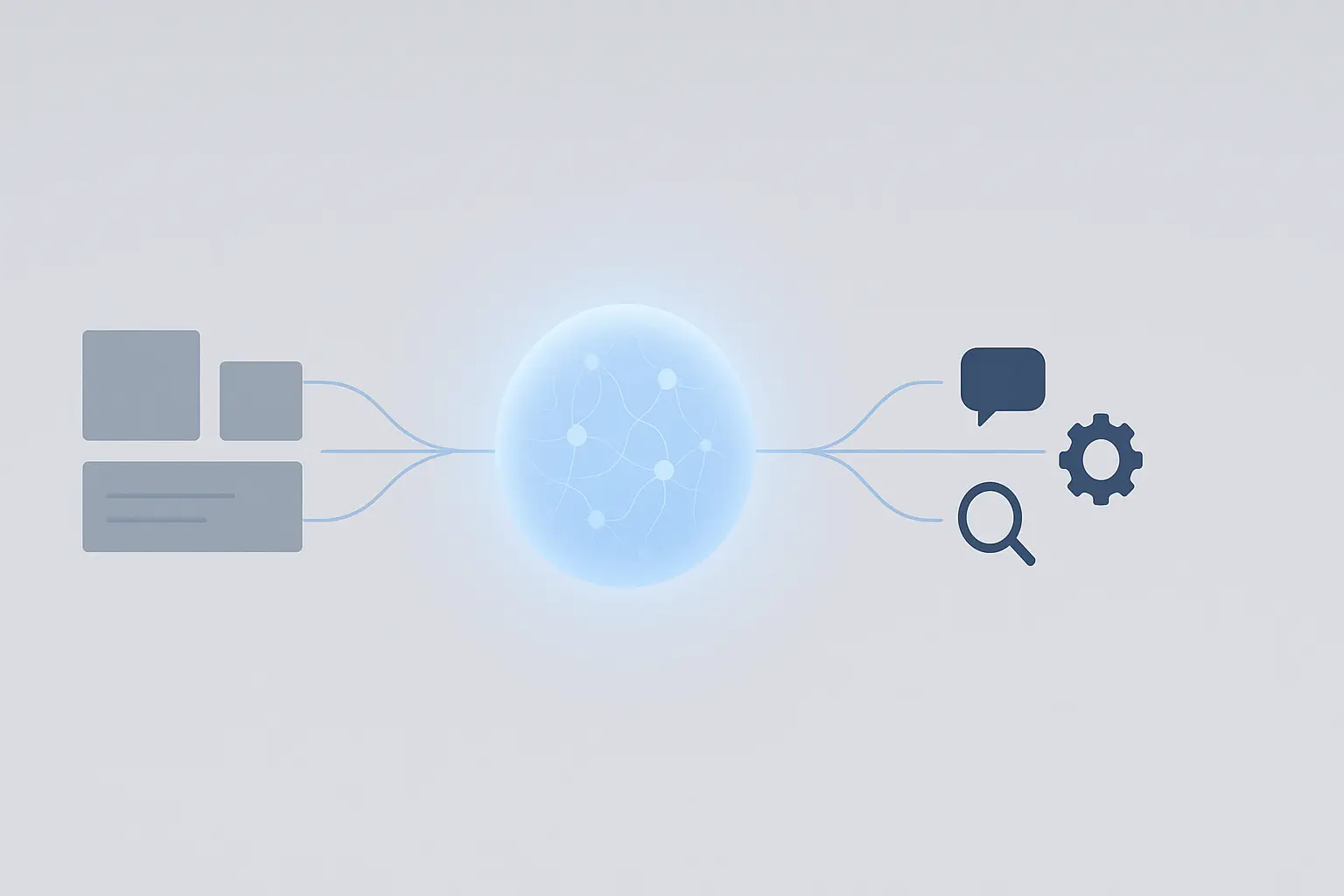
Topic Graph: Imagine a digital brain that reads all that content and understands the meaning and relationships between different concepts. It connects the idea of ‘enterprise security features’ on a product page to a specific point in a ‘finance industry case study.’ It’s a map of meaning, not just keywords.
-
API (Application Programming Interface): A secure doorway that allows other applications—like an internal chatbot, a sales enablement tool, or a content suggestion engine—to ‘ask questions’ of that digital brain and get answers based only on the client’s content.
By building this, you’re not just delivering a webpage; you’re delivering an intelligent, queryable asset that the entire organization can use to make smarter, faster decisions.
The 5-Step Blueprint for Building a Client Knowledge API
While the concept is advanced, the process is logical and follows a clear blueprint. Here’s a high-level look at how to turn a client’s website content into a living API.
Step 1: Content Ingestion and Structuring
First, you gather the raw materials. This involves crawling the client’s sitemap to extract the text from their most valuable pages—think service pages, in-depth blog posts, technical documentation, and case studies.
Once you have the text, you clean it up (removing navigation, footers, etc.) and break it into smaller, logical ‘chunks.’ A chunk might be a single paragraph or a few related sentences. This step is crucial, as it allows the system to find highly specific and relevant information later.
Step 2: Creating Semantic Embeddings
This is where the magic happens. An ’embedding’ is a way of converting text into a string of numbers (a vector) that represents its semantic meaning. Words and phrases with similar meanings will have similar numerical representations.
Using a pre-trained model (like OpenAI’s text-embedding-3-small or an open-source alternative), you convert each content chunk into a vector. At this point, you’ve transformed your client’s library of words into a library of mathematical meaning that a computer can easily compare and analyze.
Step 3: Storing in a Vector Database
Where do you store all these new vectors? Not in a traditional database. You use a specialized tool called a vector database (like Pinecone, Weaviate, or Chroma).
Think of it as a highly advanced librarian. When you ask it a question, it doesn’t just search for keywords. It converts your question into a vector and then instantly finds the content chunks whose vectors are the ‘closest’ or most similar in that multi-dimensional space. This is the core of your topic graph.
Step 4: Building the API Query Layer
The API is the secure front door to your vector database. You can build a simple API endpoint using a framework like Python’s FastAPI or Flask. This endpoint handles three key tasks:
- Accepts a question (a text query) from an application.
- Converts that question into a vector using the same model from Step 2.
- Sends that vector to the database to find the most relevant content chunks and returns them.
This process of finding and providing relevant context—an approach known as Retrieval-Augmented Generation (RAG)—is a cornerstone of modern AI, fundamental to creating reliable and factual AI-powered SEO and knowledge systems.
Step 5: Integrating with an LLM for Conversational Answers
The API retrieves the raw, relevant content chunks. To turn them into a natural, conversational answer, you pass them to an LLM (like GPT-4 or Claude) with a very specific prompt.
The prompt essentially says: “Using ONLY the following information: [insert retrieved content chunks here], please answer this user’s question: [insert original user question here].”
This final step ensures the LLM acts as a synthesizer for your client’s approved knowledge, not as a creative writer pulling from public data. It dramatically reduces the risk of ‘hallucinations’ and keeps the answers perfectly on-brand. Ultimately, the power of this system lies in its ability to drive measurable business outcomes, aligning with a broader strategy of omnichannel SEO that connects all digital touchpoints to performance.
The Agency Opportunity: From Content Creator to AI Enabler
Building a knowledge API for clients fundamentally changes your agency’s value proposition. You’re no longer just an SEO or content provider; you become a strategic AI partner.
This service allows you to:
-
Create a High-Value Retainer: This isn’t a one-off project. The API needs to be maintained and updated as you publish new content for the client.
-
Deepen Client Relationships: You become deeply integrated into their internal operations, powering tools for their sales, support, and marketing teams.
-
Future-Proof Your Agency: As 72% of executives report that AI will be the most significant business advantage of the future, agencies that can bridge the gap between content strategy and AI implementation will have an undeniable competitive edge.
You move from delivering assets that attract an audience to delivering systems that empower an entire organization.
FAQ: Your Questions Answered
What kind of content works best for this?
Structured, high-quality, and factual content is ideal. Think service and product pages, technical documentation, in-depth articles, and detailed case studies. Opinion pieces or news-style blogs are less suitable.
Is this secure for sensitive client data?
Absolutely. The entire system—from content ingestion to the vector database and the API—can be hosted in a private environment. The client’s data never touches a public LLM until the final, controlled synthesis step, and even then, it’s not used for training.
How much technical skill does this require?
Building the initial prototype requires some knowledge of Python and APIs. However, the ecosystem of tools is evolving rapidly, making this process more accessible every day. The key is to understand the strategic framework first.
Can this be used for more than just chatbots?
Yes! A knowledge API can power a wide range of applications:
-
Sales Enablement: Give your sales team an internal tool to get instant answers to complex product questions.
-
Intelligent On-Site Search: Upgrade the client’s website search to understand natural language and provide direct answers.
-
Content Strategy: Analyze the existing graph to find knowledge gaps you can fill with new content.
Your Content is Your Client’s Next AI Advantage
Every article you write and every service page you optimize is a piece of a larger puzzle. By assembling those pieces into a queryable knowledge graph, you unlock exponential value for your clients and position your agency at the forefront of the AI revolution.
The websites you build are no longer just destinations; they are the source code for your client’s future intelligence.
Ready to scale advanced services like this? Learn more about our white-label SEO services for agencies and see how we can become your invisible execution partner.