

You’ve seen the shift. The familiar rhythm of SEO—keyword research, content, links—is giving way to a current of artificial intelligence that’s rewriting the rules of digital visibility.
For agency leaders, this isn’t just another trend; it’s a fundamental challenge to the value you provide. The playbooks from Semrush, Ahrefs, and even Google’s own starter guides already feel a step behind, focused on a web that is rapidly fading.
They teach you how to optimize for the ten blue links, but what happens when those links disappear into an AI-generated answer?
The anxiety is real. Gartner predicts a potential 50% decrease in organic traffic by 2028. We’re already seeing high-traffic keywords lose as much as 64% of their click-throughs to AI Overviews. This isn’t a future problem; it’s happening now.
The question every agency must answer is no longer if they need to adapt, but how they can build a new technical foundation for their clients—one designed not just for crawlers, but for AI.
This isn’t another checklist. This is a strategic blueprint for architecting websites that thrive in an AI-first world, and a guide to how your agency can deliver it without building an in-house engineering team from scratch.
Chapter 1: Beyond the 10 Blue Links: Redefining Visibility in the AI Era
For years, visibility meant ranking on page one. Today, it means becoming a trusted source for the AI models that now sit between you and your audience. True visibility is being cited in an AI Overview, having your product data pulled into a generative answer, and your brand’s expertise shaping the conversation.
This requires a shift in mindset from winning a position to earning a citation. The new goal is to structure your clients’ data with such clarity and authority that AI models don’t just find it—they understand it, trust it, and feature it. This ecosystem has multiple layers, and your technical strategy must account for them all.
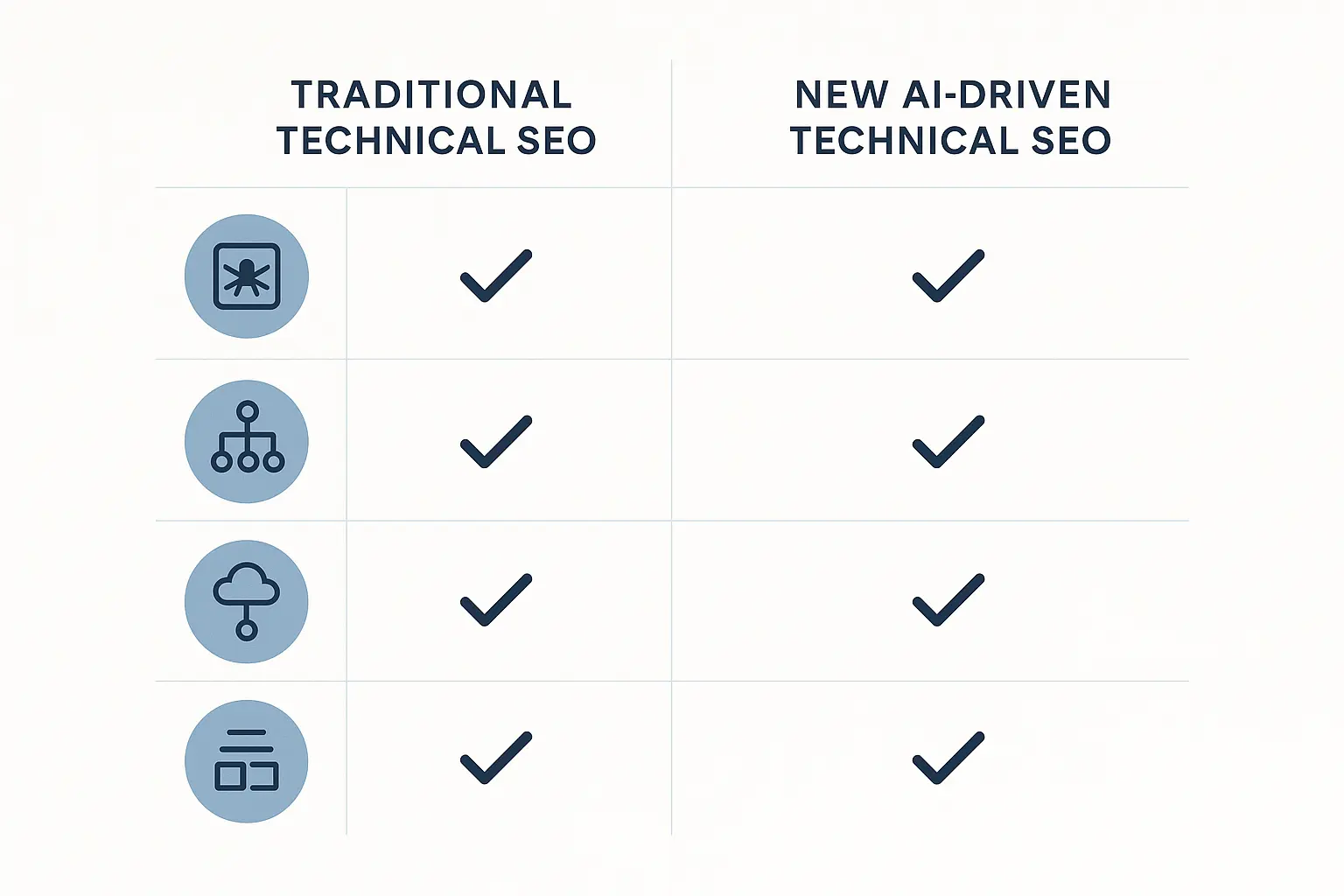
While traditional SEO focused on making content accessible to crawlers, the new technical SEO is about making your entire digital presence comprehensible to machines. It’s the difference between leaving a book on a library shelf and handing the librarian a perfectly organized set of index cards detailing every fact inside.
Chapter 2: The New Technical SEO Blueprint: Architecture for an AI-First Web
While competitors are still publishing beginner’s guides, your agency needs a forward-looking playbook. Old checklists fall short because they treat technical SEO as a series of isolated tasks. The new approach is to build a holistic architecture designed for machine comprehension.
This new blueprint stands on three core pillars that traditional guides either miss entirely or cover superficially.
Advanced Schema and Entity Clarity: Speaking the Language of LLMs
It’s no longer enough to use basic Schema.org markup for an article or a product. To feed an LLM, you must define entities—distinct concepts like a person, place, organization, or product—with absolute clarity, mapping their relationships to one another. The new technical SEO uses nested and interconnected schema to build a comprehensive knowledge graph for a client’s website.
Instead of simply adding Product schema with a name and price, the new approach uses Product schema that references an Organization (the manufacturer), which in turn links to the founder’s Person schema, all supported by Review schema that validates quality. This rich, connected data removes ambiguity for AI. It proves E-E-A-T (Experience, Expertise, Authoritativeness, Trustworthiness) at a machine-readable level, making your client’s content a prime source for generative answers.
API Integrations: The New Sitemaps for the AI Ecosystem
Sitemaps tell search engines where your pages are; APIs give them direct access to your live, structured data. This concept is completely missing from standard technical SEO guides, yet it’s critical for future relevance.
By creating and exposing APIs for key data like product inventory, pricing, or event schedules, you build a direct pipeline to search engines and other AI agents. This allows them to query your client’s data in real-time, ensuring the information they use is always accurate and up-to-date. The old way involved waiting for a bot to crawl a page and parse its HTML. The new way is to provide a dedicated API endpoint like api.clientwebsite.com/products/live that an AI can query directly, bypassing the crawl altogether.
Agencies that can implement this give their clients a massive competitive advantage, positioning them as a primary, reliable data source for the entire AI ecosystem.
Semantic Site Architecture: Building for Topics, Not Just Keywords
Keyword-stuffing was the first casualty of intelligent search, yet many sites are still structured around isolated keywords. An AI-ready website is built around topics and entities.
This means organizing content into logical hubs and spokes, where a central pillar page covers a broad topic and is internally linked to and from multiple cluster pages that explore specific sub-topics in detail. Instead of creating separate, disconnected pages for “best running shoes,” “running shoes for flat feet,” and “marathon running shoes,” the new approach is to build a central “Running Shoes” pillar page. This hub links out to detailed cluster pages on each specific sub-topic, creating a semantic structure that proves authority and context to AI systems.
Chapter 3: The Agency Playbook: How to Deliver Future-Proof Technical SEO at Scale
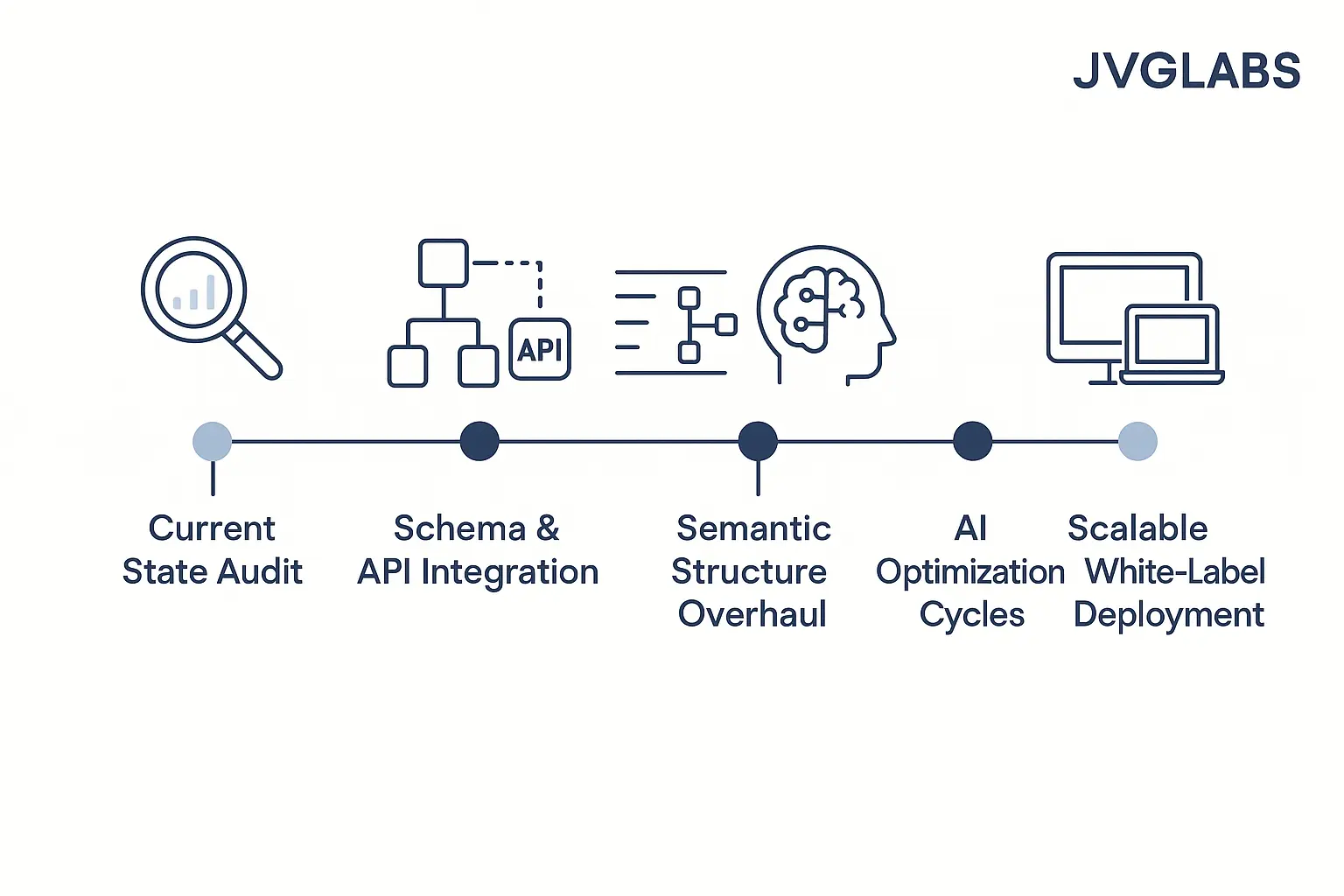
Understanding the new blueprint is one thing. Delivering it across multiple clients is another. For most agencies, this is where the real challenge begins. The technical skills required—advanced schema implementation, API development, deep architectural analysis—are closer to software engineering than traditional marketing.
This leaves you with a critical decision: do you build this capability in-house or partner with a specialist?
Building an in-house team is expensive, slow, and risky. You’d need to hire SEO engineers, not just SEO specialists, and then manage their training, overhead, and the constant race to stay ahead of a rapidly evolving technology curve.
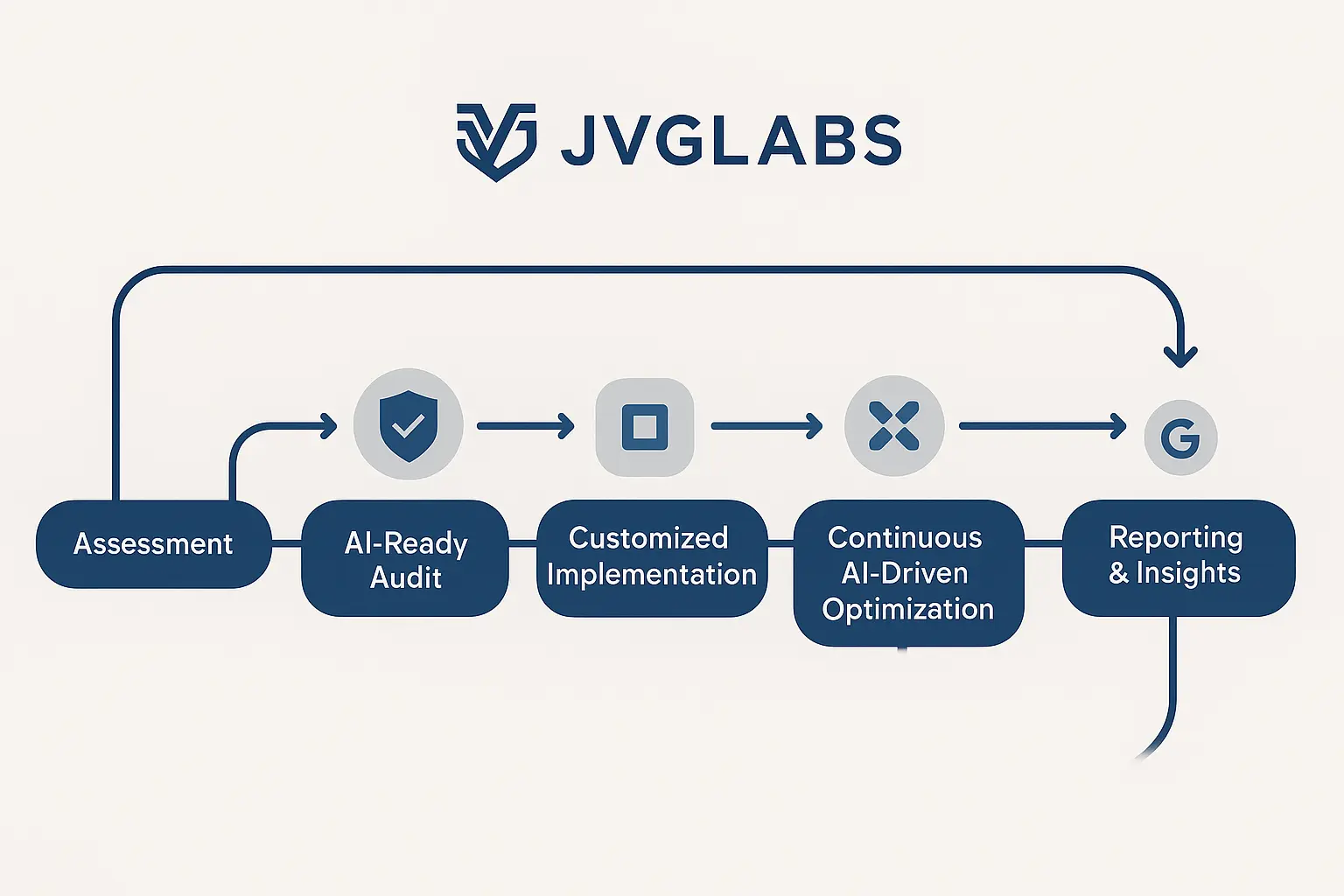
Partnering allows you to instantly access the expertise and infrastructure you need. A white-label partner acts as your invisible technical execution arm, allowing your agency to focus on client strategy and relationships while delivering sophisticated, future-proof SEO under your own brand. It’s the fastest path to scaling your services and protecting your clients in the AI era.

Becoming the Agency of the Future
The web is changing. Agencies that thrive will be those who abandon reactive checklists for proactive architectural strategy. Traffic from AI platforms has already surged by 527% in just five months—this is not a distant threat. Inaction is no longer an option.
Your agency doesn’t need to become a software development shop to compete. You need a partner that provides the deep technical execution to make this new playbook a reality for your clients.
At JVGLABS, we are that partner. We are the white-label SEO execution engine for agencies. Our team combines AI-powered automation with expert strategy to handle the complex technical work—from advanced schema to semantic architecture—in the background. You maintain the client relationship and deliver the results under your brand. We provide the invisible engineering capacity that makes it all possible.
Your Questions Answered: Navigating the Technical SEO Shift
Isn’t this new technical SEO too complex for my clients to understand and value?
That’s where your strategic guidance comes in. You don’t need to explain API endpoints to them. You frame it in terms of business outcomes: “We’re future-proofing your website to become a primary source for AI-driven search, protecting your brand’s visibility as user behavior changes.” We provide the data and reporting you need to prove that value.
Can’t I just use a plugin for schema and call it a day?
Plugins are a great starting point, but they typically only handle basic schema. They can’t create the deeply nested, interconnected entity relationships that truly differentiate a site for an LLM. AI-readiness requires a custom, architectural approach that goes far beyond what an off-the-shelf plugin can provide.
How can we possibly deliver this level of technical work without an in-house developer?
You don’t have to. That’s the exact challenge our white-label model is designed to solve. Our AI-powered SEO automation and expert team become an extension of your agency, handling the complex implementation so you can focus on strategy and growth. You get all the credit without any of the hiring headaches.
Will my agency lose control if we partner with a white-label provider?
Not with the right partner. Our entire model is built on being “white-label first.” We operate invisibly in the background. All deliverables, reports, and communication are branded with your agency’s name. You own the client relationship completely; we’re simply the engine that powers your technical execution.
Your Next Step: Secure Your Clients’ Future (and Your Own)
The agencies that hesitate will be left explaining traffic declines to their clients. The agencies that act now will become indispensable strategic partners.
If you’re ready to offer the next generation of technical SEO without the cost and complexity of building an in-house team, let’s talk. Explore our white-label SEO execution services and see how we can become the invisible engineering department behind your brand’s success.