

You just launched it: a visually stunning website for a new client. The design is flawless, the copy is sharp, and the user experience is seamless. The client is thrilled. You send the final invoice, close the project, and move on to the next creative challenge.
Three months later, you get an email. “The site looks amazing,” it begins, “but… is anyone actually seeing it?”
This moment is a silent crisis for thousands of creative, content, and web design agencies. You excel at building beautiful things, but the long-term commitment of SEO feels like a completely different business model. You sell projects with clear start and end dates; SEO demands a slow-burn, 12-month retainer. Trying to bridge that gap often leads to awkward sales conversations and lost opportunities.
But what if you didn’t have to choose? What if you could deliver tangible, high-impact SEO value within the project-based model you’ve already mastered?
The Great Disconnect: Why Traditional SEO Doesn’t Fit Your Project Model
The core challenge is simple: effective SEO takes time. In fact, research shows that the average time to rank on the first page of Google is between two and six months. That’s precisely why the traditional SEO industry is built on long-term retainers—it requires sustained effort to see significant results.
For a client who just invested in a one-off website redesign or a quarterly content package, committing to another year-long contract is a tough pill to swallow. They’re in a project mindset, and you’re trying to sell them a subscription. This disconnect creates several problems:
- You leave money on the table: You’re forced to refer SEO work to other agencies or simply ignore the opportunity.
- Your work underperforms: A beautiful website that no one can find isn’t delivering maximum value for your client.
- You miss a chance to prove your value: You don’t get to show your clients how your creative work can directly drive business growth.
The “aha moment” is realizing the goal isn’t to force a retainer on a project-based client. It’s to reframe SEO into a project-sized deliverable that provides immediate, foundational value.
Introducing the SEO Sprint: Focused Impact in a Fixed Timeline
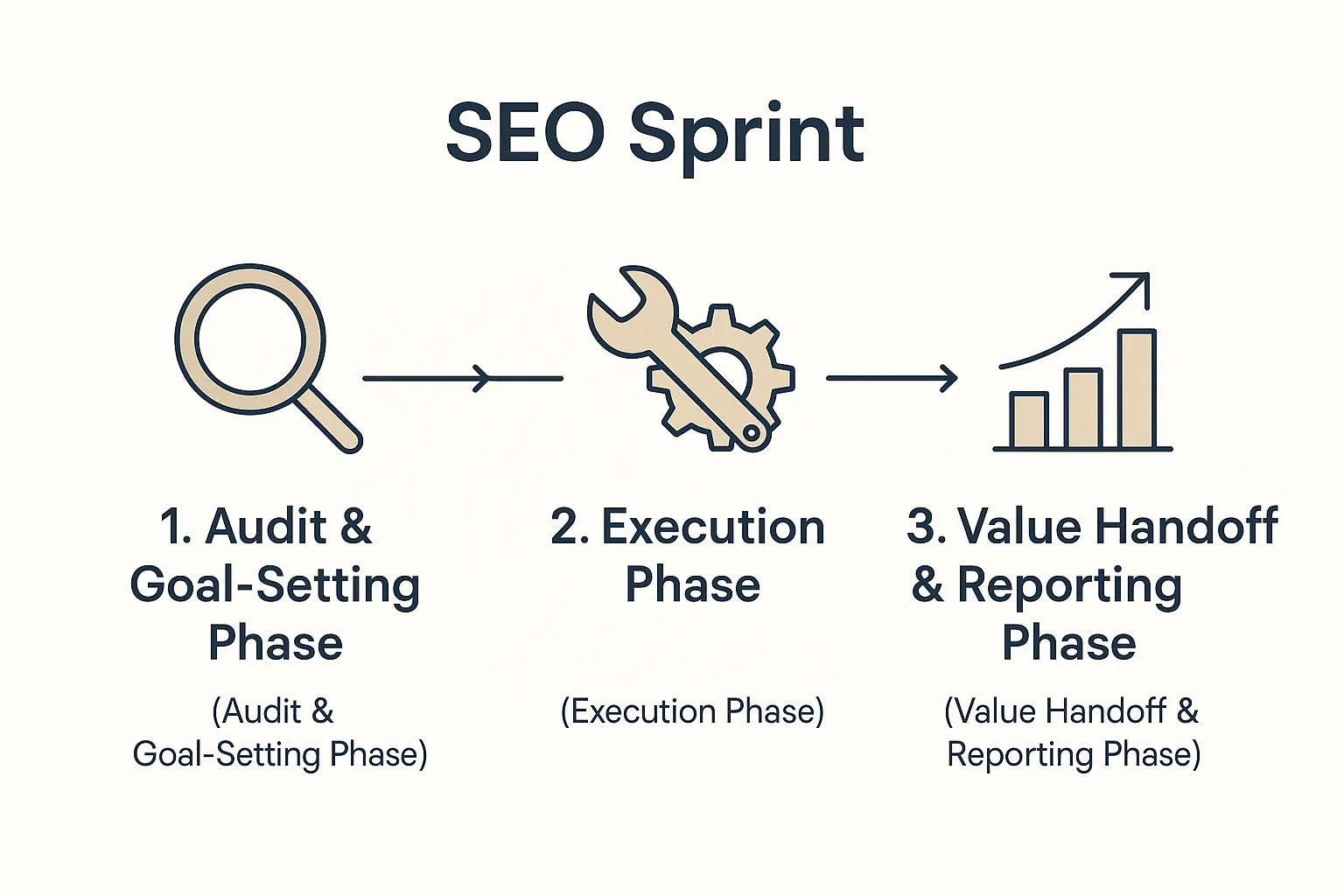
An SEO Sprint is a short-term, intensive engagement—typically 30 to 60 days—designed to achieve a specific, measurable SEO objective. Think of it less like a marathon and more like a powerful, focused burst of activity. Instead of promising to rank number one for everything in a year, you promise to get the client’s technical foundation, local visibility, or content strategy into top shape in just one month.
This model fits perfectly with the project-based work you already do. It’s an add-on, an upsell, and a value-booster that fits neatly into your existing workflow.
By breaking down the massive discipline of SEO into manageable, high-impact packages, you can introduce its value without asking for a long-term commitment clients aren’t ready for.
Three High-Impact SEO Sprints You Can Offer Today
You don’t need to offer everything at once. The key is to develop packages that complement your core services. Here are three proven SEO Sprint models perfect for creative and content agencies.
Sprint 1: The “Launch-Ready” Foundational SEO Sprint
Best For: A must-have add-on for any website design or development project.
The Goal: To ensure a brand-new or redesigned website is built on a rock-solid technical foundation, ready to be indexed and ranked by Google from day one.
Key Deliverables:
- Technical SEO Audit: Identify and fix crawl errors, broken links, and mobile-friendliness issues.
- Core Keyword Research: Define the top 10-15 “money” keywords the business needs to rank for.
- On-Page Optimization: Optimize title tags, meta descriptions, and headers for the site’s most important pages (Homepage, About, Services).
- Essential Setup: Configure Google Analytics, Google Search Console, and a basic XML sitemap.
Sprint 2: The “Content Amplification” Sprint
Best For: Content and branding agencies that deliver blog posts, case studies, or cornerstone guides.
The Goal: To turn a great piece of content from a static document into a long-term, traffic-generating asset. This directly addresses a major industry challenge: a recent study found that 61% of B2B marketers struggle to create high-quality content that engages audiences. Your agency creates the quality; this sprint ensures it engages.
Key Deliverables:
- Keyword & Topic Expansion: Optimize existing content for a wider range of relevant search terms.
- Internal Linking Strategy: Build links from other pages on the site to signal the new content’s importance.
- Schema Markup: Implement structured data to help Google understand the content and unlock rich snippets in search results.
- Initial Promotion & Outreach Plan: Identify opportunities for link building and social promotion to give the content an initial visibility boost.
Sprint 3: The “Local Visibility” Kickstart Sprint
Best For: Any agency that serves local businesses like plumbers, dentists, restaurants, or law firms.
The Goal: To rapidly improve a client’s visibility in local search results and Google Maps, driving immediate foot traffic and phone calls.
Key Deliverables:
- Google Business Profile (GBP) Optimization: A full overhaul of the client’s GBP listing, including photos, services, Q&A, and posts.
- Local Keyword Targeting: Identify “near me” and service-in-location keywords.
- NAP Consistency Audit: Ensure the business’s Name, Address, and Phone number are consistent across the web.
- Citation Building: Secure listings in key local directories and data aggregators.
How to Price and Position Your SEO Sprints
Shifting to this model means moving away from hourly rates and toward value-based project pricing. Instead of selling “10 hours of SEO,” you’re selling “A Complete Local Visibility Kickstart.” The price should reflect the tangible business outcome, not the time spent.
Position these sprints as an investment in the success of the primary project you’re delivering.
“We’re building you a beautiful website; the Foundational SEO Sprint ensures people can actually find it.”
“We’ve created this incredible guide for you; the Content Amplification Sprint will make sure it becomes your number one lead generator.”
This approach is so effective because you have data on your side. With 49% of marketers stating that organic search delivers the best return on investment of any channel, you’re not just selling an add-on; you’re selling access to the most powerful marketing channel on the planet.
And the best part? You don’t need a massive in-house team to get started. For agencies looking to offer these packages without the complexity of hiring, specialized white-label SEO services can provide the expertise and execution, allowing you to focus on client relationships while they handle the technical delivery under your brand.

From Sprint to Scale: The Path to Recurring Revenue
An SEO Sprint is more than just a one-off project. It’s the ultimate “foot in the door” strategy.
After you deliver a successful 30-day sprint and show your client tangible results—a fixed technical report, an optimized Google Business Profile with rising call numbers, or newly indexed content—the conversation naturally shifts from “Why do we need SEO?” to “This is great. What’s next?”
You’ve built trust, demonstrated expertise, and proven the ROI. At that point, proposing a longer-term engagement or a series of follow-up sprints becomes an easy, logical next step. This model offers a clear path to scaling your SEO offerings profitably and sustainably. As you grow, implementing AI-powered SEO automation can help manage reporting and analytics across multiple clients, making your new service offering even more efficient.
Frequently Asked Questions (FAQ)
What results can a client realistically expect from a 30-day sprint?
It’s crucial to manage expectations. A single sprint won’t land them on page one for a highly competitive term. Instead, focus on foundational and progress-based results. This could be a “before and after” technical health score, a perfectly optimized local listing, a list of 50 critical site errors that have been fixed, or a content piece that is now properly indexed and optimized.
How do we report on the success of an SEO sprint?
Success is measured against the sprint’s specific goals. For a Foundational Sprint, the report would show the initial audit findings versus the “all clear” report at the end. For a Local Sprint, you can show improvements in Google Business Profile insights (more calls, more direction requests). The key is to establish a clear baseline at the start and report on direct improvements.
Can we run multiple sprints for the same client?
Absolutely! A successful Foundational Sprint after a website launch is the perfect setup for a Content Amplification Sprint three months later. Stacking sprints allows you to build on previous successes and guide the client on a progressive SEO journey.
Do we need SEO experts on staff to offer this?
No. This is where partnerships are key. Many agencies begin by outsourcing the execution to a white-label partner. This allows you to sell and manage the client relationship while experts handle the technical delivery behind the scenes, all under your agency’s brand.
Your Next Move
By embracing the SEO Sprint model, you can finally bridge the gap between your project-based work and the undeniable value of search engine optimization. You’ll create a powerful new revenue stream, deliver more holistic results for your clients, and position your agency as a strategic partner, not just a creative vendor.
Start by looking at your core services. Which sprint is the most natural fit? That’s your starting point for building a more valuable, scalable, and resilient agency.