

You just landed a promising new SaaS client. You’ve run your standard SEO playbook: identified high-value commercial keywords, optimized their demo page, and started building authority. But after a few months, the results are… underwhelming. Traffic is up, but sign-ups are flat. The client is getting impatient.
What went wrong?
It’s a scenario playing out in agencies everywhere. The problem often isn’t the execution—it’s the strategy. You might be applying a sales-led SEO strategy to a product-led growth (PLG) company, and their SEO needs are worlds apart. It’s like trying to navigate London with a map of New York; the basic principles of driving are the same, but the roads, rules, and destination are completely different.
Understanding the difference between PLG and sales-led isn’t just marketing jargon—it’s the key to unlocking sustainable growth for your SaaS clients and positioning your agency as an indispensable strategic partner.
The Two Worlds of SaaS: User vs. Buyer
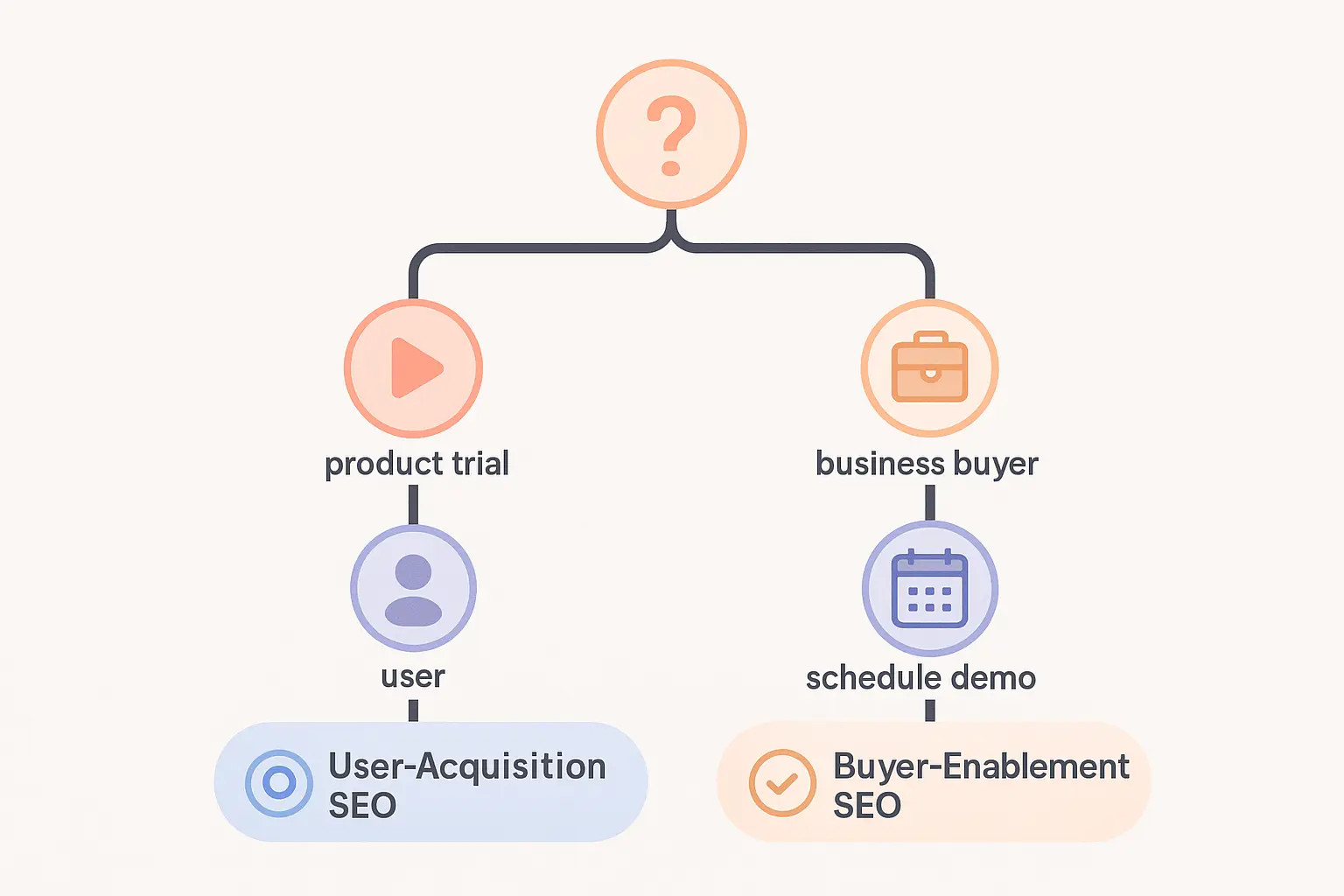
At its core, the difference between product-led and sales-led growth comes down to one critical question: Who are you trying to attract with your SEO?
Sales-Led Growth (SLG) targets the economic buyer. This is the traditional B2B model. Think of enterprise software like Salesforce or Workday. The goal is to convince a decision-maker—a VP, a C-level executive—to book a demo, get a quote, and sign a contract. The sales cycle is long, the price point is high, and the focus is on a select group of high-value leads.
Product-Led Growth (PLG) targets the end-user. Popularized by companies like Slack, Calendly, and Dropbox, this model lets the product itself drive customer acquisition. The goal is to get a user to sign up for a free trial or freemium version, experience the product’s value firsthand, and eventually upgrade or invite their team. It’s a high-volume, low-friction approach.
These two models create entirely different customer journeys and demand completely different SEO funnels.
Here’s how to build an SEO strategy for each.
SEO for Product-Led Growth (PLG): The User-First Playbook
In a PLG model, the goal of SEO isn’t to generate a lead for a salesperson; it’s to get a user into the product as quickly as possible. This means your entire strategy revolves around solving the user’s immediate problem.
The PLG SEO Mindset: Attract, educate, and activate the user.
Keyword Strategy: Volume, Problems, and “How-Tos”
The keyword universe for PLG is massive. You’re not just targeting people ready to buy software; you’re targeting anyone with a problem your product can solve, even if they don’t yet know a solution exists.
Focus: High-volume, informational keywords. Think “how to,” “what is,” “free template for,” and problem-based queries.
Example: For a project management tool like Trello, you wouldn’t just target “project management software.” You’d go after “how to organize a team project,” “content calendar template,” or “what are gantt charts.” The goal is to capture the user at their moment of need.
Intent: The primary intent is informational. Users are looking for answers, not a sales pitch. Your content must provide immediate value. Uncovering these problem-solving opportunities requires a deep understanding of keyword research and competitor analysis.
Content Strategy: Be the Solution, Not the Salesperson
PLG content is all about utility. It often acts as a “mini” version of the product itself.
Content Types: Blog posts, free templates, checklists, simple calculators, and how-to guides are your bread and butter. Each piece of content should help the user accomplish a small task that gives them a taste of what the full product can do.
Example: Canva is a master of this. They rank for millions of keywords like “birthday card maker” and “logo creator,” offering free tools and templates that seamlessly guide users into their product. The content is the top of the funnel.

Conversion Goal: The Frictionless Sign-Up
For PLG, the main conversion is a free trial or freemium account sign-up. Everything on the page should guide the user toward that action. This means prominent, clear calls-to-action (CTAs) that say “Sign up free” or “Get Started,” not “Request a Demo.”
SEO for Sales-Led Growth: The Buyer-Centric Blueprint
In a traditional sales-led model, SEO serves a different master: the sales team. The goal is to generate a pipeline of Marketing Qualified Leads (MQLs) who have high purchase intent and match the company’s Ideal Customer Profile (ICP).
The Sales-Led SEO Mindset: Qualify, persuade, and convert the buyer.
Keyword Strategy: Intent, Comparisons, and “Best of”
The keyword list for a sales-led strategy is much smaller and more focused. You’re targeting people who are actively evaluating and comparing solutions. Volume is less important than intent.
Focus: Commercial and transactional keywords. Think “best X software,” “competitor alternative,” “X vs Y,” and “pricing.”
Example: For an enterprise CRM, you’d target “best crm for small business,” “salesforce alternatives,” or “hubspot vs salesforce pricing.” These queries signal that the searcher is deep in the buying cycle.
Intent: The intent is clearly commercial. The user is looking for information to help them make a purchase decision. They expect to see feature comparisons, pricing details, and case studies.
Content Strategy: Building Trust and Justifying ROI
Sales-led content needs to build confidence and help the buyer make a business case for the purchase.
Content Types: Detailed feature comparison pages, customer case studies, whitepapers, industry reports, and ROI calculators are king. This content is designed to prove your product’s value and superiority over competitors.
Example: A cybersecurity company might create a whitepaper on “The Total Economic Impact of a Data Breach” or a case study showing how a client reduced security incidents by 40%. This content is aimed at a decision-maker, not a casual user. A truly conversion-focused SEO strategy connects this content directly to the sales process.
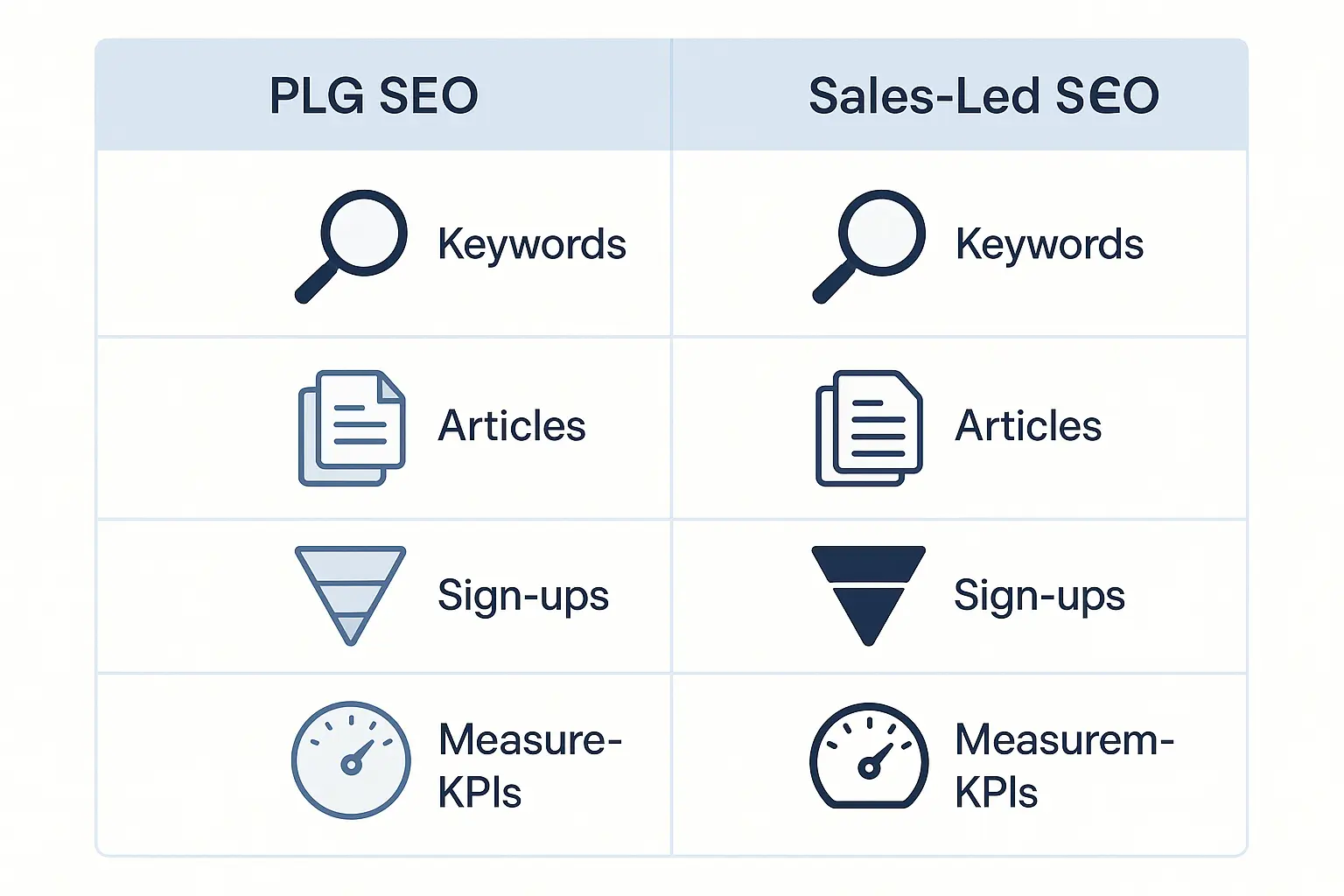
Conversion Goal: The Qualified Demo Request
The primary conversion for sales-led SEO is a demo request, a consultation, or a contact form submission. The CTAs are “Request a Demo,” “Talk to Sales,” or “Get a Custom Quote.” The goal is to hand off a warm, informed lead to the sales team.
The Hybrid Model: When Worlds Collide
In reality, most SaaS companies aren’t purely one or the other. Many PLG companies have sales teams to handle enterprise deals (think Slack Enterprise Grid), and many sales-led companies offer free trials to get users in the door.
This is where your agency can provide immense value. A hybrid SEO strategy uses both playbooks:
-
Top-of-Funnel: Use PLG-style, problem-focused content to attract a wide audience of potential users.
-
Bottom-of-Funnel: Use sales-led-style, comparison-focused content to capture high-intent buyers ready for a demo.
This integrated approach allows your client to capture the entire spectrum of potential customers, from the individual user trying to solve a small problem to the VP evaluating enterprise-wide solutions.
Why This Matters for Your Agency
Ignoring a client’s go-to-market model is a recipe for churn. If you drive thousands of “how-to” blog readers to a company that only cares about enterprise demo requests, you’ve failed—even if the traffic numbers look great.
By aligning your SEO strategy with their business model, you transform your agency from a vendor into a growth partner. You’re not just delivering keywords and links; you’re delivering the right kind of growth that fuels their entire business.
Building this specialized expertise for different SaaS models can be a challenge for many agencies. That’s why partnering for white-label SEO execution can be a powerful way to deliver sophisticated, tailored strategies for your clients without building an entire specialist team in-house. You maintain the client relationship and strategic oversight while leveraging expert execution behind the scenes.
Frequently Asked Questions (FAQ)
What exactly is Product-Led Growth (PLG)?
Product-led growth is a go-to-market strategy where the product itself is the main driver of customer acquisition, conversion, and expansion. Instead of a sales team convincing people to buy, the company makes it easy for users to sign up, find value, and decide to upgrade on their own.
How do I know if my client is PLG or Sales-Led?
The easiest way is to look at their website’s main call-to-action. Is it “Sign up for free” (likely PLG) or “Request a Demo” (likely sales-led)? You can also ask them: “Is your primary growth engine getting users to try the product themselves, or is it your sales team closing deals?”
Can a company be both PLG and Sales-Led?
Absolutely. This is called a hybrid model. Many successful SaaS companies, like Asana and HubSpot, start with a strong PLG motion to acquire users and then layer on a sales team to identify and close larger, complex enterprise accounts within that user base.
Which model is “better” for SEO?
Neither is “better”—they are just different. PLG strategies typically allow for much higher traffic volume and a broader keyword footprint. Sales-led strategies target lower traffic but much higher-value conversions. The “better” strategy is the one that aligns with the client’s business goals.
How does this affect link building?
It has a huge impact. For PLG, link building can focus on promoting helpful content and free tools to a broad audience through digital PR and resource page placements. Sales-led link building, by contrast, is more targeted. The focus shifts to gaining mentions in high-authority industry publications, guest posts on partner blogs, and placement in “best of” software roundups.
Your Strategy Starts with a Question
The next time you onboard a SaaS client, don’t just start with a keyword list. Start with a question: “Are we attracting users or buyers?”
The answer will define everything that follows. It will shape your keyword strategy, guide your content creation, and determine what success looks like. By mastering the nuances of PLG and sales-led SEO, you’re not just optimizing websites—you’re architecting growth engines that deliver real business impact for your clients.