

Imagine you just signed a multi-location plumber or a real estate agency covering 50 different neighborhoods, and they want to dominate local search. Your team stares back at you, a mix of excitement and dread. The strategy is clear—create a unique, optimized page for every single service area—but the execution is a logistical nightmare.
How do you write 50 (or 500) pages that are genuinely unique, valuable, and not just find-and-replace copies of each other? The traditional approach of hiring writers to manually research and craft each page is slow, expensive, and often results in thin, uninspired content that Google’s algorithm sees right through.
This operational bottleneck is where most agencies get stuck. But what if you could transform this challenge from a manual grind into a strategic, scalable system?
Enter the Hyperlocal Content Flywheel: a modern workflow that combines real-time data, smart templates, and AI to create high-quality, unique neighborhood pages at a scale previously unimaginable.
The Old Way: Running on the Manual Content Treadmill
For years, the standard playbook for creating location pages looked something like this:
- Create a basic template.
- Assign a writer a list of neighborhoods.
- The writer spends hours Googling things like ‘parks in Northwood’ or ‘best coffee shops in Lakeside.’
- They paraphrase information from Wikipedia, Yelp, and other blogs.
- Repeat 49 times, with diminishing enthusiasm and quality.
This ‘manual treadmill’ isn’t just inefficient; it’s fundamentally flawed. The content quickly becomes repetitive, is outdated the moment it’s published, and lacks any real, differentiating value. You’re essentially telling Google the same thing 50 different ways, which is a recipe for being ignored.
The Hyperlocal Content Flywheel flips this model on its head. It’s not about writing pages one by one; it’s about building an engine that generates them.
Deconstructing the Flywheel: The Three Core Components
Think of the flywheel as a system of three interconnected gears. When they work in unison, they create unstoppable momentum.
1. The Data Engine: Real-Time APIs
The heart of the flywheel is unique, structured data. Instead of manually scraping websites, this system plugs directly into Application Programming Interfaces (APIs). Think of an API as a secure messenger that lets different software programs share specific, up-to-the-minute information.
Instead of a writer Googling ‘population of downtown,’ the system makes an API call to a public census database. Rather than guessing the best local restaurant, it pulls real-time ratings from the Yelp or Google Maps API.
Common data sources include:
- Geographic Data: Walk Score, Transit Score, school district ratings.
- Lifestyle Data: Yelp, Foursquare, or Google Maps for top-rated restaurants, parks, and gyms.
- Market Data: Public census data for demographics, or real estate APIs for median home prices and market trends.
- Client Data: Your client’s own internal data, like completed jobs in a specific zip code or customer testimonials from a certain neighborhood.
This data-first approach is the game-changer. Research shows that 88% of consumers trust online reviews as much as personal recommendations. By programmatically pulling in review data or highlighting top-rated local spots, you embed trust and real-world value directly onto the page. Each page is no longer just about a neighborhood; it becomes a living, data-rich resource for it.
2. The Content Framework: Your Strategic Blueprint
This isn’t your old ‘fill-in-the-blank’ template. The Content Framework is a sophisticated blueprint that defines the narrative and structure of each page, ensuring every piece of data serves a purpose. It’s where human strategy guides AI-powered execution.
For example, a framework for a real estate agency’s neighborhood page might look like this:
H1: [Neighborhood Name]: A Local’s Guide to Homes, Schools, and Lifestyle
Intro: An AI-generated paragraph using demographic data to frame the neighborhood’s unique character (e.g., ‘A vibrant, walkable hub for young professionals…’ vs. ‘A quiet, family-friendly suburb with top-rated schools…’).
Data Snapshot (Table):
- Walk Score®: [Data from API]
- Median Home Price: [Data from API]
- Top-Rated High School: [Data from API]
Lifestyle & Amenities: An AI-written section using Yelp data to describe the local scene, like ‘Grab your morning coffee at [Top-Rated Cafe] before taking a stroll through [Highest-Rated Park].’
Market Insights: An AI-generated summary of real estate trends using market data.
CTA: A call-to-action to view listings in that specific neighborhood.
This framework ensures consistency in quality while allowing the unique data for each neighborhood to create a distinct, valuable page. This is a core part of a deep dive into local SEO strategies, as it directly addresses user intent with tailored information.
3. The Generation Engine: AI as Your Super-Writer
This is where the process comes to life. The Generation Engine takes the structured data from the APIs (Component 1) and pours it into your strategic Content Framework (Component 2). A Large Language Model (LLM), like GPT-4, then acts as a ‘super-writer’ to weave that data into natural, readable prose.
The prompt isn’t a simple ‘write an article about Northwood.’ It’s far more sophisticated:
‘Using the following data points for the neighborhood of ‘Northwood’—{walkscore: 88, toppark: ‘Riverwood Park’, medianprice: ‘$545,000’, dominantdemographic: ‘Young Families’}—write a 200-word introduction that positions it as an ideal place for families who value outdoor activities and community. Mention [Top Park] by name and highlight the walkability.’
This process is repeated for every section of every neighborhood page. This is a powerful application of our guide on AI in SEO, moving beyond simple content generation to a sophisticated, data-integrated workflow.

The Full Workflow: From Strategy to Scale
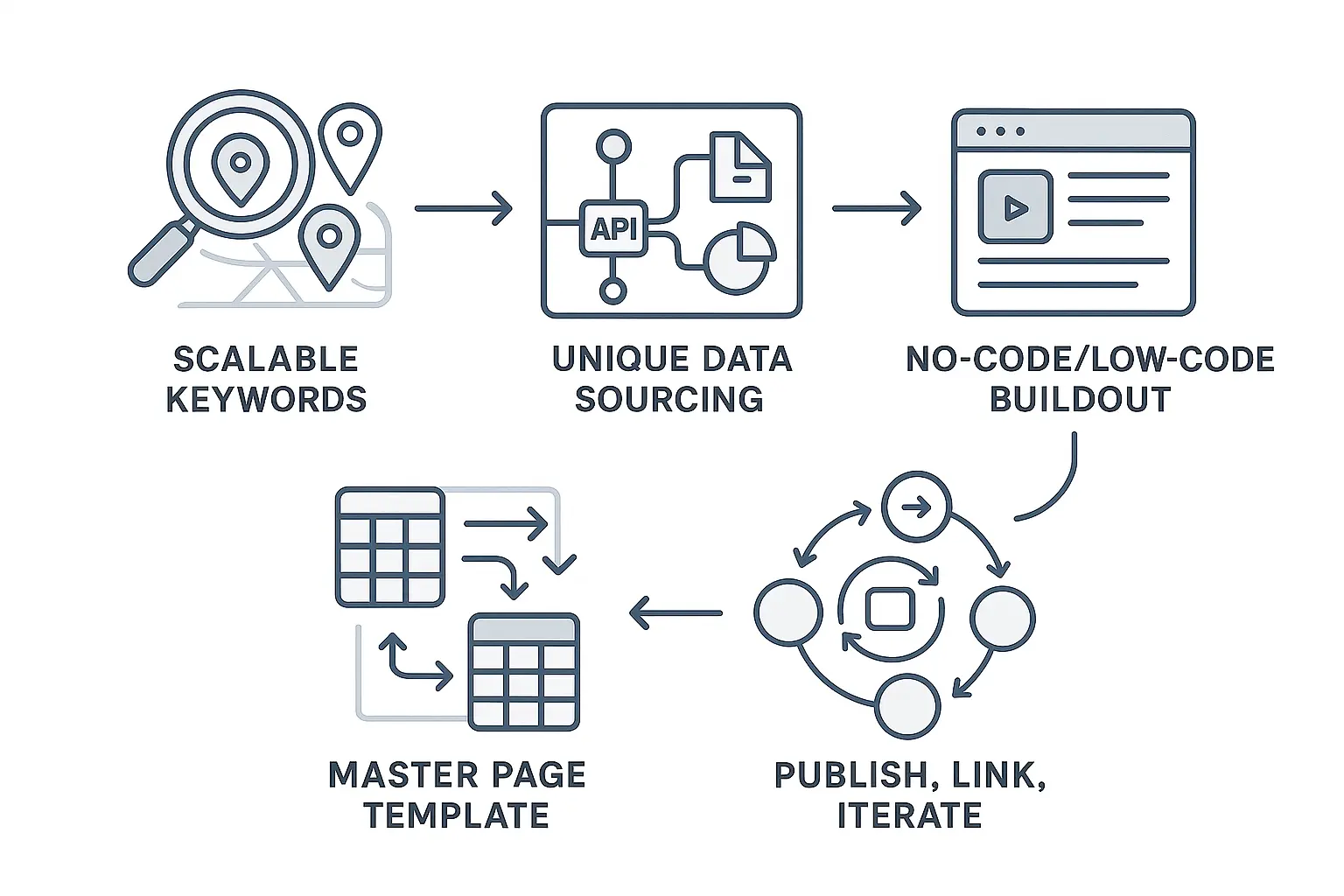
Here’s how these components come together in a repeatable, four-step process.
-
Foundation: Start with strategic keyword and location research to identify your target areas and what users are searching for (e.g., ‘plumbers in lakeside’ vs. ’emergency plumber 33461′).
-
Integration: Identify the most valuable data sources for your client’s industry and integrate the necessary APIs. A roofer needs different data (e.g., weather patterns, common roof types) than a real estate agent (e.g., school districts, market trends).
-
Generation: Create your master Content Framework and run the generation engine. This can produce hundreds of unique, data-rich draft pages in a fraction of the time it would take a human writer.
-
Human Review: This final step is crucial; it separates high-quality programmatic SEO from low-quality spam. An editor or strategist reviews the AI-generated pages to refine the tone, add specific brand messaging, check for factual inconsistencies, and provide that final layer of polish. This ensures the content meets quality standards before it ever goes live.
Why the Flywheel Approach Is a Win for Agencies
The impact of ‘near me’ searches, which have grown over 500% in recent years, can’t be overstated. The flywheel is built to capture this intent at scale.
- Unmatched Scalability: Go from servicing 10 locations to 200 without your operational costs spiraling out of control.
- True Uniqueness: Because each page is built on a unique set of real-time data points, you sidestep duplicate content penalties and provide genuine value that competitors can’t easily replicate.
- Evergreen Authority: API-driven content can be periodically refreshed, keeping pages up-to-date and establishing your client as the definitive resource for their service areas. Providing the most accurate, current information is critical, especially since 76% of local searchers visit a physical store within 24 hours.
- Strategic Focus: By automating the most laborious part of content creation, you free up your team to focus on what matters most: high-level strategy, client relationships, and driving measurable growth. This is how you expand your agency’s service offerings profitably.

FAQ: Your Hyperlocal Flywheel Questions Answered
Is this just ‘spammy’ auto-generated content?
Not at all. The key difference lies in intent and value. Spammy auto-generated content combines scraped text with keyword stuffing to trick algorithms. The Hyperlocal Flywheel, in contrast, uses structured, factual data to create genuinely useful resources for human readers—exactly what search engines want to reward.
Won’t all the pages sound the same?
While the structure is consistent, the content is anything but. The unique data points for each location—different Walk Scores, demographics, top-rated businesses, and market trends—naturally lead the AI to produce distinct narratives. A page for a dense, urban neighborhood will read very differently from one about a sprawling, rural service area.
Isn’t this technically difficult to set up?
Yes, building a system like this from scratch requires development expertise. It involves sourcing data, integrating multiple APIs, writing scripts for the generation engine, and creating a robust review process. It’s a significant R&D investment, which is why most agencies haven’t been able to implement it on their own.
How do you keep the content from becoming outdated?
This is one of the biggest advantages over manually written content. Because the pages are connected to live data APIs, you can build routines to automatically refresh the content on a set schedule (e.g., quarterly or annually) to pull in new data, ensuring the pages remain fresh, accurate, and valuable over time.
From Manual Labor to a Strategic Growth Asset
In today’s competitive landscape, the agencies that win are those that leverage technology to move faster, deliver more value, and operate more efficiently. The Hyperlocal Content Flywheel is more than just a content creation tactic; it’s a fundamental shift in how to approach local SEO.
It transforms a time-consuming cost center into a scalable, strategic asset that drives tangible results for your clients. By moving beyond the manual treadmill, you can finally deliver on the promise of local domination, no matter how many neighborhoods your client wants to conquer.