

“Why are we losing deals to Competitor X?”
If you manage marketing for a SaaS client, chances are you’ve heard this question. In a crowded market, potential customers aren’t just evaluating your client’s software in a vacuum—they’re actively comparing it against alternatives.
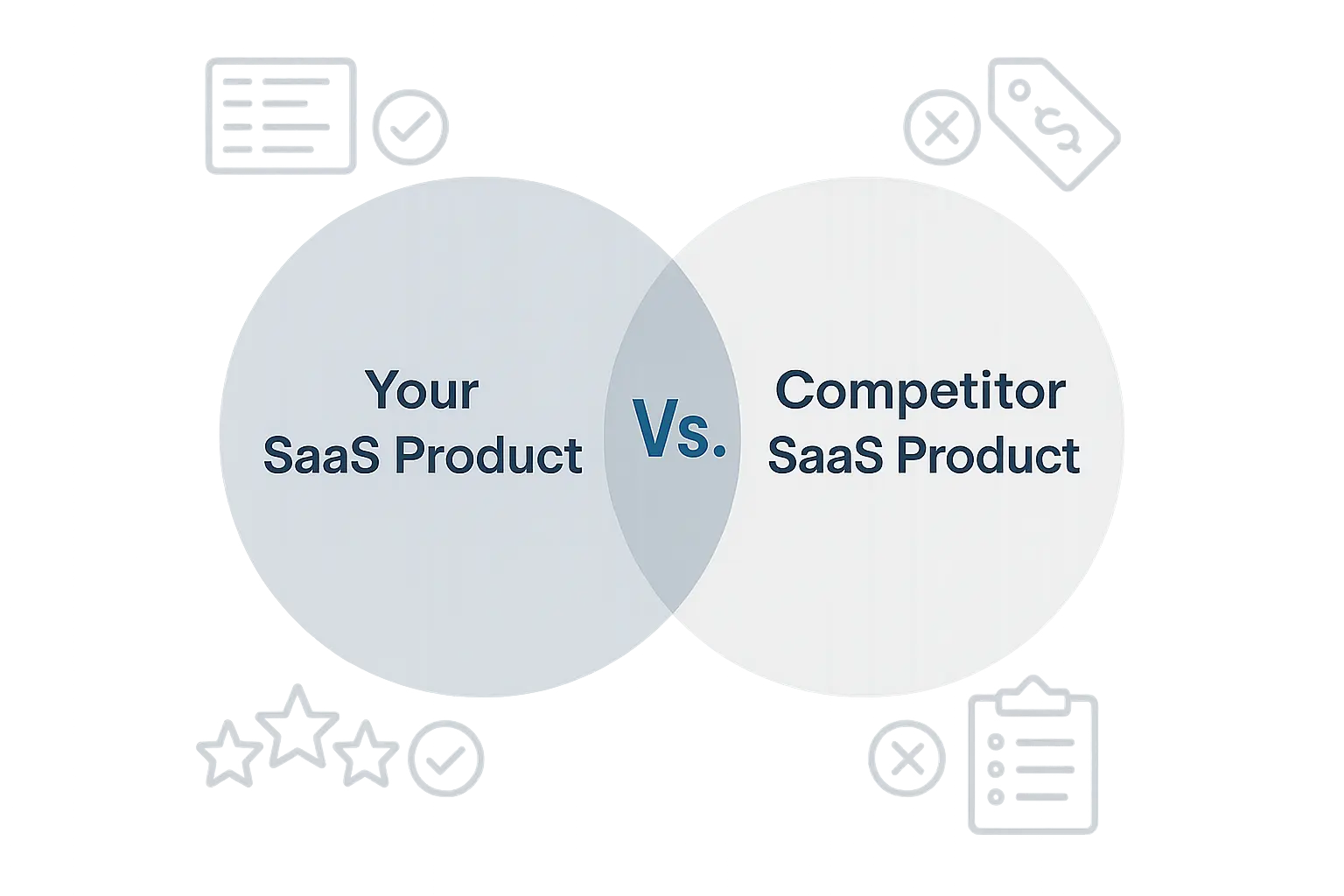
They’re typing “[Your Client’s Brand] vs. [Competitor Brand]” into Google right now. What do they find? A random third-party review? A biased Reddit thread? Or a carefully crafted page on your client’s website that controls the narrative and guides them toward a demo?
This is the power of a competitor comparison page, often called a ‘Vs.’ page. It’s one of the most potent, bottom-of-funnel assets you can build. And today, we’re giving you the blueprint to build one that converts.
Why ‘Vs.’ Pages are a Secret Weapon for SaaS Growth
In the past, the sales team owned the competitive conversation. Today, that conversation starts long before a prospect ever speaks to a human. Research shows a staggering 71% of B2B buyers actively seek out comparison content during their purchasing journey.
‘Vs.’ pages aren’t just good SEO; they’re smart sales strategy. They work because they:
-
Intercept High-Intent Traffic: You capture prospects at that critical moment of decision.
-
Frame the Conversation: You get to define the most important criteria for comparison, highlighting your client’s unique strengths.
-
Build Trust Through Transparency: By acknowledging competitors and addressing differences head-on, you position your client as a confident, knowledgeable resource.
-
Accelerate the Sales Cycle: Buyers arrive at the demo call already understanding your client’s key differentiators, leading to more productive conversations.
Think of it as the ultimate sales enablement tool, working 24/7 to turn consideration into conversion.
The Blueprint: Anatomy of a High-Converting ‘Vs.’ Page
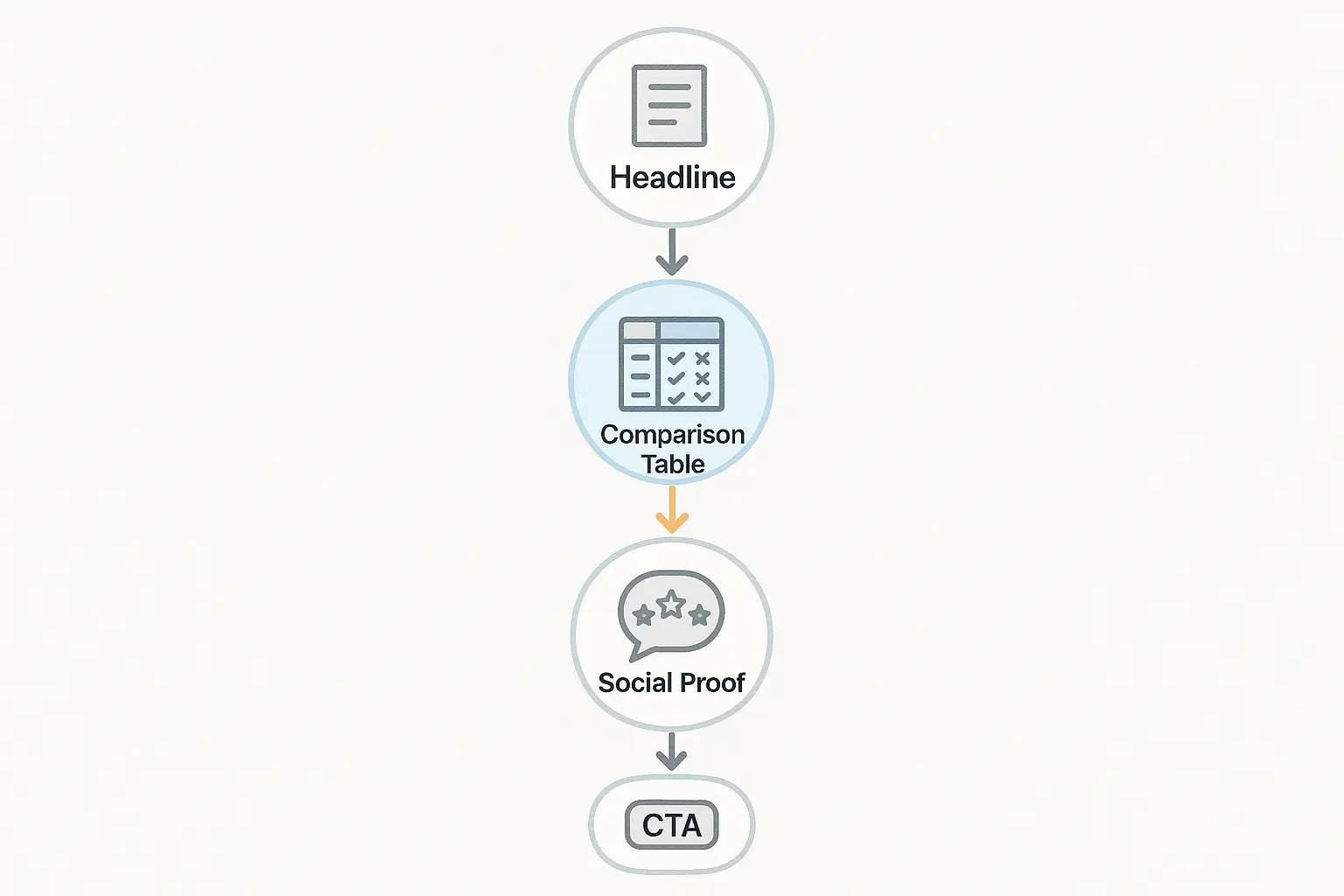
Building a ‘Vs.’ page that merely lists features is a missed opportunity. A great one tells a story and helps the reader choose with confidence. Here’s how to structure it, section by section.
Section 1: The Hero—Nail the First Impression
You have five seconds to assure visitors they’re in the right place. The goal here is clarity, not cleverness.
-
Headline: State the comparison directly. (e.g., “Why [Your Client’s Brand] is the Best Alternative to [Competitor Brand]”)
-
Sub-headline: State your core value proposition immediately. What is the single biggest reason a customer should choose your client? (e.g., “Get enterprise-level automation without the enterprise-level price tag.”)
-
Call-to-Action (CTA): Place a clear, compelling CTA above the fold. “Get a Demo” or “Start a Free Trial” works well.
-
Visuals: Simple logos of both brands side-by-side create instant recognition.
Section 2: The At-a-Glance Comparison Table
Today’s buyers are busy. They want scannable, easily digestible information. A comparison table is non-negotiable. It provides a quick verdict and anchors the rest of the page.
Focus on the categories that matter most to the customer, not just the features your client has.
-
Key Features: Choose the 5-7 most critical features for your target audience.
-
Ideal Customer: Who is each platform truly built for? (e.g., “Startups & SMBs” vs. “Large Enterprises”)
-
Pricing Model: Is it per-user, usage-based, or a flat fee?
-
Support: What level of support can customers expect?
-
Ratings: Include a G2 or Capterra rating to add third-party validation.
Use simple icons like checkmarks and X’s to make it visually clear where your client wins.
Section 3: The Deep Dive—From Features to Solutions
The table gives the “what”; this section explains the “why.” This is where you address deeper pain points. In fact, 67% of B2B buyers say it’s crucial for vendors to demonstrate a deep understanding of their specific business pains.
For each key feature where your client excels, create a dedicated sub-section.
-
Use a Pain-Driven Headline: Instead of “Reporting Features,” try “Tired of Clunky Reports That Don’t Show ROI?”
-
Explain the Benefit: Don’t just say, “We have automated reporting.” Say, “With our automated reporting, you can build custom dashboards in minutes and share real-time results with stakeholders, saving your team hours every week.”
-
Use Visuals: Include screenshots or short GIFs of the feature in action.
Section 4: The Social Proof Stack—Let Customers Do the Selling
You can say your client is the best, but it’s far more powerful when their customers say it. This section is where you build overwhelming proof.
-
Direct Comparison Testimonials: The holy grail is a quote from a customer who switched from the competitor. (e.g., “We used [Competitor Brand] for two years, but the switch to [Your Client’s Brand] unlocked the insights we needed to actually grow.”)
-
Ratings and Badges: Showcase G2, Capterra, and TrustRadius badges prominently.
-
Customer Logos: Display logos of well-known companies that use your client’s software.
Stack these elements together to create an undeniable wall of trust.
Section 5: The “Who Is It For?”—Honesty Builds Trust
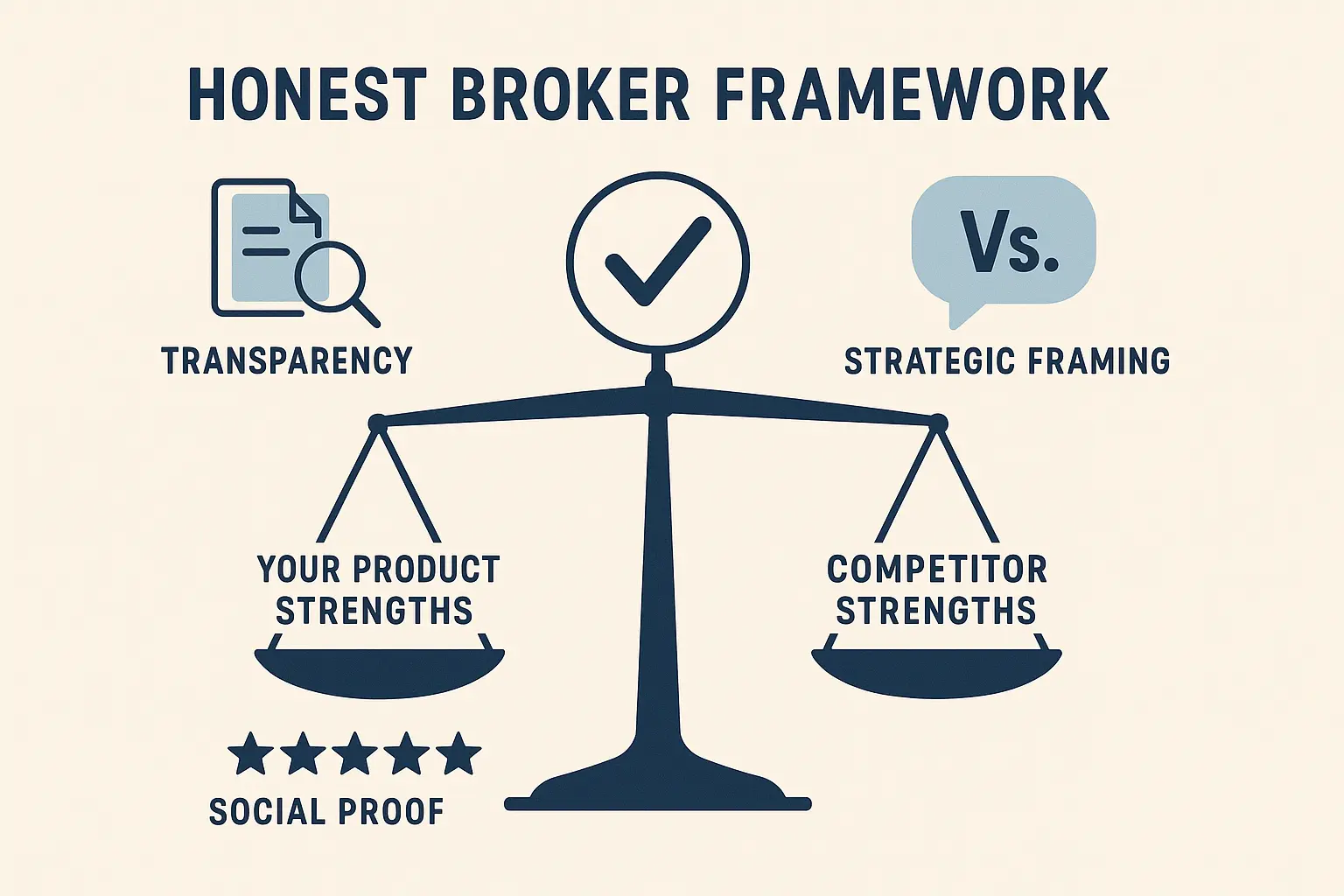
This is a pro-level move that builds immense credibility. Be honest about who each product is best for. It shows you understand the market and are more interested in finding the right fit than just making a sale.
[Competitor Brand] is a good fit for… “Solo freelancers or hobbyists who need a simple, free tool for basic tasks.”
[Your Client’s Brand] is built for… “Growing agencies and in-house marketing teams who need to manage multiple clients and prove ROI at scale.”
This technique helps disqualify poor-fit leads and makes ideal customers feel more confident they’ve found the right solution.
Section 6: The Final CTA—Close with Confidence
End the page with one last, powerful call to action. Don’t just repeat the button from the hero section. Create a dedicated block that summarizes the core choice the visitor is making.
-
Restate the Value Prop: “Ready to see how [Benefit #1] and [Benefit #2] can transform your workflow?”
-
Reinforce with Social Proof: Add a small testimonial or a “Trusted by X companies” line.
-
Provide a Clear Next Step: “Book a Personalized Demo” or “Explore Our Pricing.”
Common Traps to Avoid When Building ‘Vs.’ Pages
-
Trap 1: Talking Trash. Never bad-mouth the competition. It comes across as unprofessional and insecure. Instead, take the high road. Acknowledge their strengths before gracefully pivoting to your client’s superior approach to solving the customer’s core problem.
-
Trap 2: Creating a Feature-Dump. A long, undifferentiated list of features is overwhelming and unhelpful. The goal is not to list everything your client’s product does, but to connect the right features to the right customer problems.
-
Trap 3: Hiding the Page. Don’t just publish the page and hope for SEO traffic. A high-converting ‘Vs.’ page is a sales asset. Link to it from the main navigation (e.g., under a “Why Us?” dropdown). Empower the sales team to use it in their email sequences. Target competitor keywords with paid ads that drive to the page. This is a central part of a holistic omnichannel SEO strategy.
Scaling High-Impact SEO for Your SaaS Clients
Creating one great ‘Vs.’ page is a win. Creating a series of them for every major competitor, keeping them updated, and optimizing them for conversions is how you build a real moat for your client. This takes dedicated research, sharp copywriting, and consistent analysis.
For many agencies, this level of detailed work across multiple clients can be a huge operational drag. The key is having a system. A repeatable process for competitor analysis, content briefing, and performance monitoring is essential. Doing this effectively requires a robust white-label SEO execution process that can handle the scale without sacrificing quality.
Frequently Asked Questions (FAQ)
Should we create a ‘Vs.’ page for every competitor?
Start with the top 2-3 competitors that come up most often in sales calls or have the highest search volume for comparison keywords. You can expand from there.
What if our client is missing a feature the competitor has?
Be honest. Address it directly. For example: “While [Competitor Brand] offers [Feature X], we’ve focused our resources on perfecting [Your Client’s Core Feature] because we know it’s what drives the most value for teams like yours.” Turn a potential weakness into a strength of focus.
How do we get traffic to this page?
Beyond SEO, link to it from relevant blog posts, add it to your website’s footer or main navigation, and have your sales team use it in their outreach. You can also run targeted Google Ads campaigns for “[competitor name] alternatives” keywords.
Is it okay to mention the competitor’s pricing?
Yes, if their pricing is public. It’s a key decision-making factor. Frame the comparison around value, not just cost. If your client is more expensive, justify it by highlighting the additional ROI, support, or advanced features they provide.
Your Agency’s Next Move
A well-executed ‘Vs.’ page is more than just a piece of content. It’s a strategic asset that captures bottom-of-funnel demand and directly fuels the sales pipeline. It meets buyers exactly where they are—in the critical final stages of their decision-making process—and provides the clarity they need to choose your client with confidence.
You now have the template to build these conversion machines for your SaaS clients. By applying this structure, you can create pages that not only rank but also drive meaningful business results.
Ready to explore how automation can help you scale this kind of high-impact work across all your clients? Learn more about our AI-powered SEO automation for agencies.