
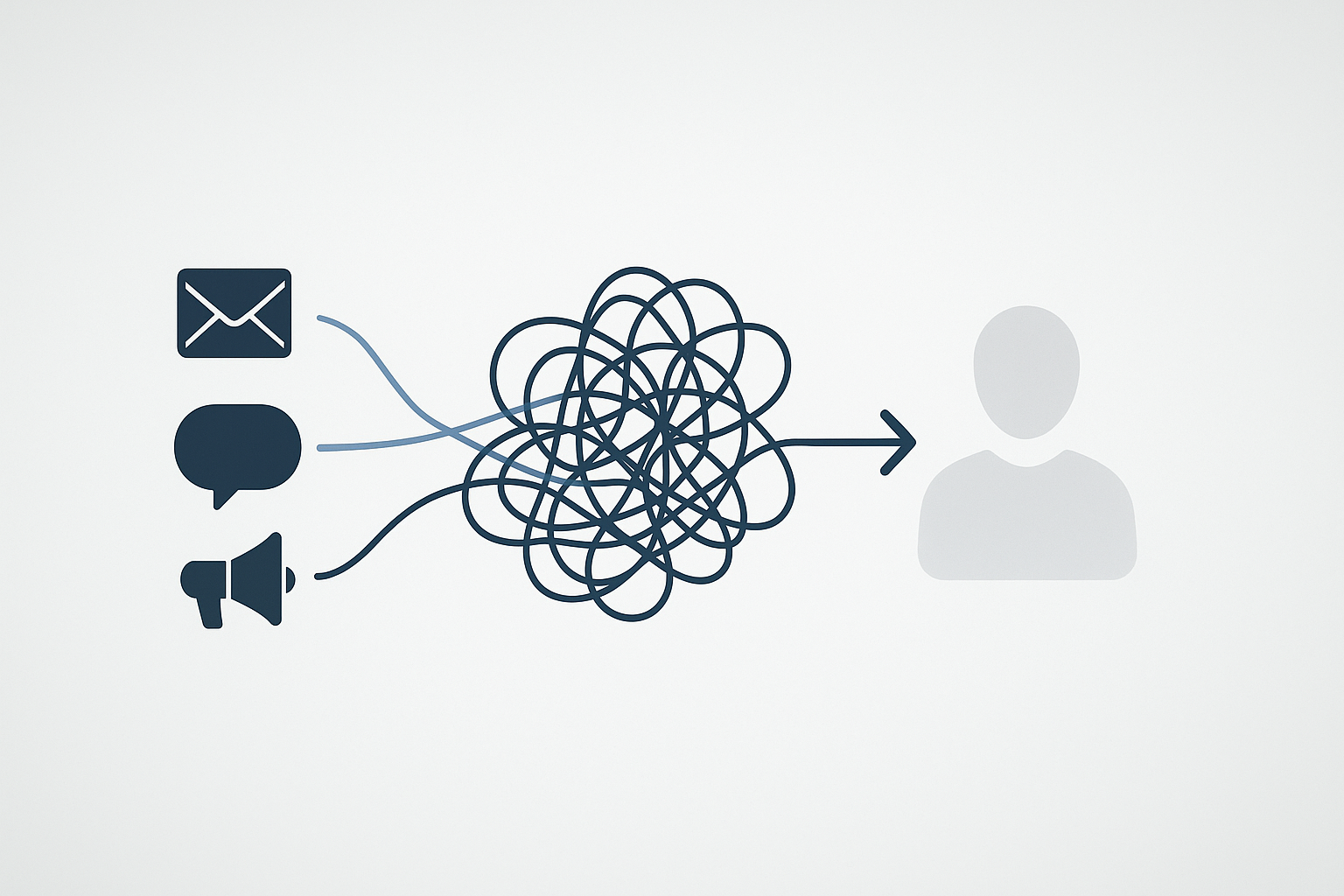
Imagine you just signed up for a newsletter from an exciting new brand. An hour later, you get a “Welcome!” email with a 10% discount. The next morning, a text message pings with a 24-hour flash sale for 20% off. That afternoon, a Facebook ad follows you around, offering a “Buy One, Get One Free” deal.
It’s a bit confusing. Which offer is best? Does this company even know you just joined?
This kind of chaotic experience is known as campaign fragmentation, and it’s a fast track to audience burnout. It’s more than an annoyance for your customers—it’s a silent revenue killer. While most businesses track obvious metrics like unsubscribe rates, they often miss the massive financial drain caused by a disconnected marketing strategy.
The good news is that you can measure this impact—and once you do, you can fix it.
What is Campaign Fragmentation, Really?
Campaign fragmentation isn’t just about sending too many emails. It’s about sending uncoordinated, conflicting, or context-less messages across different channels. It happens when your email team, social media team, and paid ads team all run separate plays from different playbooks.
Think of it like this: a cohesive marketing strategy is a symphony orchestra, where every instrument plays its part in harmony to create a beautiful piece of music. Fragmentation is the sound of the entire orchestra warming up at once—a noisy, jarring mess that makes people want to leave the room.
This chaos doesn’t just frustrate your audience; it actively erodes trust and makes your brand seem disorganized. In fact, research suggests that nearly 70% of consumers are less likely to purchase from a brand after receiving inconsistent messaging. They start to tune you out, their engagement plummets, and eventually, they leave for good.
Beyond Unsubscribes: A Model for Measuring the True Financial Impact
To understand the real cost, you need to look beyond surface-level metrics. Here’s a framework to quantify the revenue you’re losing to burnout, broken down into three key areas.
Metric 1: Declining Engagement Cohort Analysis
The first sign of burnout isn’t an unsubscribe—it’s silence. Your audience simply stops opening emails, clicking links, and interacting with your content. To measure this, you can compare audience cohorts.
A cohort is simply a group of people who started their journey with you at the same time (e.g., everyone who subscribed in May).
How to calculate the cost:
- Identify a “Fragmented Cohort”: A group of subscribers who were exposed to a series of disconnected campaigns.
- Identify a “Control Cohort”: A group from a similar time period who received a more cohesive, logical sequence of messages.
- Measure the Engagement Gap: Track the average open rate and click-through rate for both cohorts over 60-90 days. You’ll almost always see the fragmented cohort’s engagement decay much faster.
- Calculate the Cost:
- Engagement Drop = (Engagement Rate of Control Cohort – Engagement Rate of Fragmented Cohort)
- Engagement Cost = Engagement Drop x Number of People in Cohort x Value per Engagement
A 5% drop in engagement across a list of 10,000 subscribers can easily represent thousands of dollars in lost potential revenue.
Metric 2: The Unsubscribe Velocity Rate (UVR)
Instead of just counting how many people unsubscribe per month, look at when they do it. The Unsubscribe Velocity Rate (UVR) measures the speed at which people leave immediately following a marketing push.
A fragmented campaign often causes a sharp, immediate spike in unsubscribes. While your overall monthly rate might seem stable, these sudden bursts are a direct sign of burnout.
How to calculate the cost:
- Establish Your Baseline: Calculate your average daily unsubscribe rate during a normal period.
- Measure the Spike: After a fragmented campaign push, measure the unsubscribe rate for the next 3-5 days.
- Calculate the Cost:
- Excess Unsubscribes = (Spike UVR – Baseline UVR) x Number of Days
- Churn Cost = Excess Unsubscribes x Average Customer Lifetime Value (CLV)
This formula reveals the immediate revenue walking out the door. The erosion of trust from these campaigns doesn’t just impact your email list; it weakens your brand’s overall authority. Consistent messaging is a vital part of authority & trust-signal reinforcement, helping customers and AI systems alike understand your value proposition.
Metric 3: Customer Lifetime Value (CLV) Degradation
This is the most critical, and most overlooked, cost of fragmentation. Burned-out customers don’t just stop engaging—they stop buying and don’t stick around, causing their lifetime value to crater.
A customer who feels understood and respected is far more likely to become a repeat buyer and a loyal advocate. In contrast, someone who feels spammed and confused will make one or two transactional purchases (if any) and then disappear.
How to calculate the cost:
- Segment Your Audience: Create segments based on engagement levels—highly engaged, moderately engaged, and at-risk (low engagement).
- Calculate CLV per Segment: Determine the average CLV for customers in each group. The difference is often staggering.
- Identify Cohort Movement: Track how many customers from your “Fragmented Cohort” move from engaged to at-risk status compared to your “Control Cohort.”
- Calculate the Cost:
- CLV Drop = (CLV of Engaged Segment – CLV of At-Risk Segment)
- Total CLV Lost = Number of Customers Who Dropped Engagement x CLV Drop
This calculation reveals the long-term financial damage. You’re not just losing a single sale—you’re losing years of potential revenue from a once-loyal customer.
Putting It All Together: Your Burnout Cost Formula
By combining these three metrics, you can build a dashboard to track the total hidden cost of campaign fragmentation:
Total Burnout Cost = Engagement Cost + Churn Cost + Total CLV Lost
This single number transforms an abstract problem into a concrete business metric that your team can act on.
Beyond the Numbers: The Unseen Costs of Chaos
The financial impact is significant, but other costs are harder to quantify yet just as damaging:
- Damaged Brand Reputation: Inconsistent messaging makes your brand look unprofessional and untrustworthy.
- Wasted Marketing Spend: Every dollar spent on a fragmented campaign that pushes a customer away is a dollar wasted.
- Confusing AI Systems: Today, discovery is increasingly driven by AI like Google’s AI Overviews and ChatGPT. When your signals are fragmented, you’re not just confusing customers; you’re creating a muddled identity that these systems struggle to interpret. A clear narrative is essential for semantic content optimization, ensuring that machines understand who you are and what you offer.
Frequently Asked Questions (FAQ)
-
What’s the difference between audience fatigue and audience burnout?
Fatigue is temporary. A subscriber might be tired of a specific promotion but remains open to hearing from you later. Burnout is a more permanent state of disillusionment where the customer has decided your brand isn’t relevant or trustworthy and has mentally checked out for good. Fragmentation is what causes burnout, not just fatigue. -
How often is “too often” to contact my audience?
It’s less about frequency and more about relevance and coherence. You could contact a customer daily if every message adds value and feels like a logical step in their journey. Conversely, you could burn out a customer with just three contradictory messages in a single week. -
Can I reverse audience burnout?
It’s difficult but not impossible for those who haven’t unsubscribed. Reversing burnout requires a re-engagement campaign focused entirely on rebuilding trust. This involves acknowledging the issue (even implicitly), simplifying your message, and providing pure value with no immediate ask. -
Where’s the best place to start fixing campaign fragmentation?
Start by auditing your core digital assets to ensure they tell a unified story. Your website should be your brand’s source of truth. An AI-ready website architecture provides the foundation for a cohesive customer journey, ensuring every touchpoint—from an ad to an email to a landing page—reinforces the same core message.
Your Next Step: From Measurement to Mastery
Calculating the hidden cost of audience burnout is the crucial first step toward fixing it. It moves the conversation from “I feel like our marketing is a bit messy” to “Our fragmented campaigns cost us $X in revenue last quarter.”
With this data, you can begin building a cohesive strategy where every message, piece of content, and customer interaction tells a single, unified story. This approach not only delights customers and rebuilds trust but also builds a clear, authoritative presence for the AI systems shaping the future of brand discovery.