

Imagine your client, a successful roofing contractor, wants to dominate the search results not just in their home city, but in the 50 surrounding suburbs and neighborhoods. While the potential is massive, your team is facing a monumental problem: creating 50 unique, high-quality landing pages.
The old way was simple: copy, paste, and replace “Oak Brook” with “Naperville.” But today, that tactic is a surefire way to get your client’s pages filtered by Google’s Helpful Content Update (HCU), which targets scaled content that doesn’t offer real value.
So how do you capture that hyperlocal opportunity without creating an unmanageable workload or getting penalized? The answer lies in a powerful, often misunderstood strategy: Programmatic SEO. When done right, it’s less about automation and more about delivering precision at scale.

Why “Near Me” Is Your Agency’s Biggest Opportunity
The power of this approach comes from a fundamental shift in how people find local services. Vague searches have been replaced by hyper-specific, high-intent queries, and the data makes a clear case.
According to Google, searches containing phrases like “near me” have skyrocketed by over 200% in recent years. This isn’t just a trend; it’s a permanent shift in user behavior.
Hubspot research confirms this, showing that a staggering 46% of all Google searches are for local information. Better yet, BrightLocal finds that 78% of those local mobile searches result in an offline purchase.
When someone searches for “emergency plumber in Lincoln Park,” they aren’t just browsing. They have a pipe bursting and their wallet out. By creating a dedicated page that speaks directly to that user in that neighborhood, you meet their exact need at the perfect moment. That’s the power you can unlock for your clients.
What is Programmatic SEO? (Hint: It’s Not About Spam)
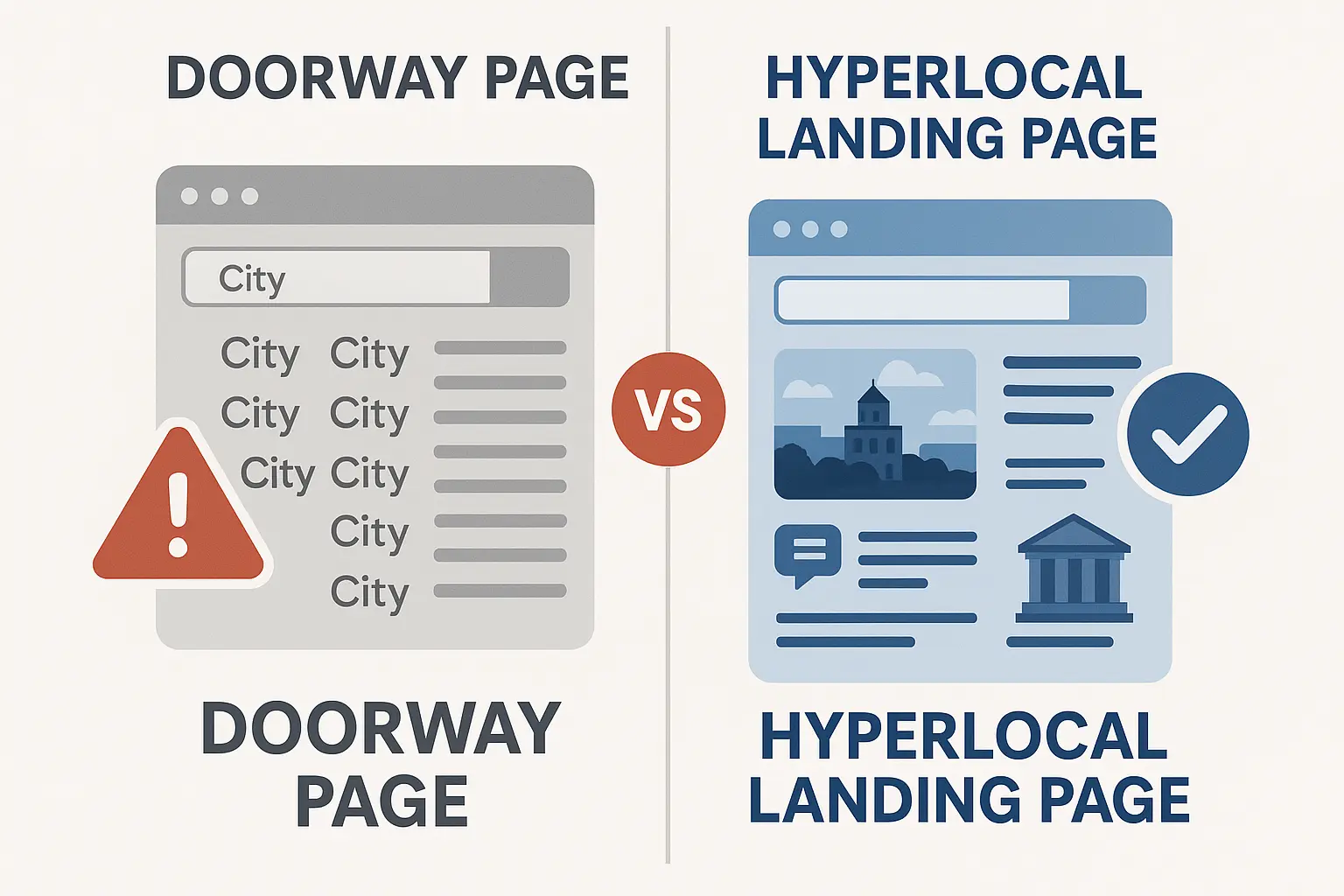
Let’s clear up a common misconception: Programmatic SEO isn’t about auto-generating thousands of low-quality, keyword-stuffed pages. It’s a framework for creating unique pages at scale by combining a master template with a structured database.
Think of it like a coffee shop. The espresso machine is your template. The process of pulling a shot is always the same. But the final drink—a latte, a cappuccino, a flat white—is unique because of the data inputs like steamed milk, foam, or a specific syrup.
Programmatic SEO works the same way. You build one high-quality page template and connect it to a database of unique local information. The system then “builds” a unique page for every location in your database.
The magic isn’t in the quantity of pages; it’s in the quality and relevance of the data you use to make each page distinct and genuinely helpful.
The Framework for Uniquely Helpful Hyperlocal Pages
Google’s biggest fear isn’t duplicate content—it’s useless content. The search engine doesn’t actively penalize sites for having similar pages; it filters them, showing only the most relevant version. Your job is to make every single page the most helpful resource for its specific location. Here’s how.
Step 1: Build Your Hyperlocal Data Schema
This is the most critical step, because your database is the engine that makes each page unique. Don’t just stop at {City Name} and {ZIP Code}. To create truly valuable pages, you need to go deeper. Your data schema should be a rich spreadsheet of local identifiers.
Consider columns for:
- City / Town
- Neighborhood / District
- ZIP Code
- A well-known local landmark (e.g., “near Wrigley Field”)
- A major cross-street (e.g., “just off Michigan Avenue”)
- A local client testimonial and their first name (e.g., “Sarah from Naperville says…”)
- A link to a case study or photo from a job completed in that area
- Local-specific FAQs (e.g., “Do you handle ice dam removal for Lake Forest winters?”)
This database becomes your single source of truth, turning generic content into a locally resonant message.
Step 2: Design Your Master Value Template
With your data ready, you can build a single page template that integrates these unique elements seamlessly. This isn’t just about swapping out a word; it’s about weaving a local narrative.
Your template should include dynamic placeholders for:
- Page Title & H1: [Service] in [Neighborhood], [City] | [Brand Name]
- Introductory Paragraph: “For homeowners in [City] looking for reliable [Service], especially those living near the [Local Landmark], we offer…”
- Social Proof Block: Feature the [Local Testimonial] prominently. Nothing builds trust faster than a neighbor’s recommendation, and with 85% of consumers finding user-generated content (UGC) more influential than brand photos or videos, it’s a critical element.
- Visual Proof: Include a section for [Local Project Photos] to show you’ve actually worked in the area.
- Local Map Embed: A simple embedded map of the service area provides immediate visual relevance.
Step 3: Weave in Uniqueness to Add Value
This is where you make your pages bulletproof against claims of “thin” or “unhelpful” content. By combining the data points from your schema, you create a page that is measurably more valuable than a generic competitor’s page.
The goal is to pass the “local test.” Could this page have been written by someone who has actually worked in this neighborhood?
A page built this way wins every time because it answers the user’s spoken and unspoken questions:
- Do you serve my exact area? (Yes, we mention your neighborhood).
- Have you worked here before? (Yes, here’s a photo from a job we did).
- Are you trusted by my neighbors? (Yes, here’s a testimonial from someone local).
This approach transforms your programmatic SEO strategy from a liability into a powerful competitive advantage. It’s a scalable system for building trust, not just pages.
Frequently Asked Questions
Is programmatic SEO a “black hat” tactic?
Not at all. “Black hat” refers to tactics that deceive search engines. Programmatic SEO, when done correctly, is the opposite—it’s a method for efficiently creating genuinely helpful and relevant content for specific user queries. The intent is to serve the user, which is exactly what Google wants.
How many pages are too many?
There is no magic number. You can have 10,000 pages, and if every single one provides unique value to a user in that specific location, you are providing a good user experience. The problem is never the number of pages; it’s the lack of unique value on each page.
What kind of technical setup does this require?
Execution can range from simple to complex. For smaller projects, plugins for CMS platforms like WordPress are a viable option. Larger-scale operations often involve a custom script that pulls from a database (like Google Sheets, Airtable, or a SQL database) to generate static HTML pages or populate a headless CMS. The key is ensuring the underlying structure is sound before you begin, which makes a thorough technical SEO audit non-negotiable.
Can I use AI to help with this process?
Absolutely. AI-powered SEO tools can be a massive help in this framework. You can use AI to:
- Generate unique meta descriptions for each location.
- Rewrite paragraphs of your template to create multiple variations, adding another layer of uniqueness.
- Brainstorm a list of potential local landmarks or neighborhood-specific pain points to include in your data schema.
How does this fit into a white-label SEO service?
This framework is a perfect example of a scalable execution strategy that a white-label SEO partner can provide. This allows an agency to focus on client strategy and relationships while their partner handles the complex technical setup and data enrichment required to deploy hundreds of high-quality local pages under the agency’s brand.
From Scattered Pages to a Scalable Strategy
For agencies, the challenge isn’t just about getting results for one client in one location. It’s about building a process that can deliver those results predictably and profitably across your entire client portfolio.
Programmatic SEO, approached with a focus on value, is that process. It turns a logistical nightmare into a strategic asset, allowing you to serve hyperlocal intent at a scale that was previously impossible. You’re no longer just building pages; you’re building a network of digital storefronts, each one perfectly tailored to its community, waiting to welcome your client’s next customer.