
You’ve done it. You landed a meeting with a regional franchise that has 40 locations. The excitement is palpable—until the inevitable question lands on your desk: “Can you send over a proposal?”
Suddenly, the victory feels like a math problem from a nightmare. Do you charge per location? Does the 35th location in a quiet suburb really require the same effort as the first in a competitive downtown core? How do you price the foundational work that benefits all 40 stores at once?
If this scenario makes your palms sweat, you’re not alone. Pricing multi-location and franchise SEO is one of the biggest hurdles agencies face as they try to scale. Get it wrong, and you either leave money on the table or drown in unprofitable work. Get it right, and you unlock a new level of recurring revenue and agency growth.
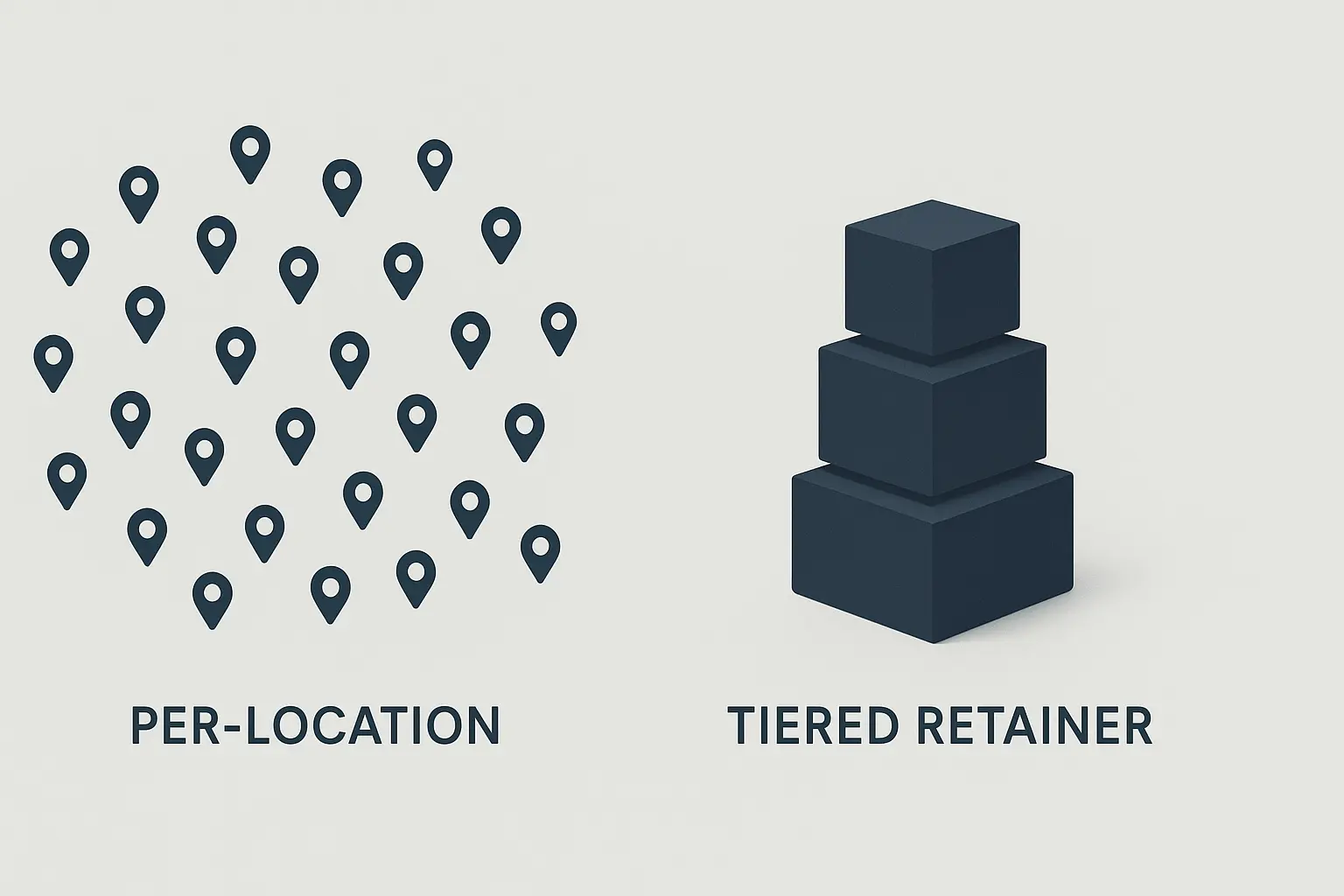
Let’s break down the two most common pricing models—per-location and tiered retainer—to help you build proposals that are fair, scalable, and, most importantly, profitable.
Why Franchise SEO Pricing Is a Unique Challenge
Before diving into the models, it helps to understand why this isn’t just a simple multiplication problem. The scale of the opportunity is massive. The United States is home to about 30% of the world’s franchise units, and the sector is projected to add over 15,000 new establishments in 2024 alone.
These businesses are desperate for local visibility. With 46% of all Google searches seeking local information, a franchise’s success hinges on showing up when a customer searches “pizza near me” or “oil change in [City Name].”
Here’s where the complexity kicks in for agencies:
-
The Demand for Localization is High: A staggering 81% of multi-location marketers say creating a localized strategy for each location is important. This isn’t a copy-and-paste job.
-
The Digital Footprint is Enormous: One study found that, on average, enterprise brands manage 107 social, review, and local pages per location. Multiply that by 40 locations, and you’re looking at managing over 4,000 digital assets.
This isn’t just about 40 Google Business Profiles. It’s about managing 40 unique community reputations, 40 different sets of local competitors, and 40 distinct customer bases—all under one cohesive brand strategy. Your pricing model has to account for both the shared, brand-level work and the individual effort each location requires.

The Two Dominant Pricing Models: A Head-to-Head Comparison
Most agencies structure their multi-location SEO proposals around two core models, each with its own pros and cons that impact everything from your sales pitch to your monthly reporting.
The Per-Location Pricing Model
This is the most straightforward approach: you charge a flat fee per location, per month. For example, you might charge $400/month per location. For a 40-location client, that’s a $16,000/month retainer.
Pros of the Per-Location Model:
-
Simplicity: It’s incredibly easy for both you and the client to understand. The math is clear.
-
Scalability: When the client adds a new location, you simply add another fee to the monthly invoice. When one closes, you remove it.
-
Transparency: The client sees a direct correlation between what they pay and the number of stores being serviced.
Cons of the Per-Location Model:
-
It Devalues Foundational Work: Major technical SEO fixes, brand-level keyword strategy, and content templates benefit all locations. With this model, it’s hard to charge appropriately for that high-value, shared effort.
-
It Can Lead to Price Commoditization: The conversation shifts from the value of your strategy to the cost per unit, leaving you more vulnerable to competitors who come in with a lower per-location price, even if their service is inferior.
-
Administrative Burden: It can create an “à la carte” mindset where clients try to cherry-pick which locations get service, complicating your workflow and results.
The Tiered Retainer Model
Instead of a simple per-unit price, this model bundles locations into tiers. Each tier has a set price and a defined scope of work.
- Tier 1 (1-10 Locations): $5,000/month
- Tier 2 (11-25 Locations): $10,000/month
- Tier 3 (26-50 Locations): $18,000/month
Pros of the Tiered Retainer Model:
-
Value-Based Pricing: This model shifts the focus from cost-per-unit to the overall value and results delivered. It lets you package foundational, brand-level work with location-specific execution.
-
Higher Profitability: By bundling services, you can protect your margins and charge for the strategic oversight that benefits the entire franchise system, not just individual stores.
-
Predictable Revenue: Your monthly revenue is more stable and isn’t subject to minor fluctuations when a single location is added or removed.
Cons of the Tiered Retainer Model:
-
More Complex to Sell: You need to clearly articulate what’s included in each tier and why the price is justified. This requires a more consultative sales process.
-
Less Flexible: If a client is sitting at 25 locations (the top of Tier 2), adding just one more can feel like a massive price jump to Tier 3.
-
Requires Careful Scoping: You must precisely define the scope for each tier to avoid scope creep and ensure you can deliver profitably.
Choosing the Right Model for Your Agency’s Growth
So, which model is better? The answer depends on your agency’s goals and the client’s maturity.
The Per-Location Model is ideal for smaller franchises (e.g., 2-10 locations), when the scope is tightly limited to local listings management, or when a client needs maximum flexibility to add and subtract stores frequently.
The Tiered Retainer Model excels with larger, more established clients. This structure is ideal for demonstrating comprehensive value and is the superior choice if you want to scale your agency with more profitable, long-term partnerships.
A popular and effective Hybrid Approach offers a middle ground: Charge a base retainer for the foundational strategy (technical SEO, brand-level content, reporting infrastructure) and add a smaller per-location fee for execution-heavy tasks like GMB management and review monitoring.
Structuring a Profitable Proposal (Beyond the Price Tag)
Your success isn’t just about the pricing model; it’s about how you frame the value.
-
Define the Scope: Clearly separate “Global” tasks from “Local” tasks.
Global: Technical site audit, core website page optimization, content strategy, location page template design, reporting setup.
Local: Google Business Profile optimization, local citation building, review management, location-specific content. This is the core of any white label local SEO service. -
Connect Price to Value: Don’t just list tasks. Frame them as outcomes. Instead of “GMB Optimization,” say “Ensuring each location appears in local map packs to drive foot traffic.”
-
Factor in Your Fulfillment Costs: How you deliver the work is as important as how you price it. If you’re handling everything manually, your costs will be higher. Consider how predefined SEO reseller packages or leveraging an automated fulfillment partner can protect your margins, freeing you to focus on strategy.
FAQ: Answering Your Top Questions on Multi-Location SEO Pricing
-
How do I handle different levels of competition across locations?
This is a key weakness of the simple per-location model. A tiered or hybrid model lets you account for this. You can create tiers based on competitive density (e.g., Tier A for major metro areas, Tier B for suburbs) and price them accordingly. -
Should I charge a one-time setup fee?
Absolutely. Any multi-location project involves significant upfront work, including audits, strategy development, and account setups. A one-time onboarding fee is standard practice and ensures you’re compensated for that initial investment of time and resources. -
How do I price content creation for dozens of locations?
This is a perfect use case for a tiered retainer. Your base fee should include creating scalable content templates (e.g., “Meet the Manager” posts, event announcements). Then, you can charge a smaller incremental fee or use a credit system for rolling out that content for individual locations. -
Should I offer discounts for a higher number of locations?
Yes, but build it into your model. A tiered retainer is built for this—the effective “per-location” cost decreases as clients move into higher tiers. This incentivizes growth and long-term commitment.
From Pricing Panic to Profitable Partnerships
Choosing how to price your multi-location SEO services is a strategic decision that defines your agency’s potential for growth. Moving away from a simple cost-per-unit and toward a value-based model positions your agency as a strategic partner, not just a task-doer.
By understanding the pros and cons of each model, you can confidently build proposals that align your efforts with your client’s success—creating a foundation for scalable, profitable, and lasting relationships.