
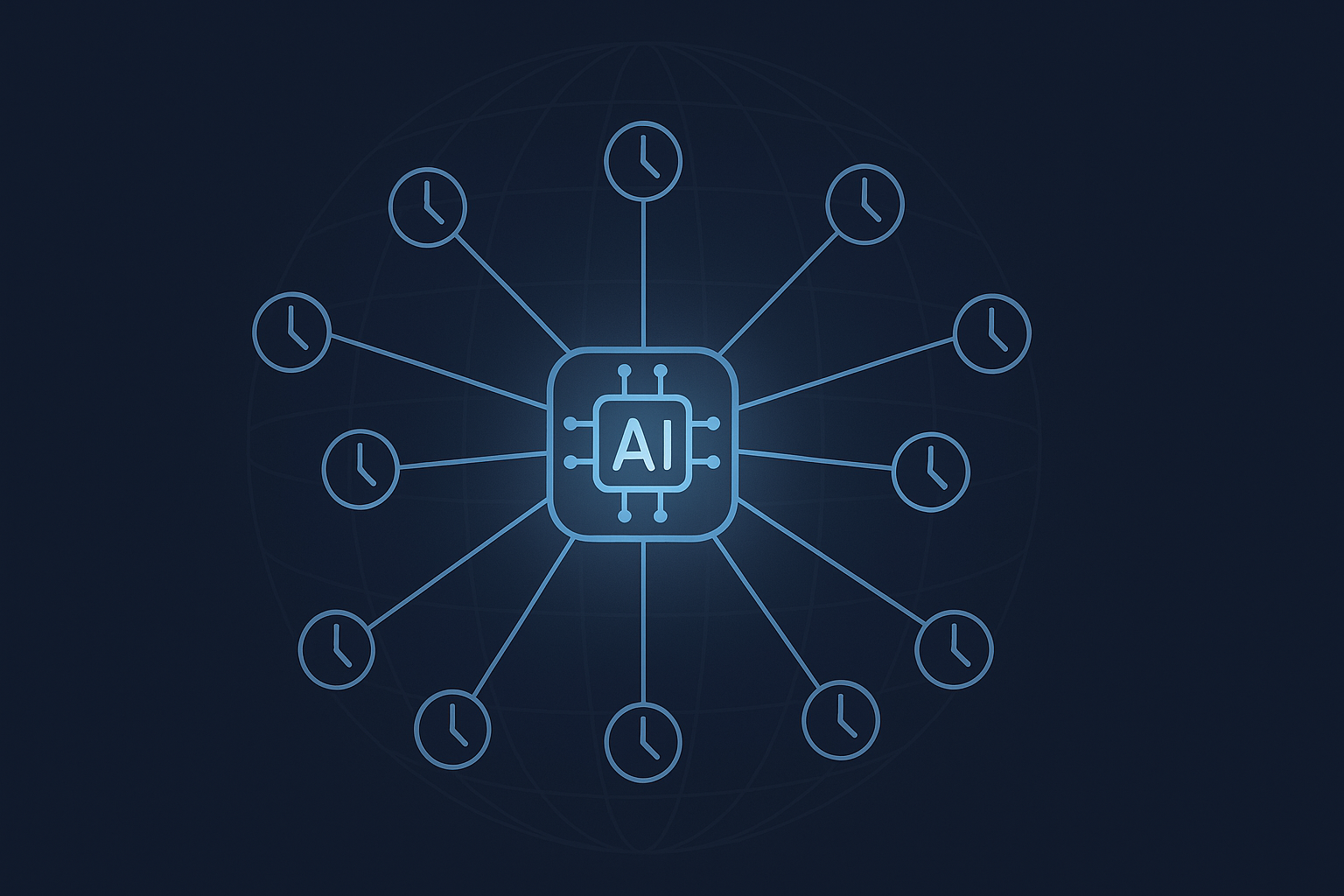
Beyond Time Zones: How AI Is Redefining the Perfect Send Time
You’ve crafted the perfect email. The subject line is compelling, the copy is crisp, and the call-to-action is irresistible. You schedule it for 9:00 AM Tuesday—the industry-standard best time to send—and hit publish.
But for your audience in London, it arrives during their afternoon slump. Your readers in Tokyo receive a notification in the middle of the night. For a night-shift worker in your own city, it’s just another email buried in a morning flood.
The result? A fraction of the engagement you hoped for.
For years, marketers have wrestled with this problem using a patchwork of manual time zone segmentation and guesswork based on broad averages. But what if you could send every message at the precise moment each user was most likely to engage? That capability isn’t science fiction—it’s the power of predictive send-time optimization AI.
The Old Way: A Battle Against the Clock
Before we dive into the AI solution, let’s be honest about the challenges of traditional scheduling. Most strategies fall into one of two camps, each with its own flaws.
Challenge 1: Manual Time Zone Segmentation
The most common approach is to segment your audience by time zone and schedule separate sends. A campaign might go out at 9:00 AM EST, then 9:00 AM PST, then 9:00 AM GMT.
The Problem:
- It’s Labor-Intensive: Creating, scheduling, and managing dozens of segments for a single campaign is a logistical nightmare.
- It’s Inaccurate: This method assumes everyone in a time zone behaves the same. A CEO in New York and a college student in Miami operate on completely different schedules, even though they share a time zone.
- It Ignores Individuality: It completely misses the most important factor: personal habit. One person meticulously clears their inbox at 7:00 AM, while another only browses promotional emails after dinner. Research consistently shows that over 60% of professionals check their email outside of traditional 9-to-5 working hours, making broad time-of-day assumptions increasingly unreliable.
Challenge 2: The “Best Practices” Guessing Game
Countless studies have tried to pinpoint universal “best times” to send emails. You’ve seen the headlines: “Tuesdays at 10 AM,” or “Thursdays at 2 PM.”
The Problem:
- Averages Obscure Reality: These “best times” are merely averages. Sending at that time means you’re competing with every other marketer who read the same article, flooding the user’s inbox at the exact same moment.
- It Creates Digital Noise: This concentration of sends contributes to email fatigue, a primary reason users disengage. When every brand shouts at the same time, most messages become background noise. Studies on email fatigue indicate that open rates can drop by as much as 25% when a user receives more than five marketing emails in a single hour.
Both methods are attempts to solve a complex, human problem with a rigid, one-size-fits-all solution. They focus on the sender’s clock, not the receiver’s reality.
The New Way: AI-Powered Predictive Sending
Predictive Send-Time Optimization (STO) AI flips the script. Instead of asking, “When should I send this?” it asks, “When does Sarah want to receive this?”
At its core, predictive STO is a machine learning model that analyzes the historical engagement data for each individual user. It doesn’t care about time zones or industry benchmarks. It cares about one thing: identifying personal patterns of behavior.
The process works in a few steps:
- Data Ingestion: The AI engine analyzes thousands of data points for each contact, including past email opens, link clicks, app notification interactions, device usage, and location data.
- Pattern Recognition: It identifies unique habits. The model learns that David in Dublin always checks his promotional emails on his commute around 8:30 AM, while Maria in Madrid engages most with newsletters during her lunch break around 2:15 PM.
- Predictive Scheduling: When you launch a campaign, you don’t pick a time. You simply hit “send with predictive AI.” The system then queues each message individually, delivering it at the precise moment its algorithm predicts that user is most likely to open, read, and click.
This isn’t about scheduling for 24 different time zones. It’s about scheduling for millions of individual “time zones of one.” This is what separates basic automation from true AI: a granular understanding of user behavior signals.
The Real-World Impact: More Than Just Opens
Adopting predictive send times isn’t just a minor tweak—it fundamentally improves the relationship between your brand and your audience by showing you respect their time. This translates into powerful, measurable results.
- Dramatically Higher Engagement: By arriving at the perfect moment, your message is more likely to be seen and acted upon. Companies using predictive AI consistently report a 15-35% lift in open rates and an even greater increase in click-through rates (CTR) compared to batch-and-blast sends.
- Reduced Unsubscribe Rates: When messages feel less intrusive and more timely, users are far less likely to opt out. It’s the difference between a welcome arrival and an unwelcome interruption.
- Improved Deliverability & Sender Reputation: Email service providers like Gmail and Outlook monitor engagement signals. Higher open and click rates tell them your content is valued, which boosts your sender reputation and ensures more of your emails land in the primary inbox, not the spam folder.
- True 1:1 Personalization: Personalization has always been about more than using a [First_Name] tag. Delivering a message when a user is truly ready for it is one of the most powerful forms of personalization available. It’s a key part of creating a holistic customer journey where every touchpoint feels relevant.
This approach is invaluable for any organization communicating with a diverse audience:
- Global E-commerce Stores announcing flash sales.
- SaaS Companies sending onboarding tips or feature updates.
- Media Outlets delivering daily newsletters.
- B2B Marketers nurturing leads across continents.
Frequently Asked Questions (FAQ)
- What’s the difference between time zone scheduling and predictive send-time AI?
Time zone scheduling sends a campaign to everyone in a specific time zone at the same local time (e.g., 9:00 AM). Predictive AI ignores time zones and delivers the message to each individual based on their unique, personal history of engagement, regardless of where they are.
- How much data does the AI need to work?
Most systems need a few weeks of engagement data (opens and clicks) to start building reliable predictive models for your audience. The more data it has, the smarter it gets. The key is building a clear data foundation so the AI can effectively identify patterns.
- Will this delay my campaigns?
Yes, by design. A traditional campaign goes out instantly. A predictive campaign might roll out over a 24-hour period as the system waits for the optimal moment for each recipient. This is a feature, not a bug. For time-sensitive announcements (like a 2-hour flash sale), you can typically override the AI and send immediately.
- Is this technology only for email marketing?
No. The same principles are being applied to push notifications, in-app messages, and even SMS marketing. The goal is always the same: deliver the message at the moment of maximum influence.
- Does this replace the need for good content?
Absolutely not. Predictive AI ensures your message gets seen, but it can’t make bad content good. A perfectly timed irrelevant message is still an irrelevant message. The foundation of all engagement is, and always will be, providing genuine value to your audience.
From Guesswork to Intelligence
The shift from manual scheduling to predictive AI marks a critical evolution in digital communication: away from brand-centric broadcasting and toward user-centric relevance. It’s about leveraging technology not just to be more efficient, but to be more thoughtful and respectful of your audience’s attention.
By understanding and adapting to individual behaviors, you can cut through the noise, build stronger relationships, and drive meaningful results. It’s a foundational step toward using AI to navigate a digital landscape where personalization and relevance are paramount.