
You have a limited link-building budget and a list of a hundred “high-priority” keywords. Where do you focus your efforts?
For most agencies, the process blends data with intuition: keyword difficulty scores, search volume, and a healthy dose of gut instinct. But what if your biggest competitor was already showing you exactly where to strike? What if they were spending thousands of dollars every month to highlight their most valuable keywords—and expose their biggest organic weaknesses?
They are. And it’s all hidden in plain sight within their PPC data.
This is how you move beyond siloed thinking and connect the dots between paid and organic search. By analyzing a competitor’s PPC impression share, you uncover a data-backed roadmap for your SEO link building, transforming your strategy from hopeful guesswork into a precision-guided attack.
The Two Sides of the Same Coin: PPC Impression Share and SEO Authority
To connect these two worlds, let’s first define our terms.
What is PPC Impression Share?
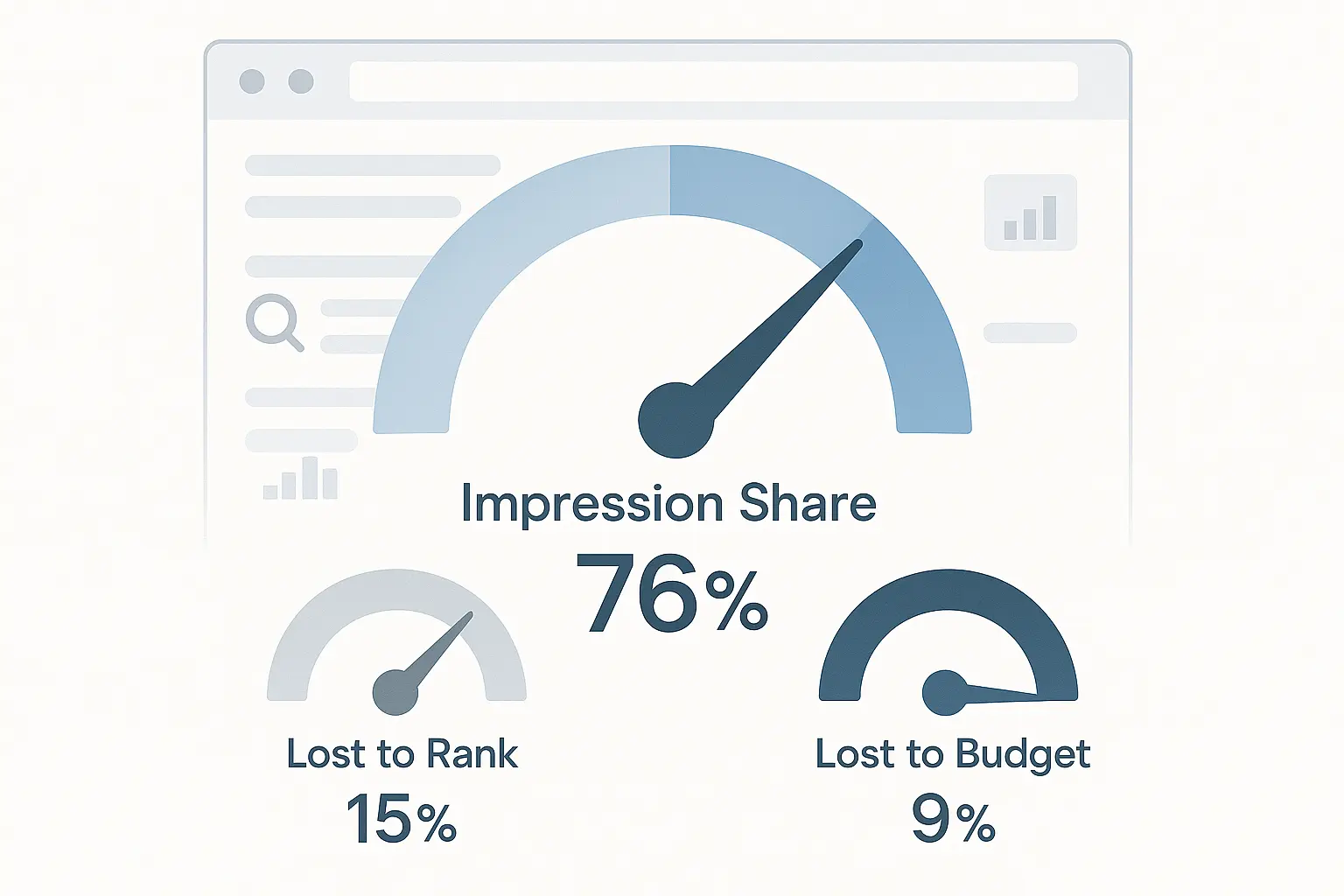
In Pay-Per-Click (PPC), Impression Share is the percentage of times your ads were shown out of the total number of times they could have been shown.
If a competitor has a 90% impression share for “commercial HVAC repair,” it means their ad appears for that search term nine out of ten times. This isn’t just a vanity metric; it’s a massive signal of intent. A high impression share tells you two things:
- They are bidding aggressively. They’ve signaled to Google their willingness to pay a premium to be seen for this keyword.
- That keyword is commercially valuable. No business spends that kind of money on a term unless it drives leads and revenue.
Essentially, their PPC budget is a research and validation tool that you get to use for free.
Why is SEO Link Building Still So Important?
On the other side, you have link building—the engine of organic authority. It’s the methodical work of earning backlinks to prove your content’s trustworthiness and relevance to Google. Research shows that links remain one of the top two criteria in Google’s ranking algorithm.
The challenge? Link building is expensive and time-consuming. You can’t build high-quality links to every page on a client’s site, so you have to be strategic. And that’s where the guessing game usually begins.
The “Opportunity Gap”: Where PPC Data Reveals Your SEO Target
Here’s the “aha moment” that connects the two.
Imagine your top competitor has a 90% impression share for a high-value keyword, but they’re stuck on page two of the organic results.
What does this tell you?
They are paying a premium for every single click because their organic presence is weak. They know this keyword converts, but they haven’t been able to earn the authority to rank for it.
This is the Opportunity Gap.
This gap is your primary target. It points to a keyword that is:
- Commercially Validated: Your competitor’s wallet has already proven its worth.
- Organically Vulnerable: Your competitor is failing to rank, creating a power vacuum you can fill.
- High-Impact: Winning the top organic spot doesn’t just earn you traffic; it directly takes money and market share from your competition.
The prize for closing this gap is huge. According to WordStream data, the average click-through rate (CTR) for a paid search ad is around 3.17%, while the number one organic position can command a CTR of over 30%. By building the links to rank number one, you can capture a share of traffic nearly ten times larger for a keyword your competitor is already paying a fortune to target.
A 3-Step Framework for Prioritizing Your Link Building
Ready to put this into action? Here’s a simple framework to turn this insight into a repeatable process for any client.
Step 1: Gather the Competitive Intelligence
First, you need the data. You don’t need access to your competitor’s Google Ads account; you can get excellent estimates using third-party competitive intelligence tools like Semrush, Ahrefs, or SpyFu.
In these tools, look for reports on PPC keywords or Advertising Research. Export a list of the keywords your top two or three competitors are bidding on, along with their estimated traffic, cost, and ad positions. This is your raw material.
Step 2: Identify Your Prime Targets
Now, filter that data to find the gold. You’re looking for the sweet spot where your competitor’s paid presence is strong and their organic presence is weak.
Create a simple chart or spreadsheet with these columns:
- Keyword
- Competitor PPC Impression Share (or a proxy like high ad spend/traffic)
- Competitor Organic Rank
- Your Organic Rank
Your prime targets are the keywords that fall into the top-left quadrant: those with a high competitor impression share and a low competitor organic rank. These are the keywords where they are paying to play because they have no other choice.
Focus on keywords where your client is currently ranking on page two or three (positions 11-30). A targeted link-building campaign has the highest chance of pushing these pages onto page one. Remember, a study by Backlinko found that the number one result in Google has an average of 3.8x more backlinks than positions 2-10. A focused effort can make all the difference.
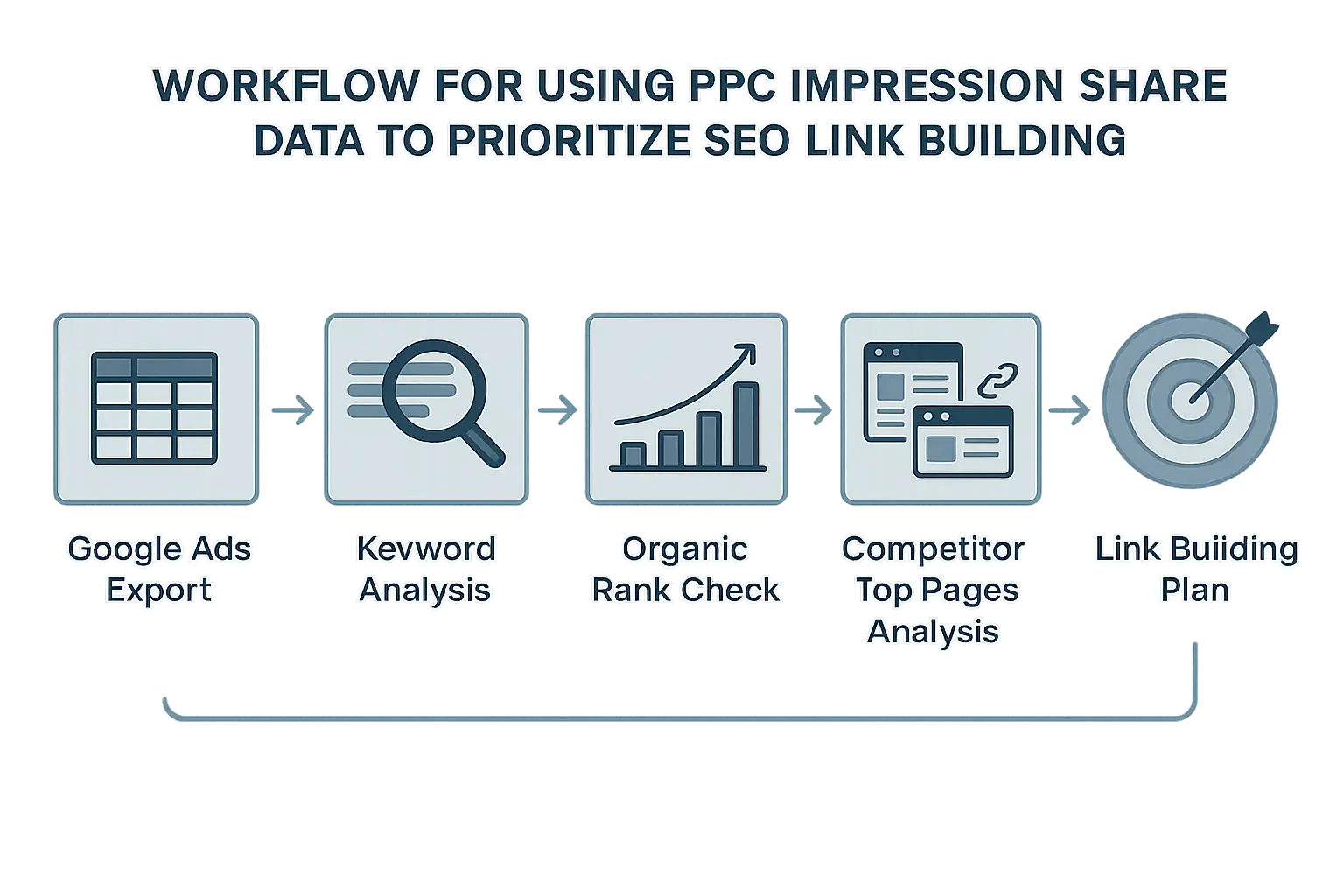
Step 3: Execute a Focused Link Building Campaign
You now have a short, data-validated list of pages to target. Instead of spreading your budget thin across dozens of keywords, you can concentrate your resources where they will have the most competitive impact.
Direct your guest posting, resource page outreach, and digital PR efforts toward building links to the specific URLs that target these “Opportunity Gap” keywords.
Executing this strategy at scale requires a seamless system. It’s a perfect example of how integrating data from multiple channels delivers superior results. For many agencies, managing this level of execution is where a white-label SEO partner can provide the necessary firepower without adding to the in-house headcount.

Frequently Asked Questions (FAQ)
Q: What is a “good” PPC impression share to look for in a competitor?
A: There’s no magic number, but generally, anything over 60% indicates a strong, consistent focus. If you see numbers in the 80-90% range, you can be certain that keyword is a top priority for them.
Q: Do I need expensive tools to do this?
A: While dedicated SEO suites make this process much faster, you can get started with free versions or trials of many tools. The key is to find a reliable source for your competitors’ top paid keywords. As you scale, investing in AI-powered SEO automation can help you process this data across multiple clients efficiently.
Q: What if we have a high impression share and a low organic rank for a keyword?
A: That’s fantastic! You’ve just identified your own internal “Opportunity Gap.” It means your PPC team has validated a high-converting keyword that your SEO team should immediately prioritize for content optimization and link building. This is a perfect chance to reduce your ad spend and own that traffic organically.
Q: Does this strategy only work for e-commerce?
A: Not at all. It works for any industry where competitors use paid search, including B2B, SaaS, local services, and lead generation. If a competitor is paying for clicks, the keyword has commercial value, regardless of the business model.
From Guesswork to Guaranteed Impact
By using PPC impression share as a compass, you transform link building from a cost center into a strategic weapon. You’re no longer just building links; you’re launching a targeted campaign to capture validated, high-value traffic your competitors are paying a premium to reach.
This is the future of SEO: integrated, data-driven, and relentlessly focused on business growth. Start by analyzing one competitor for one client. Find just one “Opportunity Gap” keyword and focus your efforts there. When you show your client how you stole the number one spot for a term their rival was spending a fortune on, you won’t just be a vendor—you’ll be an invaluable growth partner.