
Your Google Ads client loves the leads you’re generating. They’re happy—but you’ve seen the reports. You know the truth hiding in plain sight: Cost Per Click (CPC) is creeping up, competition is getting fiercer, and the client is completely dependent on the ad budget you manage. Turn off the faucet, and the leads dry up.
What if the data to build a more sustainable, profitable, and defensible growth engine for your client is already sitting inside their Google Ads account?
Most agencies treat paid and organic search as two separate channels. In reality, they’re two sides of the same coin. A recent study found that the average business allocates a mere 1% of its marketing budget to a combined search strategy. This isn’t just an oversight; it’s a massive, untapped opportunity for the agencies smart enough to see it.
This guide is your blueprint for unlocking that opportunity. We’ll show you how to use the PPC data you already have to build an undeniable case for SEO, creating a powerful, integrated search offer that lowers client acquisition costs and positions your agency as an indispensable strategic partner.
Why Your PPC Clients Secretly Need SEO (Even if They Don’t Know It Yet)
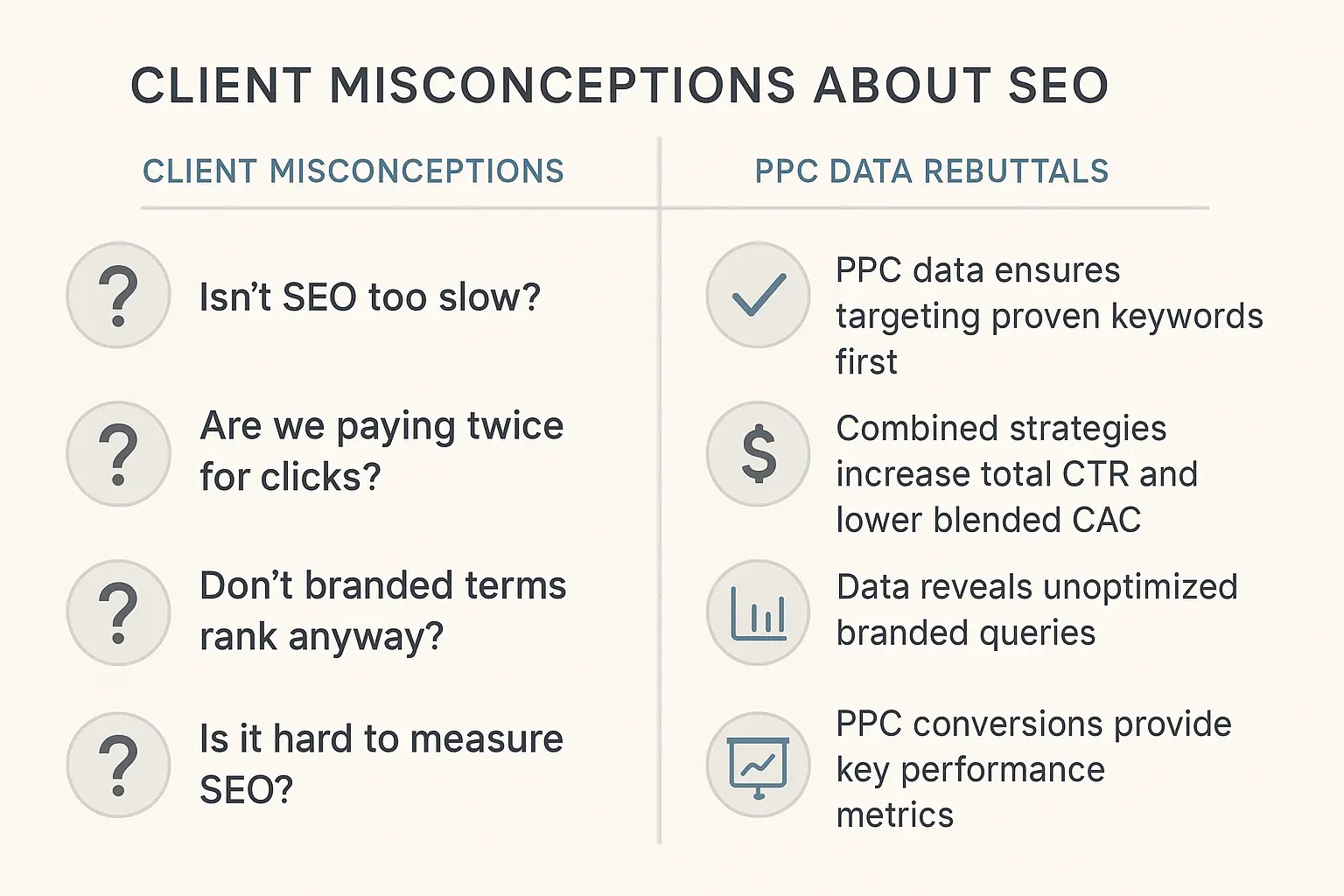
The most common objection is predictable: “Why would I pay for organic traffic when I’m already paying you to get me to the top of Google?”
It’s a fair question, but it’s based on a misunderstanding of how people search and how search engines work. Think of it this way: PPC is like renting an audience; SEO is like building an asset.
PPC is a Faucet
It’s incredibly effective for immediate, targeted traffic. But it’s a direct cost for every single click, and its effectiveness is tied directly to the daily budget.
SEO is a Flywheel
It takes time to get moving, but once it does, it generates momentum. Each piece of content and every backlink adds to its power, delivering compounding returns in the form of “free” organic clicks over time.
Consider this: for high-intent informational keywords—the queries people use when they’re researching a solution—organic results get up to 20 times more clicks than PPC ads. If your client is only running ads, they’re invisible for a massive part of the customer’s journey. By bundling SEO, you’re not just adding a service; you’re completing the picture.
The Data-Driven Pitch: Using PPC Insights to Build the Case for SEO
Instead of pitching SEO as a vague concept, you can walk into a client meeting with a data-backed proposal built from their own campaign performance. You’re not guessing; you’re using their proven conversion data to build a smarter search strategy.
Step 1: Identify Your “Proven Converters”
Log into your client’s Google Ads account. Export a list of the keywords that have driven the most conversions over the last 90 days. This is your gold mine. These aren’t just keywords; they are proven paths to revenue.
Step 2: Frame the SEO Opportunity
Now, analyze those keywords. Many will likely have a high CPC or a borderline Customer Acquisition Cost (CAC). Your pitch becomes incredibly simple:
“We know ’emergency plumbing service Chicago’ converts for you, but each click is costing us $25. What if we could also capture the number one organic spot for that exact term? We could capture a whole new stream of clicks without paying for each one, effectively lowering our total cost to acquire a customer.”
This is where you connect the dots. You’re not talking about abstract SEO benefits; you’re presenting a plan to win on the terms that already make them money.
Step 3: Highlight the “Risk Reduction” Factor
Building an SEO strategy from scratch involves a lot of research and some educated guesswork. But you have an unfair advantage: months, maybe years, of PPC data.
Research even shows that using PPC to test and validate keywords before committing to a long-term SEO effort can reduce the risk of a failed SEO campaign by 40%. You can confidently tell your client: “We’re not gambling on keywords. We’re doubling down on the ones we know work.”
The “SERP Domination” Effect: Building Unbeatable Brand Trust
Have you ever searched for a product and seen the same company in the top ad spot and the top organic listing? It immediately establishes them as the undisputed leader in that space. This isn’t just a feeling; it’s a measurable psychological advantage.
Data shows that 61% of users are more likely to trust and click on a brand if they see it appear in both paid and organic results. This SERP “real estate” dominance creates a halo effect. In fact, brands with a strong, corresponding organic presence can see up to a 50% increase in click-through rates (CTR) on their paid ads.
Your paid ads perform better, your organic listing builds long-term authority, and the client’s brand becomes synonymous with the solution they provide. This is how you move from being a “PPC vendor” to a brand-building partner.
Lowering the Blended CAC: The Financial Argument No Client Can Ignore
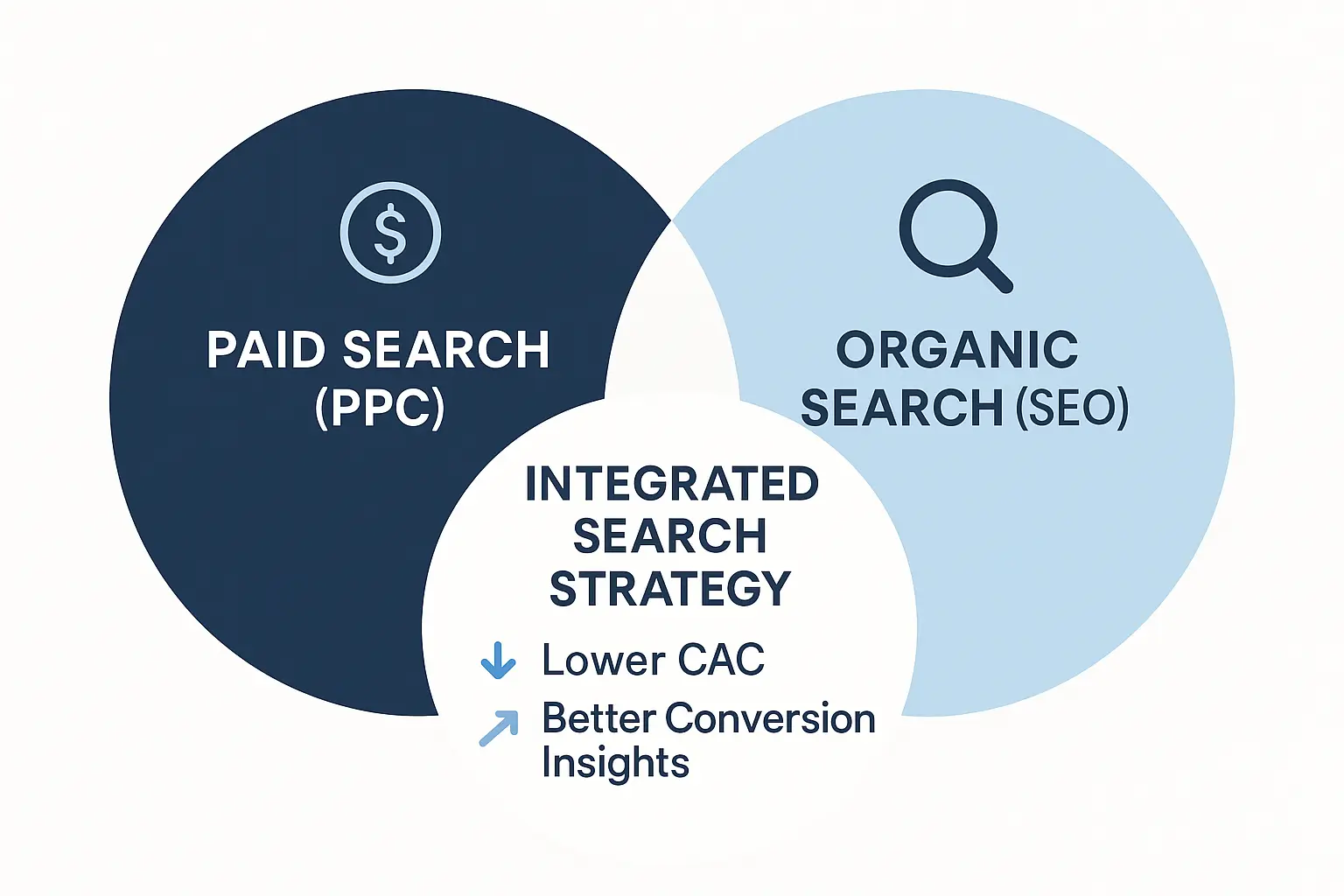
Every PPC client is focused on one thing: getting their Customer Acquisition Cost as low as possible. An integrated strategy is the most effective way to achieve this over the long term.
This is where you introduce the concept of Blended CAC.
Right now, their CAC is based purely on ad spend. But as your SEO efforts begin to rank for their top-converting keywords, something powerful happens. The “free” clicks and conversions from organic search begin to supplement the ones you’re paying for.
Over time, you can strategically lower bids on keywords where you have strong organic rankings, reallocating that budget to test new terms or dominate other high-priority ones. The result? The overall, or “blended,” CAC trends downward.
And this isn’t just a theory. Studies show a well-executed integrated search strategy can lower blended Cost Per Acquisition by 15-20%. This graph becomes your most powerful sales tool. It visually demonstrates how an initial investment in SEO pays dividends, creating a more efficient and profitable marketing engine for their business. Presenting this kind of forward-thinking strategy is a key part of learning how to scale an agency.

How to Structure Your Integrated Search Offer
You don’t need to become a full-service SEO agency overnight. You can phase your approach, using your PPC expertise as the foundation.
Phase 1: Data-Driven Foundation (Months 1-3)
Pitch a “Search Foundation” package. Use the top-converting PPC keywords to guide on-page SEO, technical fixes, and Google Business Profile optimization. The goal is to secure quick wins on their most valuable terms.
Phase 2: Content & Authority (Months 4-9)
Expand the strategy. Build content around the informational queries related to your commercial keywords. This captures users earlier in the buying cycle and builds topical authority, making it easier to rank for everything.
Phase 3: Optimization & Scale (Month 9+)
As organic rankings solidify, you can begin strategically pulling back on PPC spend for certain terms, reallocating the budget for maximum efficiency.
Executing this requires a new skill set. As you grow, you’ll need a reliable way to deliver. Many agencies find success with white-label SEO services, allowing them to offer expert-level execution under their own brand without the overhead of hiring an in-house team.
Frequently Asked Questions (FAQ)
Q1: How long does it take for SEO to show results?
While some results from on-page changes can appear in a few weeks, meaningful SEO results typically take 4-6 months to build momentum. It’s a long-term investment, which is why using PPC data to target the right keywords from day one is so crucial.
Q2: Will my organic results cannibalize my PPC clicks?
This is a common myth. In fact, the data shows the opposite is true. Combining PPC and SEO can lead to a 27% overall boost in clicks. By dominating the SERP, you increase total traffic and push competitors further down the page, capturing clicks that might have otherwise gone to them.
Q3: My client’s budget is limited. How do I convince them to invest in both?
Frame it as an investment in efficiency, not just another expense. Start small. Propose an initial SEO project focused only on the top 5-10 highest-value keywords from their PPC account. Show them the downward trend in their blended CAC for that specific keyword set, and then expand from there.
Q4: Do I need to hire a full SEO team to offer this?
Not necessarily. Your role as the PPC strategist is to identify the opportunity in the data and build the client-facing strategy. For execution, you have several options. You can hire in-house, use freelancers, or explore SEO outsourcing for agencies to partner with a specialized firm that can handle the fulfillment behind the scenes.
Your Next Step: From PPC Specialist to Integrated Search Strategist
Your Google Ads account is more than a campaign management tool; it’s a treasure map. It holds the proven, data-backed insights you need to sell a more sophisticated, valuable, and stickier service to your clients.
By bundling paid and organic, you’re not just adding a new line item to your invoice. You’re fundamentally changing the conversation from cost-per-click to long-term business growth, securing your position as an indispensable strategic partner.