
Ever ask your phone a question like, “Where can I find a dog-friendly cafe with outdoor seating near me?” A few years ago, you’d get a list of blue links to scroll through. Today, you’re increasingly likely to get a direct, conversational answer right at the top of the results, seemingly pulled out of thin air.
This isn’t magic; it’s the new face of local search, powered by AI. And for local businesses, it represents a monumental shift.
Consider this: a staggering 46% of all Google searches are for local information. This isn’t just casual browsing; 97% of people learn more about a local company online than anywhere else.
Your digital front door has never been more important. But as AI changes how Google presents information, the way you appear on that digital doorstep needs to evolve as well.
The New Local Search Landscape: From Rankings to Answers
For years, the goal of local SEO was to rank number one in the “Map Pack.” But Google’s AI is rewriting the rules. Now, the objective is not just to be in the results but to be the answer itself.
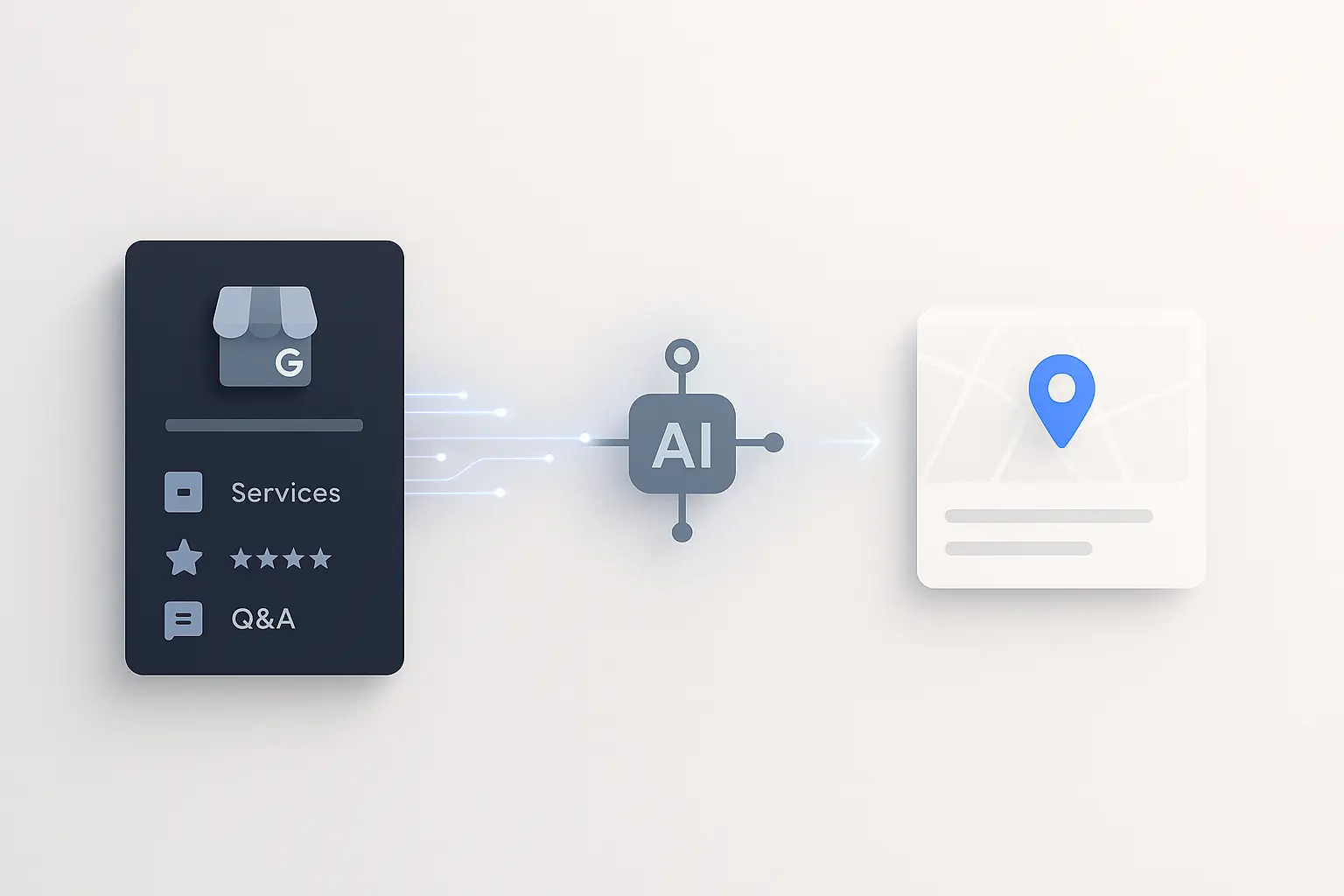
Google is rolling out AI-powered snippets and “AI Overviews” that synthesize information from various sources to give users a single, direct answer. This is especially prominent in local search, where the AI can pull details directly from Google Business Profiles (GBPs) to create a custom response.

This is a game-changer. Recent data shows that AI Overviews already appear for 84% of queries, and perhaps more critically, clicks to websites from these results are substantially lower. If you’re not the source of that AI-generated answer, you risk becoming invisible.
The opportunity? To structure your GBP so effectively that you become the primary, most citable source for Google’s AI. You’re no longer just listing your business; you’re feeding a knowledge engine.
Why Your Google Business Profile is Now Your AI Spokesperson
To understand why your GBP is so critical, you need to think like Google. Its latest AI models, like MUM and LaMDA, are built to understand conversational language and user intent. They aren’t just matching keywords; they’re trying to find the most direct, accurate, and helpful answer to someone’s question.
And where does Google look for the most trustworthy information about a local business? Your Google Business Profile.
It’s a verified, structured, and direct source of data. When you optimize it correctly, you’re essentially preparing answers for the AI, making it easy for Google to cite you as the authority on your services, hours, and unique offerings.
4 Key Strategies to Optimize Your GBP for AI Snippets
So, how do you turn your profile into an AI-ready knowledge base? It’s about going beyond the basics and treating each section of your GBP as an opportunity to answer a potential customer’s question.
1. Master the Q&A Section: Answer Questions Before They’re Asked
The Q&A section is a goldmine for AI optimization, as it’s literally a list of questions and answers about your business. Instead of waiting for customers to ask, proactively populate this section yourself.
Think about every question a potential customer might have:
- Do you offer vegan options?
- Is your parking lot accessible?
- What is your return policy on custom orders?
- Do you offer free consultations for new clients?
When you provide clear, concise answers here, you’re creating perfect, bite-sized pieces of information that Google’s AI can easily use to answer highly specific user queries.
2. Structure Your Services and Products for Clarity
Don’t just list a service like “Marketing.” Break it down with detailed descriptions. The AI needs specifics to answer specific questions.
For example, instead of just listing “Web Design,” try: “Custom WordPress Web Design: We build responsive, SEO-friendly websites for service-based businesses. Includes e-commerce integration, mobile optimization, and post-launch support.”
Each detailed description becomes a potential source for an AI snippet answering queries like, “who builds e-commerce websites for local shops?” The more structured detail you provide, the better the AI can understand your expertise.
3. Use Google Posts as Your Content Hub
Think of Google Posts not as social media updates, but as mini-articles or announcements that directly answer timely questions. You can use them to highlight promotions, events, or specific aspects of your business.
- Post about a seasonal offer: “Get 15% off all tax preparation services through April 15th.”
- Answer a common concern: “Worried about spring allergies? We now stock local honey to help!”
- Highlight a feature: “Our patio is now open for the season! Enjoy your coffee in the sunshine.”
Creating posts that consistently address customer needs and interests gives Google’s AI fresh, relevant content to cite.
4. Encourage and Respond to Detailed Reviews
Reviews are powerful because they provide third-party validation in natural, conversational language. Encourage your customers to leave detailed reviews that mention specific products or services.
When you respond, reiterate those details. For example, if a customer says, “Loved the emergency plumbing service, they were so fast!” your response could be, “We’re so glad our 24/7 emergency plumbing service could help you out quickly!” This reinforces key service terms for Google’s AI to recognize.
The Bigger Picture: Integrating AI into Your Local SEO Strategy
Optimizing for AI snippets isn’t a one-time task; it’s a fundamental shift in local SEO. The goal is to create a comprehensive, interconnected web of information about your business, with your GBP at the center.
The payoff is tangible. Research shows that 75% of local searches result in a store visit within 24 hours. Becoming the definitive answer for local queries means you’re not just winning clicks—you’re driving real-world foot traffic.
For agencies, managing this level of detail across dozens of clients is a significant operational challenge that requires a new way of thinking—one that blends strategic content with scalable execution. To handle this complexity, many are turning to a combination of expert oversight and AI-powered SEO automation. Automating data monitoring and reporting frees up teams to focus on the high-level strategy required to win in this new AI-driven landscape. This approach is central to how modern white-label SEO services help agencies scale without overwhelming their teams.
Frequently Asked Questions (FAQ)
What exactly is an AI-powered map pack snippet?
It’s a direct, conversational answer to a user’s local search query that appears at the top of the search results, often within the map interface. Instead of just showing a business name and link, it synthesizes information from a GBP to provide an immediate answer, like “Yes, The Corner Cafe has outdoor seating.”
Does this replace traditional local SEO?
Not at all—it’s an evolution. The fundamentals of local SEO, like an accurate NAP (Name, Address, Phone Number), local citations, and good reviews, are still essential. This AI optimization is a new layer built on top of that strong foundation.
How is this different from a Featured Snippet?
A traditional Featured Snippet (or “answer box”) usually pulls information from a webpage to answer a broad, informational query. An AI-powered local snippet is specifically designed for local “near me” type searches and heavily relies on data from a Google Business Profile to provide its answer.
How long does it take to see results from these optimizations?
Unlike traditional SEO, which can take months, updates to your GBP can be reflected much faster. While there’s no set timeline, Google’s AI constantly scans for the best information. Making these changes immediately makes you a stronger candidate to be featured as the primary source for relevant queries.
Your Next Move in the Age of AI Search
The shift to an AI-first search world is here, and it’s moving fast. Businesses and the agencies that support them can no longer afford to treat their Google Business Profile as a simple digital listing. It’s now your primary tool for communicating directly with Google’s AI.
Start by auditing your own profile. Are you proactively answering questions? Are your services described in detail? Are you using posts to share timely, relevant information?
When you view your GBP through this new lens, you can move beyond simply being listed and start becoming the definitive answer for customers in your area.