

A frantic email lands in your inbox. Subject: “URGENT: 1-Star Review!”
It’s from your best client, a local roofing contractor who prides themselves on quality work. A customer has just blasted them on Google, complaining about timeline delays and a messy yard. The client is panicking, worried this single review will tank their reputation and scare off new leads.
Sound familiar? For agencies serving contractors, this scenario is a common fire drill. A contractor’s reputation is their most valuable asset, and a negative online review can feel like a direct attack.
But what if that 1-star review wasn’t a crisis? What if it was a marketing opportunity?
The data is clear: how a business handles criticism is just as important as the praise it receives. While a staggering 94% of consumers say a bad review has convinced them to avoid a business, there’s a powerful flip side. Responding publicly and professionally doesn’t just solve one customer’s problem—it sends a powerful trust signal to every potential customer watching from the sidelines.
This guide gives your agency the framework and ready-to-use scripts to help your contractor clients turn negative feedback into a testament to their professionalism and commitment to their customers.
Why Every Negative Review Demands a Thoughtful Response
It’s tempting to ignore a bad review and hope it gets buried, but silence is often interpreted as either guilt or indifference—neither of which wins new business. The “silent majority” of potential customers aren’t just reading reviews; they’re reading your responses to those reviews.
Consider these findings:
-
Responsiveness Builds Trust: A BrightLocal survey found that 89% of consumers are ‘highly’ or ‘fairly’ likely to use a business that responds to all of its online reviews.
-
It Directly Influences Clicks: The same study revealed that 45% of consumers are more likely to visit a business if it responds to negative reviews.
Responding shows you’re listening, you care, and you’re committed to making things right. It reframes the narrative from “this company makes mistakes” to “this company takes accountability and solves problems.”

The Anatomy of a Perfect Response: The A-P-O-A Framework
Before diving into the scripts, it’s crucial to understand the core elements of an effective reply. A great response isn’t about winning an argument; it’s about de-escalating the situation and demonstrating professionalism to a wider audience.
We use a simple four-part framework: Acknowledge, Professionalize, Offline, Avoid.
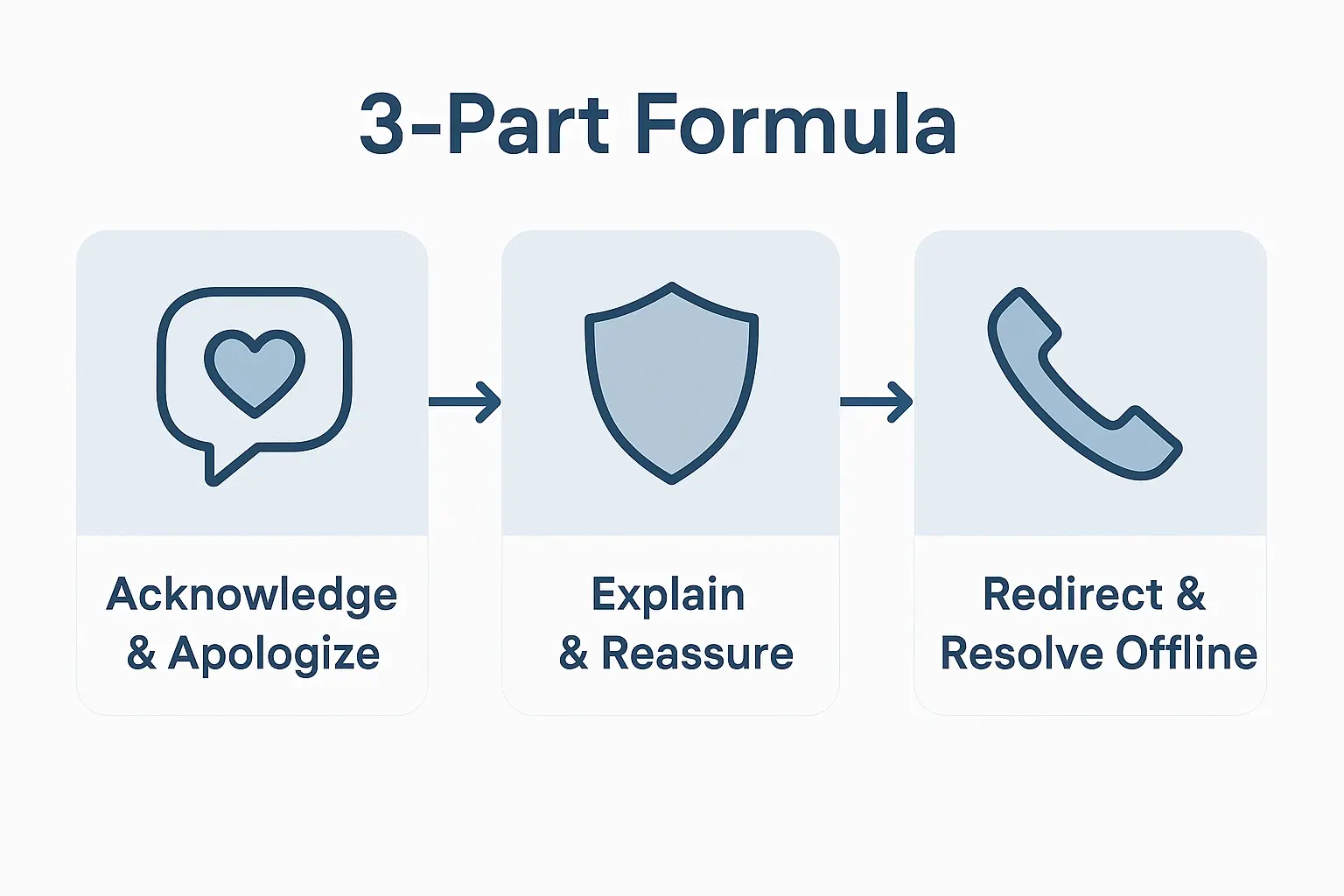
1. Acknowledge & Apologize
Start by thanking the customer for their feedback, even if it’s harsh. Then, offer a simple apology for their negative experience. This isn’t an admission of guilt; you’re apologizing that they had a bad experience, which is a neutral and empathetic starting point.
Do Say: “Thank you for sharing your feedback. We’re sorry to hear your experience didn’t meet your expectations.”
Don’t Say: “You’re wrong about what happened.”
2. Promote Professionalism
Briefly and calmly state your company’s commitment to high standards. This reinforces your values without being defensive and subtly reminds the reader (and the reviewer) that this experience is the exception, not the rule.
Do Say: “We pride ourselves on clear communication and quality craftsmanship.”
Don’t Say: “We’ve done hundreds of jobs and never had this complaint before!”
3. Offer an Offline Solution
This is the most critical step. Your goal is to take the conversation out of the public forum. Provide a direct contact name, phone number, or email address to resolve the specific issue privately. This shows you’re serious about a resolution and prevents a public back-and-forth.
Do Say: “We want to learn more and make this right. Please call our project manager, David, at (555) 123-4567 at your convenience.”
Don’t Say: “Let’s hash this out here.”
4. Avoid Specifics & Excuses
Never get into a detailed debate about the project in your public response. Don’t mention project costs, specific employee names, or make excuses. Keep the reply short, professional, and focused on the solution.
5 Plug-and-Play Negative Review Response Scripts for Contractors
Here are five templates tailored to common scenarios contractors face. Advise your clients to customize them to fit their specific situation and brand voice.
Template 1: The “Project Went Wrong” Review
Scenario: The review complains about timeline delays, budget overruns, or sloppy work.
Client Review: “The deck they built is fine, but the project took three weeks longer than they promised and my yard was a mess the whole time. Not worth the headache.”
Response Script:
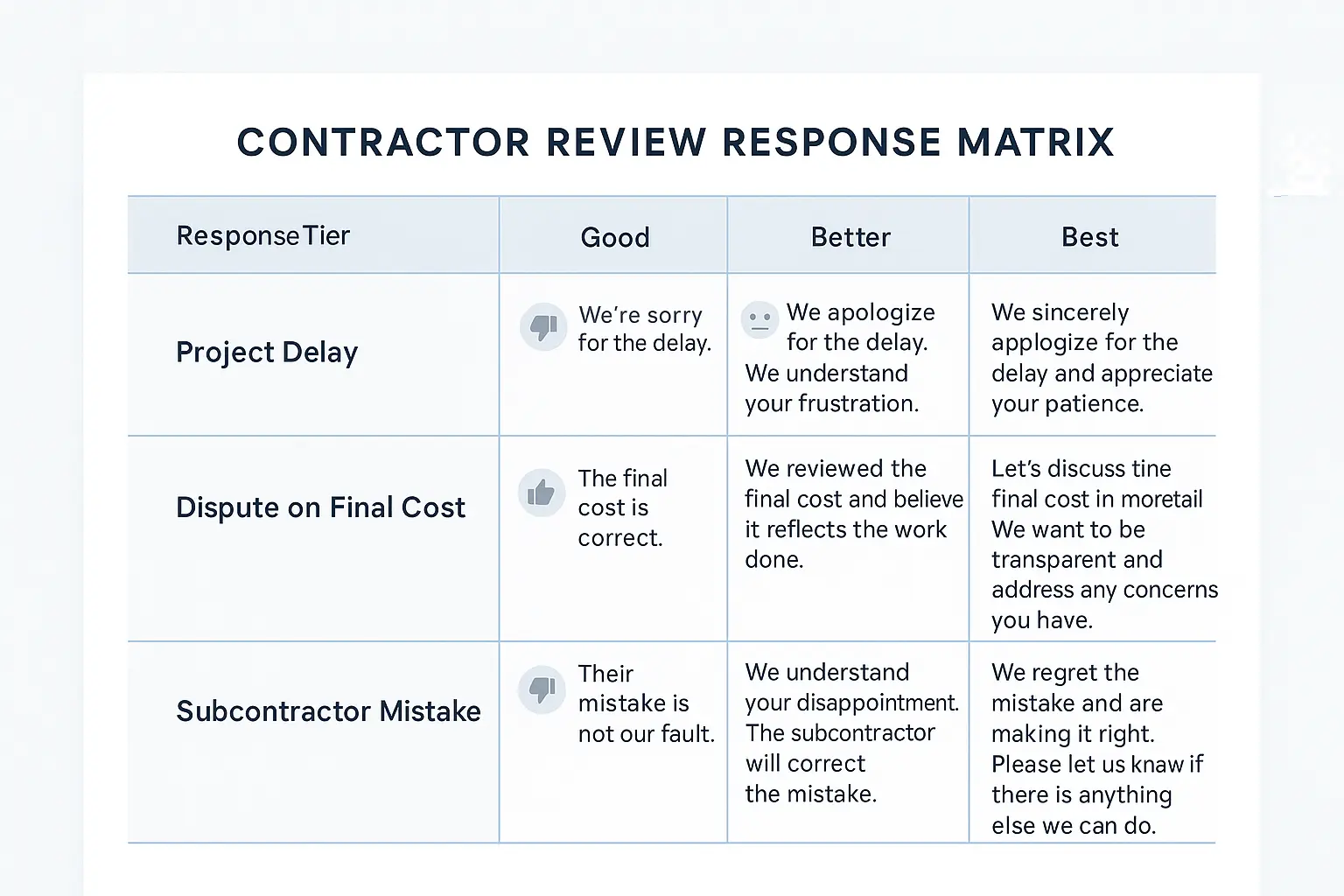
“Hi [Customer Name], thank you for taking the time to leave a review. We’re truly sorry to hear that the project timeline and site cleanliness did not meet the high standards we set for ourselves. We would appreciate the opportunity to discuss this with you directly to understand what happened and how we can improve. Please contact [Name], our owner/project manager, at [Phone Number] or [Email Address].”
Why it works: It validates the customer’s frustration without making excuses and immediately offers a direct line to someone with authority, showing a commitment to resolution.
Template 2: The “Poor Communication” Review
Scenario: The client felt out of the loop, claiming calls weren’t returned or they didn’t know the project status.
Client Review: “Felt like I was chasing them for updates the entire time. No one ever called me back. Very unprofessional.”
Response Script:
“Hi [Customer Name], thank you for your feedback. Clear and consistent communication is a core part of our service, and we sincerely apologize that we fell short in your case. This is not the standard we aim for, and we want to learn more about where our process failed. Please reach out to [Name] at [Phone Number] so we can address your concerns properly.”
Why it works: It directly addresses the core complaint (communication) and reinforces the company’s commitment to it, framing the incident as an anomaly.
Template 3: The “Misunderstanding or False Claim” Review
Scenario: The review contains information that you know to be inaccurate, but you can’t call them a liar publicly.
Client Review: “They charged me for premium materials but used cheap stuff instead! Total rip-off.”
Response Script:
“Hi [Customer Name], thank you for bringing this to our attention. We’re concerned to read your comments, as we have detailed records of all materials used on our projects and are committed to complete transparency. We believe there may be a misunderstanding, and we want to resolve it immediately. Please call [Name] at [Phone Number] to review the project file together.”
Why it works: It’s firm but professional. It mentions “records” and “transparency” to signal confidence without being aggressive. Taking the conversation offline is crucial here.
Template 4: The “Vague and Angry” Review
Scenario: A 1-star review with little to no context, like “Terrible service!” or “Do not hire.”
Client Review: “Worst experience ever.”
Response Script:
“Hi [Customer Name], we are very sorry you had a 1-star experience with our team. We are committed to customer satisfaction and would be grateful for the chance to understand what went wrong. When you have a moment, please contact [Name] at [Phone Number] so we can hear more about your experience.”
Why it works: Since you have no details, you can’t address specifics. This response shows you care and are proactively trying to get the information needed to solve the problem. To other potential customers, this demonstrates that you follow up on all feedback.
Template 5: The “Pricing is Too High” Review
Scenario: The customer is happy with the work but complains about the cost after the fact.
Client Review: “The new roof is great, but I got another quote after and realized I paid way too much. Felt taken advantage of.”
Response Script:
“Hi [Customer Name], thank you for your feedback, and we’re glad you’re happy with the quality of your new roof. We strive to provide fair, transparent pricing that reflects our use of high-quality materials, skilled labor, and comprehensive warranty. We would be happy to walk you through your project invoice again to clarify everything included. Please feel free to call [Name] at [Phone Number].”
Why it works: It doesn’t apologize for the price. Instead, it confidently justifies the value and maintains a helpful, transparent tone.
The Bigger Picture: Reputation Management as a Growth Engine
Helping your clients manage negative reviews is more than just damage control—it’s a fundamental part of a modern growth strategy. Google’s algorithms increasingly factor in review signals like quantity, velocity, and ratings to determine local search rankings.
A steady stream of recent reviews also acts as powerful social proof. Research shows that businesses with more than nine recent reviews (from the past 90 days) earn 52% more revenue than the average.
Effectively managing this process across multiple clients can be overwhelming. That’s why integrating reputation management into a holistic SEO strategy is so critical. You can learn how our AI-powered SEO automation can track and manage online reputation as part of a complete growth strategy, allowing your agency to deliver exceptional results at scale.
Frequently Asked Questions (FAQ)
Q: Should a contractor respond to every negative review?
A: Yes, absolutely. Every unanswered negative review is a missed opportunity to demonstrate professionalism to future customers. Consistency is key.
Q: How quickly should a response be posted?
A: Ideally within 24-48 hours. A prompt response shows you are attentive and proactive. However, it’s better to take a few hours to craft a calm, professional reply than to fire back an emotional one immediately.
Q: What if we’re sure the review is fake or from a competitor?
A: First, flag the review through the platform’s official channel (like Google Business Profile). Then, post a polite, professional response. You can say something like, “We are unable to locate a record of your name or project in our system. We take all feedback seriously and would like to investigate this. Please contact us at [Phone Number] so we can identify you as a customer.” This shows other readers you’re diligent while casting doubt on the review’s legitimacy.
Q: Is it okay to ask the customer to change their review after we resolve the issue?
A: Tread very carefully. Never make changing the review a condition of your help. Focus on solving their problem unconditionally. Once they are completely satisfied, you can say, “We’re so glad we were able to resolve this for you. We’d be grateful if you’d consider updating your review to reflect your recent experience, but of course, there is no obligation.” Often, happy customers will do this on their own.
Turn Your Clients’ Reputations into Your Agency’s Strength
By equipping your contractor clients with these strategies, you move beyond being a simple service provider and become an indispensable strategic partner. You’re not just building them a website or running their ads; you’re helping them build a resilient, trustworthy brand.
When you can confidently turn their biggest anxieties into marketing assets, you prove your agency’s value time and time again.
Ready to help your clients build a bulletproof online reputation? Explore our white-label SEO partner program to see how we can become your invisible execution engine for reputation management and beyond.