

An agency owner once told us a story that probably sounds familiar. They presented a glowing SEO report to a client, showing traffic was up 50%, key terms had reached page one, and domain authority was climbing.
The client nodded, then asked the million-dollar question: “This is great, but I only see five direct sales from organic search in our Shopify dashboard. Why are we spending so much on this?”
That question cuts to the heart of a massive challenge agencies face. In a world where, according to Google, over 90% of B2B buyers use search at every stage of their journey, how can you prove the value of the blog post that introduced your client’s brand six weeks before a purchase?
The answer isn’t in a standard analytics report. It’s in building a multi-touch attribution model—a new way of seeing the customer journey that gives SEO the credit it deserves.
The Last-Click Illusion: Why Your SEO Reports Are Telling Half the Story
For years, the default measurement model for digital marketing has been “last-click attribution.” It’s a simple concept: whichever link a user clicked immediately before converting gets 100% of the credit. If a user clicked a Google Ad and bought something, the sale is attributed to Google Ads. If their purchase followed an email link, email gets the win.
This model is like giving all the credit for a championship goal to the player who kicked the ball last, ignoring the midfielder who stole the ball and the defender who made the perfect pass. It’s a dangerously incomplete picture.
Today’s customer journey is anything but a straight line. Research from Think with Google found that for 80% of consumers, the buying process is a multi-step journey that happens entirely online. A potential customer might:
- Discover your client’s brand through a non-branded search, landing on an educational blog post (First Touch: Organic Search).
- See a retargeting ad on social media a few days later (Second Touch: Paid Social).
- Sign up for a newsletter to get a discount code (Third Touch: Direct).
- Finally, type the brand’s name into Google, click the organic result, and make a purchase (Final Touch: Organic Search).
In a last-click world, organic search gets 100% of the credit, but it misses the entire story of how that customer was nurtured. Worse, if the final click came from a paid ad or an email, SEO’s critical role as the first touchpoint gets completely erased.
This flawed measurement helps explain why a Nielsen report found that only 54% of marketers are confident in their ability to measure ROI. They know their efforts are working, but their tools are telling a different story.
What is Multi-Touch Attribution? (And Why It’s SEO’s Best Friend)
Multi-touch attribution (MTA) is a measurement framework that distributes credit for a conversion across multiple touchpoints in the customer journey. Instead of giving 100% of the value to a single channel, it recognizes that each interaction—from the first search to the final click—plays a role.
For SEO, this is a game-changer. It allows you to finally quantify the value of top-of-funnel content, informational keyword rankings, and brand-building activities that don’t immediately result in a sale but are essential for filling the pipeline.
By shifting the conversation from “How many sales did SEO close?” to “How did SEO influence our total revenue?”, you elevate your agency from a service provider to a strategic partner invested in growth.
Choosing Your Model: A Practical Guide to Common Attribution Frameworks
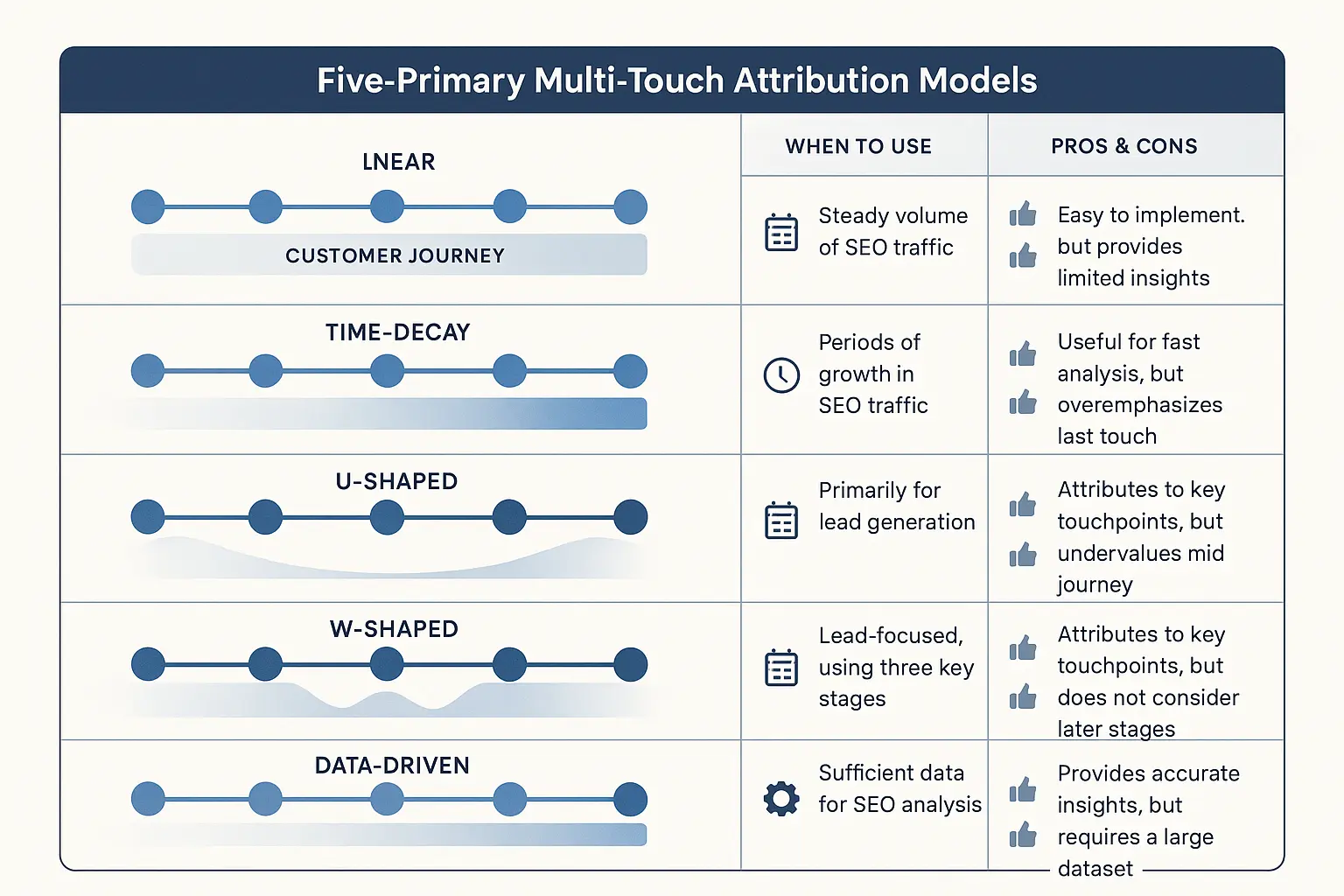
There isn’t a single “best” attribution model; the right one depends on your client’s business and sales cycle. Here are the most common models you can start using today, most of which are available directly in Google Analytics 4.
Linear Model
Imagine a straight line where every touchpoint gets an equal slice of the credit. If a customer had four interactions (Organic Search > Paid Social > Email > Direct) before converting, each channel would receive 25% of the credit.
Best for: Gaining a balanced, holistic view of the entire customer journey. It’s an excellent starting point for understanding which channels appear most often.
Time-Decay Model
This model gives more credit to touchpoints closer to the conversion. The first blog post they read a month ago gets some credit, but the email they clicked yesterday gets much more.
Best for: Clients with shorter consideration periods or promotional campaigns where recent interactions are more influential.
Position-Based Model (U-Shaped)
This model gives the most credit to the first and last touchpoints—typically 40% each—and divides the remaining 20% among all the interactions in the middle. It values what started the journey and what closed it.
Best for: Agencies that want to highlight SEO’s role in both discovery (first touch) and conversion (last touch).
Data-Driven Model (The Gold Standard)
This is the most sophisticated model, available in Google Analytics 4 for accounts with enough conversion data. It uses machine learning to analyze all converting and non-converting paths to determine which touchpoints are actually the most influential. It’s not based on assumptions; it’s based on your client’s specific data.
Best for: Any agency with enough data to use it. This model offers the most intelligent and defensible insights into what’s truly driving growth.

How to Get Started with Multi-Touch Attribution in Google Analytics 4
You don’t need expensive software to begin. You can start uncovering these insights right inside Google Analytics 4. Here’s a simplified path to get started.
Step 1: Solidify Your Conversion Tracking
Attribution is useless if you aren’t tracking the right goals. Ensure your primary conversions (e.g., form submissions, demo requests, purchases) are set up correctly in GA4.
Step 2: Navigate to the Advertising Workspace
In the left-hand menu of GA4, click on Advertising. This is your new home base for attribution insights.
Step 3: Compare Models in the ‘Model Comparison’ Report
This report is where the magic happens. It allows you to compare different attribution models side-by-side (e.g., Last Click vs. Position-Based). You’ll likely see the “Assisted Conversions” and “Conversion Value” for Organic Search increase dramatically when you move away from the last-click model. This is the data that proves SEO’s hidden value.
Armed with this data, you can go back to your client and say, “While organic search directly closed 5 sales last month, it influenced an additional 45 sales that started with a search. It was the first touchpoint for 30% of our new customers.”
Turning Insights Into Strategy
Adopting multi-touch attribution isn’t just about better reporting; it’s about making smarter strategic decisions. According to McKinsey, brands that use MTA can improve their marketing spend efficiency by 15-35%.
With these insights, you can:
- Justify Investment in Top-of-Funnel Content: Show clients precisely how many customer journeys begin with your educational blog content.
- Optimize Your Channel Mix: Understand how SEO and paid search work together, allowing you to allocate budget more effectively.
- Prove the Full-Funnel Impact of SEO: Finally connect your technical SEO, content marketing, and link-building efforts to bottom-line revenue.
Implementing and managing this level of analysis across multiple clients requires focus. For many, exploring SEO outsourcing for agencies is the most efficient path to delivering these insights without overwhelming their internal team.

FAQ: Your Multi-Touch Attribution Questions, Answered
What’s the best attribution model to start with?
Start with the Position-Based or Linear model in GA4. They are easy to understand and immediately show the value beyond the last click. Once you’re comfortable, switch to Data-Driven if your account has enough data to support it.
Does this work for both B2B and B2C clients?
Absolutely. It’s arguably even more critical for B2B, which often has long, complex sales cycles with numerous research touchpoints. Showing how SEO influences a deal over six months is incredibly powerful.
How long does it take to get meaningful data?
This depends on your client’s website traffic and conversion volume. Ideally, you want to analyze at least 30-90 days of data to identify clear patterns.
Can I do this outside of Google Analytics?
Yes. Platforms like HubSpot, Segment, and specialized attribution tools offer more advanced capabilities, but GA4 is the most accessible and powerful place to start for free.
The Future is Attributed
Moving beyond last-click attribution isn’t just a technical change; it’s a strategic shift. It’s about telling the complete story of how your hard work contributes to your clients’ success. By embracing a multi-touch view, you transform your agency from a service vendor into an indispensable growth partner.
Mastering this approach positions your firm as a leader, but the execution can be complex. Partnering with a specialist can help you scale these advanced capabilities. The right agency SEO partner doesn’t just execute tasks; they provide the framework and data to help you demonstrate undeniable value. By leveraging specialized white-label SEO services, you can deliver sophisticated, data-driven strategies under your own brand, ensuring your clients see you as the strategic expert leading their growth.