

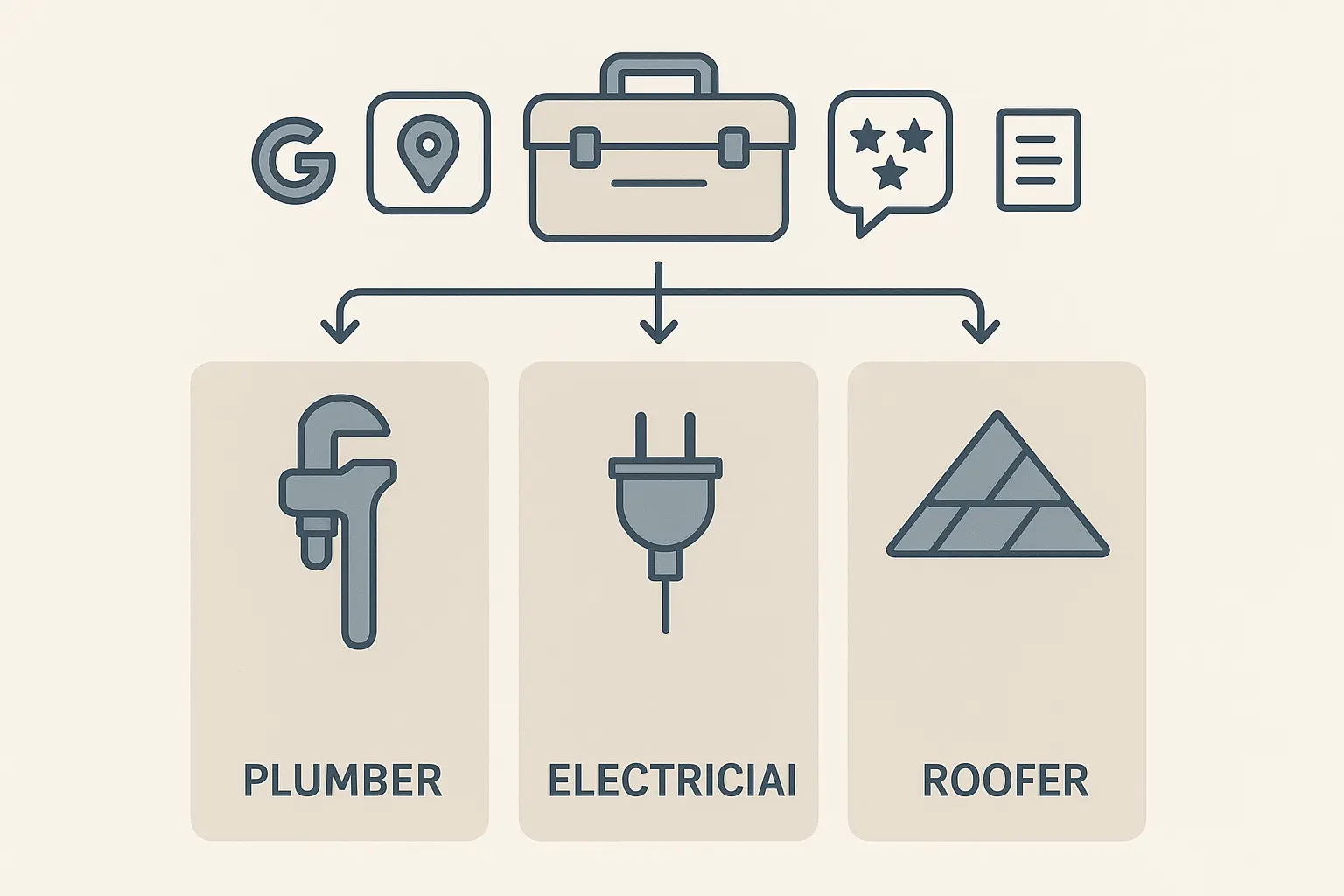
Imagine you’re managing marketing for three local home service clients: a plumber, an electrician, and a roofer. You build each of them a beautiful new service page using the same proven template: a strong headline, a list of services, a contact form, and some customer photos.
It’s efficient. It’s consistent. And it’s probably costing your clients leads.
Why? Because a homeowner frantically searching for an “emergency plumber near me” has a completely different mindset—and search intent—than someone researching the “cost of a new asphalt roof.” Google understands this nuance, and your service page structure needs to reflect it.
A one-size-fits-all approach no longer works in local SEO. The data confirms this: nearly half of all Google searches are for local information. To capture that traffic, you have to go beyond generic advice and build pages that speak directly to a specific customer’s immediate needs.
This blueprint will break down how to structure service pages for three distinct home service verticals, transforming your pages from simple online brochures into powerful lead-generation engines.
The Foundational Shift: From Keywords to Customer Intent
For years, local SEO was about stuffing city names and keywords onto a page. Today, it’s about understanding the intent behind the search. Google’s job is to deliver the most helpful result for a user’s problem, and that problem changes dramatically depending on the trade.
-
The Plumber: The search is often driven by urgency and panic. A burst pipe or clogged drain needs a fast, trustworthy solution.
-
The Electrician: The search is usually rooted in a planned project or a safety concern. It involves more research and a need for technical expertise.
-
The Roofer: The search is a high-consideration, long-term investment. The user is weighing costs, materials, and long-term value.
Failing to tailor your on-page strategy to these unique intents means you’re not fully answering the user’s question. And in SEO, the most helpful answer always wins.
The Emergency Blueprint: Structuring a Plumber’s Service Page
When a pipe bursts at 2 AM, the customer isn’t comparison shopping; they’re looking for a hero. Your plumber’s service page must be built for speed, trust, and immediate action.
Content & On-Page Elements: The “Right Now” Approach
The goal here is to reduce friction and build instant confidence.
-
Above the Fold: The first thing a user sees must contain a click-to-call phone number, an “Emergency Service Available” banner, and the primary service areas (e.g., “Serving Dallas & Fort Worth”). This is critical, since a staggering 76% of local mobile searches result in a phone call within 24 hours.
-
Trust Signals: Prominently display logos for licenses, insurance (“Fully Licensed & Insured”), and any satisfaction guarantees. This isn’t the place for modesty.
-
Urgency-Focused Copy: Use words and phrases that match the searcher’s panic: “fast,” “24/7,” “immediate response,” “emergency repair,” and “available now.”
-
Scannable Service List: Don’t write a novel. Use bullet points for common problems like “Clogged Drains,” “Leaky Faucets,” “Water Heater Repair,” and “Sewer Line Issues.”
-
Testimonials that Reflect Speed: Feature reviews that say, “They arrived in 20 minutes and fixed the leak!” instead of generic praise.
Essential Schema Markup
Schema markup is code that helps search engines better understand the content on your page. For a plumber, focus on clarity and accessibility.
-
LocalBusiness & Plumber: This tells Google exactly what the business is and where it operates.
-
Service: Mark up each specific service (e.g., Drain Cleaning) to help Google understand the full scope of offerings.
-
FAQPage: Answer common emergency questions like, “How do I shut off my main water line?” This captures valuable long-tail search traffic and establishes authority.
This entire structure is designed to answer one question: “Can you solve my emergency right now?” For agencies looking to deliver immediate value, optimizing for this intent is a core part of effective white-label SEO services.
The Project & Safety Blueprint: Structuring an Electrician’s Service Page
Hiring an electrician is rarely an impulse decision. It’s a calculated choice about safety, compliance, and technical expertise. The customer is planning a project like an EV charger installation or dealing with a flickering light that has them worried. Your page needs to build confidence in the electrician’s skill, not just their speed.
Content & On-Page Elements: The “Right Way” Approach
You’re educating a cautious buyer and proving your client is the most qualified expert for the job.
-
Highlight Expertise: Go beyond a simple list. For a service like “Electrical Panel Upgrade,” explain why a homeowner might need one (e.g., adding new appliances, safety compliance) and what the process involves.
-
Show, Don’t Just Tell: Use a gallery of high-quality photos or short before-and-after videos of completed projects. Visual proof is incredibly powerful.
-
Emphasize Safety & Compliance: Mention specific certifications (e.g., “Master Electrician”), adherence to the National Electrical Code (NEC), and a commitment to safety protocols. This is a massive differentiator.
-
Detailed Service Descriptions: Break down complex services into understandable steps. For “EV Charger Installation,” you might detail the consultation, wiring, and final testing process.
-
Case Studies: A brief “Project Spotlight” on a recent installation can demonstrate capability far better than a simple bulleted list.
Essential Schema Markup
For an electrician, schema should highlight their qualifications and the specifics of their work.
-
LocalBusiness & Electrician: The foundational markup.
-
Service: Detail each service clearly.
-
HowTo: For a topic like “How to test a smoke detector,” you can create a simple guide with HowTo schema. This builds topical authority and attracts users early in their journey.
-
ImageObject: Use this for your project photos to help them appear in image search results, providing another entry point for potential customers.

The High-Consideration Blueprint: Structuring a Roofer’s Service Page
A new roof is one of the biggest investments a homeowner will make. The sales cycle is long, and the decision is based on trust, value, and long-term performance. The service page must function as a comprehensive resource that guides the user through this complex decision.
Content & On-Page Elements: The “Right Investment” Approach
Your goal is to be a trusted advisor, helping the user make a smart financial decision they’ll be happy with for decades.
-
Lead with Value, Not Just Price: Instead of “Cheap Roof Repair,” focus on “Durable Roofing Solutions” and “25-Year Warranty.” Frame the service as a long-term investment in their home’s safety and value.
-
Material Comparison Guides: Create a section that clearly explains the pros and cons of different materials (e.g., asphalt shingles, metal, tile). Include information on lifespan, cost, and energy efficiency.
-
Explain The Process: Detail what a customer can expect, from the initial inspection and estimate to the final cleanup. Demystifying the process reduces anxiety and builds trust.
-
Showcase Reviews and Reputation: With an investment this large, social proof is everything—after all, 88% of consumers trust online reviews as much as personal recommendations. Feature full-text testimonials, link to your Google Business Profile, and display badges from the Better Business Bureau or local trade associations.
-
Financing Information: If your client offers financing, make it a prominent callout. This addresses a major purchase barrier head-on.
Essential Schema Markup
A roofer’s schema should reflect the investment-level nature of their services.
-
LocalBusiness & Roofer: The essentials.
-
Service: Markup services like “Roof Replacement” and “Storm Damage Repair.”
-
Product: If you detail specific roofing materials (e.g., GAF Timberline HDZ Shingles), you can use Product schema with details about the material and its warranty.
-
VideoObject: Drone footage of a completed roofing project is incredibly compelling. Use VideoObject schema to help it rank in video search results.

Beyond the Blueprint: Tying It All Together
While the structure for each trade is unique, some elements are universal:
-
Hyperlocal Signals: Every page must include the city, state, and prominent neighborhoods served.
-
Clear Calls-to-Action (CTAs): Whether it’s “Call Now for Emergency Service” or “Request a Free Estimate,” guide the user to the next step.
-
Mobile-First Design: The majority of local searches happen on a phone. Your page must be flawless on a small screen.
By moving away from a generic template and adopting a user-intent-driven model, you can create service pages that don’t just rank—they convert. You prove to both Google and potential customers that your client is the absolute best solution for their specific, immediate problem.
Frequently Asked Questions (FAQ)
What is schema markup and why does it matter for local SEO?
Schema markup is a type of microdata you add to your website’s code to help search engines better understand your content. Think of it as a translator for Google. For local businesses, it can explicitly state your address, phone number, business hours, and services offered, which can lead to richer, more informative search results (like star ratings or FAQs appearing directly in the SERP).
How many service pages should a local business have?
A business should have a dedicated page for each distinct service it wants to rank for. For example, a plumber should have separate pages for “Water Heater Installation,” “Drain Cleaning,” and “Sewer Line Repair.” This allows you to tailor the content on each page to the specific user intent behind that search query, increasing your relevance and ranking potential.
Should I create a service page for every city I service?
This is a common question. If you have a physical office in a city, you should absolutely create a dedicated location page. For a service-area business (SAB), it’s more effective to create robust service pages that mention the key cities and neighborhoods you serve, rather than creating thin, duplicate “service + city” pages for every single town. Focus on building one strong page and localizing it with testimonials, project photos, and mentions from the areas you cover.
How important are customer reviews for these service pages?
Extremely important. Reviews are a massive trust signal for both users and search engines. They provide social proof and contain valuable keywords related to your services. Weaving snippets of positive reviews directly onto your service pages (and using schema to mark them up) can significantly boost credibility and conversion rates.