
You feel the pressure every day. Client demands are growing, the competition is fierce, and the only way to stay profitable is to scale. So you turn to AI, hoping for a silver bullet.
But instead of a solution, you find a new dilemma: How do you embrace automation for 90% of the workload without letting the crucial 10% of strategic oversight slip through the cracks?
This is the core scalability challenge every agency leader is facing. While some guides offer a list of AI tools and others warn you about Google’s policies, few provide a practical, operational playbook for balancing AI execution with human expertise.
That’s what this guide is for. We’re going to walk you through the Human-in-the-Loop (HITL) model—a framework designed not just to manage AI, but to master it. It’s how you scale execution while maintaining quality control, empowering your team to focus on what they do best: strategy and client success.
The JVGLABS Human-in-the-Loop Framework
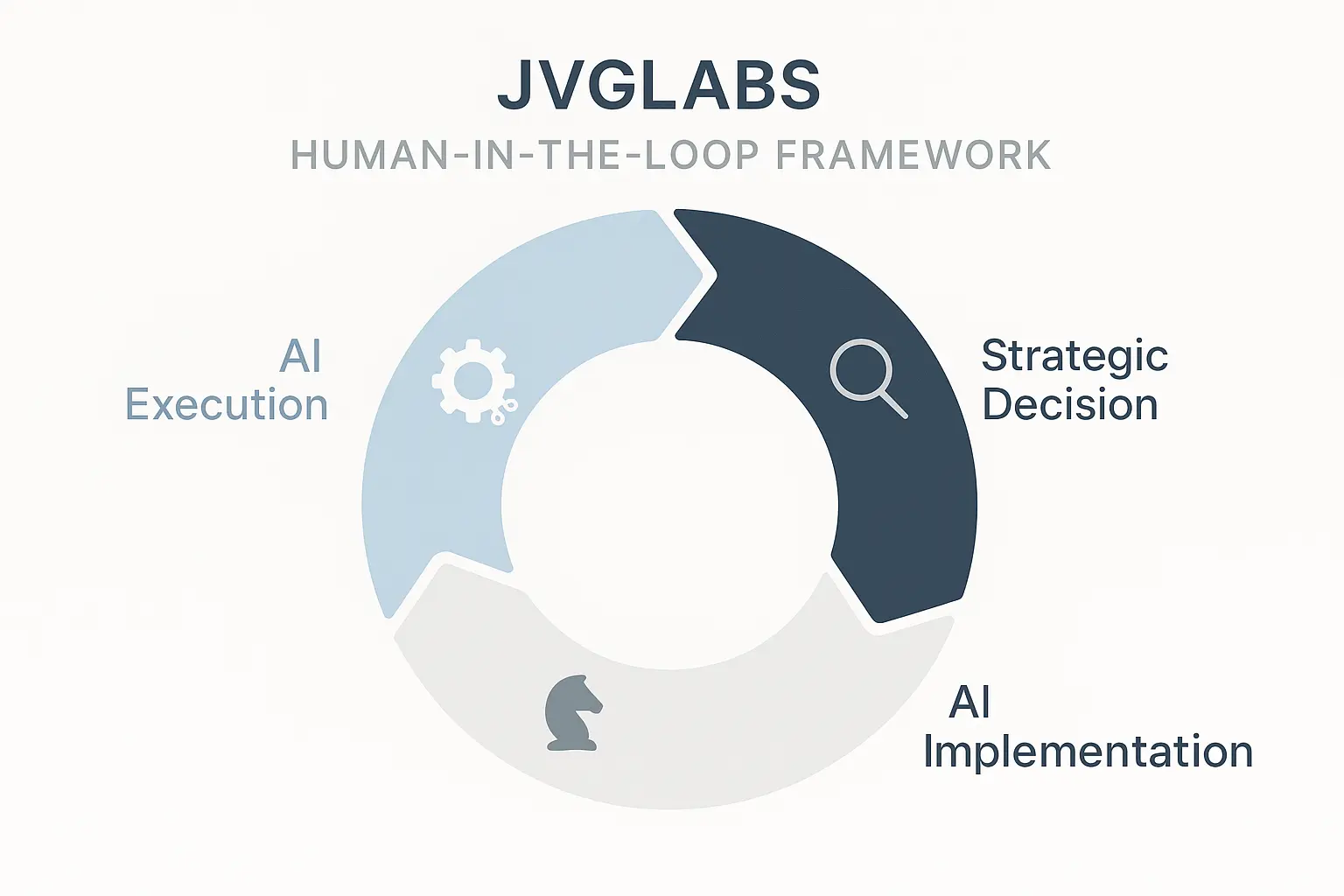
The problem isn’t AI; it’s the workflow. A successful AI-driven SEO operation isn’t a simple handoff to a machine. It’s a continuous, self-reinforcing cycle where technology amplifies human intelligence. We’ve designed our entire white-label SEO service around this principle.
Our framework visualizes this process in four distinct but interconnected stages:
- AI-Powered Execution: This is where scale happens. AI handles the heavy lifting—running technical audits across dozens of sites, generating content outlines from SERP data, and compiling performance metrics for reports.
- Strategic Human Review: At critical checkpoints, a human expert intervenes. This isn’t about redoing the work; it’s about validating it. Does the AI-flagged technical issue impact conversions? Does the content brief align with the client’s brand voice? Is the data telling the full story?
- Data-Driven Decision: Based on the review, the strategist makes a key decision. This might be prioritizing a specific set of technical fixes, refining a content angle to demonstrate E-E-A-T, or identifying a new keyword opportunity from an automated report.
- Targeted Implementation: The decision is fed back into the system. The strategist directs the AI (or a human specialist for complex tasks) to implement the refined action, ensuring human intelligence guides every execution cycle.
This cyclical process ensures you gain the efficiency of automation without ever sacrificing the strategic integrity your clients pay for.
Structuring Your Agency for an AI-Assisted Future
Adopting a HITL model means evolving your team’s roles to focus on oversight and strategy, not just manual execution. Instead of hiring more generalists to handle more tasks, you empower specialists to manage the output of your automation systems.
Here’s what that looks like in practice:
- SEO Strategist: This role shifts from “doer” to “director.” The strategist sets overarching client goals, reviews AI-generated audits and reports for strategic insights, and makes the final call on priorities. They spend less time pulling data and more time interpreting it.
- AI Content Editor: This isn’t just a proofreader. Since 93% of marketers already review AI-generated content, this role has become mission-critical. The editor ensures AI-assisted drafts meet E-E-A-T standards, align with brand voice, and fulfill searcher intent. They work with AI to refine briefs and optimize content, not just write it from scratch.
- Technical SEO Analyst: This specialist takes the output from automated crawlers and diagnostic tools and contextualizes it. Instead of manually running audits, they validate AI-flagged errors, determine their business impact, and create prioritized implementation plans for development teams.
By restructuring around these roles, your agency can handle double the client load without doubling your headcount. You transform your team into strategic advisors—a far more valuable and profitable position to be in.
QA Workflows for Core SEO Tasks
A framework is only as good as its execution. To avoid sacrificing quality, you need rigorous Quality Assurance checkpoints built directly into your automated workflows. While competitors may offer high-level advice, they rarely provide the tactical checklists needed in an agency setting.
Here’s a breakdown of how to implement human-led QA for three core SEO functions.
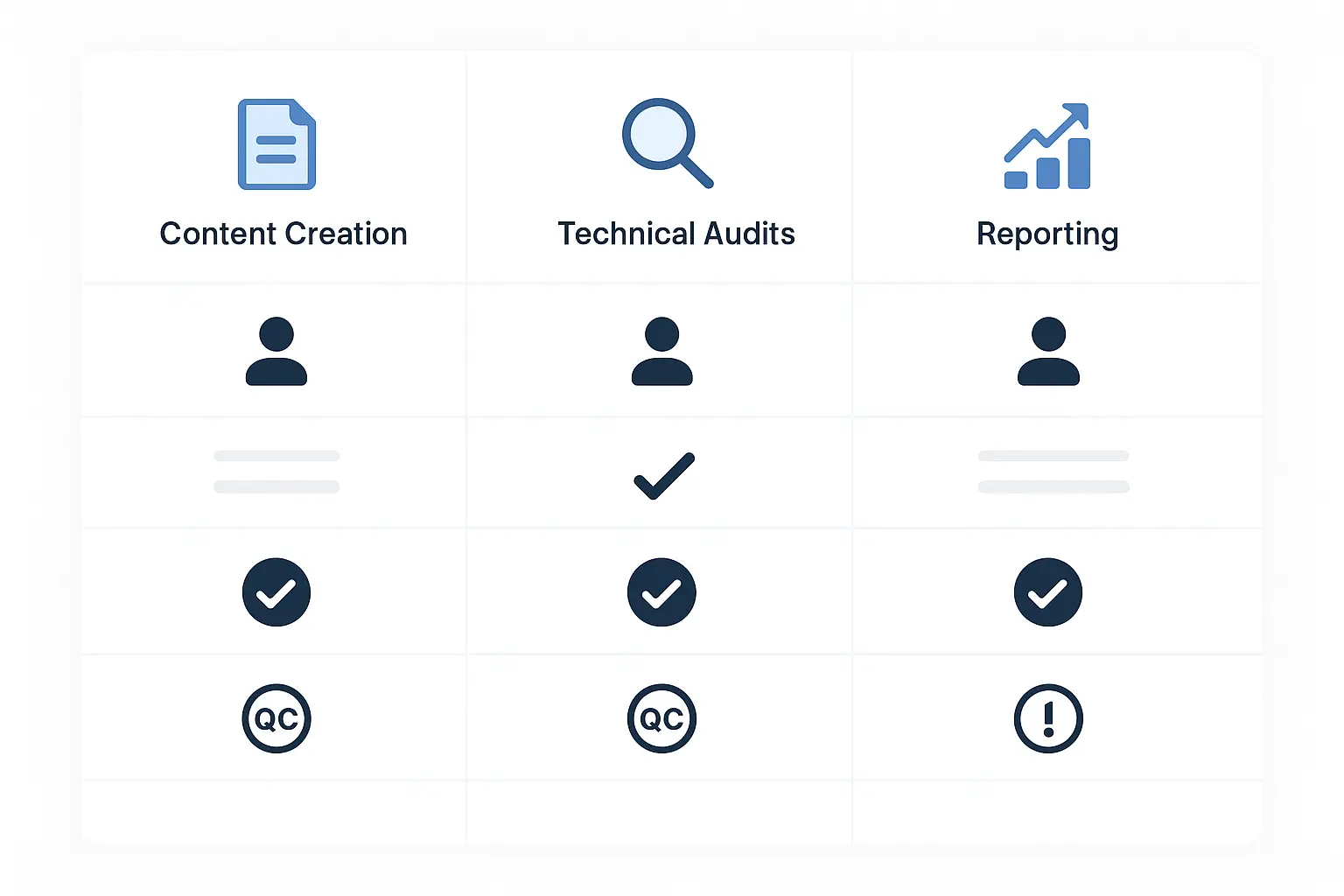
1. AI-Assisted Content Creation
- AI Execution: Generate content briefs based on top-ranking pages, including keywords, entities, word count targets, and question-based headings.
- Human QA Checklist:
- Strategic Alignment: Does the proposed angle align with the client’s unique expertise and business goals?
- E-E-A-T Review: Where can we inject first-hand experience, expert quotes, or proprietary data that AI can’t invent? (Remember, Google rewards helpful content, regardless of how it’s produced.)
- Brand Voice Check: Is the tone appropriate? Does it reflect the client’s established voice?
- Fact-Checking: Are all stats, dates, and claims cited and verified from primary sources?
2. Automated Technical Audits
- AI Execution: Run scheduled site crawls to automatically identify common issues like broken links, missing meta descriptions, slow page speed, and schema errors.
- Human QA Checklist:
- Impact Prioritization: Which of these 50 flagged “errors” actually affect rankings and user experience? (e.g., A broken link on a high-traffic page is P1; a missing alt tag on a decorative image is P4.)
- Root Cause Analysis: Is this 404 error a one-off, or does it indicate a systemic problem with the CMS permalink structure?
- Validation: Is the AI’s diagnosis correct? Cross-reference critical errors with Google Search Console data.
3. Scalable Client Reporting
- AI Execution: Automate the aggregation of data from Google Analytics, Search Console, and rank tracking tools into a branded report template.
- Human QA Checklist:
- Narrative Building: What is the story behind the numbers? Move beyond “rankings went up” to “rankings for high-intent keywords improved, leading to a 15% increase in qualified leads.”
- Insight Generation: What are the key takeaways and recommended next steps? AI can present data, but a human strategist provides the “so what.”
- Contextualization: Did a known algorithm update or a client’s marketing campaign influence these results? Add the context AI lacks.
This structured QA process is central to our AI-powered SEO automation, allowing us to deliver consistent, high-quality results for our agency partners.
Escalation Processes: When to Intervene
Automation is powerful, but it’s not infallible. A robust HITL model must include a clear plan for when things go wrong. Without an escalation process, a small AI-generated anomaly can quickly become a major client issue.
Your agency needs a simple decision tree to empower your team to act decisively.
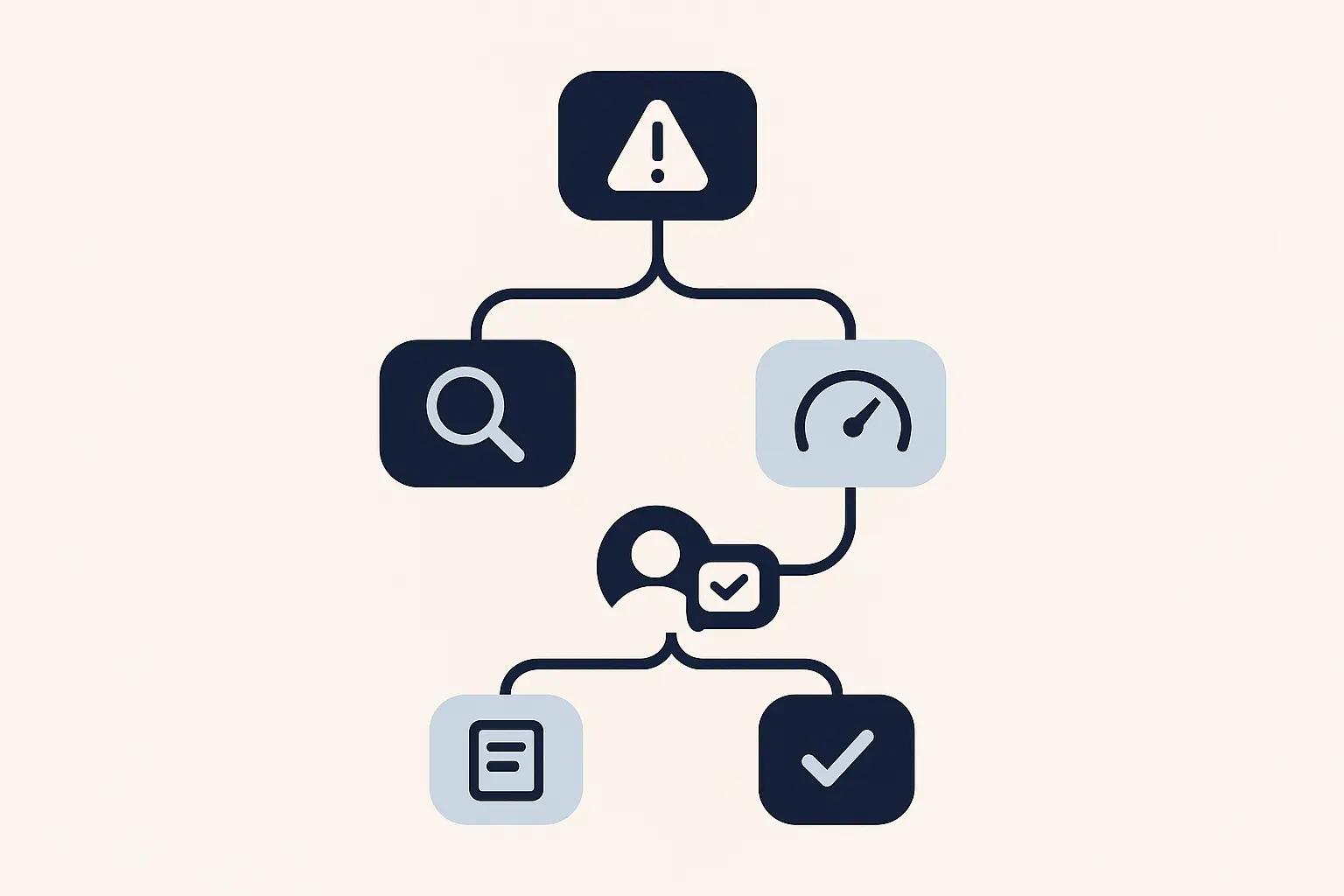
- Detect Anomaly: An automated alert fires (e.g., a key client page suddenly drops from the top 3, or organic traffic plummets by 20% overnight).
- Initial Triage (Analyst): The Technical SEO Analyst performs a quick diagnosis. Is this a reporting glitch, a known Google update, or a technical change on the client’s site?
- Investigate & Verify (Analyst): Using a standard checklist, the analyst dives deeper, checking GSC for manual actions, reviewing recent code deployments, and analyzing server logs. The goal is to isolate the probable cause within a set timeframe (e.g., 60 minutes).
- Escalate to Strategist (If Needed): If the cause isn’t immediately obvious or the potential impact is high, the analyst escalates the issue to the SEO Strategist.
- Strategic Response (Strategist): The Strategist owns the client communication and recovery plan. They analyze the competitive landscape, determine the business impact, and devise a solution—whether it’s rolling back a change, disavowing toxic links, or overhauling a piece of content.
This structured approach prevents panic and ensures a measured, expert-led response, building client trust even when things go wrong.
Case Study: Putting the Framework into Practice
Consider a typical digital marketing agency struggling to scale its SEO offering.
The Challenge: The agency has 15 clients but only one in-house SEO specialist, who is completely swamped with manual audits, content briefs, and reporting. They’re turning away new business because they lack the capacity to deliver.
The Solution: They partner with JVGLABS, implementing our white-label Human-in-the-Loop model.
- AI Execution: JVGLABS’ platform automates the initial technical audits, keyword research, and performance data aggregation for all 15 clients.
- Human Review: The agency’s specialist transitions into a Strategic Director role. Instead of spending 30 hours a week on manual tasks, she now spends 10 hours reviewing the prioritized outputs, validating content briefs for strategic fit, and adding a narrative to the reports.
- The Results:
- Capacity Increased 3x: The agency can now confidently take on 30+ SEO clients without hiring additional staff.
- Efficiency Gained: The time spent on monthly reporting per client drops from 4 hours to just 45 minutes.
- Performance Improved: With the strategist focused on high-impact opportunities instead of routine tasks, client performance improves. This aligns with industry data showing 52% of SEOs report better performance when using AI for on-page SEO.
This isn’t just theory. This is the operational reality for agencies that successfully blend automation with expertise.
Frequently Asked Questions
- Won’t adding human review checkpoints slow down our delivery?
On the contrary, it speeds up what matters. It eliminates time wasted on low-impact tasks and prevents costly mistakes that require hours of rework. The goal isn’t to review everything, but to review the right things at critical junctures. This is agility, not bureaucracy. - How do we implement this without investing in expensive new tools and training?
This is the core challenge our model solves. Partnering with a white-label provider like JVGLABS gives you immediate access to a pre-built, fine-tuned Human-in-the-Loop system. You get the benefits of our AI-powered SEO automation and expert oversight without the overhead of building it yourself. - Can we really trust AI with sensitive client data?
Security and compliance are non-negotiable. Any reputable partner must provide enterprise-grade security protocols. At JVGLABS, our platform is built with data privacy at its core, ensuring all client information is handled with the strictest confidentiality so you can scale with peace of mind. - How do we explain the use of AI to our clients?
You don’t have to. The beauty of a true white-label partnership is that we remain invisible. You present the strategic insights and impressive results as your own. If you do choose to discuss your methods, you can confidently frame it as using a “proprietary technology platform” to enhance efficiency and deliver data-driven insights faster.
The Future of SEO is a Hybrid You Can’t Build Alone
The debate is over. AI is a permanent fixture in SEO. Today, 86% of SEO professionals have already integrated it into their workflows, and that number is only growing.
The winning agencies of tomorrow won’t be the ones who resist automation, nor will they be the ones who blindly trust it. The winners will be those who master the hybrid model—seamlessly blending the scalable power of AI with the irreplaceable strategic wisdom of human experts.
Building that system from scratch is a massive undertaking. It requires the right technology, the right processes, and the right talent.
Or, you can partner with a team that has already perfected it. JVGLABS provides the platform, the process, and the people to act as your invisible, scalable SEO department. You maintain full client control and brand integrity; we deliver the results in the background.
If you’re ready to stop choosing between scale and quality, let’s talk. Schedule a demo to see how our Human-in-the-Loop model can transform your agency’s capacity and profitability.