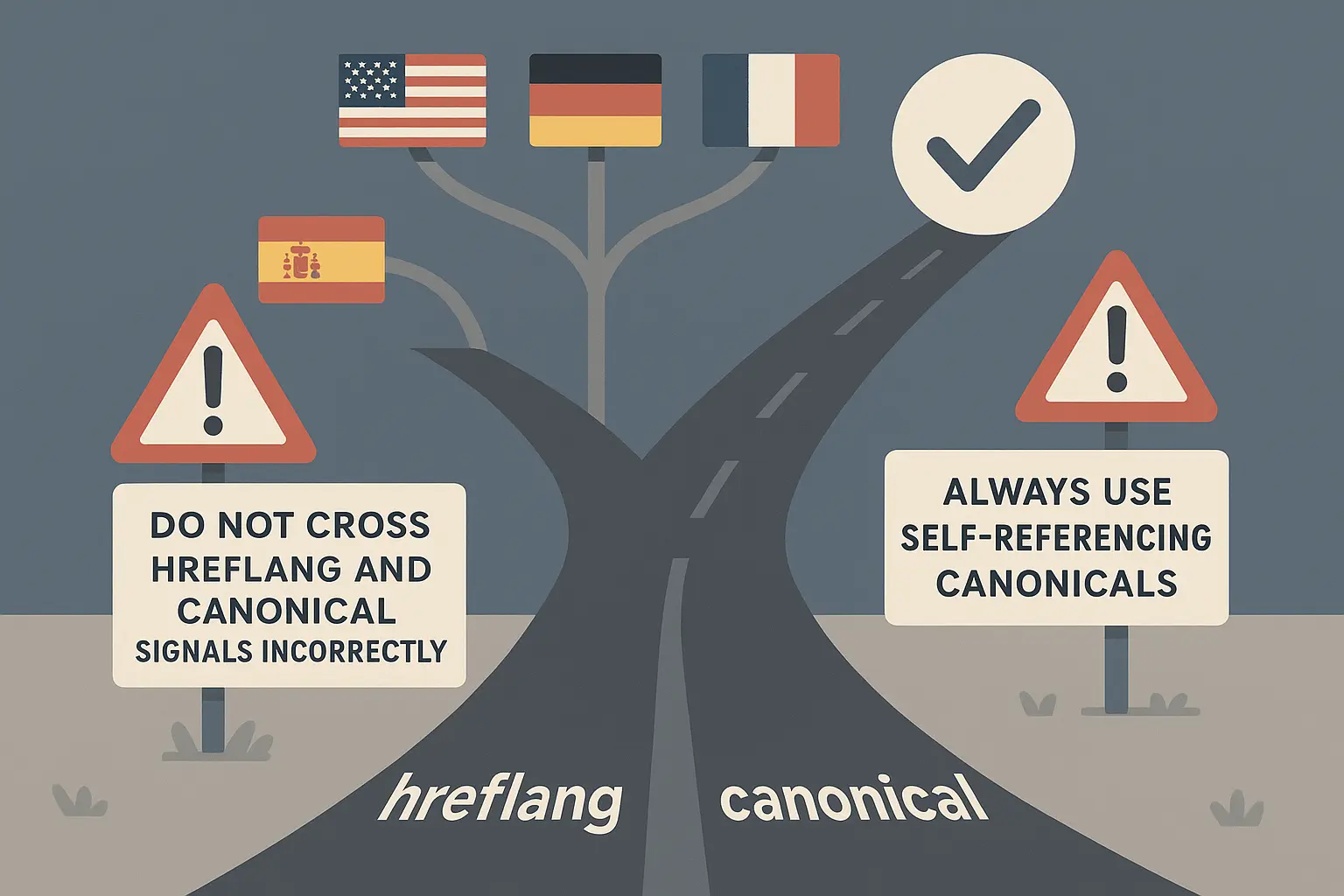

The Currency Conundrum: Solving Hreflang & Canonical Conflicts on International E-commerce Sites
Imagine your agency helps a client launch their e-commerce store in the UK. The products are the same as in the US—just priced in Pounds Sterling (£) instead of Dollars ($). The launch is a success, and UK sales are climbing. But then, you notice something strange: the original US product pages are starting to drop out of Google’s search results.
Panic sets in. What’s going on?
You’ve just encountered one of the most common and costly traps in international SEO: the conflict between hreflang and canonical tags on multi-currency websites. It’s a subtle technical issue with significant business implications. A Baymard Institute study found that 55% of users will abandon a site if they can’t easily understand the currency or language.
If your agency helps clients expand globally, understanding this conflict isn’t just a best practice—it’s fundamental to their success. Let’s break it down.
A Simple Refresher: Hreflang vs. Canonical Tags
Before diving into the conflict, let’s quickly review the two signals at play. Think of them as instructions you send to search engines to help them understand your site’s structure.
What is an Hreflang Tag?
An hreflang tag is like a helpful airport guide for Google. It says, “You’ve landed at the right terminal, but the gate for travelers from Germany is over here, and the gate for travelers from France is over there.”
In technical terms, it tells search engines which language and regional version of a page to show a user based on their location and language settings.
hreflang=”en-us” is for English speakers in the United States.
hreflang=”en-gb” is for English speakers in Great Britain.
hreflang=”de-de” is for German speakers in Germany.
Its purpose is to connect the right user with the right version of your content.
What is a Canonical Tag (rel=”canonical”)?
A canonical tag acts as the “master copy” declaration. When you have multiple pages with similar or identical content (like a product page sorted differently or, in our case, just with a different currency), the canonical tag tells Google, “Of all these similar pages, this is the one true version. Please focus all your indexing power and ranking signals on it.”
This tag’s primary job is to prevent duplicate content issues and consolidate your SEO authority onto a single, preferred URL.
The Currency Conflict: Why Your Signals Are Getting Crossed
Here’s where e-commerce gets tricky. You have a product page for a blue widget on your US site (example.com/blue-widget) priced at $50. You then create an identical page for your UK audience (example.com/uk/blue-widget) priced at £40.
The content is 99% the same. The language is the same. The only significant difference is the currency and perhaps some shipping details.
The common—but incorrect—instinct is to think: “This is duplicate content. I should tell Google the US page is the master version.” So, you add a canonical tag on the UK page that points back to the US page.
On example.com/uk/blue-widget, you set: <link rel="canonical" href="https://example.com/blue-widget" />
At the same time, you use hreflang tags to tell Google that the UK page is for UK users.
On both pages, you set: <link rel="alternate" hreflang="en-gb" href="https://example.com/uk/blue-widget" />
See the problem? You’re sending Google two completely contradictory signals:
-
Hreflang says: “Hey Google, this UK page is a unique and important version for users in Great Britain!”
-
Canonical says: “Hey Google, ignore this UK page. It’s just a copy. The real one is the US page.”
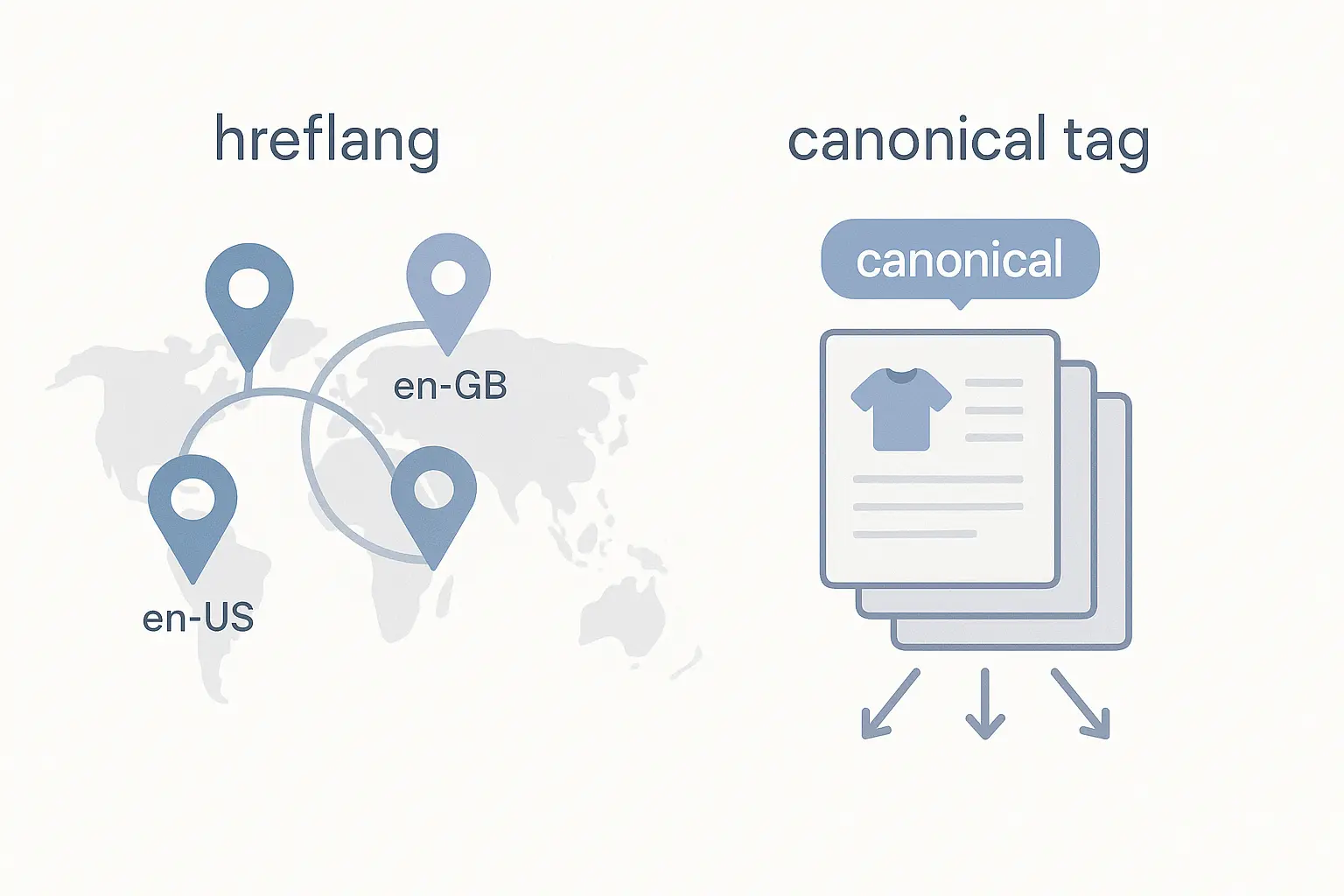
Google’s crawlers are powerful, but they aren’t mind readers. As Google Search Central documentation warns, rel=”canonical” and hreflang are signals, not directives. When you send conflicting signals, Google has to make a choice, and it often leads to the wrong page being indexed—or de-indexed entirely.
More Than a Tech Issue: The Real Cost of Getting It Wrong
This isn’t just a technical SEO headache; it directly impacts the bottom line. Research shows that 76% of online shoppers prefer to see prices in their local currency. When Google gets confused and shows your US page to a UK shopper, you introduce friction at the most critical point of their journey.
This confusion can lead to:
-
Increased Cart Abandonment: Forty percent of shoppers will abandon a purchase if their preferred payment method or currency isn’t obvious.
-
Poor User Experience: Forcing users to convert currencies or guess at shipping costs creates uncertainty and erodes trust.
-
Skewed SEO Performance: The wrong pages rank in the wrong countries, leading to high bounce rates and low conversion rates.
-
De-indexing: In the worst-case scenario, Google may follow your canonical tag and simply stop indexing your regional pages, making them invisible in search.
For agencies managing multiple global clients, spotting these nuances is critical. It’s often where a dedicated white-label SEO partner can turn a potential disaster into a competitive advantage by ensuring technical precision across every client account.
The Right Way: How to Align Hreflang and Canonical Signals
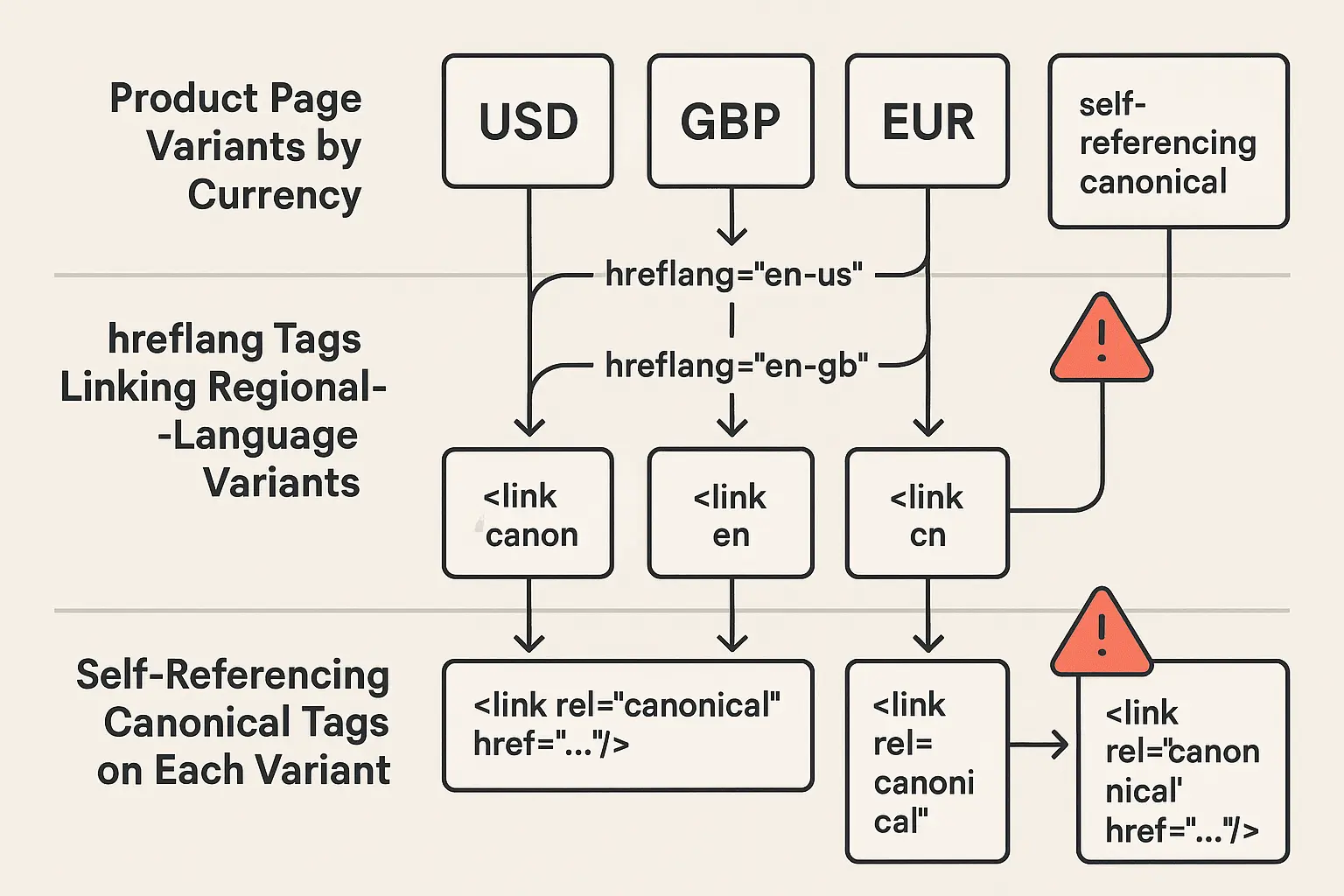
The fix, thankfully, is surprisingly simple: the self-referencing canonical.
A self-referencing canonical tag is one where a page declares itself as the master copy.
This approach resolves the conflict by sending Google two clear, consistent signals:
-
Hreflang says: “I have several distinct international versions of this page (for the US, UK, Australia, etc.).”
-
Canonical says: “And each of these versions is its own unique master copy that deserves to be indexed.”
Here’s how it looks in practice for our blue widget:
On the US page (example.com/blue-widget):
<link rel="canonical" href="https://example.com/blue-widget" /><link rel="alternate" hreflang="en-us" href="https://example.com/blue-widget" /><link rel="alternate" hreflang="en-gb" href="https://example.com/uk/blue-widget" />On the UK page (example.com/uk/blue-widget):
<link rel="canonical" href="https://example.com/uk/blue-widget" /><link rel="alternate" hreflang="en-us" href="https://example.com/blue-widget" /><link rel="alternate" hreflang="en-gb" href="https://example.com/uk/blue-widget" />This implementation tells Google that both the US and UK pages are legitimate, valuable, and should be indexed and served to the appropriate audiences. Google’s John Mueller confirmed this, noting that pages with the same content but different currencies risk being seen as duplicates without proper signals like these.
Manually checking thousands of product pages for correct implementation is impossible at scale, which is why many agencies rely on AI-powered SEO automation to crawl sites and flag these kinds of critical errors before they impact client revenue.
Your Questions, Answered: Hreflang & Canonical FAQs
Do I need hreflang if my site is only in English but has different currencies (USD, GBP, AUD)?
Yes, absolutely. Hreflang isn’t just for different languages; it’s for different regional audiences. Using en-us, en-gb, and en-au is the correct way to target English speakers in different markets with localized pricing.
What is a self-referencing canonical again?
It’s a canonical tag (rel=”canonical”) on a page that points to its own URL. This sends a clear signal to search engines that the page itself is the definitive version and should be the one indexed.
Can’t I just use one global page with a currency switcher?
You can, but it’s often not ideal for SEO. Having dedicated URLs for each region (e.g., /uk/product) allows you to send much stronger geographic signals to Google. It also provides the flexibility to customize content, promotions, and shipping information for each market, creating a better user experience.
How do I implement hreflang tags?
There are three primary methods: adding them as HTML tags in the <head> of your page (most common), including them in your HTTP headers, or listing them in your XML sitemap. For large e-commerce sites, the XML sitemap method is often the most scalable.
From Confusion to Clarity: Building a Global SEO Foundation
While international SEO is complex, the relationship between hreflang and canonicalization doesn’t have to be. By abandoning the cross-regional canonical and embracing the self-referencing model, you provide search engines with the clarity they need to rank the right pages for the right users.
Getting these technical details right is crucial. By understanding how these signals interact, you build a more resilient and profitable foundation for your clients’ global ambitions—and prove your agency’s value in a competitive market.