

The Franchise Dilemma: A Step-by-Step Agency Guide to GBP Ownership & Conflict Resolution
Imagine this: You’ve just landed a 50-location franchise client—a massive win. You’re ready to roll out a killer local SEO strategy, but on day one, you hit a wall.
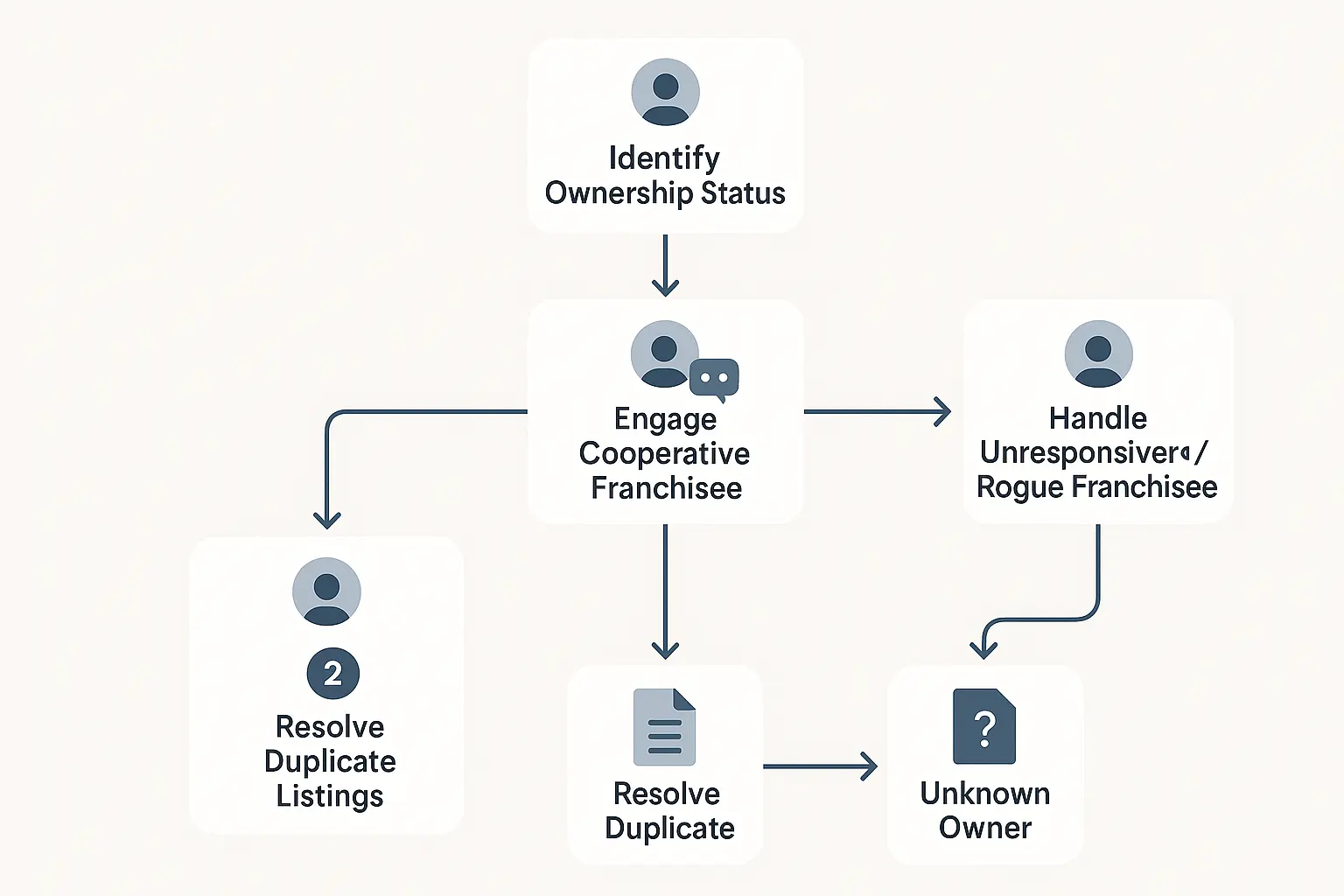
Ten different franchisees have already claimed their Google Business Profiles (GBPs). Another five listings are duplicates created by unknown users. Each profile has slightly different branding, outdated phone numbers, and a manager who believes they have the final say.
Sound familiar?
For agencies, managing multi-location brands is both a huge opportunity and a potential minefield. Franchisees are entrepreneurial and want to drive local business, which is a great instinct. But without a central playbook, their well-intentioned efforts can create a digital mess that undermines the entire brand. This isn’t just an organizational headache; it’s a direct threat to brand consistency and local search performance.
Why GBP Chaos Is a Bigger Problem Than You Think
Before we dive into the solution, let’s be clear about the stakes. A disorganized approach to franchise GBPs isn’t a minor inconvenience—it actively harms the business.
The data tells a compelling story. According to Whitespark’s renowned Local Search Ranking Factors study, Google Business Profile signals are the single most important factor for ranking in the coveted local map pack. When listings are inconsistent, they send conflicting signals to Google, diluting your client’s authority and pushing them down the results.
But the damage goes beyond rankings. It hits the bottom line.
Lost Engagement: Inconsistent profiles confuse customers and erode trust. According to Uberall, brands with accurate listings see up to 300% more engagement.
Missed Conversions: The impact on conversions is even more direct. Research from BrightLocal shows that profiles with over 100 images—a hallmark of good management—get 520% more calls and over 2,700% more website clicks.
When every franchisee is doing their own thing, you lose the cohesive power of the brand. This isn’t just a theory; it’s a widespread issue. Chatmeter reports that a staggering 41% of enterprise brands struggle with managing duplicate or inaccurate listings. You’re not alone in this fight, but you can be one of the few with a clear plan to win it.
The Root of the Conflict: When Good Intentions Go Wrong
The problem rarely starts with malice. It begins with an ambitious franchisee in Des Moines or a new manager in Miami wanting to update their holiday hours. They search for their business on Google, see “Own this business?” and click it. Just like that, a new branch of ownership is created, completely separate from the corporate marketing strategy.
Multiply this across dozens or hundreds of locations, and you get a tangled web of conflicting information, brand dilution, and ownership disputes.
As the agency, you’re caught in the middle, trying to implement a unified strategy while navigating local politics. To succeed, you need more than just SEO skills; you need a workflow for establishing a clear chain of command.
The Agency’s Playbook: A 5-Step Workflow for Taming GBP Chaos
Wrangling franchise GBP listings requires a diplomatic yet firm approach. This proven five-step process transforms chaos into a streamlined, high-performing asset for your client.
Step 1: The Global Audit & Identification Phase
You can’t fix what you can’t see. The first step is a comprehensive audit to identify every single listing associated with the brand.
Search Variations: Look for the brand name plus city or ZIP code, common misspellings, and old brand names.
Map Search: Manually scan Google Maps in key service areas to uncover rogue pins.
Use Tools: Leverage third-party tools to scan for duplicate listings with matching addresses or phone numbers.
Document everything in a central spreadsheet: the listing URL, its claimed or unclaimed status, the current owner (if known), and any inconsistencies like the wrong name, address, or phone number. This document becomes your single source of truth.
Step 2: Establish the Corporate Mandate
This is the most critical non-technical step. You cannot win this battle on a location-by-location basis; you need executive buy-in from the franchisor.
Present Your Audit: Show the corporate team the audit from Step 1. Visualize the inconsistencies and explain the negative impact on rankings and revenue, citing the research data.
Propose a Centralized Model: Make the case that for the brand to succeed in local search, all GBP assets must be managed under a single, central account that the agency controls on their behalf.
Secure an Official Memo: The goal is an official communication from the corporate office to all franchisees explaining the new policy. This memo must state that your agency is the designated manager for all GBP listings to ensure brand consistency and performance.
This corporate mandate gives you the authority to act and transforms franchisee pushback from a debate into simple policy enforcement.
Step 3: The Centralized Ownership & Request Process
With the corporate mandate in hand, it’s time to take control.
-
Create a Central Email: Use a generic corporate email for ownership, like gbp-admin@corporatebrand.com. This ensures the brand, not an individual or agency, retains ultimate ownership.
-
Request Ownership: For each claimed listing, use the “Request access” feature. In the request form, briefly state your purpose: “As per the corporate mandate from [Franchisor Name], our agency is centralizing GBP management to improve brand performance. Please grant us ownership access.”
-
Follow Up and Escalate: If a franchisee doesn’t respond within 3–7 days, follow up using the contact information in their profile and reference the corporate memo. If they still refuse, escalate the issue to your corporate contact.
Step 4: The Cleanup Crew: Merging and Removing Duplicates
Once you have ownership of the legitimate profiles, it’s time to clean up the duplicates.
Merge Listings: If you have two listings for the same location (e.g., one you claimed and one a franchisee created), you can ask Google to merge them. This consolidates their authority and review history but usually requires contacting Google Business Profile support directly.
Remove Ineligible Listings: For listings that are fraudulent or represent a closed location, suggest an edit on the profile to mark it as “permanently closed” or “doesn’t exist.”
Step 5: Education & Empowerment (The Diplomatic Finish)
You’ve taken control, but you don’t want to alienate the franchisees. The final step is to educate them on their new role.
Provide Guidelines: Create a simple one-page PDF explaining what has changed and why.
Define Their Role: Grant them “Site Manager” access. This allows them to respond to reviews, answer Q&As, create posts, and add photos—all the local engagement activities they care about—without being able to change core brand information like the business name, address, or primary category.
Show Them the Value: Explain that your agency is now handling the technical SEO, so they can focus on what they do best: serving local customers. Frame it as a partnership.
By empowering franchisees to contribute within a controlled environment, you get the best of both worlds: local authenticity and centralized brand control.

From Chaos to Control: The Payoff of a Unified Strategy
Implementing this workflow does more than tidy up listings; it creates a powerful foundation for growth. When all locations are aligned, you unlock massive benefits:
Brand Consistency: Every customer has the same high-quality experience, no matter which location they interact with.
Performance Data: You can accurately track calls, clicks, and direction requests across the entire enterprise from one dashboard.
Efficient Execution: Rolling out new promotions, updating holiday hours, or launching a new service becomes a simple task, not a 50-email nightmare.
Ultimately, a streamlined process makes it possible to scale your agency and deliver repeatable, high-impact results for large clients.
Frequently Asked Questions (FAQ)
What if a franchisee refuses to grant access?
This is exactly why the corporate mandate from Step 2 is essential. Escalate the issue to your corporate contact, who can then enforce the policy directly with the franchisee. Without that top-down authority, you risk getting stuck in endless negotiations.
How long does the GBP ownership request process take?
After you submit a request, the current owner has 3-7 days to respond. If they approve, you get access immediately. If they deny it, you can appeal. If they don’t respond, Google may allow you to verify your affiliation with the business to claim the profile.
Can franchisees still post updates or respond to reviews with this model?
Absolutely. By granting them “Site Manager” access, you empower them to handle day-to-day engagement like responding to reviews, adding photos, creating Google Posts, and answering questions. This allows them to connect with local customers without being able to alter core business details.
Is it better to create new listings or claim existing ones?
Always try to claim an existing, legitimate listing first, as it may have already accumulated reviews and search authority. Only create a new listing if one doesn’t exist for a location or if the existing one is hopelessly incorrect and Google Support can’t fix it.
Your Path to Franchise SEO Mastery
Managing GBP for a franchise is a complex but solvable challenge. By shifting from a reactive, location-by-location approach to a proactive, centralized workflow, you can eliminate brand dilution, drive measurable performance gains, and prove your strategic value to high-value clients.
The key is having a structured process, securing corporate buy-in, and using a blend of technology and diplomacy. For many agencies, executing this kind of detailed work across hundreds of locations requires dedicated systems and operational muscle. This is where specialized white-label SEO services can provide the necessary firepower, allowing you to focus on strategy while an expert partner handles the complex execution.