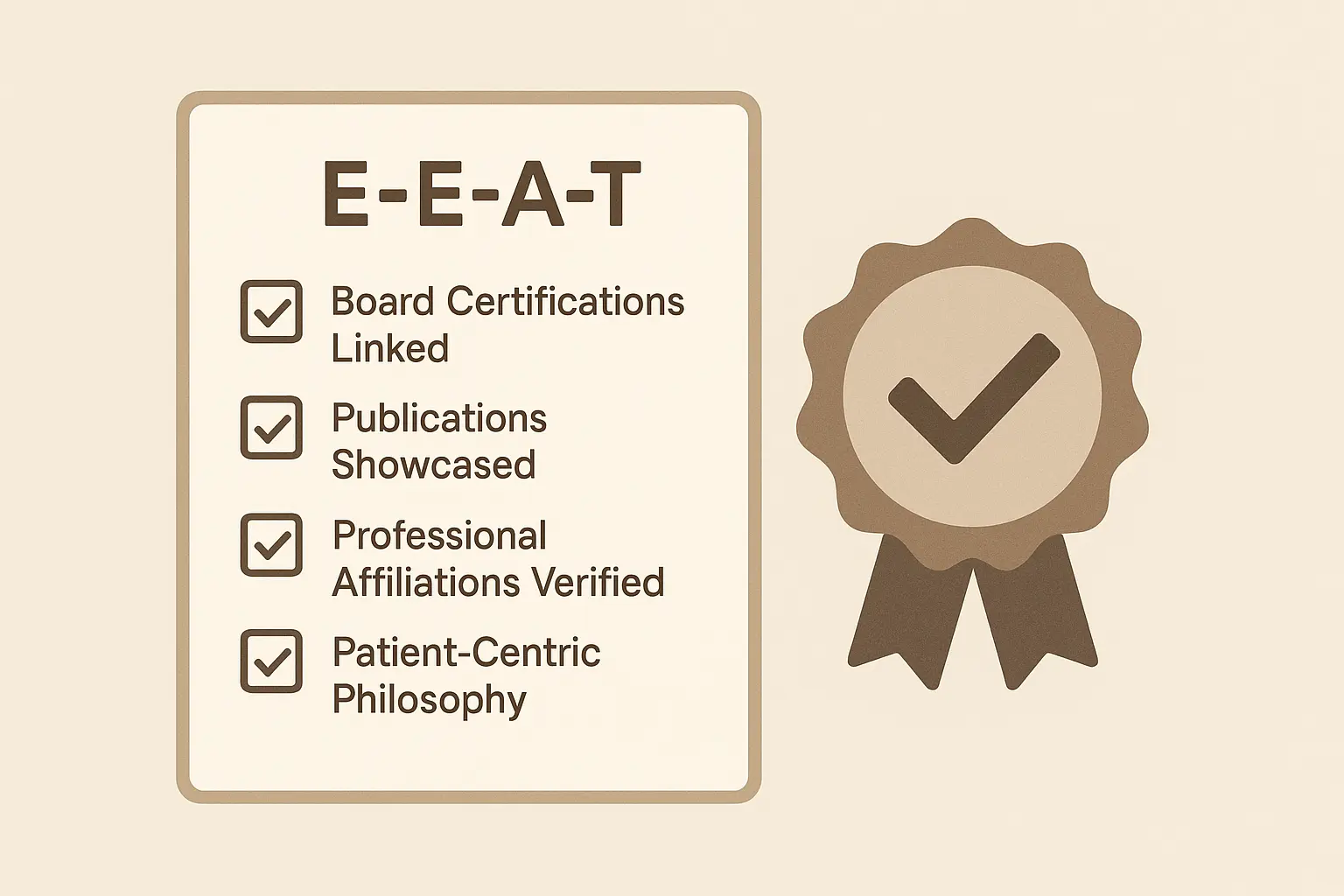

Imagine your agency has landed a fantastic new client: a respected multi-specialty medical practice. You’ve launched a brilliant content strategy, publishing well-researched articles on various health topics. Yet, weeks turn into months, and the traffic needle barely moves. The content is sound, and the keywords are right, but you’re stuck on page three of Google.
What’s missing? In the high-stakes world of healthcare content, the answer often lies not in what is said, but in who is saying it.
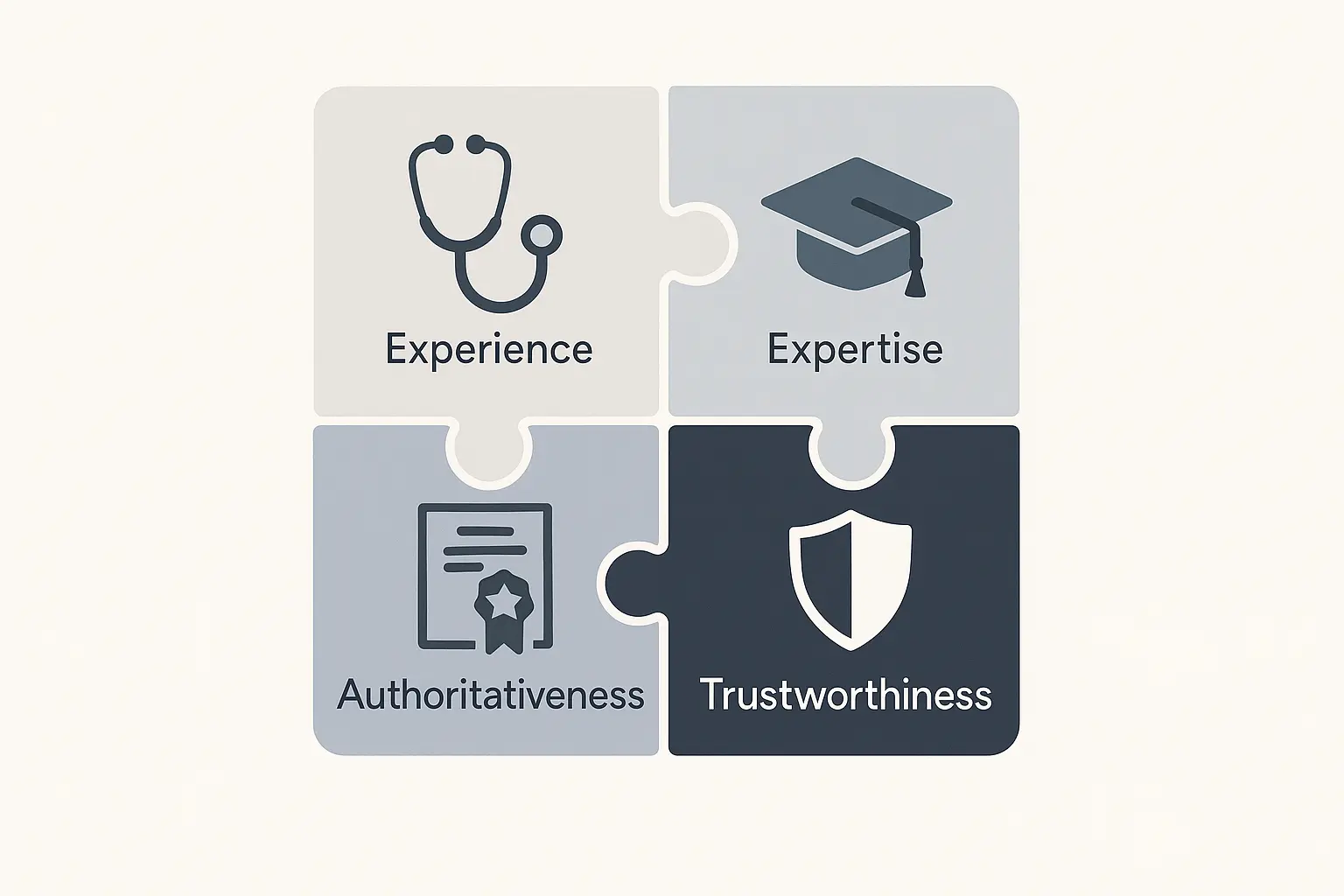
For medical websites, Google acts less like a search engine and more like a background checker. It scrutinizes every piece of content under its “Your Money or Your Life” (YMYL) guidelines, where misinformation can have devastating real-world consequences. This is where E-E-A-T—Experience, Expertise, Authoritativeness, and Trustworthiness—is the critical ranking factor you might be overlooking. And the single most powerful tool for demonstrating it is a doctor’s author bio.
Why Doctor Bios Are SEO Gold, Not an Afterthought
In many industries, an “About Us” page is a simple formality. In medicine, it’s the cornerstone of your entire SEO strategy. Google’s own Search Quality Rater Guidelines state that for YMYL topics, the reputation and E-A-T of the content creators are “extremely important.”
A doctor’s bio page is your opportunity to present a verifiable resume directly to Google. When you link to this bio from every article and service page the doctor has authored or reviewed, you send a clear, consistent signal that the information is backed by a qualified, real-world expert.
This article breaks down a framework for transforming a standard doctor bio into a powerful E-E-A-T asset, building trust with search engines and potential patients alike.
The Verifiable E-E-A-T Bio Framework
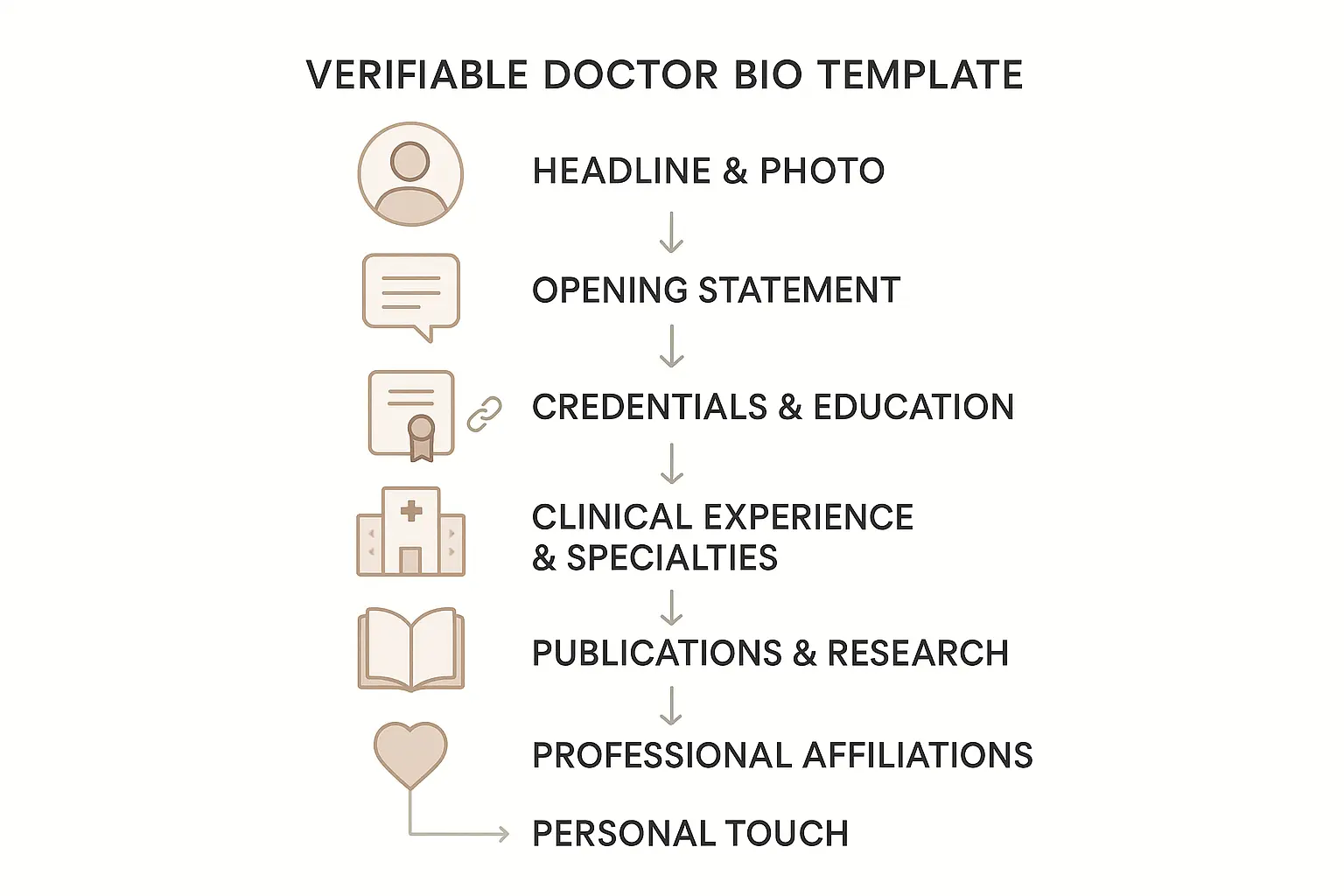
Think of this not as writing a bio, but as assembling a dossier of proof. Every claim must be verifiable, preferably with a link.
1. The Foundation: Name, Credentials, and Specialization
This is the non-negotiable starting point. Get it right and ensure it’s consistent everywhere the doctor is mentioned online.
- Full Name & Credentials: Use the full, formal name followed by all relevant credentials (e.g., “Maria S. Hernandez, MD, FACC”).
- Professional Title: Clearly state their role at the practice (e.g., “Lead Cardiologist,” “Founder and Chief of Surgery”).
- Specialization: Be specific about their area of expertise (e.g., “Board-Certified in Interventional Cardiology”). This immediately establishes relevance for related search queries.
This foundational information is the first step in a comprehensive white-label SEO for healthcare strategy, setting the stage for everything that follows.
2. Building Trust Through Verifiable Expertise
Trust is the final—and most important—letter in E-E-A-T. In the digital world, trust is built through third-party verification. Don’t just state facts; prove them with outbound links.
- Education & Training: List the doctor’s medical school, residency, and any fellowships. Crucially, link out to the official websites of these institutions. This allows search engines to verify the claim algorithmically.
- Board Certifications & Licenses: Name the certifying board (e.g., American Board of Internal Medicine) and link directly to it. If possible, include the state medical license number and a link to the state licensing board’s verification page.
These external links create a powerful, interconnected web of authority. You’re not just telling Google the doctor is an expert; you’re showing them that other respected institutions agree.
3. Demonstrating Authoritativeness & Experience
Expertise is what a doctor knows; authoritativeness is how that expertise is recognized by their peers and the public.
- Publications & Research: Has the doctor been published in peer-reviewed journals? Link to their profile on PubMed, Google Scholar, or directly to the published articles. This is one of the strongest authority signals you can send.
- Professional Memberships: List memberships in prestigious organizations like the American Medical Association (AMA) or the American College of Surgeons (ACS). Link to the official membership directories or websites.
- Speaking Engagements & Media Mentions: If the doctor has spoken at a conference or been quoted in a news article, link to the event or publication. This demonstrates that their expertise is sought after in the real world.
- Years in Practice: Clearly state the number of years the doctor has been practicing. This directly addresses the “Experience” component of E-E-A-T.
Managing these assets across multiple clients can be complex, which is why our AI-powered SEO platform helps agencies track and manage these crucial authority signals at scale.
4. The Technical Layer: Schema Markup
Schema markup is code you add to your website to help search engines better understand your content. For a doctor’s bio, it’s like adding a digital name tag that clearly spells out their credentials for Google’s crawlers.
Use Physician schema (a more specific type of Person and MedicalBusiness schema) to label key information like:
- name: The doctor’s full name.
- medicalSpecialty: Their area of focus.
- alumniOf: The educational institutions they attended.
- knowsAbout: The conditions and treatments they specialize in.
While it looks technical, this structured data makes it incredibly easy for Google to verify the doctor’s expertise and connect it to the content they produce.
Putting It All Together: The Bio as a Central Hub
Once this E-E-A-T-optimized bio page is complete, it becomes a central hub of authority. The final step is to ensure every piece of content the doctor writes or medically reviews includes a clear author byline that links back to their comprehensive bio page.
This simple internal link tells Google: “The person responsible for this information is the verified expert detailed on this page.” This directly answers the quality rater’s core question: “Who is responsible for the content on this site?”
Common Mistakes to Avoid
- Vague Claims: Avoid unprovable statements like “a leading expert” or “highly respected.” Instead, say “Published in The New England Journal of Medicine” and link to the article.
- No Outbound Links: A bio without links is just a list of claims. A bio with links is a portfolio of evidence.
- Forgetting Schema: Without schema, you’re making Google guess. With schema, you’re handing it an organized file.
- Orphaned Bios: A great bio that isn’t linked from content pages is an untapped asset. Connect it everywhere.
Frequently Asked Questions
What is E-E-A-T and why does it matter so much for doctors?
E-E-A-T stands for Experience, Expertise, Authoritativeness, and Trustworthiness. It’s Google’s framework for evaluating the quality and reliability of content, especially for “Your Money or Your Life” (YMYL) topics like healthcare. For doctors, a high E-E-A-T score signals to Google that their content is reliable, which is essential for ranking well and earning patient trust.
Does every doctor at a practice need a detailed bio?
Yes, absolutely. Every practitioner who contributes to the website’s content—whether by writing articles, appearing in videos, or being listed as a service provider—should have a detailed, verifiable bio. This strengthens the E-E-A-T of the entire domain.
Is it really a good practice to link out to other websites from a bio page?
Yes. For YMYL content, linking to authoritative, relevant sources like universities, medical boards, and publications is a best practice. It’s not about “leaking” SEO authority; it’s about providing third-party verification that builds trust and proves the claims you’re making.
How does a strong doctor bio help with more than just SEO?
A comprehensive bio builds immense trust with potential patients before they even pick up the phone. It answers their subconscious questions: “Is this doctor qualified?” “Do they have experience with my condition?” “Can I trust them?” A great bio turns a website visitor into a confident, informed potential patient.
Your Next Step: From Authority to Growth
Building a verifiable, E-E-A-T-optimized bio is no longer optional for medical practices—it’s a fundamental requirement for digital success. It’s the difference between being a voice in the crowd and being a trusted authority.
By implementing this framework, you provide clients with a powerful asset that signals credibility to search engines and builds confidence with patients. For agencies looking to deliver these kinds of sophisticated strategies consistently, the challenge is often execution at scale. Understanding the ‘what’ is the first step, but the capacity for the ‘how’ is what truly drives growth. That’s why many firms are turning to partners for scaling your agency with white-label SEO, allowing them to focus on strategy while ensuring expert execution.