

Standard e-commerce SEO guides are broken. They show you the what—keyword research, product page optimization, link building—but they don’t address the real challenge agencies face: delivering enterprise-level results at scale, without burning out your team or destroying your margins.
You aren’t just managing one store; you’re managing five, ten, maybe twenty. Each has thousands of SKUs, complex technical debt, and clients who demand revenue, not just rankings. The generic playbooks from high-authority blogs won’t help you build a scalable, profitable service.
This playbook is different. It’s built for agencies ready to move beyond the basics and start delivering revenue-focused e-commerce SEO that wins and retains high-value clients.
The Business Case: Why E-commerce SEO is a Non-Negotiable Service
Before you can build a service, you need to sell the vision. Your clients know they need SEO, but they might not grasp the sheer scale of the opportunity. Your job is to connect the dots between search visibility and their bottom line.
Frame the conversation with undeniable data. With global e-commerce sales projected to hit a staggering $6.4 trillion by 2025, the digital shelf is infinitely larger than any physical one. SEO isn’t just another marketing channel; it’s the primary driver of discoverability.
Research shows that SEO-driven traffic accounts for 23.6% of all e-commerce orders, one of the most efficient and sustainable sources of revenue available. This isn’t about short-term wins; it’s about building a long-term asset that generates predictable growth.
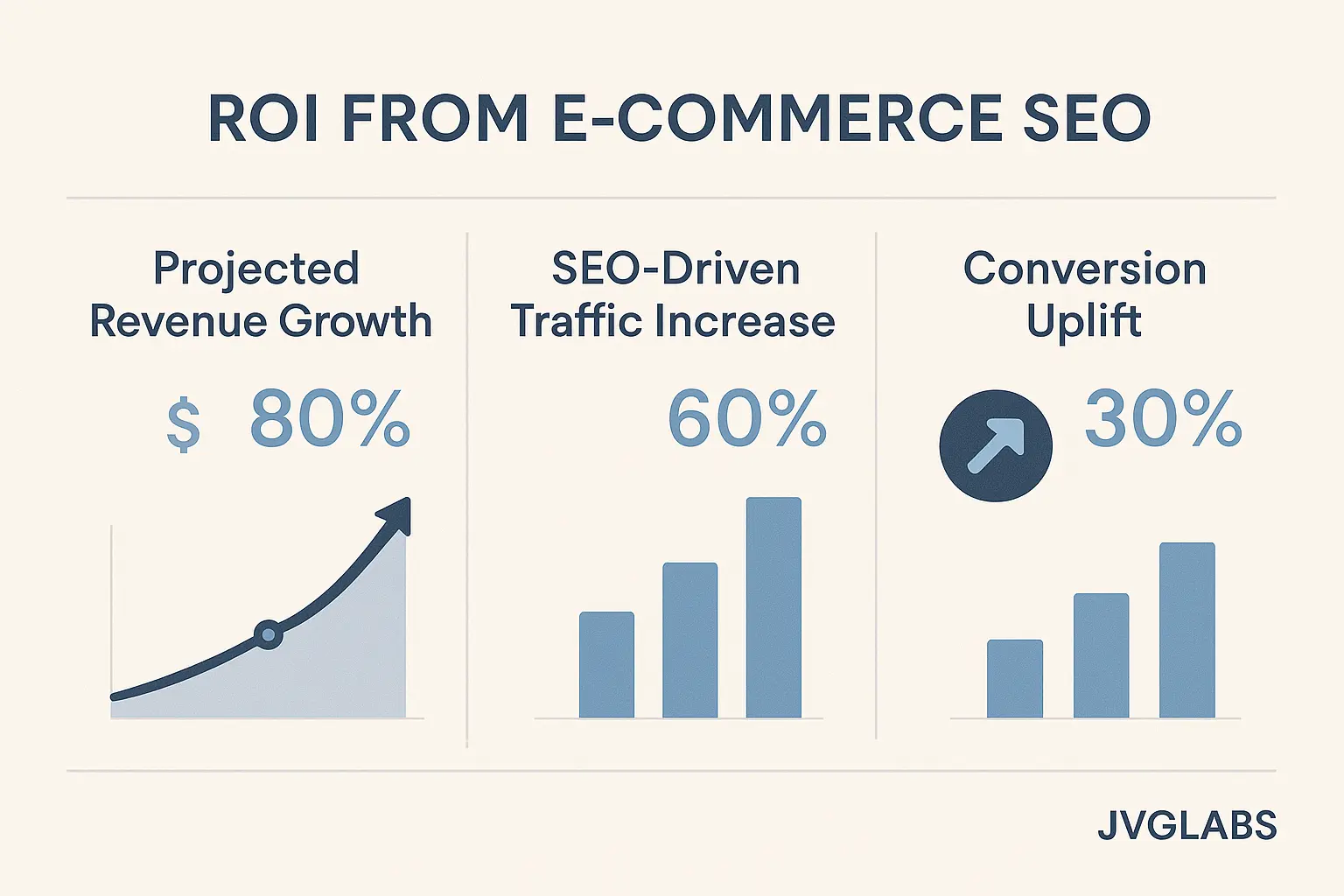
Clear ROI graphics help you justify SEO investment by illustrating its measurable impact on the bottom line.

When you pitch e-commerce SEO, you aren’t selling keywords and backlinks. You’re selling market share in a multi-trillion-dollar industry.
Foundational E-commerce SEO: Mastering the Core Four
While this playbook focuses on advanced strategy, a winning service is built on a flawless foundation. Most guides cover these topics, but they miss the e-commerce-specific nuances that separate struggling stores from market leaders.
- Revenue-Focused Keyword Research: Move beyond high-volume, top-of-funnel terms. Focus on commercial intent keywords across the entire buyer journey—from long-tail product queries (“men’s waterproof size 11 running shoes”) to category-level searches (“best trail running shoes for wide feet”). Your goal is to map these keywords to specific URLs, from product and category pages to buying guides.
- Conversion-Centric On-Page SEO: Every on-page element must serve two masters: search engines and shoppers.
- Product Pages: Optimize titles, meta descriptions, and image alt text not just for keywords, but for click-through rate and conversion. Use persuasive copy that highlights benefits over features.
- Category Pages: Write unique, helpful introductory content that guides users and gives context to search engines. Avoid generic, keyword-stuffed paragraphs.
- Scalable Site Architecture: A logical site structure is vital for both user experience and crawlability, especially with large catalogs. A simple, flat architecture (Homepage > Category > Sub-category > Product) is usually best. Use breadcrumbs to help users and search crawlers understand the site hierarchy.
- Bulletproof Technical SEO: For e-commerce sites, technical SEO is non-negotiable. Pay close attention to clean URLs, a robust XML sitemap, and a mobile-first design, since 77% of retail site traffic now comes from smartphones.
Advanced E-commerce SEO: From Traffic to Transactions
This is where you differentiate your agency. Foundational SEO gets your clients in the game; advanced strategies help them dominate it.
Technical SEO for Large Catalogs: Scale Without Chaos
Managing a site with 10,000+ SKUs is a technical minefield. Three areas require expert-level execution:
- Faceted Navigation: Filters for size, color, and brand create thousands of parameter-based URLs, which can dilute ranking signals and consume crawl budget. Solve this with a strategic use of canonical tags, rel=”nofollow” attributes, and robots.txt disallows to guide Google toward indexing only valuable pages.
- Schema Markup: Implementing Product, Offer, and Review schema is table stakes. For a competitive edge, leverage schema for Breadcrumbs, FAQPage on category pages, and Organization markup to claim more SERP real estate and provide rich results.
- Site Speed: Every second counts. A slow site kills conversions and rankings. That means going beyond image compression. Focus on server response time, reducing third-party scripts, and implementing a Content Delivery Network (CDN) to ensure a fast experience for every user, no matter where they are.
The challenge is execution at scale. Manually implementing these fixes across thousands of pages is impossible. This is where a partnership built on AI-powered SEO automation becomes essential to identify issues and deploy fixes systematically.
A side-by-side comparison helps agencies quickly evaluate different technical SEO strategies and their scalability.

Product-Led Content Marketing: Beyond the Blog Post
Content for e-commerce shouldn’t just attract eyeballs; it should guide them toward a purchase. Product-led content directly integrates products into helpful, top-of-funnel articles.
- Buying Guides: Instead of “10 Best Winter Jackets,” create “The Ultimate Guide to Choosing a Winter Jacket” that explains materials, insulation types, and features, naturally linking to your client’s relevant products throughout.
- Comparison Articles: Articles like “Brand X Model 1 vs. Brand Y Model 2” capture high-intent users at the final decision stage.
- Inspiration Hubs: For visual brands in fashion or home decor, create lookbooks or style guides that showcase products in real-world contexts, linking each item back to its product page.
This approach builds authority, captures long-tail keyword traffic, and generates valuable internal links to your money pages.
Next-Level Category Page Optimization
Too many agencies treat category pages as simple product listings, but they are powerful commercial hubs that can rank for high-volume, high-intent keywords.
- Expand Beyond the Grid: Add sections for FAQs, buying guides, user-generated content like Instagram galleries, and video tutorials.
- Optimize for Intent: Does the user want to browse, compare, or learn? Tailor the content and layout to match the dominant search intent for that category’s primary keywords.
- Internal Linking Strategy: Use the descriptive text on category pages to link contextually to important sub-categories and top-selling products, distributing link equity and improving user navigation.
Capturing Global Markets with International SEO
For brands ready to scale, international expansion is the next frontier. Expanding internationally requires a nuanced approach using hreflang tags to signal language and regional targeting to Google. You’ll need to decide between using subdomains (de.brand.com), subdirectories (brand.com/de), or country-code top-level domains (brand.de), each with its own SEO implications. Beyond the technical setup, an effective strategy requires localized keyword research and content that respects cultural nuances.
The Agency Playbook: Packaging & Selling E-commerce SEO
Knowing how to execute is only half the battle. You need a framework to package, price, and deliver your services profitably.
Building Your E-commerce SEO Service Offering
Structure your offering in tiers to meet clients where they are. A typical structure might include:
- Foundation: Technical audit and implementation, on-page optimization for core pages, and local SEO setup (if applicable).
- Growth: Everything in Foundation, plus category page optimization, product-led content creation (e.g., two articles per month), and foundational link building.
- Scale: Everything in Growth, plus advanced technical SEO (like international SEO or advanced schema), a more aggressive content and link building strategy, and conversion rate optimization (CRO) consulting.
The goal is a repeatable workflow that lets you focus on strategy and client relationships, while a dedicated partner handles tactical implementation in the background.
Visualizing the process shows agencies how a seamless partnership works, building trust and clarifying the workflow.
Pricing Models that Protect Your Margins
- Retainer-Based: The most common model, this provides predictable revenue and allows for long-term strategic planning. Price your tiers based on the scope of work and the resources required.
- Project-Based: Ideal for one-off needs like a technical SEO audit, a site migration, or an initial optimization push.
- Hybrid: Combine a monthly retainer for ongoing work with project fees for larger initiatives.
Client Reporting that Proves Your Value
Go beyond rankings. Your reports should tell a story of business growth. Key metrics include:
- Organic Traffic & Revenue Growth
- Conversion Rate from Organic Traffic
- Top-Performing Pages (by revenue)
- Keyword Visibility for Commercial Terms
- Share of Voice vs. Competitors
Frame your reports around the client’s business goals to demonstrate ROI and build long-lasting partnerships.
The Modern E-commerce SEO Tech Stack
Executing this playbook requires the right tools. While there are hundreds of options, a core stack for agencies includes:
- All-in-One Platforms: Ahrefs, Semrush (for keyword research, competitor analysis, and rank tracking)
- Technical SEO Tools: Screaming Frog SEO Spider, Sitebulb (for in-depth site audits)
- Site Speed Analysis: Google PageSpeed Insights, GTmetrix
- Analytics: Google Analytics, Google Search Console
Your Questions Answered: E-commerce SEO FAQ for Agencies
How long does it take to see results from e-commerce SEO?
While quick wins from technical fixes can show impact within weeks, significant revenue growth from content and authority building typically takes 6-12 months. Set this expectation with clients from the start.
What’s the biggest mistake agencies make with e-commerce clients?
Focusing too much on vanity metrics (like rankings for broad, low-intent keywords) instead of business metrics (organic revenue, conversion rates). Every action must be tied to the bottom line.
Can we really compete with giants like Amazon?
Yes. You compete by finding and dominating profitable niches. Focus on long-tail keywords, expert-level content, and building a brand community. You can’t outspend Amazon, but you can outsmart them in specific verticals.
How do we handle SEO for a site with thousands of similar products?
It comes down to canonicalization and content differentiation. Use canonical tags to consolidate ranking signals for similar products (e.g., different colors of the same shoe). Then, focus on creating unique, high-value content for your main category pages to attract traffic and authority.
Scale Your Agency with White-Label E-commerce SEO
Implementing this playbook requires deep expertise and significant resources—resources most agencies don’t have in-house. Hiring an enterprise-level e-commerce SEO specialist is expensive, and training your existing team is slow and risky.
This is the fundamental scaling challenge. You know the strategy, but you’re bottlenecked by execution.
A modern white-label SEO partner like JVGLABS provides the solution. We become your invisible, in-house execution team, powered by AI automation and overseen by expert strategists. You maintain complete control over strategy and client relationships, while we handle the complex, time-consuming technical fixes, content optimization, and reporting—all under your brand.
It’s how you deliver the advanced, revenue-focused SEO outlined in this playbook without the overhead. You get the scalability of an enterprise team with the agility and cost-efficiency of a partner model.
Ready to add a world-class e-commerce SEO offering to your agency’s portfolio? Learn how our agency SEO partner program can help you scale profitably.