
It starts with a simple email.
“Hey, quick question…”
As an agency owner, you know that phrase is rarely followed by a quick answer. It’s the Trojan horse for a request that falls just outside your agreed-upon scope of work. It’s a client asking you to “just take a look” at their new landing page, optimize one more blog post, or pull a quick report on a competitor they just discovered.
Individually, these requests seem small. But cumulatively, they become scope creep—the silent killer of agency profitability. If this feels familiar, you’re not alone. A landmark survey by the 4A’s found that a staggering 74% of agencies report scope creep as a significant business challenge.
It’s the reason your team works late, your margins shrink, and your best-laid plans go sideways.
But what if you could transform this frustration into your greatest growth lever? What if every out-of-scope request wasn’t a headache, but a pre-qualified opportunity to increase revenue?
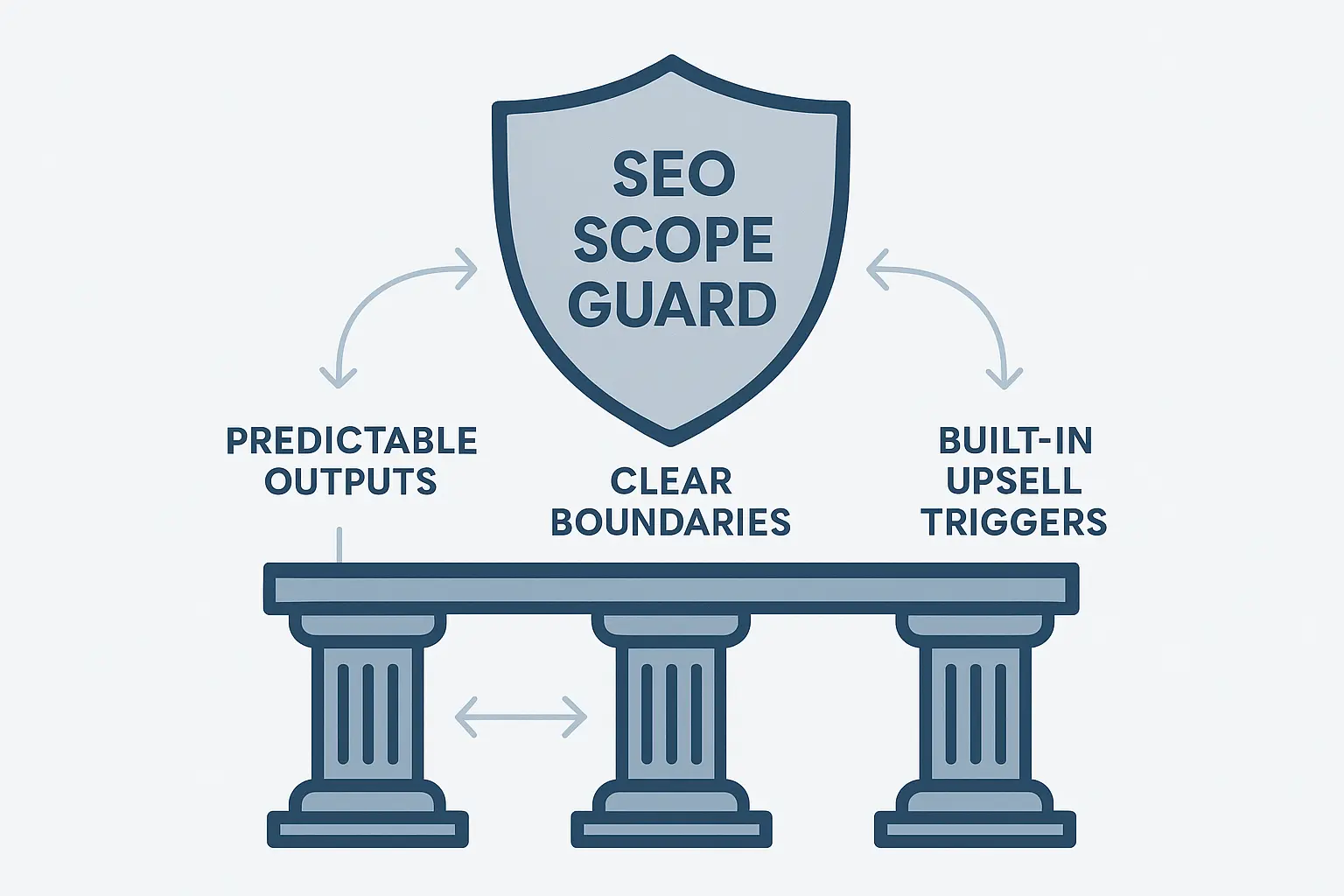
That’s where the SEO Scope Guard comes in: a framework for defining your deliverables so clearly that it prevents unbilled work while creating natural, client-initiated triggers for upsells.
What is Scope Creep (and Why Is It Silently Killing Your Agency’s Profitability?)
Scope creep is the gradual, uncontrolled expansion of a project’s requirements without a corresponding adjustment in time, budget, or resources. It’s the death-by-a-thousand-cuts that turns a profitable client into a liability.
This isn’t just an operational annoyance; it has severe business consequences. Research from Deloitte identifies poorly defined scopes as one of the top reasons for project failure. When the goalposts are constantly moving, it’s impossible to deliver measurable results, leading to client dissatisfaction and churn.
In an SEO services market projected to be worth over $613 billion by 2028, you can’t afford to let undefined expectations eat away at your piece of the pie. Every hour of unbilled work is an hour you can’t spend on strategy, client success, or winning new business. That’s a critical issue, especially when HubSpot data shows 61% of agencies already struggle to acquire new clients.
The antidote isn’t to say “no” to everything. It’s to create a system where “yes” has a clear and profitable path.
The “Aha Moment”: Shifting from Scope Creep to Strategic Upsells
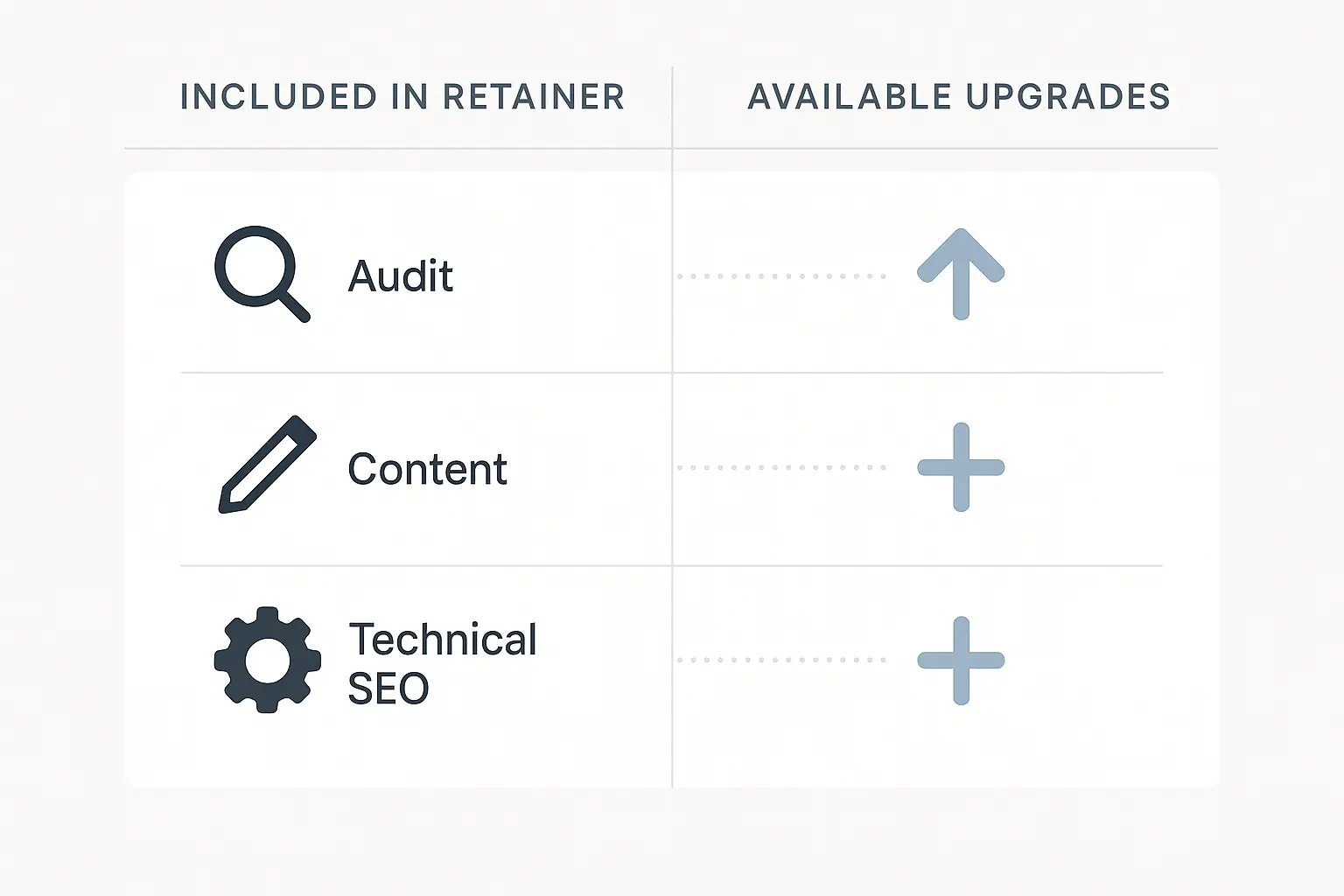
The fundamental mindset shift is this: a well-defined scope isn’t a restrictive wall; it’s a fence with clearly marked gates. The fence protects your core retainer deliverables, while the gates are your pre-planned upsell opportunities.
Here’s the difference:
Scope Creep is reactive, unplanned, and unbilled work that erodes your margins. It happens to you.
An Upsell Trigger is a proactive, planned opportunity to offer more value for a greater investment. It happens for you.
When a client asks for something outside the “fence,” you don’t see it as a problem. You see them walking right up to one of your gates.
This reframing turns a defensive conversation (“Sorry, that’s not included”) into a constructive, consultative one (“Great idea! That falls into our ‘Video SEO’ package. Would you like me to add that to our scope?”).
Building Your SEO Scope Guard: A 3-Tier Framework for Your Retainer
Clarity is kindness—to your client, your team, and your bottom line. An effective SEO scope is built on three distinct layers, leaving no room for ambiguity. This structure helps you define what’s in, what’s out, and what’s next.
Tier 1: The “Included” Core Retainer
This is the foundation of your service—the non-negotiable activities included in every retainer, every month. These should be standardized and easy to deliver consistently.
Examples:
- Monthly performance reporting & dashboard access
- Keyword rank tracking for up to 50 keywords
- Technical SEO site health monitoring (crawling, indexing, etc.)
- Google Business Profile monitoring
- Core on-page SEO for existing pages (title tags, meta descriptions)
Tier 2: The “Advanced” In-Scope Deliverables (with Limits)
These are the primary value-driving activities, but they must have clear, quantifiable limits. This is where most scope creep happens, so precision is key.
Your limits should correspond directly to where your client falls in their budget range. For context, research from Backlinko shows the average small business spends between $500 and $5,000 per month on SEO.
Examples:
- Content Creation: “Up to 2 new blog posts (max 1,500 words each) per month.”
- Link Building: “Manual outreach to 15 qualified prospects per month.”
- Technical Fixes: “4 hours of developer time for implementing technical SEO recommendations.”
- On-Page Optimization: “In-depth optimization for 3 new pages or blog posts per month.”
Tier 3: The “Upsell Trigger” Menu (Out-of-Scope)
This is your menu of additional services. By defining what’s not included, you create an instant catalog of growth opportunities. When a client mentions a need related to one of these items, it’s your trigger to start a sales conversation.
Examples:
- Video SEO & YouTube channel optimization
- Digital PR campaigns & large-scale link building asset creation
- Conversion Rate Optimization (CRO) and A/B testing
- Local SEO for additional business locations
- International SEO & hreflang implementation
With this framework in place, you can confidently price your SEO services in a way that protects your profitability.
The Secret Weapon for Scope Integrity: Predictable Outputs
A perfectly defined scope is useless if your delivery is chaotic. You can’t promise a client two 1,500-word blog posts per month if you don’t have a reliable system to produce them. Upholding your Scope Guard relies on predictable, repeatable fulfillment processes.
This is where many agencies get stuck. They either build a massive in-house team, which is expensive and hard to scale, or they rely on a patchwork of freelancers, which can be inconsistent.
But modern approaches change the game. An AI-driven SEO strategy, combined with expert oversight, can automate up to 90% of traditional SEO tasks, creating the consistency needed to deliver on a fixed scope.
For many firms, the most efficient path is to work with a partner for white-label SEO fulfillment. A dedicated partner provides fixed deliverables at a fixed cost, allowing you to build your Scope Guard with confidence. This model is especially powerful for agencies looking to add or scale SEO services for agencies without taking on the risk and complexity of building an in-house department.
When your outputs are predictable, your scope becomes iron-clad, and your upsell conversations become effortless.
Frequently Asked Questions (FAQ)
How do I introduce a new, stricter scope to an existing client?
Frame it as a benefit to them. Schedule a meeting to review your partnership and say something like, “To ensure we’re dedicating our strategic resources to the activities that drive the most growth for you, we’re clarifying our scope of work. This will allow us to focus our efforts on Core Activity 1 and Core Activity 2, which our data shows are delivering the best results.”
What if a client pushes back on the scope?
This is a great opportunity to reinforce your value. Reiterate that the scope is designed to protect their investment by keeping your team focused on the highest-impact activities agreed upon in your strategy. If they insist on adding a task, guide them to your upsell menu: “We can absolutely do that. That would fall under our Add-on Service, which we can add to the retainer for Price.”
How many deliverables should be in a typical retainer?
There’s no magic number. It depends entirely on the client’s budget and goals. The key isn’t the quantity of deliverables but the clarity of their definitions and limits. A $1,000/month retainer might have fewer deliverables with tighter limits than a $5,000/month retainer, but both should be equally clear.
Isn’t a strict scope inflexible?
Quite the opposite. An undefined scope leads to chaos, which is the enemy of flexibility. A Scope Guard creates structured flexibility. It provides a stable foundation (the core retainer) and a clear, pre-approved menu for growth and adaptation (the upsell triggers).
From Overwhelmed to In Control
Scope creep isn’t a client problem; it’s a process problem. Implementing a Scope Guard framework transforms ambiguity into opportunity, protecting your team’s time, clarifying your value to the client, and building a predictable, profitable engine for account growth.
Stop letting “quick questions” derail your strategy and erode your profits. Define your fence, build your gates, and start guiding your clients toward greater investment and better results.