
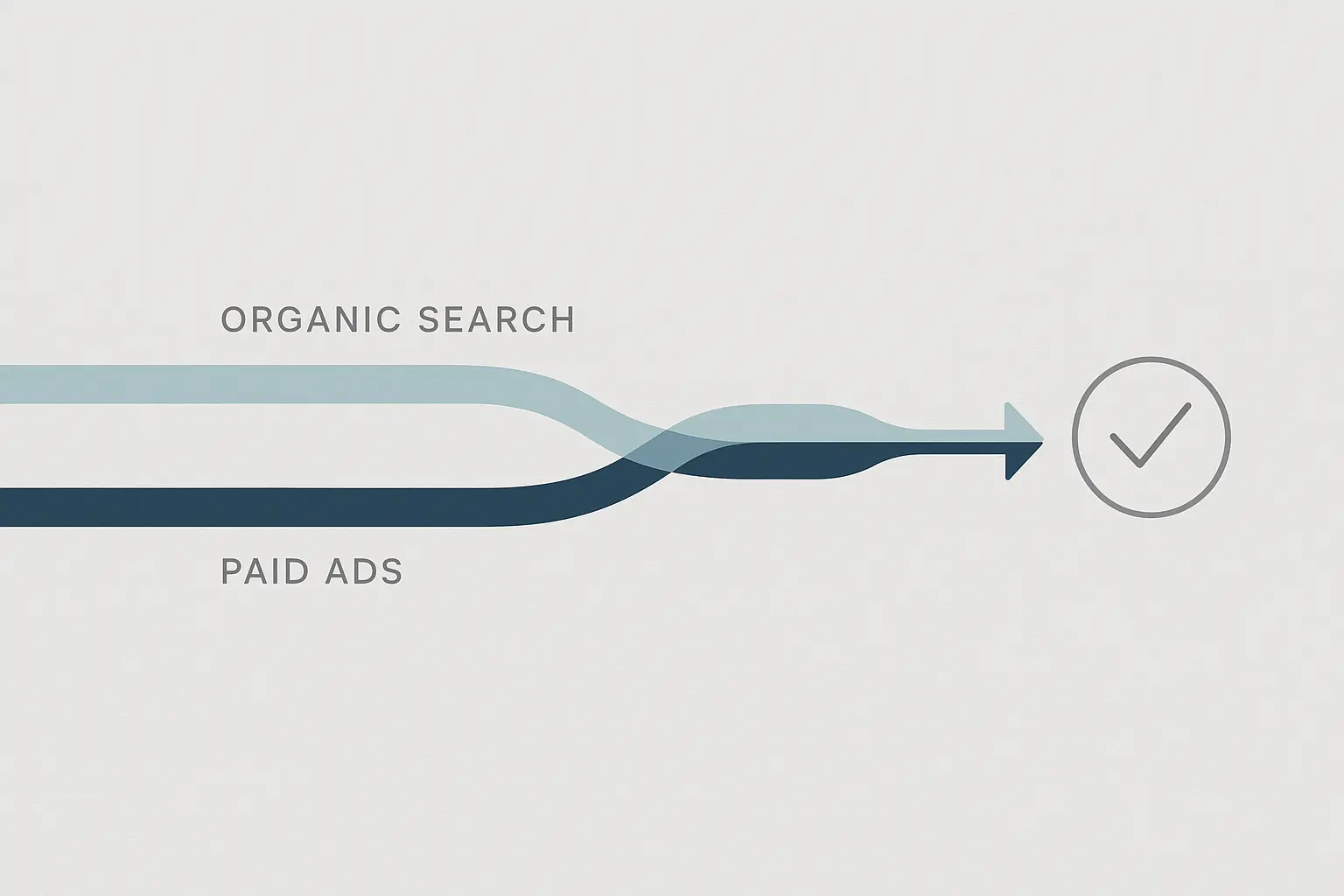
You’ve just wrapped up a monthly client report. The Google Ads campaign shows 50 conversions. The organic search report in Google Analytics shows 40 conversions. You proudly present a total of 90 new leads. The client is thrilled.
But later, when you look at their CRM, there are only 65 new leads for the month.
Where did the other 25 go? They never existed. They were counted twice.
If this scenario feels familiar, you’re not alone. A staggering 85% of marketers say that demonstrating ROI is one of their biggest challenges, and a huge part of that challenge comes down to a simple but pervasive problem: different marketing channels taking credit for the same conversion. This overlap leads to inflated numbers and skewed strategies, especially between Google Ads and organic search—two channels that often work in tandem along the customer’s path to purchase.
The Hidden Problem: When 1 + 1 = 1
Imagine a potential customer, Sarah, is looking for a new project management tool. She starts by clicking a Google Ad for “best PM software” and lands on your client’s website. She browses the features but isn’t ready to commit. Google Ads rightfully records this as an influential click.
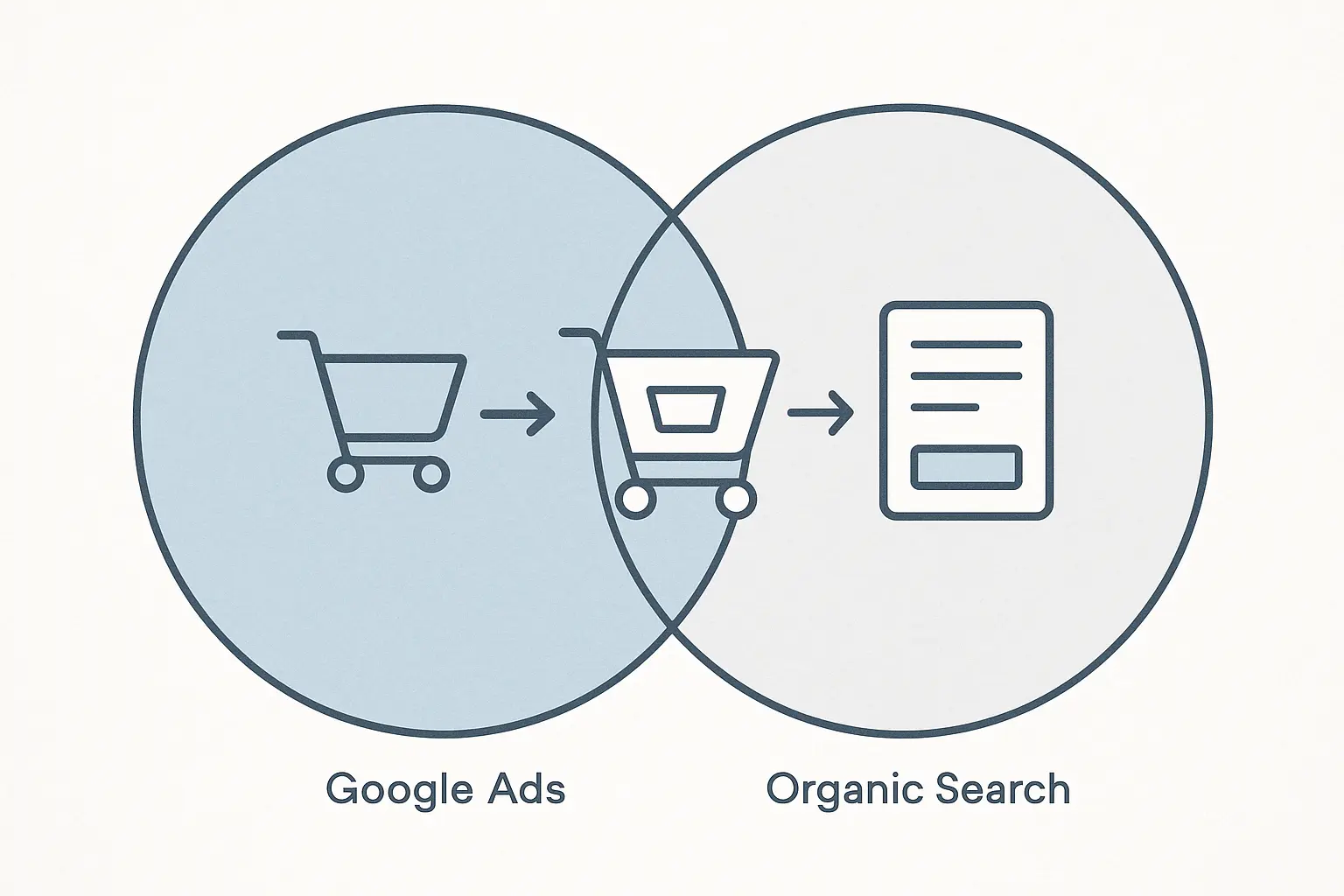
A week later, having done more research, Sarah remembers the brand. She searches for “[Client Brand Name] reviews,” clicks on an organic search result, returns to the site, and signs up for a free trial. Google Analytics, looking at its own data, attributes this conversion to the organic channel.
The result? Your Google Ads report shows one conversion, and so does your organic search report. But in reality, there was only one Sarah and one free trial sign-up. That’s conversion duplication.
This isn’t just a minor accounting error; it’s a strategic blind spot. Most marketers still measure success channel by channel, but that siloed view ignores a critical reality: the average customer journey now involves 6-8 touchpoints. Sarah’s path is the norm, not the exception. Without a unified view, you aren’t seeing the whole picture—just multiple, overlapping snapshots.
Last-Click Isn’t the Whole Story
So, why does this happen? The culprit is often an over-reliance on the default “last-click” attribution model, which gives 100% of the credit for a conversion to the final touchpoint a user interacted with.
It’s simple and easy to understand, which is why it’s been the standard for years. But it’s also dangerously misleading. Research shows that last-click attribution can undervalue organic search’s contribution by as much as 50%. It completely ignores earlier touchpoints—like that initial ad click—that introduced the brand and nurtured the user’s interest.
The Real Cost of Inflated Metrics
When you can’t accurately de-duplicate conversions, the consequences affect your entire strategy:
-
Flawed Budget Allocation: You might pour more money into Google Ads, believing it’s generating more unique conversions than it actually is, while underfunding the organic content that helps close the deal.
-
Inaccurate Performance Analysis: You might pause a campaign or keyword that seems to be underperforming on a last-click basis, not realizing it’s a crucial first touchpoint for many organic conversions.
-
Eroding Client Trust: Sooner or later, savvy clients will notice the discrepancy between your channel reports and their actual business results, leading to difficult conversations.
The goal isn’t to prove one channel is “better” than another, but to understand how they work together. Companies that adopt consistent cross-channel attribution are 1.5x more likely to experience revenue growth above 15% because they aren’t just reporting—they’re making smarter decisions.
How to Get Closer to the Truth: A Unified View
Getting an accurate, de-duplicated picture doesn’t require a complete overhaul of your tech stack. It starts with using the tools you already have more strategically, like Google Analytics 4 (GA4).
Step 1: Establish a Single Source of Truth
The first rule of accurate tracking is to have one place where all your data comes together. For most agencies, that single source of truth should be Google Analytics 4. Instead of trying to add up the numbers from the Google Ads and Google Analytics UIs, ensure both platforms feed data into a single, centralized GA4 property. This allows GA4 to see the entire user journey and act as the final arbiter of where credit is due.
Step 2: Move Beyond Last-Click with Data-Driven Attribution
GA4’s default attribution model is Data-Driven Attribution (DDA), and for good reason. Unlike last-click, DDA uses machine learning to analyze all the touchpoints in both converting and non-converting paths. It then assigns fractional credit to each channel based on its actual contribution to the final conversion.
With DDA, Sarah’s journey would be reported correctly: Google Ads would get partial credit for introducing her to the brand, and Organic Search would get partial credit for bringing her back to convert. No more double-counting—just a clear view of the teamwork between your channels.
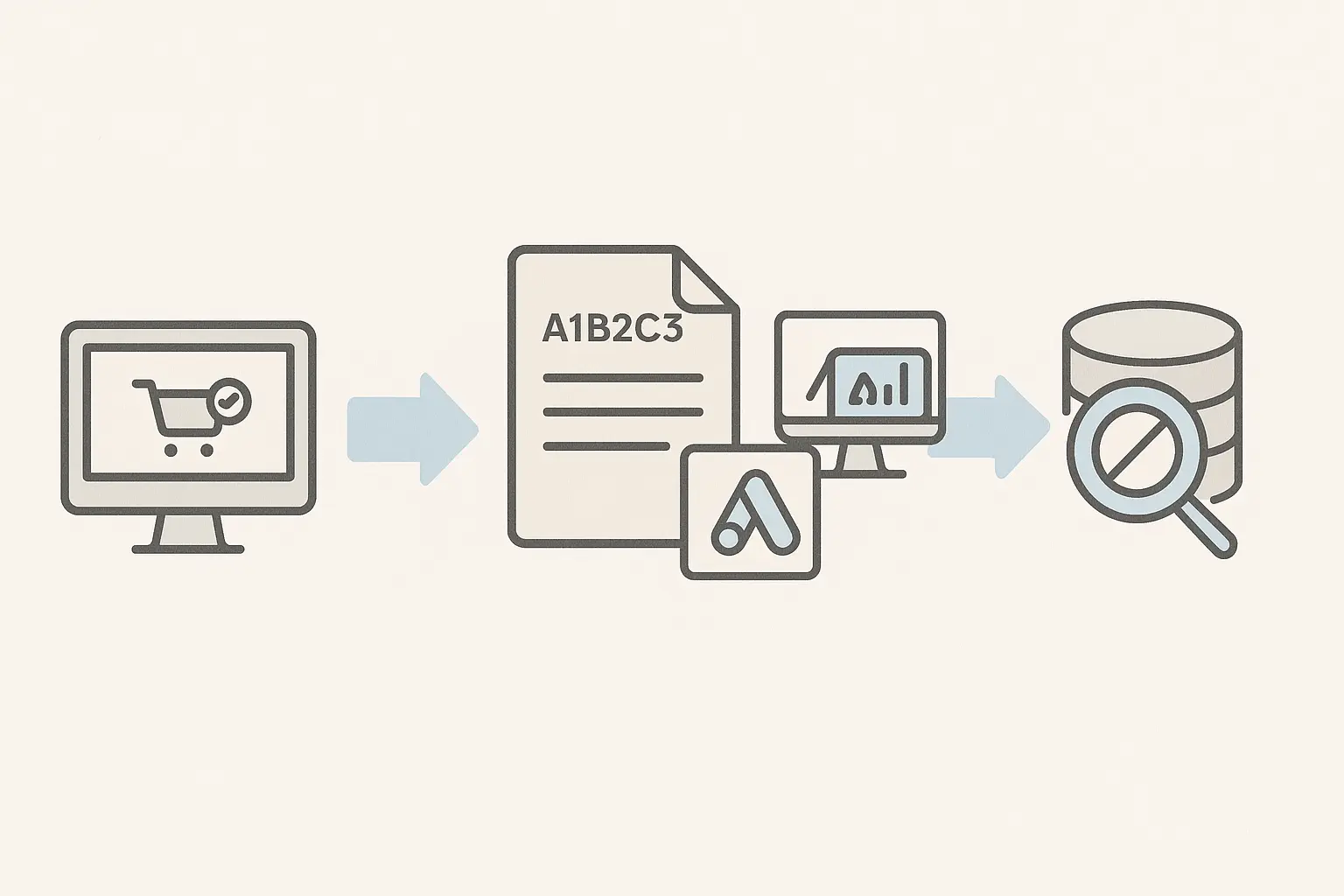
Step 3: Build Reports That Tell the Full Story
Once your data is centralized and your attribution model is set, you can build reports that reveal the synergy between paid and organic. Instead of just looking at “Conversions,” explore the “Model comparison” and “Conversion paths” reports in GA4. These reports help you visualize how different channels assist one another, allowing you to properly measure the ROI of SEO by showing its role in the full funnel. This holistic approach is the foundation of modern omnichannel SEO strategies.
What This Means for Your Agency
Moving from a siloed to a unified view of conversions does more than clean up your data—it fundamentally changes the way you operate and the value you provide.
You become a better strategist: You can confidently advise clients on how to invest their budget across channels for maximum impact.
You build stronger client relationships: You deliver reports that align with their business reality, building trust and positioning your agency as a true growth partner.
You can scale more effectively: With a clear understanding of what’s working, it becomes easier to streamline processes and double down on successful tactics. For agencies struggling to manage the complexities of integrated campaigns, white-label SEO services can provide the specialized expertise needed to execute these strategies without adding in-house overhead.

Frequently Asked Questions (FAQ)
What is conversion de-duplication?
Conversion de-duplication is the process of ensuring a single conversion, like a sale or lead submission, is counted only once, even if the customer interacted with multiple marketing channels (such as a paid ad and an organic link) before converting.
Why is last-click attribution the default in so many older platforms?
It was the simplest method to implement and understand. In the early days of digital marketing, when customer journeys were shorter, it was “good enough.” Today, with much more complex paths to purchase, its limitations are far more apparent.
Can’t I just add the conversions from Google Ads and Google Analytics together?
No. This is a common mistake that almost always leads to double-counting because a significant number of users interact with both channels. The only way to get an accurate total is to use a single analytics platform (like GA4) to analyze all touchpoints and de-duplicate the data.
Does this mean my Google Ads campaigns are less effective than I thought?
Not necessarily. It means their role might be different. A campaign that looks poor on a last-click basis might be a critical “opener” that introduces new customers who later convert through other channels. A unified view gives you the true context of its performance.
Your Next Step: From Data Chaos to Clarity
Recognizing the problem of conversion duplication is the first step toward smarter marketing and reporting. It’s about shifting your perspective from “which channel won?” to “how did our channels work together to win?”
By centralizing your data in GA4 and embracing a more sophisticated attribution model, you can stop reporting on vanity metrics and start delivering insights that drive real business growth. This is how you evolve from being just another service provider to an indispensable strategic partner for your clients.