

Ever had that conversation with a client? The one where you present a beautiful report showing keyword rankings climbing, organic traffic surging, and impression share hitting new highs… only to be met with the question:
“This is great, but how is it impacting our sales pipeline?”
For B2B agencies, it’s the million-dollar question. You know your SEO work is driving value, but proving it in terms of closed deals and revenue can feel like chasing a ghost. The trail goes cold somewhere between a user’s Google search and a sales rep marking an opportunity “Closed-Won” in Salesforce.
What if you could connect those two points directly? What if you could tell your client, “The keyword cluster we targeted last quarter didn’t just bring in 10,000 clicks; it sourced three new enterprise deals worth $250,000 in pipeline.”
That’s not a fantasy. It’s the holy grail of B2B SEO attribution—and it’s more achievable than you might think. This guide will show you exactly how to connect pre-click data from Google Search Console (GSC) with post-conversion data in Salesforce, creating a powerful model for proving your agency’s true value.
Why B2B SEO Attribution Is So Hard (and Why Last-Click Is a Lie)
Before we build the bridge, let’s appreciate the size of the canyon we’re trying to cross. The B2B customer journey is nothing like a simple e-commerce purchase. It’s long, complex, and involves multiple stakeholders.
This complexity creates three major attribution challenges:
-
The Marathon Sales Cycle: In the B2B world, nobody clicks a blog post and buys a $50,000 software package an hour later. Research shows that for 60% of companies, purchasing a new solution takes six to 12 months. A user might read your client’s blog post today but not become a lead for another six months. By then, last-click attribution models have long forgotten that initial, crucial SEO touchpoint.
-
The “Invisible” Research Phase: Here’s a startling fact: only 17% of the B2B buyer’s journey is spent meeting with potential suppliers. The other 83% is spent on independent research—reading articles, comparing solutions, and watching videos. This is SEO’s home turf. Your work influences prospects long before they ever raise their hand to talk to a salesperson, but traditional analytics often fail to capture this early-stage impact.
-
The Siloed Data Problem: Your client’s data lives in different universes. Pre-click search data is in GSC, on-site behavior is in Google Analytics, and lead, opportunity, and revenue data reside in Salesforce. These platforms don’t speak the same language, and getting them to communicate requires a deliberate strategy.
Trying to measure SEO’s impact with a last-click model in this environment is like giving credit for a marathon win to the runner’s final shoelace tie. It ignores the entire race.
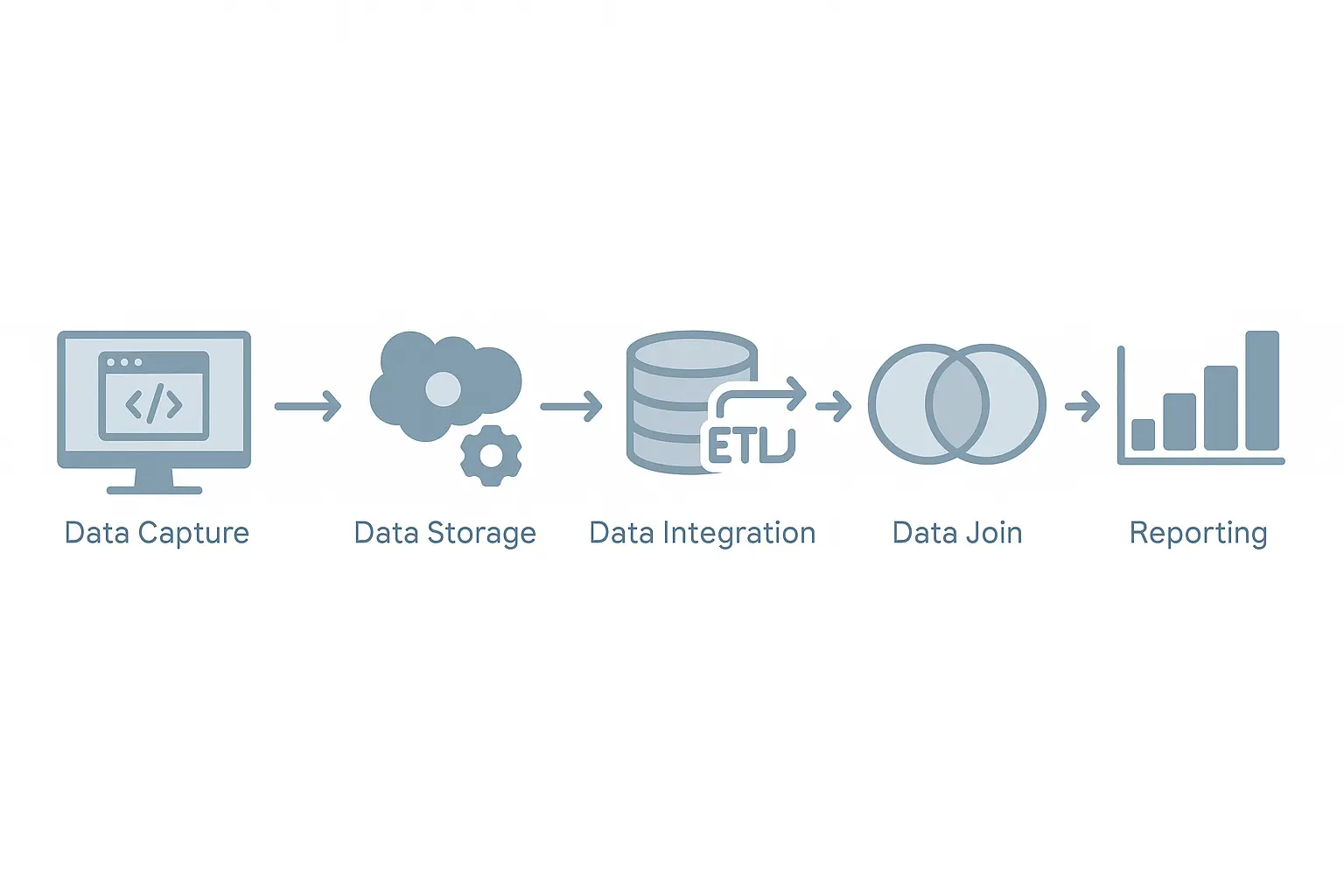
The Model: A Step-by-Step Framework for Connecting Clicks to Cash
To connect SEO performance to sales outcomes, you need a system that captures the very first organic touchpoint and carries that information throughout the entire customer journey, right into the CRM.
Here’s the conceptual blueprint.
Step 1: User Clicks an Organic Search Result
Everything starts in Google. A potential customer searches for a solution (e.g., “best accounting software for small agencies”), sees your client’s blog post in the results, and clicks. GSC records the impression, the query, the click, and the landing page. This is our starting point.
Step 2: The Digital Breadcrumb (Using a Cookie)
When the user lands on the blog post, a simple script on the website captures two key pieces of information from their session: the initial landing page URL and the referrer (google.com). This data is stored in a first-party cookie in the user’s browser. Think of this cookie as a digital name tag that says, “I first arrived here from a Google search, and this was the first page I saw.”

Step 3: Populating Hidden Form Fields
The user reads the article and leaves. Weeks later, perhaps after being retargeted with ads or receiving a newsletter, they return to the site and fill out a “Request a Demo” form.
This is where the magic happens. The website form contains hidden fields. As the page loads, the script reads the information from the cookie planted weeks ago and automatically populates these fields with the original landing page URL.
initialorganiclanding_page = /blog/best-accounting-software
Step 4: Passing the Data to Salesforce
When the user submits the form, the data from those hidden fields is passed along with their name, email, and company into Salesforce. Your client’s new Lead record now contains a crucial piece of attribution data: the exact SEO-driven page that started their entire journey.
Step 5: Connecting SEO to Pipeline and Revenue
Now that the first-touch data is in Salesforce, you can build powerful reports. You can see:
- How many leads originated from a specific blog post.
- How many of those leads converted into qualified opportunities.
- The total pipeline value associated with content on a specific topic cluster.
- The final closed-won revenue generated from traffic to a particular service page.
You are no longer guessing. You are measuring.
Step 6: Closing the Loop with GSC
While you can’t tie a specific Salesforce deal back to a single search query due to privacy constraints, you can work backward in aggregate.
Let’s say your Salesforce report shows that the /blog/best-accounting-software page has generated $300,000 in closed-won revenue over the last year. You can now go into GSC, filter for that exact page, and see every high-intent, bottom-of-the-funnel keyword driving traffic to your most profitable piece of content.
This is revenue-driven keyword research. You can now double down on what’s proven to make money, not just what’s proven to attract clicks.
What This Model Unlocks for Your Agency
Adopting this attribution framework elevates your agency from a service provider to a strategic growth partner.
-
You Can Prove Definitive ROI: The conversation shifts from “We improved your rankings for 20 keywords” to “Our content strategy sourced 15 qualified opportunities worth $400k in pipeline this quarter.” This is the language that builds long-term, high-value retainers.
-
You Can Justify Bigger Budgets: When SEO is positioned as a direct revenue driver, it’s no longer a cost center but an investment with a clear, measurable return. This makes it far easier to justify your retainer and upsell clients on more comprehensive strategies. After all, content marketing can generate over three times more leads than outbound marketing at 62% less cost—and proving that connection to revenue makes clients eager to invest more.
-
You Gain a Strategic Advantage: Most agencies are still reporting on vanity metrics. By connecting your work to revenue, you provide a level of insight and accountability your competitors can’t match. Building these attribution models requires a blend of technical SEO, analytics, and CRM expertise—a combination many agencies supplement by working with a dedicated agency SEO partner.

Frequently Asked Questions (FAQ)
What’s the difference between Google Search Console clicks and Google Analytics sessions?
GSC measures what happens before a user gets to your site (impressions, clicks in Google’s search results). Google Analytics measures what happens after they land on your site (sessions, pageviews, bounce rate). This model connects the pre-click world of GSC to what happens on-site and post-conversion.
Do I need a developer to set this up?
Most likely, yes. The process involves adding a custom script to the website to manage cookies and ensuring your forms are configured correctly to pass hidden field data to the CRM. While not overly complex, it typically requires some development resources.
Can this attribution model work with other CRMs like HubSpot or Zoho?
Absolutely. The principles are universal. As long as your CRM can accept custom fields from a web form, you can implement this first-touch attribution model.
Is this model 100% accurate?
No attribution model is perfect. This model won’t capture users who clear their cookies, switch devices, or have ad-blockers that interfere with scripts. It is, however, a monumental leap forward from last-click or no attribution at all. It provides a strong, directional measure of SEO’s impact on the sales pipeline.
The Future is Measured
For B2B agencies, the future of SEO isn’t about winning rankings; it’s about winning revenue. By building a bridge between Google Search Console and your client’s CRM, you move beyond vanity metrics and into the world of tangible business impact.
This framework lets you prove your worth, secure retainers, and guide strategy with data directly tied to your client’s bottom line. As you scale these efforts across multiple clients, automating the data collection and reporting becomes essential. That’s where exploring how AI-driven SEO can streamline these complex attribution workflows comes in.
Stop guessing your impact. Start measuring it.