

Your agency has a leaky bucket. You work hard to fill it with new clients, but others quietly slip out the back. If this feels familiar, you’re not alone. Research shows that marketing firms can see up to 40% client turnover per year.
That’s a staggering number. It’s a treadmill of constant selling that stifles growth and burns out your team.
The common culprit isn’t poor results—it’s poor communication of value. Agencies lose clients when they deliver data dumps instead of strategic narratives. A generic report filled with ranking charts and traffic graphs doesn’t answer the one question every client has: “What am I paying for, and is it working?”
The solution isn’t just better software; it’s a better system. This is the blueprint for that system: a proactive, value-driven Client Reporting Framework that transforms your reports from a monthly chore into your most powerful retention tool.
The Client Retention Framework: 4 Steps to Becoming an Indispensable Partner
Before you even think about which reporting platform to use, you need a process. A great tool without a strategy is just a faster way to create confusing reports. This four-step framework ensures every report you deliver reinforces your value and strengthens your client relationships.
Step 1: The Onboarding & Alignment Blueprint
The most effective client relationships are built on shared goals from day one. Your reporting framework begins during onboarding, not 30 days later.
Define Business Goals, Not Just SEO Metrics: Ask questions that go beyond keywords. “What does a successful quarter look like for your business?” “How many qualified leads does your sales team need each month?” “What is the average lifetime value of a customer acquired through organic search?”
Establish Primary KPIs: Translate business goals into 1-3 primary Key Performance Indicators (KPIs). Instead of just “organic traffic,” your primary KPI might be “marketing qualified leads (MQLs) from organic search.” This simple shift frames your work around their bottom line.
Set a Realistic Timeline: Use this initial conversation to manage expectations. Explain that SEO is a long-term strategy and map out what success looks like at 90 days, 6 months, and one year. This prevents the dreaded “Why aren’t we #1 yet?” conversation after the first month.
Step 2: Building the Value Dashboard
Your dashboard shouldn’t be a maze of every metric you can track. It should be a curated, one-page story of performance that a busy CEO can understand in five minutes.
Essential Components of a Value Dashboard:
- Executive Summary: Start with 2-3 bullet points in plain English. What happened this month? What does it mean for their business? What are we doing next? This is arguably the most important section.
- Goal Pacing: Display your primary KPI (e.g., MQLs from organic) on a chart showing progress toward the quarterly or annual goal. This visual keeps the main objective front and center.
- Key Wins & Highlights: Did you secure a high-authority backlink? Did a new blog post rank on page one for a critical keyword? Call out 2-3 specific victories that demonstrate momentum.
- Strategic Recommendations: Based on the data, what’s next? “We’ve noticed a competitor losing ground on ‘X’ keyword cluster. Next month, we’ll focus on creating content to capture that opportunity.” This positions you as a proactive strategist, not just a reactive executor.
Step 3: Communicating Progress Beyond Rankings
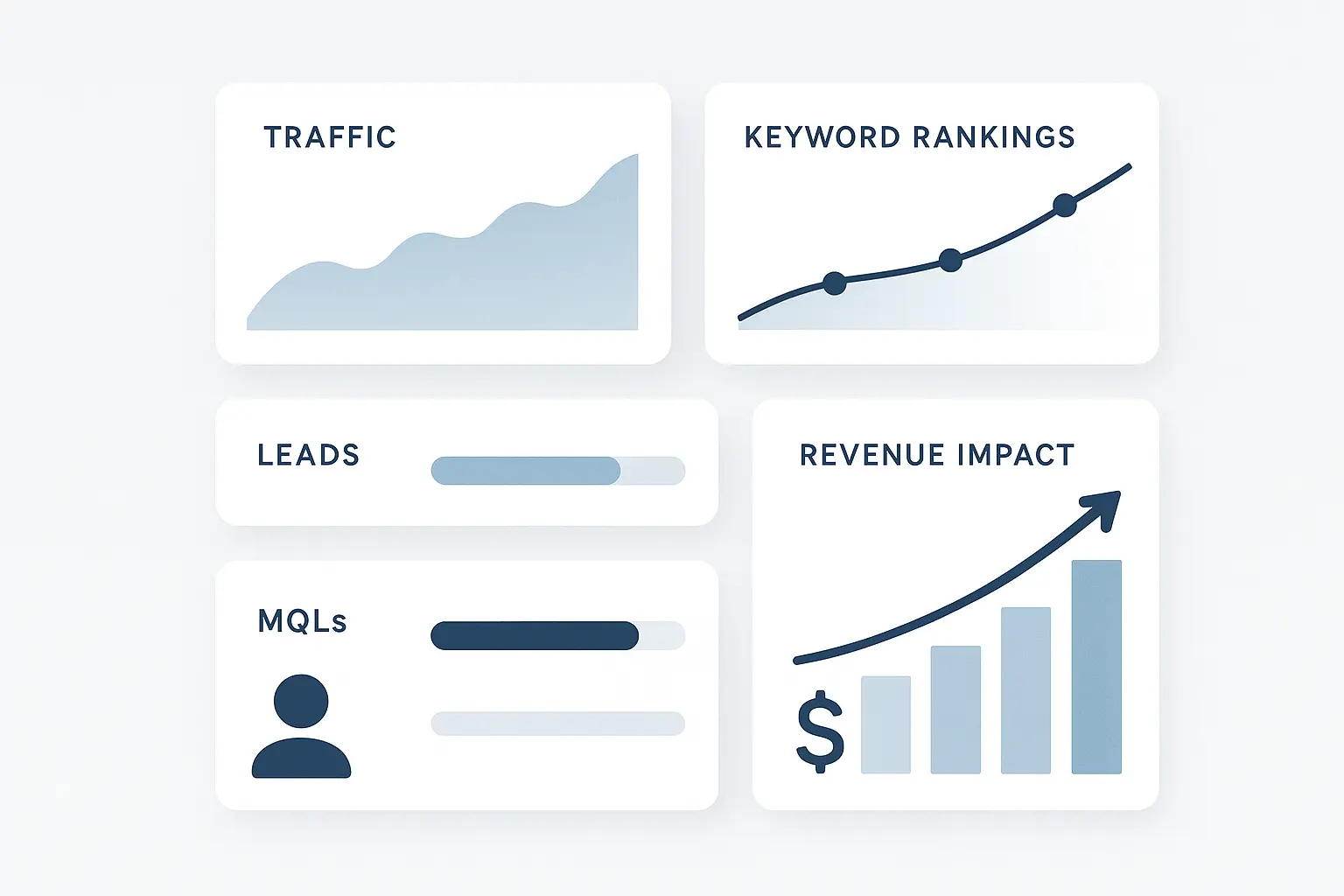
Rankings are a means to an end, not the end itself. The most successful agencies shift the conversation from positions to performance. Your job is to connect the dots between your SEO activities and the client’s revenue.
This means integrating data from their CRM or analytics to show the full funnel. Instead of simply reporting a 20% increase in organic traffic, your report should tell a complete story. For example, show that the 20% traffic increase led to 50 new demo requests, which resulted in 10 marketing qualified leads for the sales team, valued at an estimated $15,000 in new pipeline.
When you frame results this way, you change your agency’s role from a cost center to a revenue driver. This is the core of our omnichannel growth SEO philosophy—connecting search visibility directly to business performance.

Step 4: The Monthly Performance Review That Builds Trust
A report sent over email is just data; a report presented by a trusted advisor becomes a strategy session. According to an AgencyAnalytics benchmark report, most agencies stick to monthly reporting, which sets the perfect cadence for building this trust.
Don’t just walk through the numbers. Use a structured agenda to guide the conversation and reinforce your partnership.
A Simple Agenda for a 30-Minute Review Call:
- (5 min) High-Level Summary: Start with the executive summary from your dashboard. Reiterate the wins.
- (10 min) Performance Deep Dive: Briefly explain the “why” behind the numbers. Why did traffic increase? What caused the drop in bounce rate?
- (10 min) Strategy & Next Steps: Discuss your strategic recommendations. Get their feedback and buy-in for the upcoming month’s priorities.
- (5 min) Q&A and Open Discussion: Give them space to ask questions and share business updates that might impact your strategy.
This consistent, strategic conversation is what builds client confidence and makes your agency feel like an extension of their in-house team.
The Agency Toolkit: Top 5 White-Label Platforms to Execute Your Framework
Once your strategic framework is in place, you can choose the right tools to bring it to life. The best white-label reporting platforms don’t just pull data; they help you tell a compelling story, automate manual work, and present it all under your brand.
Here’s a look at the top contenders, each suited to help you execute this framework.
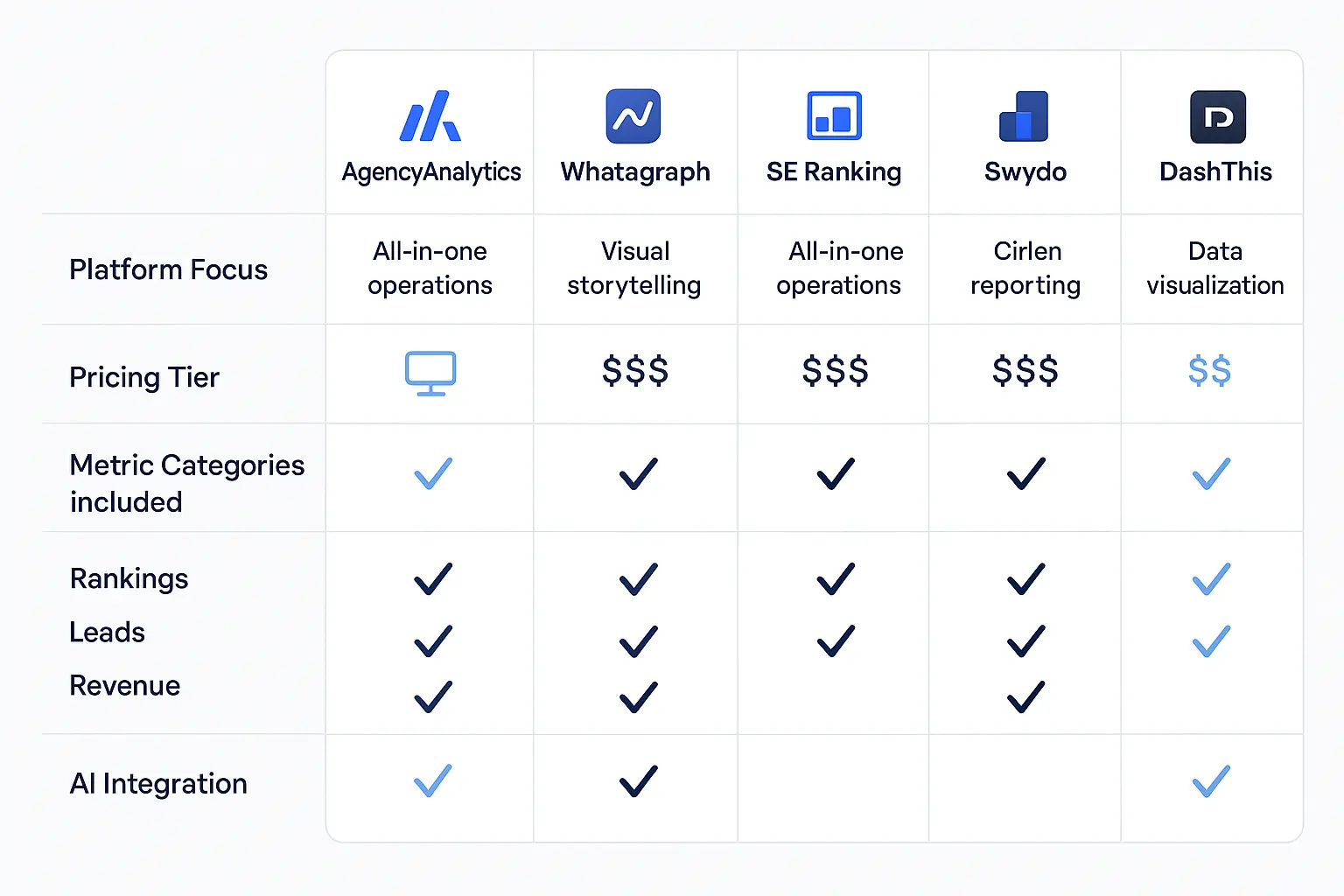
1. AgencyAnalytics: Best for All-in-One Agency Operations
What it is: A comprehensive platform built exclusively for agencies. It combines SEO reporting with project management and client communication tools.
Why it fits the framework: It excels at consolidating data from 75+ integrations (Google Analytics, Search Console, social media, call tracking) into a single, brandable dashboard. This makes it ideal for building the holistic “Value Dashboard” in Step 2.
2. Whatagraph: Best for Visual Storytelling and Ease of Use
What it is: A reporting tool known for its beautiful, easy-to-digest visual reports and templates.
Why it fits the framework: Whatagraph excels at making data look good. If your primary goal is to create highly polished, visually compelling reports that impress clients at a glance, this is a top choice for creating your dashboard and communicating results.
3. SE Ranking: Best for Cost-Effective, Scalable Reporting
What it is: An all-in-one SEO platform that includes a powerful and highly customizable white-label reporting module.
Why it fits the framework: SE Ranking offers immense flexibility at a competitive price point, making it great for growing agencies. You can build reports from scratch or use templates, giving you full control over the narrative you present to clients.
4. Swydo: Best for Integrating PPC and Multi-Channel Data
What it is: A reporting and monitoring platform that excels at integrating data from paid advertising channels alongside SEO.
Why it fits the framework: If your agency offers both SEO and PPC services, Swydo is invaluable for telling an integrated story. It helps you execute Step 3 (communicating beyond rankings) by showing how organic and paid efforts work together to drive business goals.
5. DashThis: Best for Simple, No-Frills Dashboards
What it is: A straightforward tool focused on one thing: creating clean, effective dashboards quickly.
Why it fits the framework: For agencies that want to implement a simple “Value Dashboard” without getting lost in excessive features, DashThis is perfect. It’s fast, reliable, and focuses on getting the essential KPIs in front of your clients with minimal fuss.

Future-Proofing Your Reporting: The Role of AI and Automation
The landscape of client reporting is evolving. According to a recent survey, over 80% of marketers are now using AI for tasks like data analysis and creating personalized reports. Leaning into this trend doesn’t just save you time; it positions your agency as a forward-thinking leader.
Here’s how AI is changing the game:
- AI-Generated Summaries: New tools are now incorporating AI that can analyze the data in your report and automatically generate a draft of your executive summary. This saves time and helps you pinpoint key trends you might have missed.
- Predictive Analytics: Instead of just reporting on what happened last month, AI can help you forecast future performance based on current trends. This shifts your client conversations from reactive to proactive.
- Automated Anomaly Detection: AI-powered systems can monitor your clients’ data 24/7 and alert you to sudden drops in traffic or rankings, allowing you to address issues before the client even notices.
This shift towards smarter, automated reporting is at the heart of our mission. By leveraging AI-powered SEO automation, we help our agency partners spend less time pulling data and more time on client strategy.
From Vendor to Partner: Final Thoughts
Choosing a white-label reporting tool is an important decision, but it’s the last step, not the first. A tool is only as good as the strategy behind it.
By implementing a client retention framework, you shift your agency’s role from a service provider to an indispensable strategic partner. You stop delivering data and start delivering insights. You stop talking about rankings and start talking about revenue.
This is how you plug the leaks in your bucket, reduce churn, and build an agency that grows on the foundation of strong, lasting client relationships.
Frequently Asked Questions
- How do I transition existing clients to this new reporting framework?
Start with a dedicated “strategy refresh” meeting. Explain that you’re upgrading your reporting process to provide more business-centric insights, not just data. Frame it as a benefit to them—clearer goals, better visibility into ROI, and more strategic guidance. Most clients will welcome the change.
- What should I do if performance dips one month?
This framework is built for those moments. Address it head-on in your executive summary and during the review call. Explain what happened, why it happened (e.g., a Google algorithm update, a competitor’s campaign), and most importantly, what your plan is to address it. Transparency builds trust far more than hiding bad news.
- How much time should I spend on reporting for each client?
With the right framework and tools, reporting shouldn’t take more than 1-2 hours per client each month. Automation handles the data gathering, and your framework provides the template for your analysis and narrative. The goal is to maximize your time on strategy, not on building slides.
- Can this framework work if we’re a white-label partner handling execution?
Absolutely. This is precisely the system that enables a seamless partnership. As an execution partner, we provide the performance data and key insights. Your agency then uses this framework to craft the narrative, build the Value Dashboard, and lead the client-facing strategy review, maintaining full control over the relationship. It’s the perfect model for scaling your white-label SEO services without the operational headache.