
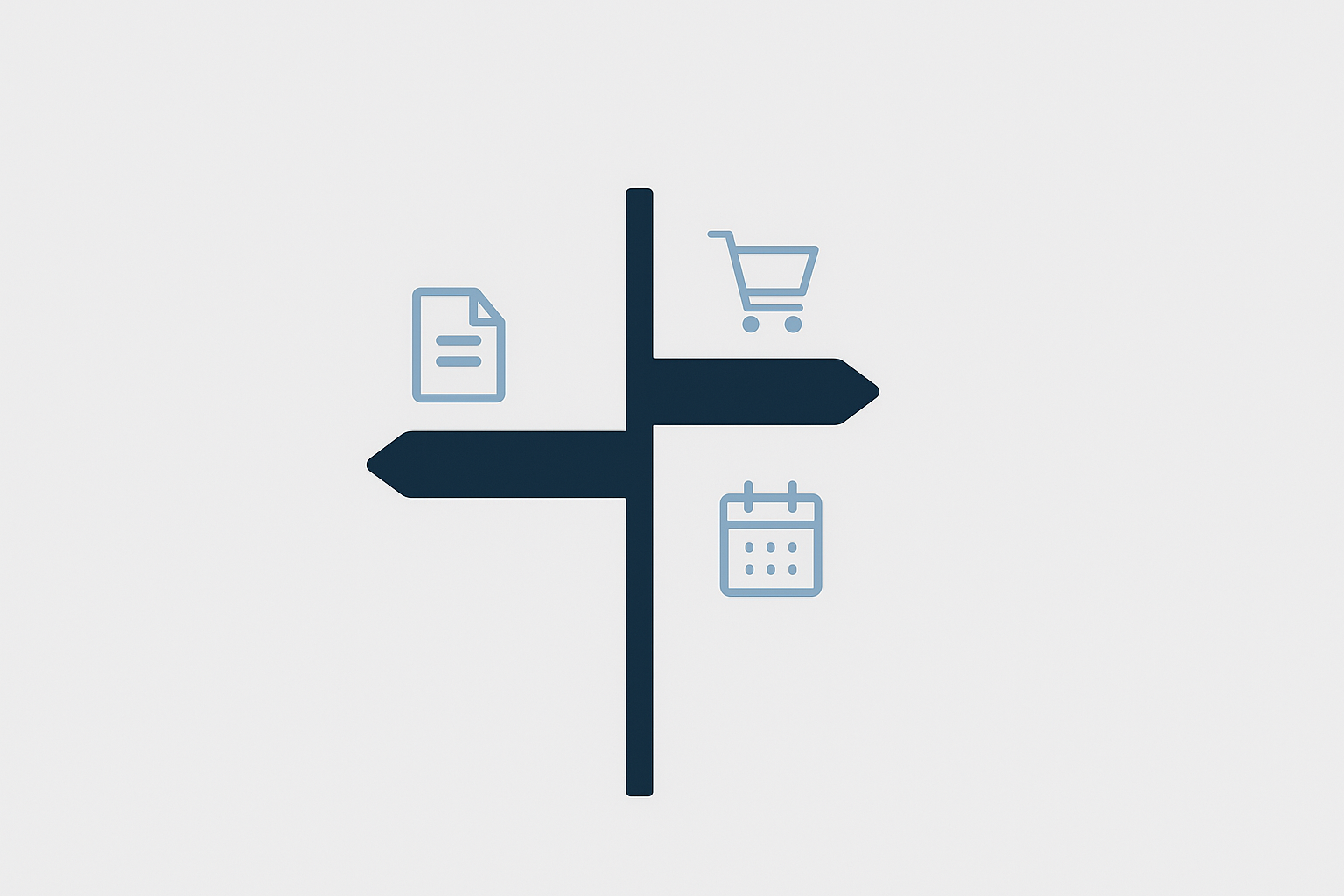
It’s Tuesday morning. You’re scrolling through your inbox, and an email from your favorite clothing brand catches your eye. “Your Ultimate Fall Style Guide Awaits,” the subject line promises. You click, intrigued. It’s a thoughtful email guiding you toward a blog post about layering for the season. Nice.
An hour later, another email from the same brand arrives: “FLASH SALE! 40% Off Everything, 48 Hours Only!” Suddenly, the leisurely style guide feels irrelevant. The urgent call to buy takes over.
Then, just after lunch, a third email appears, this one an invitation to a “VIP Webinar” with a famous designer they’re hosting next month.
So, in the span of a few hours, the brand has asked you to:
- Read a blog post (a low-commitment educational ask).
- Buy something right now (a high-commitment transactional ask).
- Register for a future event (a medium-commitment community ask).
What are you supposed to do? If you’re like most people, the answer is simple: nothing. You close your inbox, overwhelmed and a little confused. This, right here, is “Campaign Whiplash.”
What Exactly Is Campaign Whiplash?
Campaign Whiplash is the cognitive dissonance a customer feels when a brand sends them conflicting or rapidly shifting calls-to-action (CTAs) in a short period. It’s the digital equivalent of a salesperson asking you to browse casually, then demanding you buy immediately, then trying to book a follow-up meeting—all in the same breath.
It’s rarely intentional. More often, it’s a symptom of internal silos. The content team launches its new guide, the e-commerce team kicks off a flash sale, and the events team promotes its webinar. Each team hits “send” on their campaign, unaware they are collectively creating a confusing, disjointed experience for the most important person: the customer.
In an era where the average person receives 121 emails per day, clarity isn’t just helpful—it’s a requirement for getting noticed. Campaign Whiplash does the opposite; it creates noise and trains your audience to tune you out.
The Hidden Damage of Inconsistent CTAs
The impact of Campaign Whiplash goes beyond customer annoyance. It causes real, measurable damage to your marketing efforts by triggering decision paralysis. When presented with too many competing choices, the human brain often defaults to making no choice at all.
Instead of inspiring action, you inadvertently create friction. The data on this is incredibly clear: simplicity and focus win. Research shows that emails with a single, clear call-to-action can increase clicks by a staggering 371%.
This isn’t just about clicks. That same study found that a single, focused CTA can boost actual sales by 1617%. When you send three different emails with three different goals, you’re not giving customers more options; you’re dividing their attention and sabotaging your own results. Each message cannibalizes the others, making it less likely that any single action will be taken—a direct hit on your conversion rates.
Why a Cohesive Journey Is Your Superpower
If Campaign Whiplash is the problem, a cohesive, intentional journey is the solution. Instead of thinking in terms of isolated campaigns, the goal is to create a seamless conversation.
And the data backs this up: 77% of marketing ROI comes from segmented, targeted, and triggered campaigns. These aren’t just random email “blasts.” They are thoughtful sequences where each message builds on the last, guiding a customer from one logical step to the next.
Well-planned email nurture sequences are designed to avoid this whiplash. A new subscriber might first receive a welcome email, then an educational resource, and only then an invitation to a demo or a special offer. Each step has a purpose, and the CTA aligns with where the customer is in their journey.
The results of this consistency are profound. According to Campaign Monitor, segmented campaigns drive a 100.95% higher click-through rate than non-segmented ones. When a message feels like the right next step instead of a random interruption, people are exponentially more likely to engage.
Three Simple Ways to Avoid Campaign Whiplash
You don’t need a complex suite of new tools to solve this problem. The solution starts with strategy and communication.
1. Map the Entire Conversation
Before launching a campaign, take a step back and look at all the touchpoints a customer might experience this week. Is the support team sending out a survey? Is the sales team running an outreach sequence? Effective customer journey mapping means thinking like a customer, not a department. A shared marketing calendar is the simplest first step to visualizing these overlaps and preventing collisions.
2. Prioritize a “Primary CTA” for Each Segment
It’s okay to have multiple things happening in your business, but each customer segment should have one primary “ask” at a time. A brand new lead shouldn’t be getting a hard-sell promo; their primary CTA should be educational. A loyal, repeat customer, meanwhile, might be the perfect audience for a flash sale. This is why personalization is so powerful: data shows that personalized CTAs convert 202% better than default versions because they align with the user’s specific context.
3. Define the “Job” of Each Channel
Decide on the primary purpose of each communication channel. For instance, your weekly newsletter might be purely for building relationships through content, with soft CTAs. Meanwhile, automated nurture sequences can guide new leads toward a purchase, and promotional emails can be reserved for specific, high-intent segments. When every channel has a clear job, it’s much harder for messages to get crossed.
Frequently Asked Questions (FAQ)
Q: What’s the difference between a nurture email and a newsletter?
A: A nurture email is typically part of an automated sequence triggered by a specific action (like downloading a guide). Its goal is to “nurture” a lead toward a specific outcome. A newsletter is a regularly scheduled communication sent to a broader list to build community and share valuable content, usually without a hard sales push.
Q: Is it ever okay to have two CTAs in one email?
A: Yes, but with a clear hierarchy. It’s common to have a primary CTA (a button) and a secondary CTA (a text link). For example, the primary CTA might be “Shop the New Collection,” while a secondary link in the footer could be “Read Our Blog.” The key is that the secondary option shouldn’t compete with or distract from the main goal of the email.
Q: Isn’t sending more emails always better for engagement?
A: Not if the quality and coherence are low. Sending three confusing emails is worse than sending one clear, focused message. Consistency and relevance are far more important than frequency. Bombarding your audience doesn’t just lead to higher unsubscribe rates—it teaches them to ignore you.
Your Next Step: From Campaigns to Conversations
Campaign Whiplash is a silent conversion killer, born from good intentions but poor coordination. When you shift your perspective from launching isolated campaigns to designing a cohesive customer conversation, you replace confusion with clarity.
Before you schedule your next email, ask a simple question: “What is the single most important thing we want this person to do right now?”
Answering that question honestly is the first step to building a stronger, more trusting relationship with your audience—one email at a time.