

You just landed the client you’ve been chasing for months: a successful personal injury law firm. With a solid budget and ambitious goals, your team is ready to drive serious growth. You fire up your keyword research tools, map out a content strategy, and start optimizing their Google Business Profile.
Then, you get an email from the lead partner: “Just a heads-up, all content and website changes need to be reviewed for State Bar compliance.”
Suddenly, familiar SEO tactics feel like walking through a minefield. Can you call them the “best lawyers in Austin”? Can you feature that glowing five-star review on the homepage? Is your killer title tag, “Guaranteed Results for Car Accident Victims,” about to land your new client in hot water?
For agencies new to the legal vertical, this is a common—and jarring—realization. The world of attorney marketing is governed by a complex web of advertising rules that can vary dramatically from state to state. What works for an e-commerce brand or a local contractor can create serious ethical and regulatory risks for a law firm.
But here’s the secret: understanding these rules isn’t a barrier. It’s a massive competitive advantage. Agencies that master compliance-first SEO become indispensable partners, protecting their clients while delivering powerful, ethical results.
The “Why” Behind the Rules: From Yellow Pages to SEO
Attorney advertising regulations aren’t new. They existed long before the internet, designed to protect the public from false, deceptive, or misleading claims when legal help was most needed. The American Bar Association (ABA) established a set of Model Rules of Professional Conduct, which most states have adopted and modified.
The core principles are straightforward:
- No False or Misleading Communication: You cannot make claims that are factually untrue or could mislead a reasonable person.
- No Unjustified Expectations: You cannot promise or guarantee specific outcomes for a case. Past success does not guarantee future results.
- No Unsubstantiated Comparisons: You can’t claim your client’s services are “better” or “more effective” than another lawyer’s without objective, verifiable proof.
The challenge lies in applying these decades-old principles to modern digital marketing. A single keyword, a line of website copy, or an automated review snippet can inadvertently cross the line.
Where Good SEO Meets Bad Legal Marketing: Common Pitfalls for Agencies
Working with law firms means rethinking many standard SEO best practices. What seems like savvy optimization to you might look like a prohibited claim to a State Bar ethics committee.
Here are the most common traps agencies fall into.
The Language Landmine: Keywords and Copy
Words you use every day in SEO can become compliance liabilities. Phrases like “expert,” “specialist,” or “best” are red flags in most jurisdictions.
The Problem: Many states, like Florida and Texas, have strict certification programs. An attorney can only be called a “specialist” or “expert” in a field of law if they are officially board-certified in that specialty. Using these terms without certification is a direct violation. Optimizing for “best personal injury expert” could put your client at risk.
The Compliant Approach: Focus on objective, descriptive language. Instead of “best,” use “experienced” or “award-winning” (if you can cite the specific award). Instead of “expert,” describe their practice focus, such as “Our firm focuses exclusively on catastrophic injury cases.”
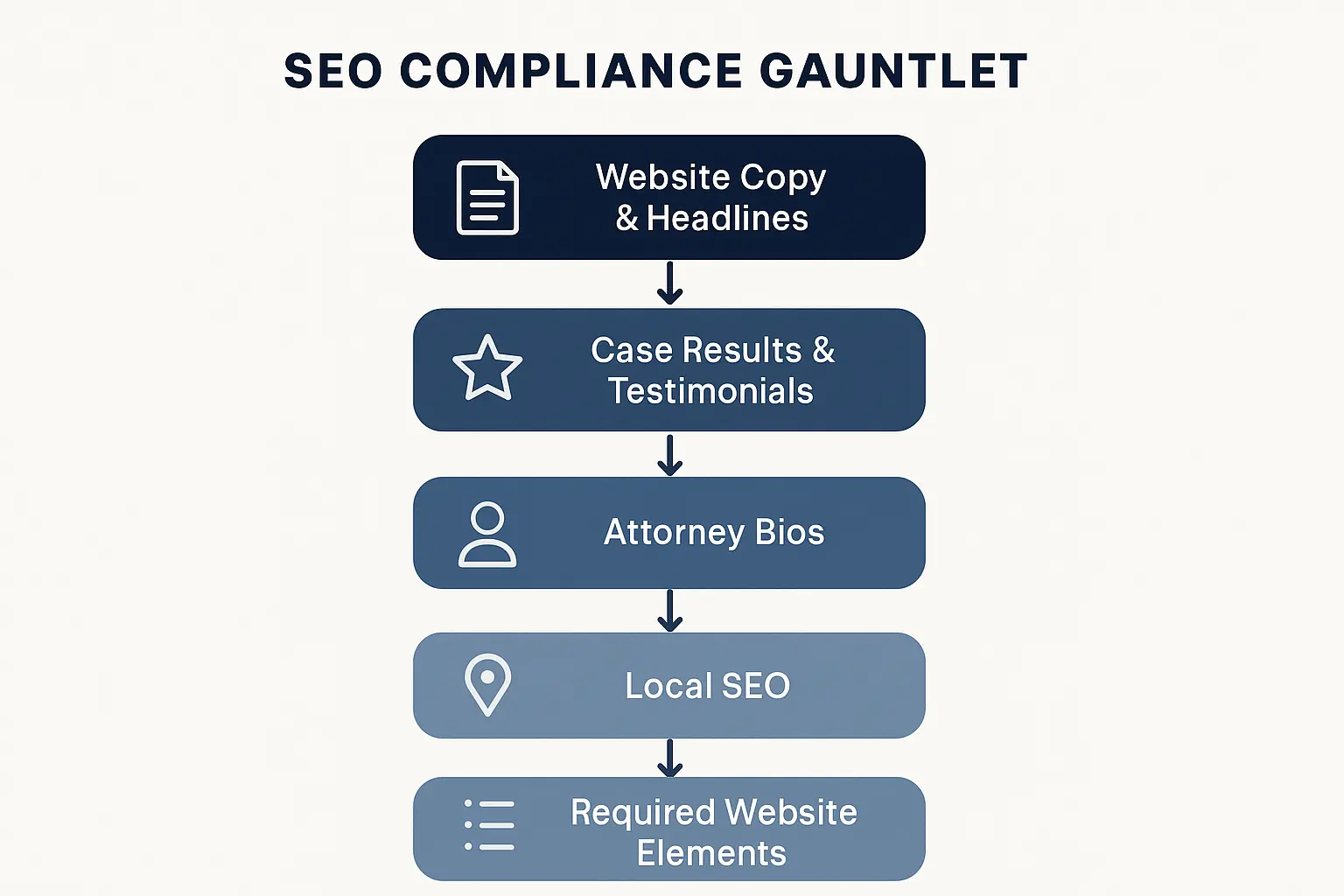
“Results Aren’t Typical”: Testimonials and Case Histories
Showcasing wins is a powerful marketing tool, but for lawyers, it’s riddled with compliance tripwires. You can’t simply copy and paste a glowing client email onto the homepage.
The Problem: Displaying past verdicts, settlements, or positive testimonials can create an “unjustified expectation” that future clients will achieve the same outcome. Every case is unique, and the rules are designed to prevent clients from feeling guaranteed a win.
The Compliant Approach: Every testimonial or case result must be accompanied by a clear and conspicuous disclaimer. Common phrasings include: “Results may vary depending on your particular facts and legal circumstances” or “Past results are not a guarantee of future performance.” This disclaimer shouldn’t be hidden in the footer; it should appear right next to the testimonial or case result itself.
The Unseen Risk: Metadata and Schema
Much of an agency’s optimization work happens behind the scenes in title tags, meta descriptions, and schema markup. But these elements are public-facing and absolutely fall under advertising rules.
The Problem: A title tag like Best Divorce Lawyer in Chicago | Guaranteed Consultation is a double violation. It makes an unsubstantiated comparison (“best”) and implies a guarantee. Google may pull this text for the search results page, making it a public advertisement. Similarly, review schema can automatically pull snippets from testimonials that lack the required disclaimers.
The Compliant Approach: Treat all metadata as public-facing ad copy. Keep it factual and objective. For example: Chicago Divorce & Family Law Attorney | Smith & Jones, LLP. Ensure any schema you implement doesn’t pull testimonial content that violates compliance rules.
A Compliance-First Framework for Agency SEO
Navigating these rules doesn’t have to be intimidating. It just requires a shift in your workflow. Putting compliance at the forefront protects your client, builds immense trust, and sets your agency apart from competitors who take a riskier approach.
Step 1: The Pre-Launch Compliance Conversation
Before you write a single line of copy or optimize a single page, have a dedicated compliance meeting with your law firm client. You’re the SEO experts; they’re the legal experts. The goal is to align your strategies with their ethical obligations.
Ask them directly:
- Which state bar rules do we need to follow? (Crucial for firms that practice in multiple states).
- What are your internal review and approval processes for new content?
- Are there specific words or phrases your firm avoids?
- Do you have approved disclaimer language we must use for testimonials and case results?
Step 2: Establish an Ironclad “Client Review” Workflow
Never, ever publish content, website changes, or ad copy without written approval from the client. Your agency’s role is to execute SEO strategy, while theirs is to provide the final legal and ethical sign-off.
This protects both you and them. If a compliance issue ever arises, you have a documented record showing the client approved the material. It’s an essential workflow for any agency that serves multiple law firms.
Step 3: Master the Art of the Disclaimer
Disclaimers are your best friend in legal SEO. Work with your client to create a library of pre-approved disclaimers for different situations.
Key placements include:
- Website Footer: A general disclaimer stating the website is for informational purposes and does not create an attorney-client relationship.
- Contact Forms: A notice that submitting a form does not create an attorney-client relationship.
- Testimonials & Case Results Pages: The “results are not guaranteed” disclaimer placed clearly alongside each entry.
- Blog Posts: A notice that the content is legal information, not legal advice.

Protecting Your Agency, Empowering Your Client
By embracing a compliance-first mindset, you transform a potential liability into a powerful value proposition. You’re no longer just the “SEO agency”; you’re a strategic partner who understands the unique demands of the legal industry.
This approach builds incredible trust and makes your services stickier. When a law firm knows their agency partner is actively protecting them from ethical complaints and State Bar sanctions, they have no reason to look elsewhere. You become an integrated part of their growth and risk management strategy—the ultimate goal for any white-label partnership.
Frequently Asked Questions (FAQ)
Who is ultimately responsible for advertising compliance—the agency or the law firm?
The law firm and its attorneys are always ultimately responsible for their compliance with State Bar rules. However, as their marketing partner, you have a professional duty to understand these rules and operate ethically to protect your client’s interests.
Do these rules apply to blog posts and informational content?
Yes. Most states consider any public communication about a lawyer’s services to be a form of advertising. A blog post designed to attract clients is subject to the same rules about misleading claims and unjustified expectations as a service page.
Can I just copy the disclaimers I see on other law firm websites?
You should not. Disclaimer language can be highly specific to a state’s rules and a firm’s practice areas. Always get the exact, approved language from your client, who should vet it with their own legal counsel.
What is the biggest mistake agencies make with law firm SEO?
The biggest mistake is assuming what works for other industries will work for law. Applying a generic SEO playbook without understanding the compliance layer—specifically around superlatives (“best”), guarantees, and testimonials without disclaimers—is the fastest way to put a client at risk.
How do these rules affect link building and digital PR?
They require careful oversight of how other sites talk about your client. If you secure a guest post or a mention on another website, you need to ensure the language used is compliant. You cannot have a third-party site call your client “the top-rated expert” if that’s a claim your client couldn’t make themselves.