
The Secret to a 900% Conversion Boost? How AI Triage Finds Your ‘Buy Now’ Leads
Your marketing is working. The forms are being filled out, the chatbot is buzzing, and your team’s inboxes are flooded with new leads. It’s a great problem to have, until you realize it’s actually two problems in one:
- Hidden somewhere in that flood is a perfect-fit customer ready to buy right now.
- Buried right alongside them are dozens of people who are “just looking,” kicking the tires, or months away from a decision.
The race is on. Research shows that responding to a lead within the first five minutes can increase conversion rates by a staggering 900%. But who gets that lightning-fast follow-up? The “buy now” lead who needs a quote, or the student downloading a whitepaper for a research project?
If your team is treating every inbound request the same, they’re likely wasting precious time on the second group while the first one grows cold. This is the daily, frustrating reality of modern lead management. But what if you could instantly tell the difference?
The Hidden Cost of ‘Lead Equality’
For decades, the go-to strategy has been “first come, first served.” Every form submission is a ticket, and every ticket gets a call or an email. While the intention is good, the outcome is often deeply inefficient.
The data paints a clear picture:
- A landmark study by Lead Connect found that 79% of marketing leads never convert into sales. The top reason? A failure to properly nurture them.
- The same research highlights that sales reps often ignore leads they perceive as low-quality, with some studies showing up to 70% of leads are never followed up on.
- Gartner research reinforces this, noting that sales reps spend roughly two-thirds of their time on non-selling activities, with lead qualification being a major time sink.
When your highly-skilled sales team spends their day sifting through unqualified inquiries, they aren’t selling. They’re performing an administrative task—a costly, manual sorting process that AI is perfectly suited to handle.
From Keywords to Intent: How AI Understands the Real Message
The key to solving this isn’t just speed; it’s understanding intent.
A human can instantly spot the difference between these two messages:
- Message A: “I’m the marketing director for a 500-person tech company and need a price quote for your enterprise plan to present to my VP by Friday.”
- Message B: “How does your pricing work?”
Message A is screaming “buy now.” It contains urgency (a deadline), authority (a job title), and specificity (company size, plan type). Message B is pure research. It’s a valid question, but it lacks any immediate commercial intent.
For years, we tried to solve this with simple keyword-based rules. If a message contained “quote” or “pricing,” it was flagged as “hot.” But this is a blunt instrument. It can’t grasp nuance, context, or the subtle signals that reveal a person’s true position in the buying journey.
This is where AI changes the game. Using Natural Language Processing (NLP), AI models can read and understand the language in your form submissions and chat logs just like a person would—only at a scale and speed no human team could ever match.
How AI Deciphers Intent
Instead of just looking for keywords, AI triage analyzes several layers of language to build a complete picture of intent:
- Entity Recognition: It identifies key details like job titles (“VP of Sales”), company names, budget figures (“we have a $50k budget”), and timelines (“need to implement this quarter”).
- Urgency & Sentiment Analysis: It detects words and phrases that signal urgency (“need this ASAP,” “deadline is next week”) or strong positive sentiment (“excited to get started,” “looks like a perfect fit”).
- Specificity & Detail: It measures how specific the request is. A detailed list of requirements signals a well-researched, serious buyer, whereas vague, open-ended questions often come from someone in the early stages of discovery.
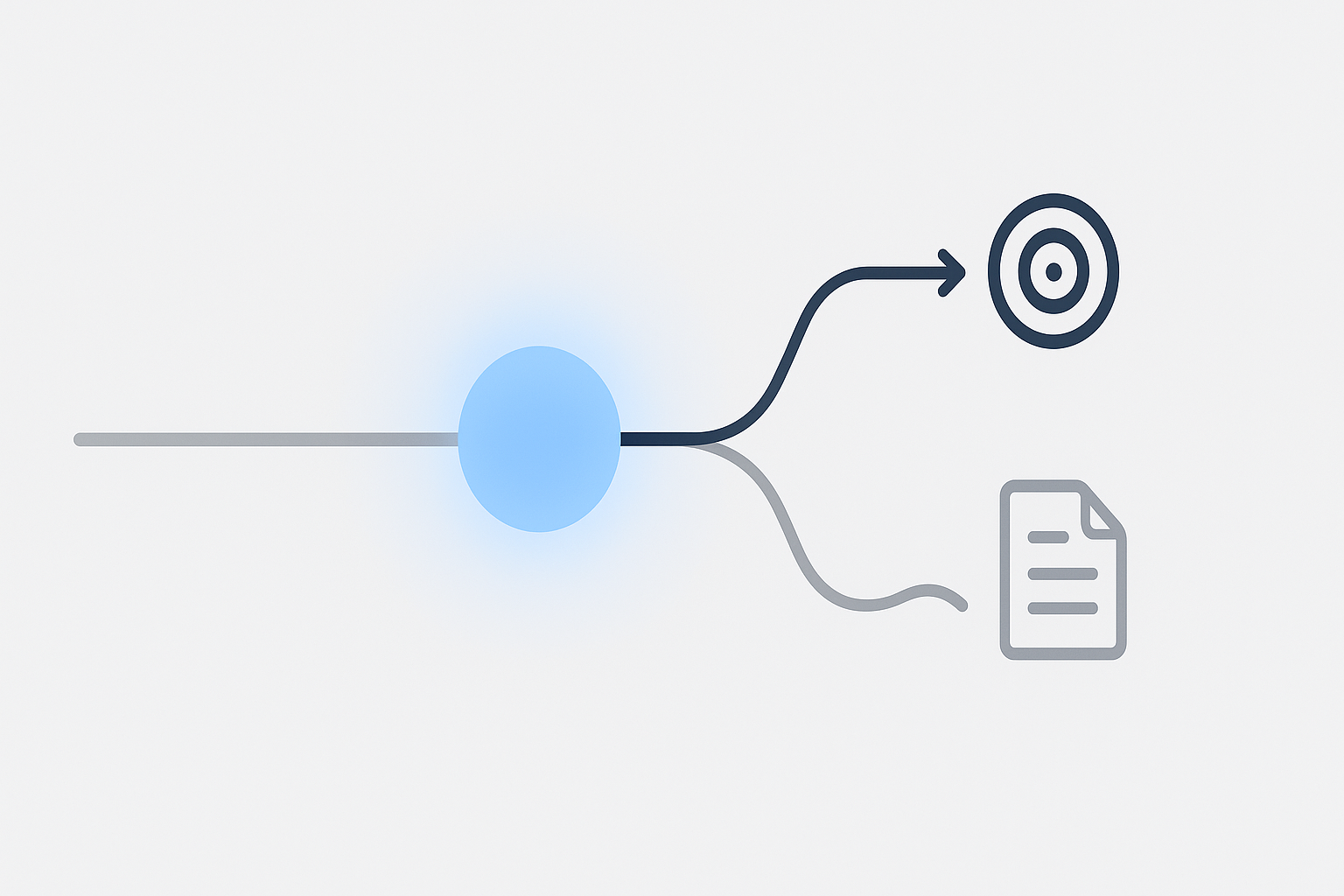
By analyzing these signals in milliseconds, the AI can reliably sort incoming requests into simple buckets:
- High-Intent / “Buy Now”: Route immediately to the sales team with a “Priority 1” flag.
- Low-Intent / “Researching”: Add to a long-term nurturing sequence with educational content.
- Support/Other: Send directly to the customer support queue, keeping it out of the sales pipeline entirely.
This isn’t just about filtering; it’s about deeply understanding the questions your audience asks, allowing you to prioritize outreach with surgical precision.
The Tangible Wins of AI-Powered Triage
Implementing an AI-driven system to sort inbound requests isn’t just a fancy tech upgrade. It delivers concrete business results by fundamentally changing the way your team operates.
1. Maximize the ‘Golden Window’ for High-Intent Leads
That 5-minute window we talked about? AI triage makes it possible to hit it every single time for the leads that matter most. Instead of sales reps digging through a crowded inbox, they receive real-time alerts for only the highest-priority opportunities. This lets them engage when a buyer’s interest is at its absolute peak.
2. Nurture Future Customers Instead of Annoying Them
Nothing alienates a potential future customer faster than a sales call they aren’t ready for. By identifying researchers early, you can serve them what they actually want: valuable, educational content. You build trust and establish your brand as a helpful resource. When they are ready to buy, you’re the first one they call.
3. Empower Your Sales Team to Sell, Not Sift
Great salespeople are strategists, relationship-builders, and closers—not administrators. By automating the manual sorting process, you free them up to focus on high-value activities. Their morale improves, efficiency skyrockets, and they can dedicate their expertise to what they do best: building relationships and generating revenue.
Your Questions About AI Lead Triage, Answered
Is this complicated to set up?
Not anymore. Many modern AI tools are designed to integrate directly with your existing CRM, web forms, and chat applications. Often, it’s as simple as connecting the systems and letting the AI “learn” from your existing data for a short period before it starts making accurate recommendations.
Will AI replace my sales development reps (SDRs)?
No, it empowers them. Instead of making 100 cold calls to a mixed-quality list, an SDR can now make 20 highly-informed calls to leads who have already been identified as sales-ready. Their role shifts from sifting for needles in a haystack to nurturing qualified interest.
What kind of data does the AI need to learn?
It learns from the data you already have: past form submissions, chat transcripts, and email inquiries. By analyzing historical conversations and their outcomes (e.g., which leads became customers), the model learns to recognize the patterns associated with high-intent buyers.
How is this different from traditional lead scoring?
Traditional lead scoring is typically rule-based and relies on demographic or firmographic data (e.g., “add 10 points if their title is ‘Director,’ add 5 points if they visited the pricing page”). AI intent analysis is far more sophisticated. It understands the context and nuance of natural language, and it scores a lead based on what they actually say, not just who they are or what they clicked.
Is it 100% accurate?
No system is perfect, but it’s a massive improvement over manual guesswork or rigid keyword rules. The best systems provide a confidence score with each prediction and improve over time, becoming more accurate with every interaction they analyze.
Moving from Guesswork to Intelligence
The challenge of separating buyers from researchers isn’t new, but the solution has fundamentally evolved. AI offers a way to move beyond manual processes and simple rules, letting your teams operate with a new level of precision and focus.
By intelligently triaging your inbound requests, you ensure that your most valuable leads get the immediate attention they deserve, while future customers are nurtured effectively. It’s about working smarter, not harder, and focusing your most valuable resource—your team’s time—where it will have the greatest impact.