
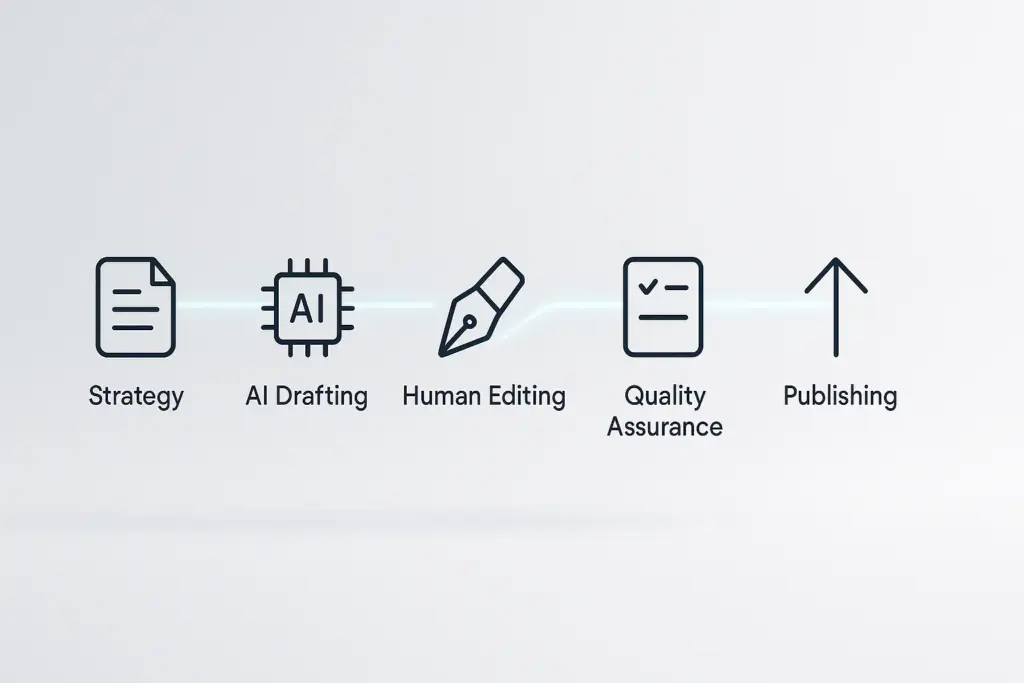
Your agency is brilliant at client strategy. You can map a customer journey, build a brand narrative, and drive incredible results. But when it comes to execution, you’ve hit a wall.
Content production has become a bottleneck—a slow, manual process that can’t keep pace with your clients’ ambitions or your agency’s growth.
You’re not alone. While 81% of B2B marketers are experimenting with generative AI, a staggering 45% admit they lack a scalable model for content creation. You have the tools—maybe a Jasper subscription here, a SurferSEO account there—but you don’t have the system.
The difference between dabbling in AI and truly scaling with it isn’t about finding a better AI writer. It’s about building an operational engine: a repeatable, efficient, and quality-controlled workflow that transforms content from a bottleneck into a revenue driver. This playbook provides the blueprint.
Part 1: The Anatomy of an AI-Assisted Content Workflow
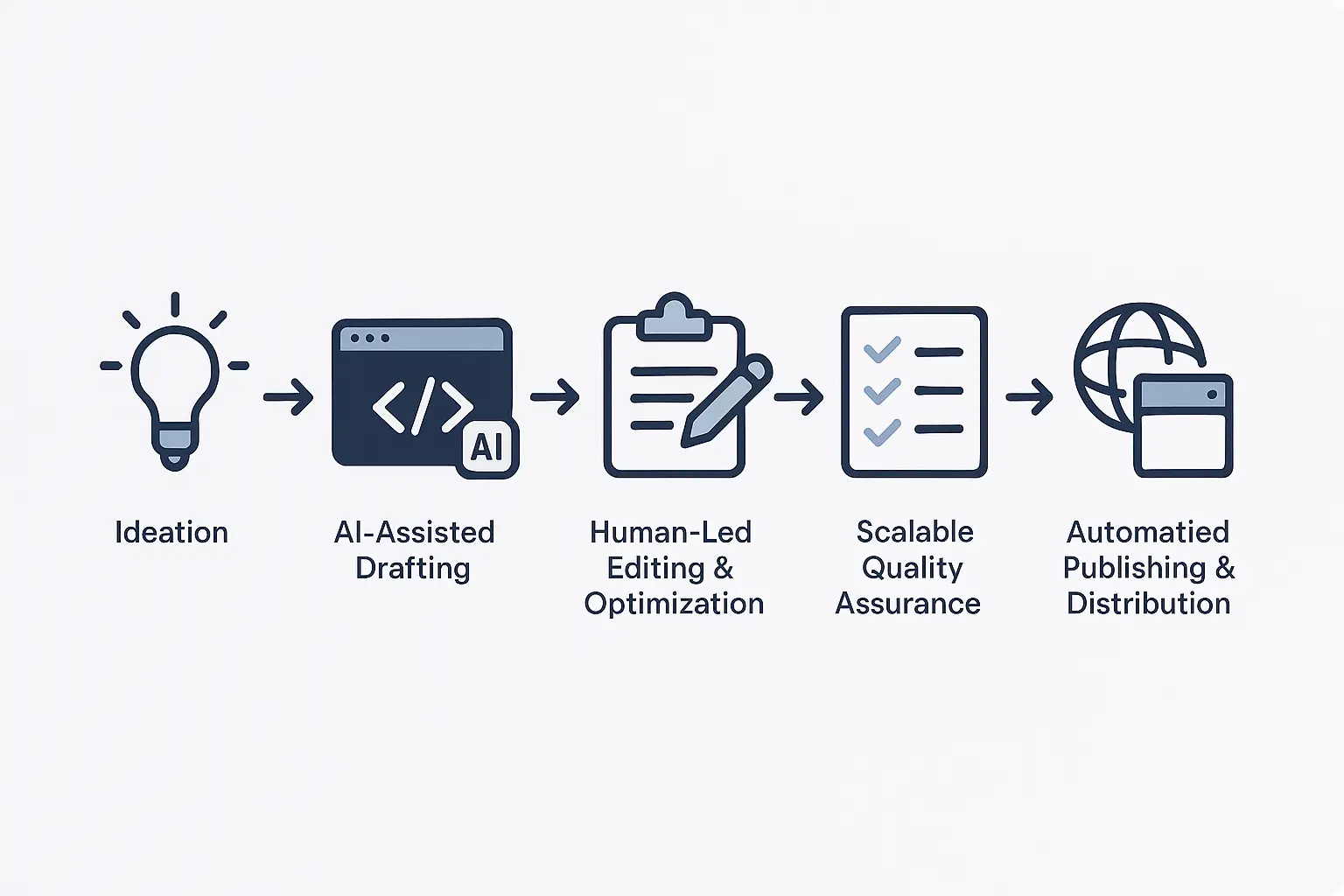
Most agencies approach AI content sporadically. A writer might use it for an outline and an editor for a headline, but the process remains disjointed. A scalable system, however, treats content production like an assembly line with five distinct, integrated stages. This isn’t just about speed; it’s about control, consistency, and quality at scale.
This framework replaces manual, one-off tasks with a streamlined production engine that works for every client, every time.
Part 2: Building Your Technology Stack (The Right Way)
The market is flooded with AI tools, leading many agencies to adopt a patchwork of subscriptions that don’t talk to each other. A strategic approach focuses on building a cohesive stack where each tool serves a specific function in your workflow. Instead of asking, “Which tool is best?” ask, “What capability do I need at this stage?”
Your technology stack will evolve as you scale, but the core categories remain the same:
- Large Language Model (LLM): The engine for generating text, often accessed via an API like GPT-4 for better integration.
- SEO Optimization Tool: The data layer for on-page optimization, providing keyword targets, structure recommendations, and competitive analysis (e.g., SurferSEO, Clearscope).
- Automation Platform: The connective tissue that links your tools, automating handoffs and reducing manual work (e.g., Make.com, Zapier).
- Content Management System (CMS): The final destination for your content, which can be integrated into your workflow for automated publishing (e.g., WordPress, Webflow).
Here’s how that looks at different maturity levels:
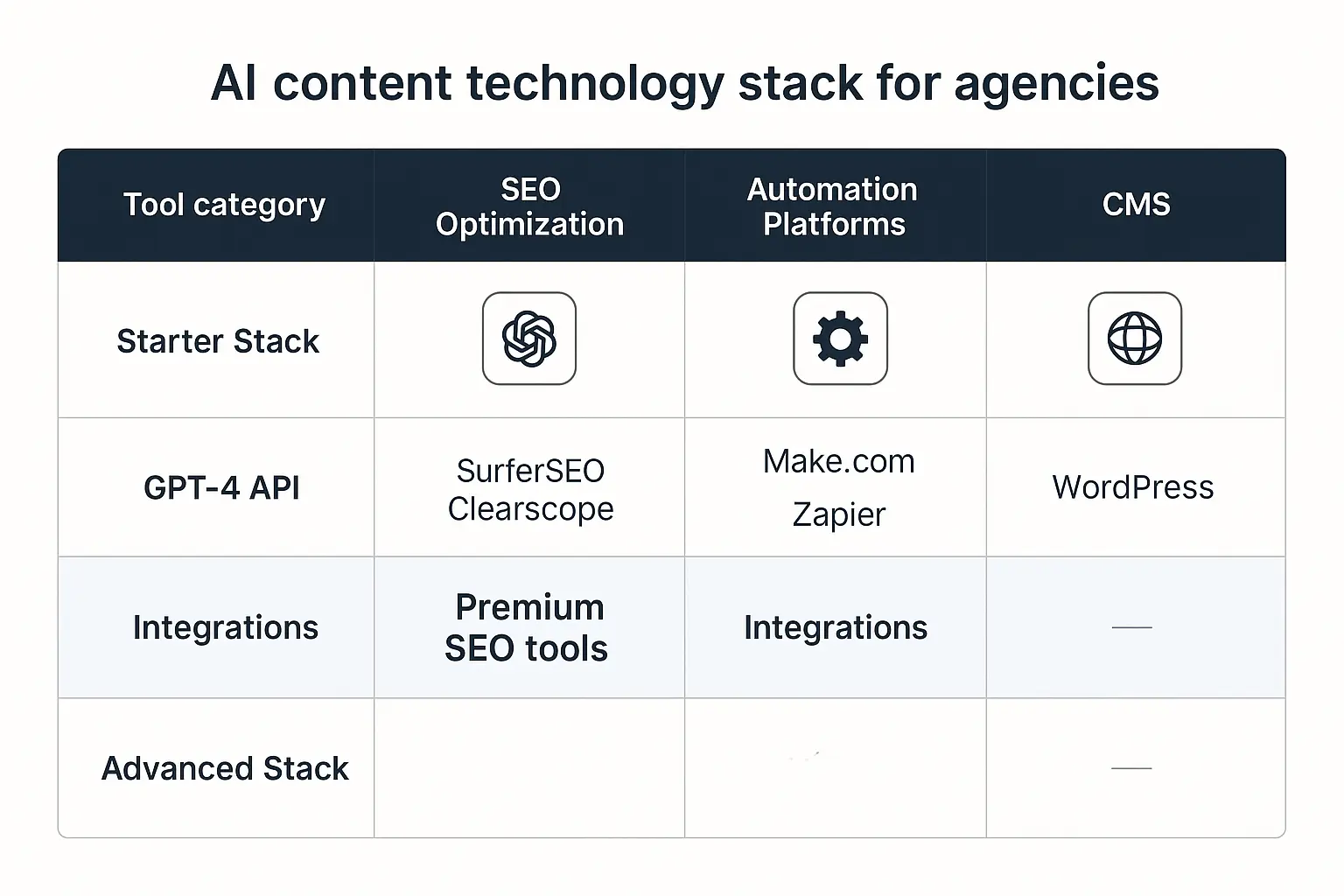
The goal isn’t to have the most advanced stack; it’s to have one that matches your operational capacity. The key takeaway is that the emerging trend isn’t just AI writing, but seamless workflow integration that connects these tools via APIs.
Part 3: The Step-by-Step Workflow for a Blog Post
Let’s make this tangible. Here is a tactical, step-by-step process for creating a high-quality, SEO-optimized blog post using an AI-assisted workflow. This is where theory meets practice.
- Automated Brief Generation: The process begins with a data-rich brief. Instead of manually researching competitors, use an SEO tool’s API to automatically pull the top 10 ranking articles for your target keyword. Your system should extract common H2s and H3s, frequently asked questions from “People Also Ask,” and target keyword density. This data forms the foundation of a highly detailed prompt.
- AI-Assisted First Draft: Feed the structured brief into your LLM (e.g., via a GPT-4 API call in Make.com). Your prompt shouldn’t just be “write a blog post about X.” It should be a detailed command that includes the target audience, tone of voice, keyword list, required entities, and the exact heading structure from the brief. The result is an 80% complete draft that is structurally sound and on-topic.
- Human-Led Editing & Storytelling: This is where your team’s expertise shines. The AI draft is a scaffold, not the final product. An editor reviews it for flow, narrative, and brand voice, then adds unique insights, client case studies, and anecdotes—the human elements AI cannot replicate. This “human-in-the-loop” step is non-negotiable for high-quality content.
- Data-Driven Optimization: The human-edited draft is run through an SEO optimization tool. The editor or an SEO specialist uses the tool’s recommendations to refine the content, ensuring it meets all on-page SEO criteria for the target keyword. This is a data-driven process, not guesswork.
- Quality Assurance & Final Review: Before publishing, the content goes through a final quality check against a standardized protocol. This crucial step, which we’ll detail next, ensures consistency and prevents errors.
- Automated Publishing: Once approved, the workflow can automatically push the final content, complete with formatting and metadata, directly to the client’s CMS.
This system is designed to leverage AI for the heavy lifting (research, drafting) while empowering your human experts to focus on high-value tasks like strategy, storytelling, and final quality. Organizations using similar AI-driven systems report up to 65% faster content production cycles—a game-changer for agency capacity.
Part 4: The Unskippable Step: The Quality Assurance Protocol
The biggest fear agencies have about AI is a drop in quality. This is a valid concern, but it’s solvable with a rigorous Quality Assurance (QA) protocol. A standardized checklist ensures that every piece of content, regardless of who wrote or edited it, meets the same high standard.
This isn’t just about catching typos. It’s about verifying factual accuracy, ensuring brand alignment, and confirming SEO-readiness. This step is what separates amateur AI users from professional content operations.
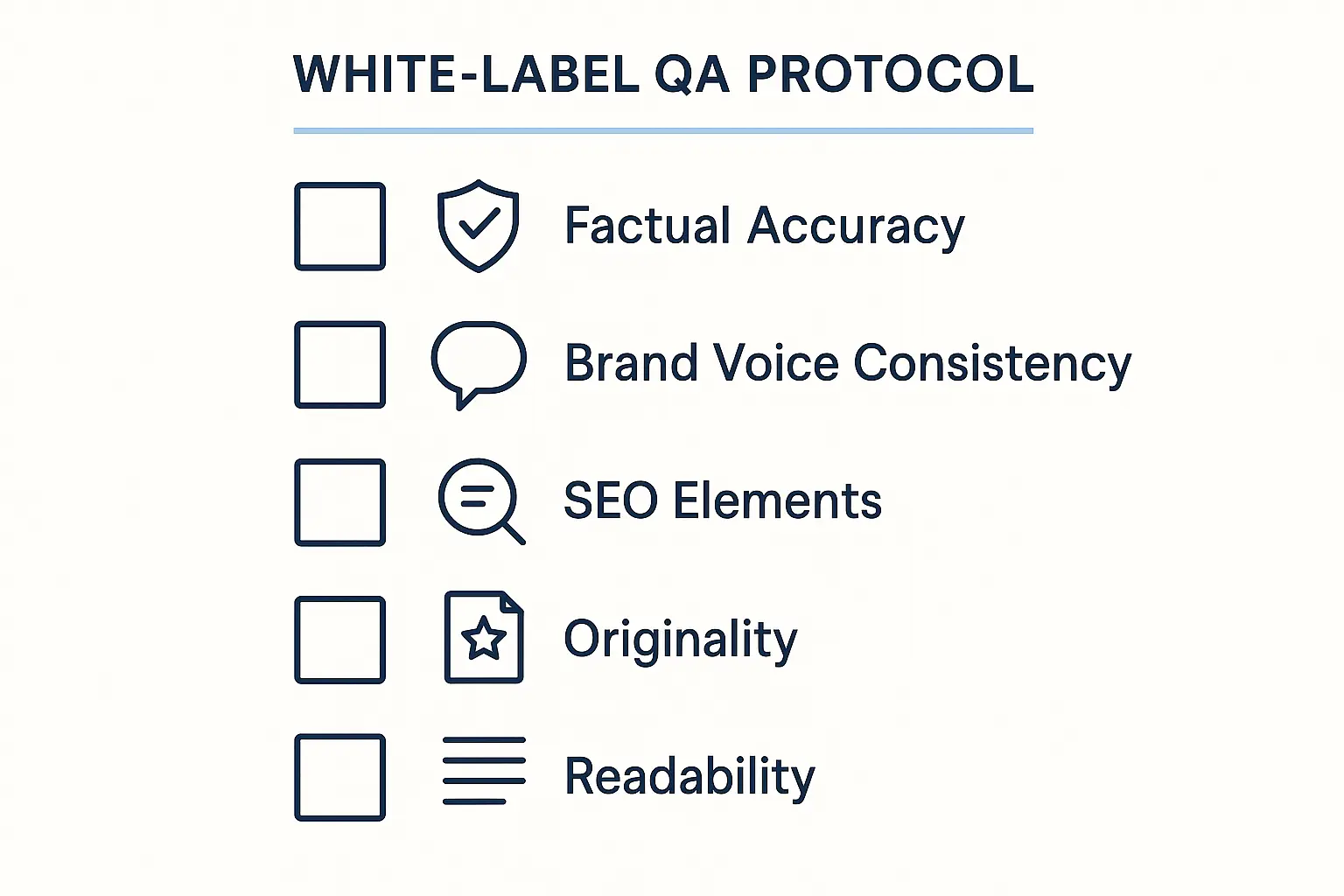
By systemizing your QA, you build a defensible process that guarantees quality. This checklist can be adapted for your clients and used as a white-label document to demonstrate your agency’s commitment to excellence.
Part 5: Scaling the Workflow Across Formats
The beauty of this framework is its flexibility. While we detailed the process for a blog post, the core five-stage engine can be adapted for nearly any content format your clients need. The technology and principles remain the same—only the inputs and QA criteria change.
This turns your agency into a multi-format content powerhouse, capable of executing diverse client requests without needing to reinvent the production process each time.

By applying a consistent system, you can confidently expand your service offerings, knowing you have the operational backbone to deliver at scale.
From Bottleneck to Revenue Driver: Your Path Forward
The challenge facing your agency isn’t a lack of tools or talent; it’s the lack of a scalable, repeatable system. By implementing an AI-assisted content engine, you transform your content production from a costly, linear bottleneck into an efficient, profitable, and scalable service line. The data confirms it: 65% of companies using AI report improved SEO results.
You now have the strategic blueprint. The next step is execution. Building this engine requires a unique blend of technical expertise, SEO strategy, and operational discipline.
For many agencies, the smartest move isn’t to build this engine in-house but to partner with a specialist who can run it for them. JVGLABS acts as your invisible, white-label execution team. We build and operate this exact content engine in the background, allowing you to focus on client strategy and growth while delivering consistently high-quality, optimized content under your brand.
Frequently Asked Questions
- Will using AI-generated content get our clients penalized by Google?
No. Google’s guidance is clear: they reward high-quality, helpful content, regardless of how it’s produced. The key is value. Our human-in-the-loop workflow ensures AI-assisted drafts are elevated with unique insights, expertise, and helpfulness, fully aligning with Google’s E-E-A-T (Experience, Expertise, Authoritativeness, Trustworthiness) principles. - How much human oversight is actually required? Can’t we just fully automate it?
Full automation is a recipe for generic, low-quality content. The magic of this system is the synergy between AI and human expertise. We find the sweet spot is around 80% AI assistance and 20% human strategy, editing, and final review. This maintains quality and strategic alignment while capturing massive efficiency gains. - Can an AI workflow truly match the unique brand voice for each of our clients?
Absolutely, but it requires a rigorous process. The key is in the initial brief and the editing stage. By providing the AI with detailed brand voice guidelines (e.g., “write in a witty, authoritative tone for a B2B SaaS audience”) and having a skilled human editor refine the output, the final content will be perfectly on-brand. - Isn’t setting up a custom, API-driven workflow expensive and complicated?
It can be, which is why many agencies choose to partner with an execution specialist. However, when you compare the cost of building an integrated workflow (or partnering with a firm like JVGLABS) to the cost of hiring, training, and managing a larger in-house content team, the ROI becomes clear. This system allows you to double your content capacity without doubling your headcount.