

A successful law firm, let’s call them “Acme Legal,” is growing. After years of dominating their home city, they’ve just opened a new office two states over and brought on a team of highly respected ‘Of Counsel’ attorneys. They’ve updated their website, issued a press release, and are ready for the calls to roll in.
But a month later, confusion sets in. Potential clients in the new city are calling the main office, frustrated they can’t reach someone local. The new star attorneys aren’t showing up in “lawyer near me” searches. Online, their new office address is listed correctly on their site, but half a dozen legal directories show a different suite number.
This isn’t a marketing failure; it’s a data problem. And it’s a problem that proves a critical truth: for modern law firms, the old playbook of managing only Name, Address, and Phone (NAP) is no longer enough. In fact, research shows that 80% of consumers lose trust in a business with incorrect or inconsistent contact details online. In the high-stakes world of legal services, trust is everything.
Why Standard Citation Management Fails for Law Firms
Most businesses have a simple citation profile: one name, one address, one phone number. Law firms, however, operate in a more complex world. Their digital footprint is a web of interconnected entities, and standard citation tools often miss the nuances.
Here are the unique challenges law firms face:
-
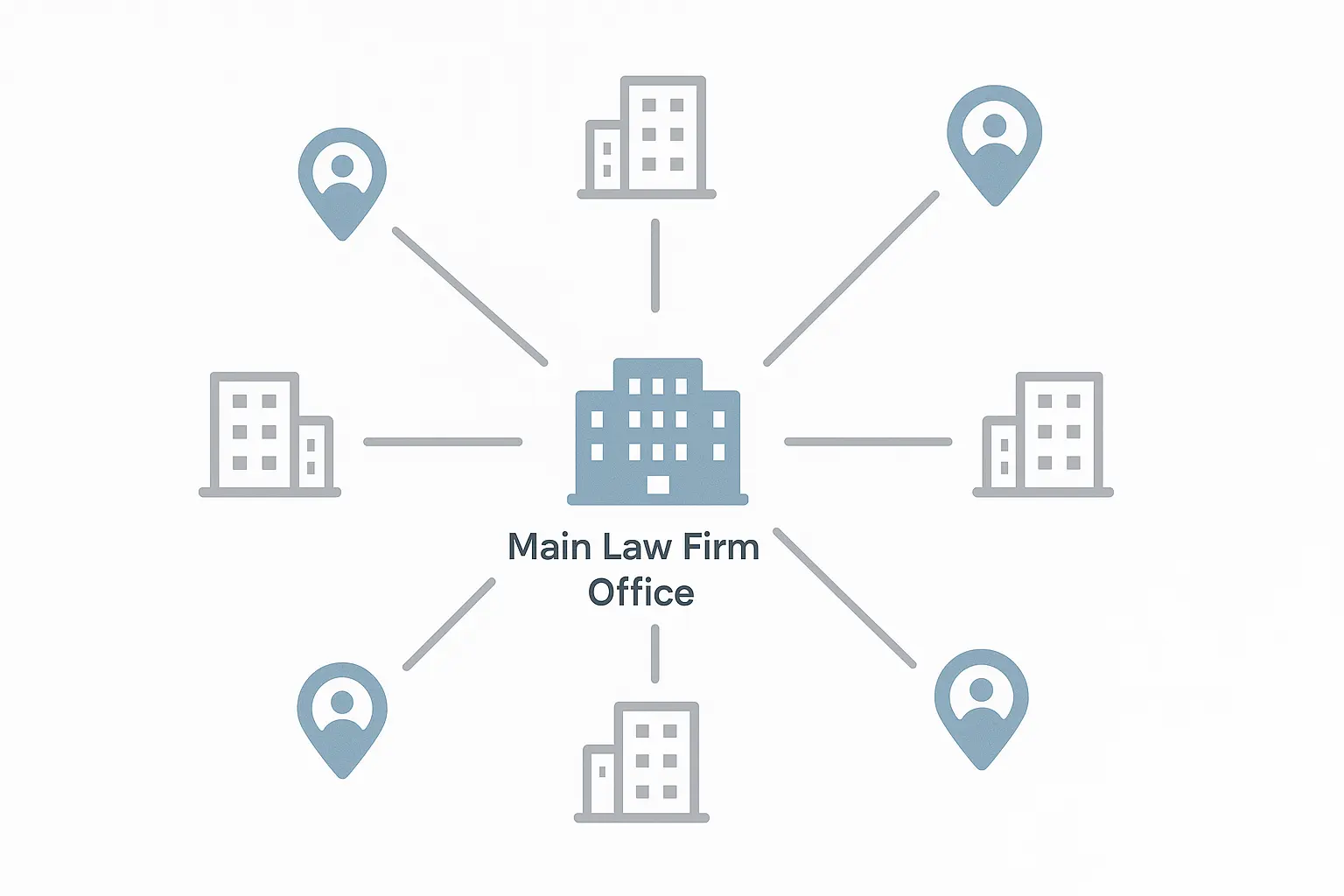
Multi-Location Ambiguity: Each office is a distinct local entity. If the digital signals for a Dallas office and a Houston office get crossed, Google gets confused. This makes it difficult for the search engine to determine which location is most relevant to a local searcher, often hurting the rankings of both.
-
The Practitioner Problem: Your firm is not just a brand; it’s a collection of individual experts. Every client-facing attorney—partners, named associates, ‘Of Counsel’—is a searchable entity with their own professional history, credentials, and sometimes, a separate Google Business Profile (GBP).
-
‘Of Counsel’ and Mergers: When an established attorney joins your firm, they bring their digital history with them. Old addresses, phone numbers, and associations don’t just disappear. They linger online, creating conflicting information that can dilute the authority of both the individual and the firm.
According to a study by Whitespark, Google Business Profile signals (like a correctly optimized profile) and citation signals (like consistency across directories) are two of the top 5 factors influencing local pack rankings. When a law firm’s complex structure creates messy signals, it’s directly harming its ability to be found.
The Two Layers of Legal SEO Citations: Firm vs. Practitioner
Solving this requires a shift in perspective. You have to stop thinking about your firm as a single entity and instead visualize its digital presence in two distinct, interconnected layers.
Layer 1: The Firm-Level Citation
This is the foundation: the official business information for each physical office location.
- Entity: The Law Firm Name (e.g., “Acme Legal, Dallas Office”)
- Address: The unique physical address for that office.
- Phone: A unique, local phone number for that office. Using a call-tracking number is great for measurement, but the primary number listed should be local.
Crucial Best Practice: Each office location must have its own dedicated page on your website. This page acts as the “single source of truth” for Google and should feature the unique NAP, details about the attorneys at that location, and location-specific content.
Layer 2: The Practitioner-Level Citation
This is where most firms stumble. Each key, client-facing lawyer at a specific location can have their own citation profile, which must be perfectly aligned with the firm.
- Entity: The Lawyer’s Name (e.g., “Jane Doe”)
- Address: The exact same address as the firm’s office where they practice.
- Phone: The firm’s phone number for that location.
A practitioner listing often takes the form of a separate Google Business Profile for an individual lawyer. It should list their title as “Attorney” and link back to their bio page on the firm’s website, not the firm’s homepage. This creates a clear, hierarchical relationship: Jane Doe is an attorney at Acme Legal’s Dallas office.
When these two layers are consistent, Google understands the relationship. The firm’s authority flows to the practitioner, and the practitioner’s individual authority and reviews bolster the firm’s local presence. When they are inconsistent, it creates a tangled mess that search engines can’t decipher.
A Scalable Workflow for Advanced Citation Management
Cleaning this up requires a systematic approach. It’s not about playing whack-a-mole with incorrect listings; it’s about building a foundational system that scales as your firm grows.
Step 1: The Comprehensive Audit
Before you can fix anything, you need a complete picture of the problem. This goes far beyond a standard NAP audit.
- List All Entities: Create a master spreadsheet of every location and every key practitioner.
- Audit the Firm: For each office location, search for all existing citations across the web. Note every inconsistency, no matter how small (“St.” vs. “Street,” “Ste.” vs. “#”).
- Audit the Practitioners: This is the critical step. Search for each lawyer by name, name + old firm, and name + “attorney.” Uncover every profile on legal directories (Avvo, FindLaw, Justia), social media, and alumni pages.
- Document Everything: For each entity, your spreadsheet should have columns for the directory, the listing URL, the incorrect information, and the correct information.
Step 2: Establishing a Single Source of Truth
Your firm’s website is the ultimate authority on who you are and where you operate.
-
For Firm Locations: Optimize each location page. It should have the correct NAP, an embedded Google Map, and schema markup (LocalBusiness) that explicitly tells Google the address details. For agencies, this is where a robust white-label technical SEO audit can identify foundational issues before you even start on citations.
-
For Practitioners: Optimize each lawyer’s bio page. It should state which office they are associated with and link to their official Google Business Profile.
Step 3: Prioritizing and Cleaning Up
With your audit complete, the cleanup begins. Don’t start randomly; prioritize your efforts for maximum impact.
- Data Aggregators: Start with the core data aggregators (like Data Axle and Neustar Localeze). These services feed information to hundreds of other directories, so fixing it at the source is powerful.
- Legal Directories: Next, focus on the high-authority, legal-specific directories, as these carry significant weight in your industry.
- General Directories: Finally, tackle the major general directories (Yelp, Apple Maps, Bing Places, etc.).
The process is meticulous: claim the listing, submit corrections, and verify the changes. This also means identifying and requesting the removal of duplicate listings, which are a major source of confusion for search engines.
Step 4: Building and Standardizing
Once the existing clutter is cleaned up, you can begin building a consistent and powerful citation profile.
-
Consistency is Key: Every new citation you build must match your “single source of truth” website data exactly.
-
Enhance with Schema: Use schema markup on your website to explicitly define the firm-practitioner relationship. You can nest a Person schema for the attorney within the LegalService schema for the firm location. This is like handing Google a clear organizational chart.
This detailed, structured work is a core part of any effective white-label local SEO service. It’s the kind of foundational effort that pays dividends for months and years to come.
Measuring Success: What Does a Good Citation Strategy Achieve?
The goal isn’t just a clean spreadsheet; it’s tangible business growth. A successful advanced citation strategy delivers:
-
Improved Map Pack Visibility: Your firm and its lawyers appear more frequently in the coveted “map pack” for high-intent local searches. A study by ahrefs found a strong correlation between the number of citations and local organic search rankings.
-
Increased Local Calls & Leads: With consistent, accurate data, potential clients can easily find and contact the right office, leading to more qualified inquiries.
-
Dominance in “Near Me” Searches: Your firm will be better positioned to capture searches like “personal injury lawyer near me” in every market you serve.
-
Enhanced Brand Authority: A consistent digital presence builds trust not only with clients but also with search engines, establishing your firm as the authoritative choice in your practice areas and locations.
Frequently Asked Questions (FAQ)
What’s the difference between a citation and a backlink?
A citation is any online mention of your firm’s Name, Address, and Phone number (NAP). It doesn’t have to be a clickable link. A backlink is a clickable hyperlink from another website to yours. Both are valuable for SEO, but citations are especially crucial for local search rankings.
Should every lawyer at my firm have their own Google Business Profile?
Not necessarily. Generally, only client-facing practitioners who have direct contact with clients (like partners or senior associates) should have their own GBP. Support staff or junior lawyers typically do not need one. The key is that they must be a public-facing professional at the firm’s location.
What if two of our offices are in the same building?
This requires extreme precision. You must have a unique suite number for each office, and this suite number must be used consistently in every single citation. Each office also needs a unique local phone number.
How long does it take to see results from citation cleanup?
It varies. Some directories update within days, while data aggregators can take weeks or even a few months to propagate changes across their network. You can typically expect to see initial ranking improvements within 60-90 days, with continued gains as the new, consistent data solidifies across the web.
Can we use a P.O. Box or virtual office for a new location?
No. This is a direct violation of Google’s guidelines. A Google Business Profile must be associated with a physical location where you have in-person contact with clients. Using a virtual office or P.O. box risks getting your listing suspended.
From Logistical Headache to Competitive Edge
For multi-location and ‘Of Counsel’ law firms, citation management is more than a simple marketing task. It’s a complex data management challenge that directly impacts your ability to attract clients in every market you serve.
By moving beyond basic NAP and adopting a two-layer strategy for both the firm and its individual practitioners, you can build a clean, authoritative, and scalable digital foundation. This turns what was once a logistical headache into a powerful competitive advantage. Mastering this complex process is what sets a great agency SEO partner apart from the rest, ensuring your firm is visible, trusted, and chosen by clients when it matters most.