
The New Sales Math: 4 Steps to Grow Revenue Without Adding Headcount
The executive board meeting agenda is set. You’re looking at the Q4 revenue target, and the math feels stubbornly familiar: to grow revenue by 20%, you need to increase sales capacity by 20%. For most of modern business history, “sales capacity” has been a synonym for headcount. The default lever for growth has always been hiring more reps.
But what if that model is fundamentally broken?
Consider this: research shows that sales reps spend a staggering 66% of their day on non-revenue-generating activities. They’re drowning in CRM updates, manual prospecting, and administrative tasks. You can hire more people, but you might just be hiring them to spend two-thirds of their time not selling.
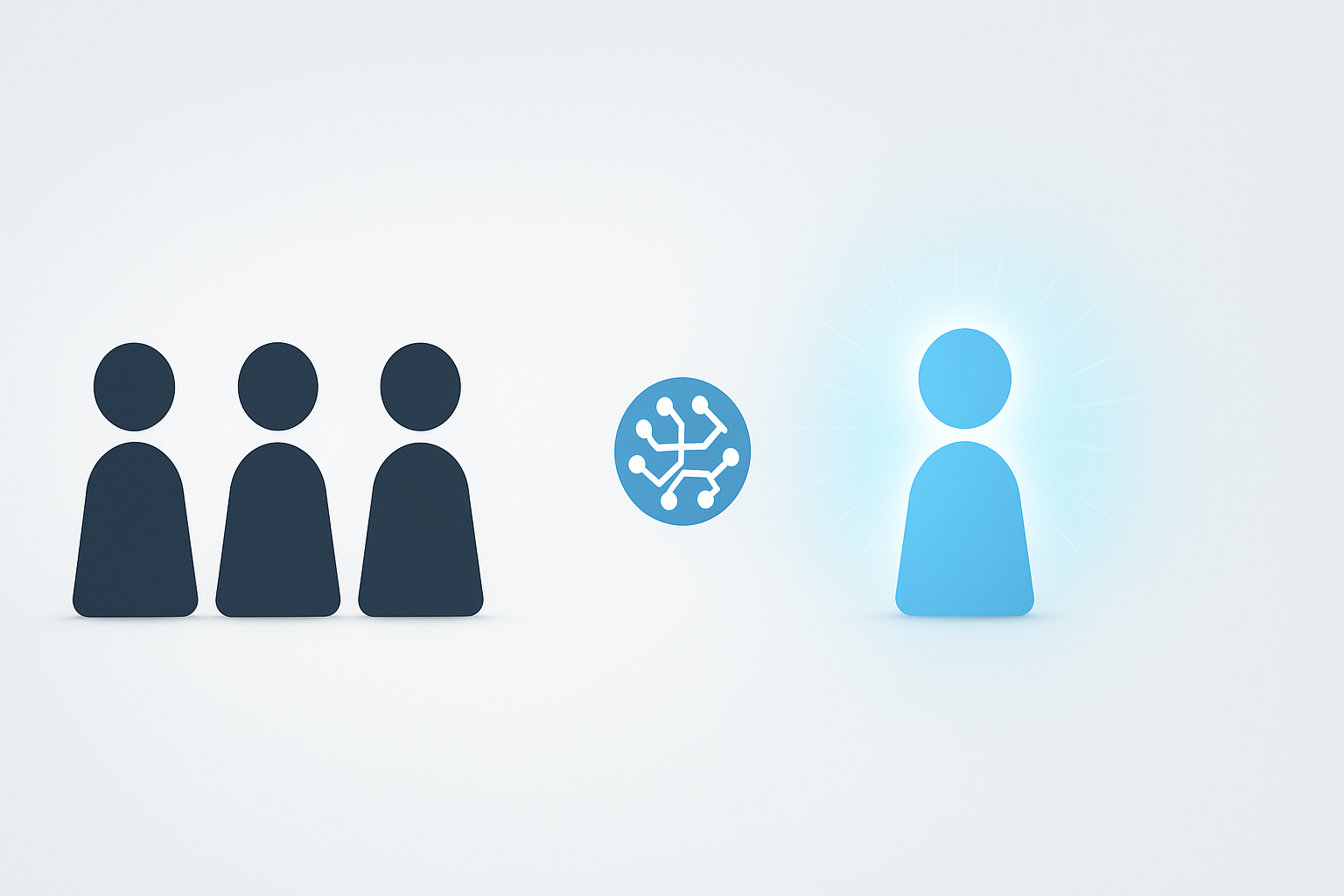
This isn’t a people problem; it’s a process problem. And that’s where AI shifts from a buzzword to a core financial strategy. By automating the noise and augmenting rep intelligence, AI introduces a new, powerful variable into your capacity planning that lets you model significant growth without the linear cost and complexity of adding headcount.
The Old Math: Why Linear Headcount Planning Fails
Traditional sales capacity planning is straightforward. You take the number of quota-carrying reps, multiply it by their average quota, and you get your total capacity.
(Number of Reps) x (Average Quota) = Total Sales Capacity
Want to grow? The formula dictates you need more reps. While reliable for decades, this linear model is becoming a liability in today’s economic climate for several key reasons:
- It’s Expensive: The cost of a new sales hire goes far beyond salary. Recruiting fees, training, benefits, and tools can push the first-year cost to 1.5-2x their base pay.
- It’s Slow: It takes months to recruit, hire, and onboard a new rep. Even then, full productivity isn’t immediate. This “ramp time” creates a significant lag between investment and return.
- It Doesn’t Scale Efficiently: Doubling your team doesn’t always double your revenue. Increased complexity, management overhead, and market saturation can lead to diminishing returns.
You’re essentially pouring more water into a leaky bucket. The fundamental inefficiency—that reps only spend about 28% of their week actually selling—remains unchanged.
The New Equation: Introducing the AI Productivity Multiplier
AI reframes the capacity equation. Instead of just adding more reps, you can now multiply the effectiveness of your existing ones. The new formula looks like this:
(Number of Reps) x (Average Quota) x (AI Productivity Multiplier) = Total Sales Capacity
This “AI Productivity Multiplier” isn’t a vague concept; it’s a quantifiable lift from specific AI interventions that give your team back its most valuable resource: time. High-performing sales teams are already twice as likely to be using AI, and the results are clear.
How does it work? AI targets the 66% of the day reps lose to non-selling tasks:
- Automating Low-Value Work: AI-powered tools can handle CRM data entry, write follow-up emails, transcribe meeting notes, and summarize action items, freeing reps to focus on conversations.
- Improving Deal Intelligence: AI analyzes deal data, conversation sentiment, and engagement patterns to provide more accurate sales forecasts, identify at-risk deals, and suggest the next best action. This moves reps from gut feeling to data-driven selling.
- Enhancing Rep Effectiveness: AI can act as a real-time sales coach, offering talking points during a live call, providing deep research on a prospect moments before a meeting, and personalizing outreach at scale.
This isn’t about replacing reps. It’s about elevating them from manual task-doers to strategic relationship-builders.
Building Your AI-Powered Sales Capacity Model: A 4-Step Framework
So, how do you move from theory to a practical financial model? You don’t need to be an AI expert, but you do need to be systematic.
Step 1: Baseline Your Current Productivity
Before you can apply a multiplier, you need to know your starting point. Work with your sales operations team to get a clear, honest picture of how your reps spend their time. Analyze CRM data, conduct surveys, and interview top and mid-tier performers.
Ask critical questions:
- How many hours per week are spent on manual data entry?
- How much time is dedicated to pre-call research?
- What’s the average time spent writing emails and follow-ups?
This exercise will quickly highlight the biggest time sinks and therefore your biggest opportunities for AI intervention.
Step 2: Identify High-Impact AI Intervention Points
With your baseline established, map the biggest time-wasters to specific AI solutions. You don’t need a single, massive platform. Often, the best approach is to target the most painful problems first.
- Problem: Reps spend 5-7 hours a week updating the CRM.
- AI Intervention: A tool that auto-captures contact info, logs activities, and transcribes call notes directly into the right fields.
- Problem: Prospecting is inefficient and yields low-quality leads.
- AI Intervention: AI-driven lead scoring that prioritizes the most promising accounts and tools that generate hyper-personalized outreach. Studies show AI can increase sales leads by up to 50%.
- Problem: Forecasting is a guessing game, leading to missed targets.
- AI Intervention: A platform that analyzes your sales pipeline and conversation data to produce objective, data-driven revenue forecasts.
Step 3: Quantify the Potential Productivity Lift
Now, you can start building your model. Be conservative. Even small gains in efficiency create significant leverage.
Let’s say you determine an AI tool can save each rep 4 hours per week by automating administrative tasks.
- 4 hours/week is ~10% of a 40-hour workweek.
- This means you’ve just increased each rep’s available selling time by 10%.
- Your AI Productivity Multiplier starts at 1.10.
For a team of 20 reps, that’s the equivalent of adding two “new” reps to the team without any recruiting costs or ramp time. This efficiency is a direct result of how AI processes language to automate tasks like summarization and email drafting—a concept explained by understanding How Large Language Models Work.
Step 4: Remodel Your Revenue Projections with AI
With your multiplier in hand, you can now forecast growth based on productivity gains, not just headcount.
Traditional Model:
- You have a team of 50 reps, each with a $1M annual quota.
- Total Capacity = 50 reps x $1M = $50M.
- To reach a $55M target, you need to hire 5 more reps.
AI-Powered Model:
- You have the same 50 reps with a $1M quota.
- You implement AI tools that create a 10% productivity lift (a 1.10 multiplier).
- Total Capacity = 50 reps x $1M x 1.10 = $55M.
You hit your growth target with zero new hires, avoiding months of recruitment, onboarding costs, and administrative overhead. This is the financial leverage that gets boards excited—a clear path to scalable, profitable growth. Companies that successfully integrate AI often see a 10-20% increase in overall revenue.
Beyond the Spreadsheet: The Cultural Impact
Modeling AI’s impact is a financial exercise, but implementing it is a human one. The goal is to create a culture where technology empowers people, not replaces them. This internal evolution mirrors an external one: the very landscape of customer discovery is changing, and understanding How AI Search is Replacing SEO provides critical context for this shift.
Your reps’ roles will evolve from performing repetitive tasks to focusing on high-value skills: strategic thinking, complex problem-solving, and building deep customer relationships. The machine handles the “what,” freeing the human to focus on the “why.”
Frequently Asked Questions (FAQ)
- Isn’t this just another expensive software subscription?
While AI tools have costs, the key is to frame the investment against the alternative: hiring. A $100/month per user AI tool costs $1,200 per year. A new sales rep can cost over $100,000 in their first year with salary, benefits, and overhead. If the tool makes your existing team just 5-10% more effective, the ROI is massive and immediate.
- Will AI replace my sales reps?
No. AI is terrible at building human rapport, understanding nuanced business challenges, and navigating complex organizational politics. It’s a tool for augmentation, not replacement. The most successful models are “human-in-the-loop,” where AI assists the rep, making them faster, smarter, and more focused on what they do best.
- How do I measure the actual ROI of these tools?
Tie measurement back to your capacity model. Key metrics to track include:
- Time-to-Productivity: How much selling time was reclaimed?
- Activity Metrics: Did reps make more calls or book more meetings with their newfound time?
- Pipeline Velocity: Are deals moving through the sales cycle faster?
- Win Rates: Are reps closing more of the deals they pursue?
- Where is the best place to start?
Don’t try to boil the ocean. Start with the most obvious and painful administrative bottleneck. CRM data entry, meeting notes, and follow-up email templates are often the best “quick win” areas. Success in one area builds momentum and buy-in for broader adoption.
The Future of Growth Isn’t More People—It’s More Productive People
For decades, the path to revenue growth was paved with more cubicles and more coffee machines. Today, forward-thinking leaders are realizing that the next wave of growth will come from unlocking the latent capacity that already exists within their teams.
By shifting your mindset from a headcount-based model to a productivity-based one, you change the entire financial DNA of your organization. You build a more resilient, efficient, and scalable sales engine poised to win not by out-hiring the competition, but by out-performing them.
As you build a more productive internal sales engine, it’s just as critical to ensure customers can find you in an AI-driven world. To adapt your strategy for this new ecosystem, explore The Ultimate Guide to AI Visibility for Agencies.