
You’ve been there. Your marketing team launches a brilliant “welcome” campaign designed to nurture new leads with helpful, introductory content. With great open rates and solid clicks, everyone’s feeling good.
Then the email comes in from your Head of Sales: “Why did our biggest enterprise client, a partner for five years, just get an email inviting them to a ‘Beginner’s 101’ webinar?”
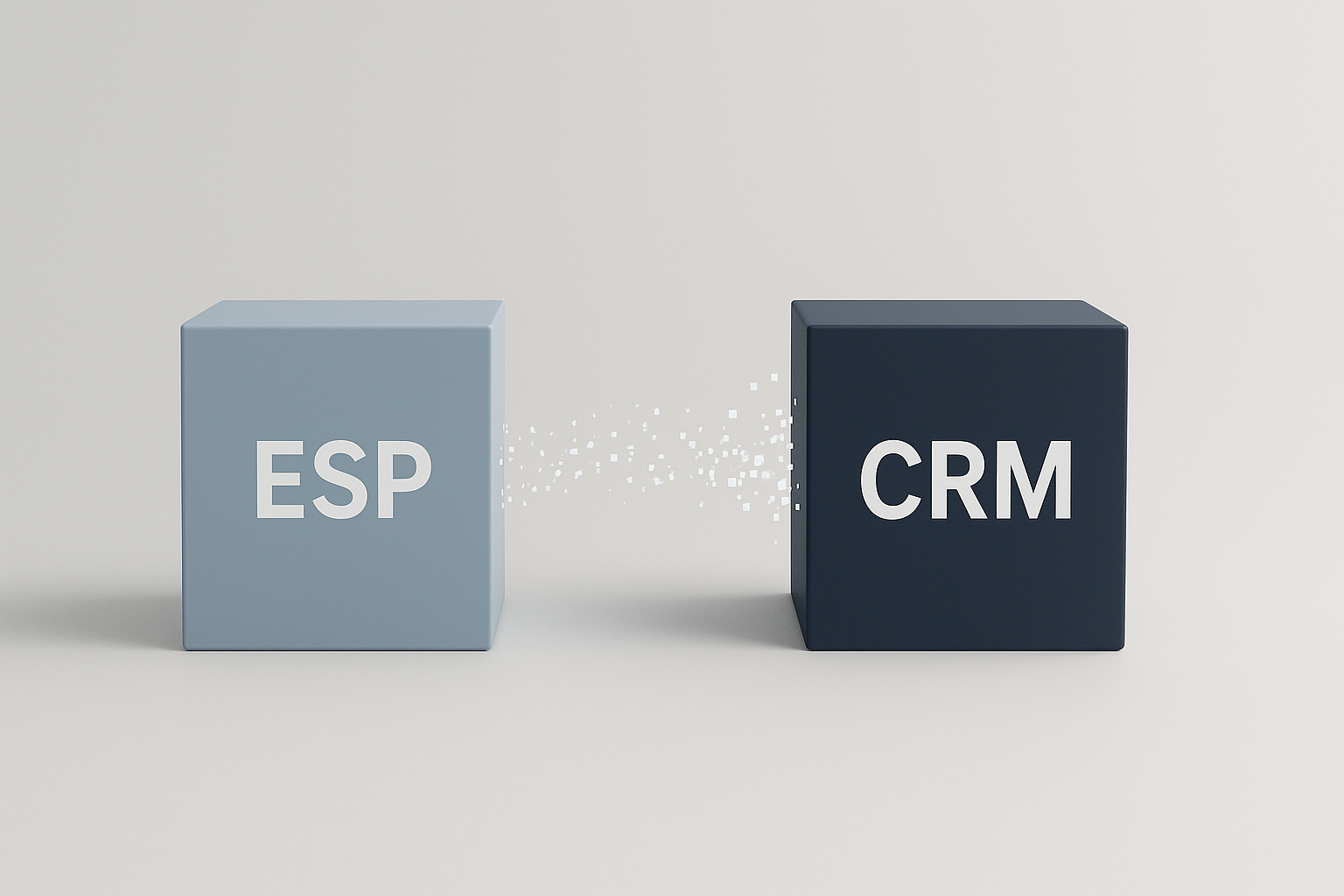
The culprit isn’t a clumsy intern or a bad mailing list. It’s a silent, structural problem hiding in plain sight: your technology stack is working against you. Your Email Service Provider (ESP) and your Customer Relationship Management (CRM) platform are both doing their jobs—but they aren’t having a meaningful conversation with each other.
This disconnect isn’t just a minor inconvenience; it’s a trap that forces you to deliver fragmented, disjointed, and occasionally embarrassing customer experiences. And if you’re facing this, you’re not alone. Research shows a staggering 87% of business leaders say data silos are the single biggest obstacle to achieving their digital transformation goals.
The Great Divide: What Your ESP Knows vs. What Your CRM Knows
At first glance, your ESP and CRM seem to have overlapping roles. Both hold customer data, and both are used for communication. But because they were built for fundamentally different purposes, there’s a natural divide in what they know about your customer.
- Your Email Service Provider (ESP) is the master of top-of-funnel engagement. It knows who opened your newsletter, which links they clicked, what automation sequence they’re in, and which marketing assets they’ve downloaded. It’s your megaphone for one-to-many communication.
- Your Customer Relationship Management (CRM) is the keeper of bottom-of-funnel context. It tracks the full sales history, deal size, support ticket history, contract renewal dates, and the names of key decision-makers. It’s your ledger for one-to-one relationships.
When these two systems don’t share data effectively, your business develops a split personality. Marketing sees a lead who loves clicking on blog posts, while Sales sees a strategic account in the middle of a delicate negotiation. The result? A broken data flow that actively undermines the customer journey.
Without a bridge between these two worlds, your marketing team is flying blind, and your customers feel the turbulence.
The Hidden Costs of Disconnected Data
This technological gap isn’t just an internal headache; it has real, measurable consequences that impact your bottom line. While the symptoms feel like one-off mistakes, the disease is a systemic lack of a unified customer view. In fact, studies show that only 23% of marketers report having a fully unified picture of their customer data.
This fragmentation leads to three core problems:
1. A Fragmented and Frustrating Customer Experience
When your systems are siloed, your customers are forced to reintroduce themselves at every touchpoint. They download a whitepaper from marketing, then have to repeat all their information to a sales development rep who has no context. This friction isn’t just annoying; it erodes trust. Research confirms that fragmented customer experiences can cause a 12% drop in customer loyalty.
2. Missed Opportunities for Personalization and Growth
True personalization goes beyond using a [first_name] tag in an email. It’s about delivering the right message at the right time based on a customer’s entire history with your brand. But how can you send a relevant upsell offer if your ESP doesn’t know the customer just filed a critical support ticket logged in the CRM? Companies miss out on significant gains, as effective personalization can drive a 10-15% revenue lift.
3. Inefficient and Misaligned Teams
Silos create internal friction. The marketing team celebrates campaign metrics that have no bearing on the sales team’s pipeline goals. Sales complains about lead quality, while marketing points to high engagement scores. Both teams are working hard, but they’re using different maps to navigate the same territory. This misalignment is a tax on your resources, efficiency, and morale.
Why Does This Happen? The Anatomy of a Data Silo
No one sets out to build a siloed tech stack. It usually happens gradually, for a few common reasons:
- Separate Tooling Decisions: The marketing team chose an ESP years ago based on its campaign features. The sales team selected a CRM for its pipeline management. They were never designed to be part of a single, cohesive ecosystem.
- Organizational Boundaries: Marketing “owns” the ESP, and Sales “owns” the CRM. With no central owner of the customer data journey, integrations become a low-priority “nice-to-have” instead of a business necessity.
- Surface-Level Integrations: Many platforms offer “integrations” that are little more than a one-way sync of a name and email address. They don’t transfer the rich behavioral, transactional, and conversational data needed for a true 360-degree view.
The chain reaction is predictable and costly, turning valuable data into isolated pockets of information that hurt the business from the inside out.
Charting a New Course: Towards a Unified Customer View
Escaping the silo trap isn’t about finding the one perfect tool to replace all others. It’s about shifting your mindset from “connecting tools” to “unifying data.” The goal is to create a single source of truth for every customer—a central record that all systems can read from and write to.
Achieving this creates a seamless journey where every interaction is informed by the last, no matter where it happened.
This unified profile becomes the foundation for smarter marketing, more effective sales, and a customer experience that feels personal and coherent. Building this foundation also has a powerful secondary benefit: it prepares your brand for the future of search and AI. Modern systems, from Google’s AI Overviews to ChatGPT, rely on clear, consistent, and structured data to understand and recommend brands. A unified customer view is a powerful form of that structure.
Ready to start building bridges? Here are three practical first steps:
- Map Your Customer Data: Get your marketing, sales, and support leads in a room (or a Zoom call). Ask one question: “Where does all of our customer information live?” Document every platform, spreadsheet, and database. You can’t fix what you can’t see.
- Define Your “Golden Record”: Agree on the most critical data points that define a customer. This might include their company size, last purchase date, product interest, and support status. Start with the 5-10 data points that would change how you communicate with them.
- Focus on One High-Impact Journey: Don’t try to integrate everything at once. Pick one critical journey to fix first, like the new customer onboarding process or the trial-to-paid conversion path. Score an early win to build momentum.
Frequently Asked Questions (FAQ)
What’s the real difference between an ESP and a CRM?
Think of it this way: an ESP is a broadcast tool, great for sending messages to large groups (one-to-many). A CRM is a relationship management tool, built for tracking conversations, deals, and history with specific individuals and accounts (one-to-one).
Can’t I just use a tool like Zapier to connect them?
Tools like Zapier are fantastic for simple, trigger-based automations (“if this, then that”). They can patch specific data gaps, like adding a new lead from a form to both systems. However, they don’t typically create a true, two-way, historical sync. They are more like messengers than a centralized brain, becoming complex and brittle to manage at scale.
We have our data in one place, but our marketing still feels disconnected. Why?
This is a common challenge. You may have solved the “silo” problem but now face a “data quality” problem. The data might be messy, duplicated, or lacking the right structure to be truly actionable. Unifying data is the first step; cleaning, enriching, and structuring it is the next.
What is the single biggest mistake companies make here?
Buying more technology to solve what is fundamentally a strategy and process problem. A shiny new platform won’t fix misaligned teams or a poorly defined customer journey. The strategy must come first, and then you can choose the right tools to execute it.
Your First Step Towards a Connected Journey
Building a perfectly unified tech stack is a journey, not a destination. But ignoring the problem is no longer an option. And the data is clear: companies that effectively integrate their customer data are 190% more likely to achieve above-average revenue growth.
The path forward begins with a commitment to breaking down internal walls and putting the customer’s experience at the center of your operations. It requires a strategic approach to getting your data house in order, ensuring that your most valuable asset—your customer information—is accurate, accessible, and actionable.
By moving from disconnected tools to a single, coherent customer story, you don’t just fix embarrassing email mistakes—you build a resilient, efficient, and growth-oriented business ready for the future.