
Ever get that feeling your tried-and-true keyword research playbook is starting to gather dust? You’re not alone.
For years, the game was simple: find what people type into a search box, create content that matches, and climb the ranks. But your clients’ customers aren’t just “Googling” anymore. They’re having conversations.
They’re asking ChatGPT, “What’s a complete marketing plan for a new coffee shop in Austin that targets young professionals?” They’re prompting Google’s AI-powered Search Generative Experience (SGE), “Compare the pros and cons of scaling my agency with freelancers versus a white-label partner.”
These aren’t just keywords; they’re complex, multi-layered problems wrapped in conversational language. And if your current strategy is still chasing two-word phrases, you’re fading from view for a rapidly growing group of high-intent users. The game has changed, and it’s time to learn the new rules.
The Big Shift: From Search Queries to Conversational Prompts
The rise of conversational AI isn’t a distant trend; it’s a seismic shift happening right now. According to Gartner, traditional search engine volume is projected to drop by 25% by 2026, largely due to the rise of AI chatbots and other virtual agents.
Think about the fundamental difference:
A Traditional Search Query is a request for information retrieval. Someone types “best CRM for small business” and expects a list of links to review.
An AI Prompt is a request for synthesis and execution. Someone asks an AI, “Help me choose the best CRM for my 5-person sales team that needs to integrate with Mailchimp and is under $50/month per user.” The user expects a tailored recommendation, not just a list of options.
This new behavior revolves around what we call “multi-intent prompts.” A single conversational prompt often contains multiple underlying questions the user wants answered, all at once. The coffee shop prompt, for instance, is implicitly asking for:
- Target audience analysis in Austin.
- Local SEO strategies.
- Social media content ideas.
- Grand opening promotion tactics.
- A potential budget outline.
Your old keyword, “marketing for coffee shops,” barely scratches the surface.
Why Your Old Keyword Tools Are Flying Blind
Tools like Semrush and Ahrefs are masters of the old game. They’re indispensable for measuring search volume, analyzing backlinks, and tracking rankings on traditional search engine results pages (SERPs). But they weren’t built for this new conversational world.
They simply can’t “hear” the conversations happening inside AI interfaces. This presents a huge challenge:
-
No “Prompt Volume”: There’s no metric for how many people are asking AI about a specific complex problem.
-
Hidden Intent: Traditional tools might show you the volume for “agency scaling,” but they can’t reveal the nuanced debate between “hiring freelancers,” “hiring in-house,” or using white-label SEO services.
-
Synthesis Over Ranking: In AI-generated answers, the goal isn’t just to be the number one link. It’s to have your information, data, and brand perspective woven into the AI’s synthesized answer.
This is where we need to stop thinking like keyword researchers and start thinking like problem-solvers. We need to reverse-engineer the conversation.
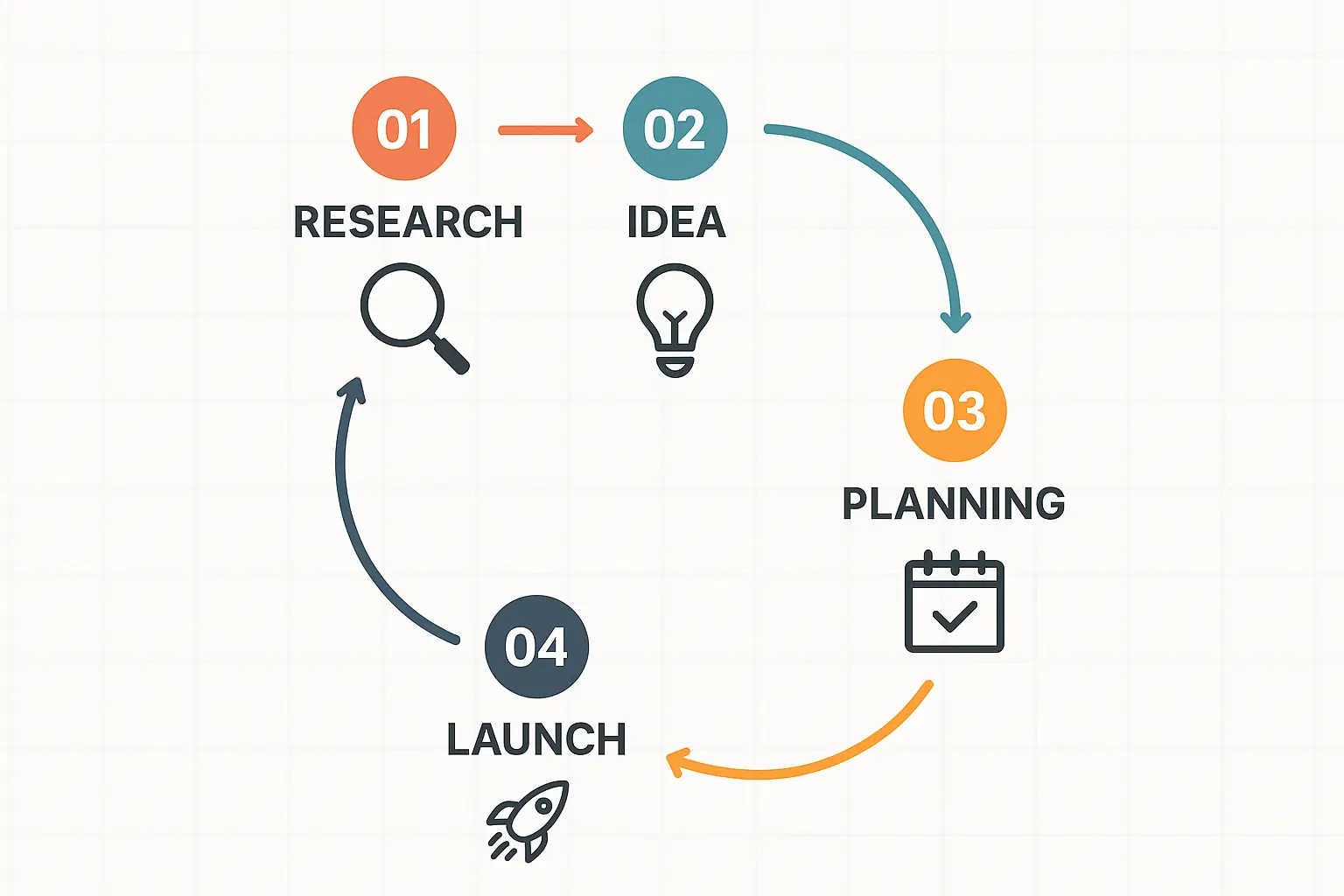
The Reverse-Engineering Workflow: A 4-Step Guide
This workflow is designed to uncover the complex problems your clients’ customers are trying to solve with AI. It shifts the focus from what people type to what they truly mean.
Step 1: Identify the Core Customer Problem
Forget about keywords for a moment. Start with your client’s ideal customer and ask: what is the biggest, hairiest problem they are trying to solve? Don’t start with the solution (e.g., “blue running shoes”). Start with the problem (e.g., “training for my first marathon without getting injured”).
These high-level problems are your new “seed” topics—the real starting point for the conversation.
Step 2: Use AI to Simulate the Conversation
Now, take that core problem and turn it into a detailed prompt. Open up ChatGPT, Gemini, or your preferred AI tool and ask it the same way a motivated, slightly overwhelmed customer would.
For the marathon runner, you might prompt: “Create a comprehensive 12-week training plan for a beginner running their first marathon. Include advice on nutrition, injury prevention, and the right gear I’ll need.”
This is the “reverse-engineering” part: using AI to reveal the structure of a perfect answer.
Step 3: Deconstruct the AI’s Answer into “Intent Clusters”
The AI’s response is a goldmine, neatly organized into sections, subheadings, and bullet points. These are your intent clusters—the collection of sub-topics that, together, fully solve a user’s problem.
For our marathon example, the AI might generate sections like:
Cluster 1: Weekly Running Schedules (Miles & Pacing)
Cluster 2: Cross-Training and Strength Workouts
Cluster 3: Marathon Nutrition & Hydration Strategy
Cluster 4: Choosing the Right Running Shoes
Cluster 5: Common Running Injuries & How to Prevent Them
Suddenly, you don’t have one topic; you have a complete content pillar with five supporting articles that comprehensively address the user’s entire problem.
Step 4: Validate and Map to Traditional Keywords
Now, and only now, do you go back to your traditional SEO tools. Take each intent cluster and use it to find related long-tail keywords, People Also Ask questions, and estimated search volumes.
“Choosing the right running shoes” becomes research for keywords like “best marathon shoes for beginners,” “pronation support running shoes,” and “how often to replace running shoes.”
“Marathon nutrition strategy” becomes research for “what to eat before a long run,” “best energy gels for marathon,” and “carb-loading plan.”
This final step connects your conversational strategy back to measurable SEO metrics. You now have a data-backed content plan built to satisfy both conversational AI and traditional search engines. This approach demonstrates your value as a strategic agency SEO partner who understands the future of search.
Putting It Into Practice: An Agency Example
Let’s say your client is a B2B SaaS company that sells project management software for creative agencies.
-
Core Problem: “My agency is growing, but our projects are chaotic. We’re missing deadlines and losing profitability.”
-
AI Prompt: “What are the best practices for a creative agency to manage multiple client projects effectively to ensure profitability and on-time delivery?”
-
Deconstruct into Intent Clusters: The AI’s response would likely include:
- Client Onboarding Workflows
- Project Scoping & Proposals
- Task Management & Delegation
- Time Tracking & Budgeting
- Client Communication & Reporting
- Validate and Plan Content: You can now build a content hub around “Agency Project Management” with articles, templates, and guides for each cluster. This content is perfectly positioned to be included in AI-generated answers and will also rank for dozens of traditional long-tail keywords.
Frequently Asked Questions
What’s the main difference between a prompt and a keyword?
A keyword is typically a short phrase used to retrieve a list of documents. A prompt is a longer, conversational instruction given to an AI to synthesize information, generate ideas, or perform a task. It’s the difference between asking for a library card catalog and asking the librarian to find you three books on a topic and summarize their main points.
Do I still need traditional keyword research tools?
Absolutely. This workflow is an enhancement, not a replacement. Traditional tools are essential for Step 4, where you validate your intent clusters and find the specific language people are using in search engines today. This ensures your content serves both audiences.
How does this workflow impact ranking in Google’s SGE?
Google’s Search Generative Experience (SGE) creates an AI-powered snapshot at the top of the results. It builds this answer by synthesizing information from multiple top-ranking, authoritative sources. By creating comprehensive content that covers all the intent clusters around a core problem, you increase the likelihood that your content will be sourced for these AI-generated answers.
Is there a tool that measures “prompt volume”?
Not directly, and that’s the key opportunity. Because this data isn’t easily available, agencies that adopt a strategic, problem-first workflow have a significant advantage. This manual, human-led strategy is what uncovers the opportunities that automated tools currently miss.
The Future of Search is a Conversation
Shifting from a keyword-first to a problem-first mindset is the single most important thing you can do to future-proof your SEO strategy. Users expect answers, not just links. They demand synthesis, not just options.
By reverse-engineering the prompts they use to solve their most complex problems, you can create content that truly meets their needs. You build authority not just by ranking for a keyword, but by becoming the go-to resource for solving their entire problem.
This is the new SEO—a strategic, growth-focused approach that connects with customers on a deeper level.