
You’ve done everything by the book. You found the right keywords, created great content, and meticulously linked your client’s pages together. Yet, traffic is flat. Rankings are stuck. It feels like you’re speaking a language that search engines don’t fully understand.
Here’s the thing: you probably are.
For years, SEO has been a game of keywords. We treated internal linking like a switchboard operator connecting one keyword-focused page to another. But search engines like Google have evolved far beyond matching strings of text. They think in terms of entities, relationships, and context.
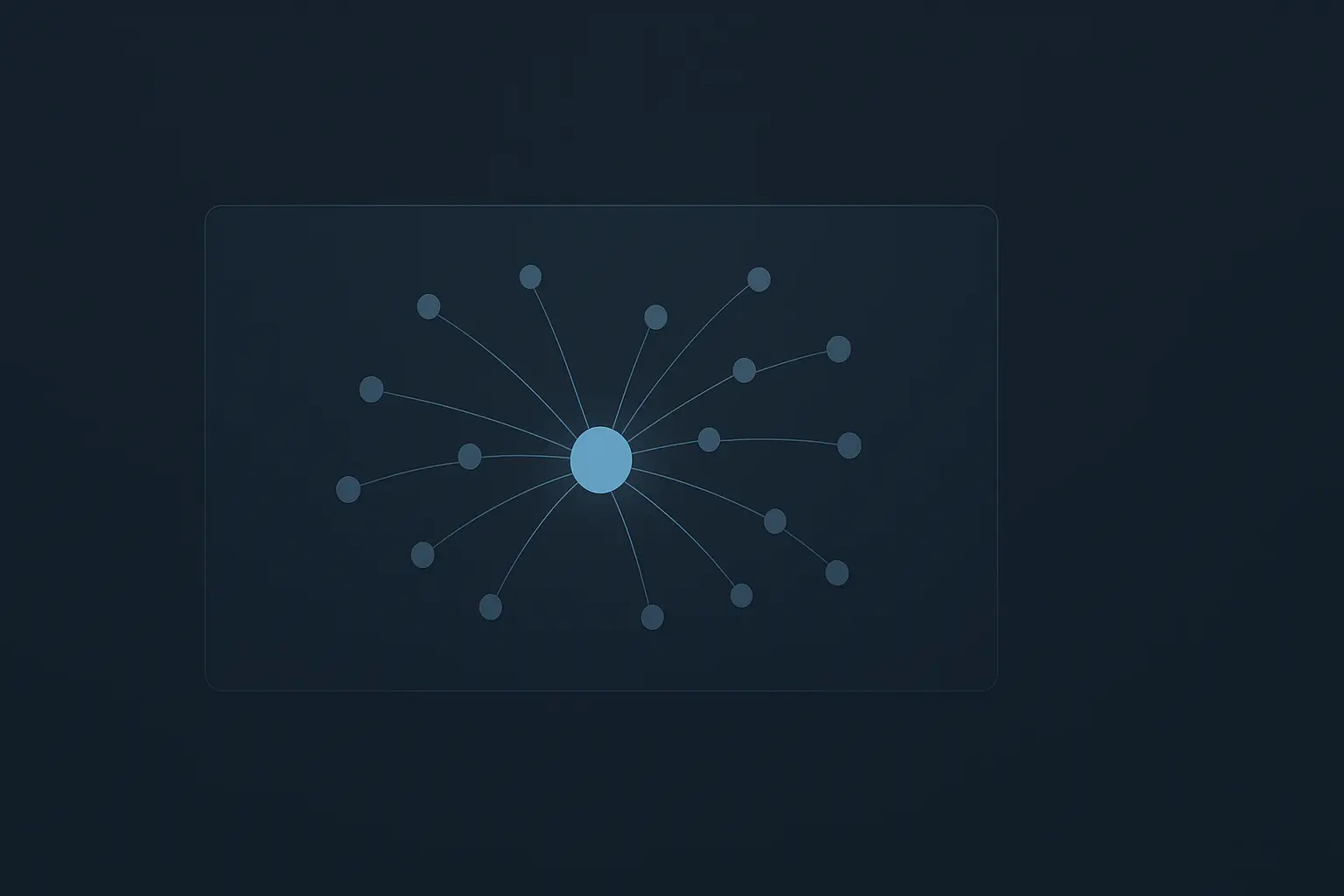
They’ve moved from being a dictionary to being an encyclopedia—or more accurately, a dynamic knowledge graph. If your internal linking strategy is still stuck in the dictionary phase, you’re missing the single biggest opportunity to communicate your client’s authority.
It’s time to stop just connecting pages and start connecting ideas. This is how you build a semantic topic layer.
From Keyword Matching to Concept Understanding
To grasp why this matters, we need to understand a fundamental shift in search. Google’s algorithms, from BERT to MUM, are designed to understand the relationships between concepts. They don’t just see the keyword “SaaS accounting software”; they see an entity and seek to understand its attributes (features, pricing), its functions (solves cash flow problems), and its connections to other entities (how it integrates with Stripe, who it’s for).
When your website’s internal structure clearly defines these relationships, you’re essentially handing Google a blueprint of your client’s expertise. You’re not just telling it what a page is about; you’re teaching it how that page fits into the larger ecosystem of your client’s knowledge.
The old way was flat. You had a page about “email marketing software,” and you linked to it from a blog post using the anchor text “email marketing software.”
The new way is dimensional. You build a structure that shows how your “email marketing software” (the entity) features “automation workflows,” integrates with “CRM platforms,” and is designed for “small businesses.” Each of those internal links becomes a statement that clarifies a relationship, building a rich, machine-readable map of your client’s domain.
This isn’t just theory; it directly impacts rankings. Search engines reward sites they understand because they can confidently serve them to users for complex, conversational queries. By making your client’s site easy for AI to interpret, you directly align your SEO strategy with the future of search.
The Building Blocks: Entities and Semantic Triples
So, how do we translate this high-level concept into an actionable linking strategy? We start by thinking in “semantic triples.”
It sounds technical, but it’s a beautifully simple concept most of us learned in grade school: Subject-Predicate-Object.
Subject: The main entity or concept on a page. (e.g., “Our CRM Software”)
Object: Another entity that the subject is related to. (e.g., “Sales Automation”)
Predicate: The verb that defines the relationship between them. (e.g., “improves”)
This creates a clear, relational statement: “Our CRM Software” (Subject) “improves” (Predicate) “Sales Automation” (Object).
Your internal link’s anchor text becomes the predicate—the verb that describes the relationship. Instead of a generic anchor like “sales automation,” your link carries richer contextual meaning:
…our CRM software fundamentally improves your team’s sales automation capabilities…
Suddenly, that link is no longer a simple signpost. It’s a piece of data that teaches Google how your two pages (and the concepts they represent) are connected. Doing this consistently across a site builds a powerful, interconnected web of meaning. This semantic layer makes your client’s expertise undeniable to algorithms.
A Practical 4-Step Guide to Semantic Internal Linking
While this approach is more strategic than simply linking keywords, it doesn’t have to be complicated. Here’s how to start implementing it for your clients.
Step 1: Identify Your Core and Supporting Entities
Forget keywords for a moment. What are the core concepts your client owns? These are their products, services, or primary areas of expertise. These are your “Subject” entities.
Example: For a cybersecurity firm, core entities might be “penetration testing,” “incident response,” and “vulnerability assessment.”
Next, map out the supporting entities that relate to each core entity. These are the features, benefits, processes, and related topics. These will often be your “Object” entities.
Example: For the “penetration testing” entity, supporting entities could be “testing methodologies,” “compliance standards,” and “reporting process.”
Step 2: Define the Relationships (The Predicate)
Now, connect your core entities to your supporting entities using verbs. How do they interact?
“Penetration testing” (Subject) identifies (Predicate) “security vulnerabilities” (Object).
“Incident response plan” (Subject) mitigates (Predicate) “data breach damage” (Object).
“Vulnerability assessment” (Subject) ensures (Predicate) “PCI DSS compliance” (Object).
This list of relationships becomes your blueprint for creating contextually rich anchor text.
Step 3: Weave Links into Your Content Naturally
With your map of entities and relationships in hand, go back to your content. Look for opportunities to insert links where these relationships are mentioned. The goal is to make the link a natural part of the sentence that educates both the user and the search engine.
Old Way:
Our services include penetration testing. We help businesses stay secure. Learn more about our vulnerability assessments.
Semantic Way:
Our penetration testing services are designed to uncover hidden risks, while our reporting process details every vulnerability so you can prioritize remediation.
The second example explicitly tells Google that the “reporting process” page details vulnerabilities, creating a much stronger semantic connection.
Step 4: Prioritize and Scale
You don’t need to overhaul an entire 1,000-page website overnight. Start with your client’s most important pillar pages—the ones that represent their core services. Build out the semantic topic layer for these first, then expand to supporting blog posts and secondary pages.
For many agencies, implementing this strategy at scale can be a huge operational lift. This is where leveraging an agency SEO partner for execution can be a game-changer, allowing you to deliver advanced results without getting bogged down in the tactical details.
Frequently Asked Questions (FAQ)
Is this the same as topic clusters?
Think of it as the next evolution. Topic clusters group pages around a central topic, which is a great start. A semantic topic layer goes deeper by explicitly defining the relationships between the pillar and the cluster pages using relational anchor text. It adds the “why” and “how” to the cluster’s “what.”
How many internal links should a page have?
There’s no magic number. The right answer is as many as are useful and relevant. Focus on quality over quantity. A single, contextually rich semantic link is more valuable than ten generic, keyword-stuffed links.
Do I need to go back and change all my old internal links?
Not necessarily. A practical approach is to prioritize your 10-20 most important pages (your “money pages”) and update the links pointing to and from them first. Apply this semantic strategy to all new content moving forward.
Can this approach help with AI Overviews and generative search?
Absolutely. AI-driven search models like Google’s SGE (Search Generative Experience) rely heavily on understanding context and relationships to generate answers. By building a clear semantic layer, you are essentially pre-packaging your client’s expertise in a format that these AI systems can easily digest and use to formulate answers, increasing the likelihood of being cited as a source. Staying ahead of these changes requires a forward-thinking approach, which is why many firms explore SEO outsourcing for agencies that specialize in AI-driven strategies.
From a Web of Pages to a Brain of Ideas
Moving from a keyword-based to an entity-based linking strategy is more than just an SEO tactic; it’s a shift in perspective. You stop thinking about your client’s website as a collection of pages and start seeing it as a living brain of interconnected ideas.
By explicitly defining the relationships between these ideas, you’re not just optimizing for an algorithm. You’re building a more intuitive, logical, and helpful experience for users. And in the long run, what’s good for the user is always good for SEO.
When you’re ready to implement these advanced strategies at scale, exploring a partnership could be your next step. Discover how specialized white-label SEO services can provide the execution engine to bring this vision to life for all your clients.