
Your new orthopedic client is thrilled to have you on board. You fire up your favorite keyword tool, pull a list of high-volume terms like “orthopedic surgeon near me” and “knee surgery,” and present a plan to rank for them.
It’s a solid, standard approach. But it’s also missing the most important part of the story.
Before someone ever types “orthopedic surgeon near me,” they search for things like “why does my knee pop when I squat?” or “dull ache in shoulder after sleeping.” They aren’t looking for a doctor yet; they’re looking for answers. And they’re not alone. According to Google, a staggering 7% of all daily searches are health-related.
By focusing only on bottom-of-the-funnel keywords, you’re showing up for the final scene of a three-act play. The real opportunity lies in being the trusted guide throughout the entire story—the patient journey.
Why Generic Keyword Research Fails in Healthcare
In healthcare, you aren’t marketing to a “customer.” You’re communicating with a person who is often dealing with pain, uncertainty, and a deep need for trust. That’s why only 12% of consumers trust traditional healthcare advertising. They don’t want to be sold to; they want to be educated and understood.
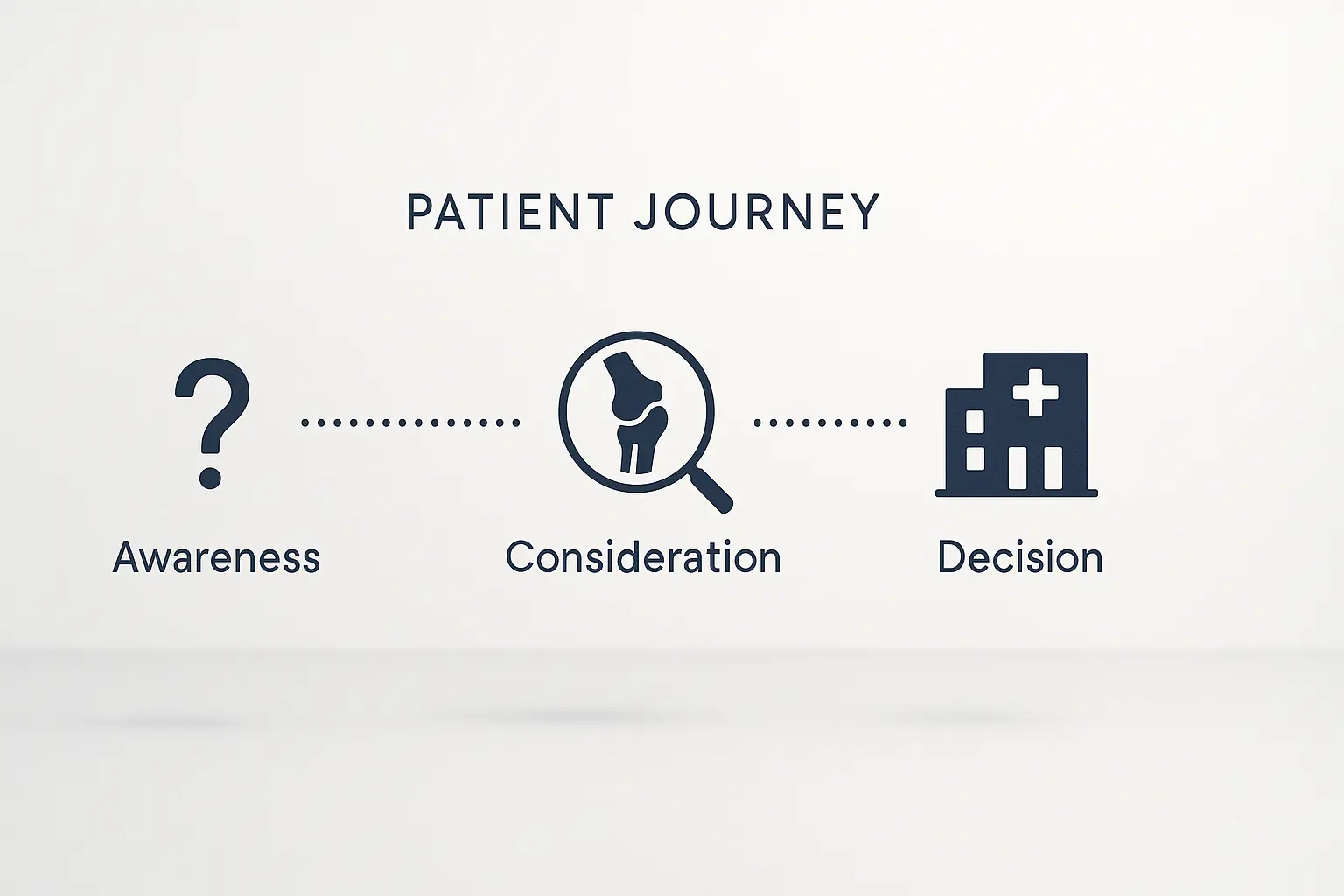
This is where the patient journey model becomes essential. It’s a framework for understanding the distinct phases an individual goes through, from the first sign of a symptom to the moment they book an appointment.
For an agency, mapping keywords to this journey allows you to:
- Build Trust Early: Provide helpful answers when patients are most vulnerable and searching for information.
- Capture High-Intent Traffic: Attract qualified leads by aligning content with their specific needs at each stage.
- Become a Strategic Partner: Move beyond basic SEO execution and offer your clients a sophisticated patient acquisition strategy.
The Three Stages of the Patient Journey
Think of the journey in three core stages: Awareness, Consideration, and Decision. Each stage is driven by a different set of questions and calls for a different type of content.
Stage 1: Awareness (The “What’s Wrong?” Stage)
This is the journey’s starting point. The patient has a symptom, but they don’t have a diagnosis. They’re looking for information, not a doctor—at least, not yet.
- Patient Mindset: “What is this pain?” “Is this serious?” “What could be causing this?”
- Keywords: These are almost always informational, long-tail keywords framed as questions—symptom-focused, not solution-focused.
- Your Goal: To be the most helpful, reassuring, and authoritative source of information.
Stage 2: Consideration (The “What Can I Do?” Stage)
After doing some initial research, the patient has a better sense of their potential condition. Now they’re exploring treatment options, solutions, and potential providers.
- Patient Mindset: “What are the treatments for a meniscus tear?” “Do I need surgery?” “Who is the best knee specialist in my area?”
- Keywords: These keywords shift from symptoms to solutions. They include treatment types, comparisons (“physical therapy vs. surgery”), and searches for specialists. Research shows that 47% of internet users search for information about doctors or other health professionals, and this is the stage where that discovery process begins.
- Your Goal: To demonstrate expertise and guide the patient toward the solutions your client offers.
Stage 3: Decision (The “Who Do I Choose?” Stage)
The patient is ready to take action. They have a good idea of what they need and are now evaluating specific practices and doctors to find the right fit.
- Patient Mindset: “How do I book an appointment with Dr. Smith?” “Reviews for [Orthopedic Clinic Name].” “Directions to [Practice Address].”
- Keywords: These are high-intent and navigational. They often include the doctor’s or practice’s name, location modifiers, and action-oriented terms like “book,” “schedule,” and “contact.” With 83% of patients visiting a hospital or practice website before booking an appointment, your client’s online presence here is critical.
- Your Goal: To make it as easy as possible for the patient to choose your client and book their appointment.
Putting It All Together: A Sample Orthopedic Keyword Map
Let’s see what this looks like in practice. Generic keyword research might give you a list like “knee pain,” “orthopedic doctor,” and “ACL surgery.” A patient journey map gives you a strategic blueprint.
Here’s a breakdown for a patient experiencing knee pain:
Awareness Stage Keywords
Here, the focus is purely on the symptom. The patient is using conversational language to describe what they’re feeling. Creating blog content or health guides around these topics establishes your client as a helpful resource long before the patient considers an appointment.
- why does my knee hurt when I bend it
- popping sound in knee when walking
- what does a torn meniscus feel like
- home remedies for runner’s knee
- is it safe to exercise with knee pain

Consideration Stage Keywords
The patient now suspects a specific issue (e.g., a meniscus tear) and is weighing their options. This is the time for detailed service pages, doctor bios, and articles comparing treatment options. It’s a crucial part of a modern omnichannel SEO strategy (/blog/what-is-omnichannel-seo), connecting initial search queries to specific service offerings.
- non-surgical treatment for meniscus tear
- recovery time for arthroscopic knee surgery
- best orthopedic surgeon for knee replacement in [City]
- questions to ask an orthopedic surgeon
- physical therapy exercises for knee injury
Decision Stage Keywords
The patient is ready to book. Your client’s website, local listings, and contact information need to be perfectly optimized for these high-value searches.
- [Practice Name] orthopedic clinic
- Dr. Jane Smith reviews
- book appointment [Practice Name]
- orthopedic urgent care [City]
- directions to [Practice Name] office

By mapping keywords this way, you create a full-funnel content plan that nurtures a potential patient from a moment of concern to a scheduled appointment. This approach is far more effective because it mirrors how real people search for health information.
Frequently Asked Questions (FAQ)
-
How is this different from standard keyword research?
Standard keyword research often prioritizes high search volume. Patient journey mapping prioritizes user intent. It organizes keywords based on the patient’s mindset, ensuring you create content that answers the right question at the right time. -
What tools can I use for this?
Tools like Ahrefs, Semrush, and AnswerThePublic are excellent for finding the question-based keywords common in the Awareness stage. Google’s “People Also Ask” and “Related Searches” features are also fantastic free resources for getting inside the mind of a patient. -
How do I start building a map for my client?
Begin by talking to them. Ask their staff about the most common questions patients ask during their first call or visit. These real-world questions are a goldmine for Awareness and Consideration stage keywords. -
Does this mean I should ignore high-volume keywords like “orthopedic surgeon”?
Not at all. Those high-intent, bottom-of-the-funnel keywords are still incredibly valuable for your client’s main service and location pages. A patient journey map ensures you don’t only focus on them, allowing you to build a much wider net to attract future patients.
From Keywords to Patients
Shifting from a simple keyword list to a patient journey map transforms your role from a technical executor to a strategic growth partner. You’re no longer just chasing rankings; you’re building a predictable system for patient acquisition that delivers value at every touchpoint.
This approach not only drives more qualified traffic but also builds a foundation of trust that turns anxious searchers into loyal patients. For agencies looking to deliver exceptional results in the competitive healthcare space, this is no longer an option—it’s the new standard of care.
If you’re ready to scale this level of strategic execution for your clients, exploring white-label SEO services for agencies (/services/white-label-seo) can provide the expert support and automation needed to deliver results without overwhelming your team.