

Picture this: your real estate client ranks number four for “luxury condos in downtown,” but the competitor at number five is getting all the clicks. Their listing pops off the page with star ratings, pricing, and availability right there in the search results. Your client’s result? Just a standard blue link.
They’re on the first page, but they might as well be invisible.
This isn’t a failure of traditional SEO. It’s a missed opportunity in the modern search landscape. With a staggering 92% of all homebuyers using the internet for their search, simply being present isn’t enough. You have to be prominent.
The secret isn’t just about keywords or backlinks; it’s about speaking Google’s language through advanced structured data. Let’s move beyond the basics and explore how two specific types of schema—RealEstateListing and AggregateRating—can turn a standard search result into a client-winning billboard.
What Is Schema Markup, Really? A Translator for Your Website
Think of schema markup as a secret translator whispering in Google’s ear. Your website has tons of information: addresses, prices, square footage, property types. To a person, “For Sale: $450,000” is clearly the price of an available property.
But to a search engine crawler, it’s just a string of text.
Schema markup adds a layer of context, like putting digital labels on your content. It tells Google, “Hey, this number isn’t just a number—it’s a price. And this status isn’t just a word—it means the availability is InStock.” This translation helps Google understand your content so well that it can feature it in special ways, like rich snippets.
Conceptually, the process is simple: you add the right labels to your website’s content, which Google’s crawlers then read. In return, Google may reward you with an enhanced listing in the search results.
 The Basic vs. The Brilliant: Why Standard Schema Isn’t Enough
Many agencies stop at basic schema. They might use Organization markup for the real estate brokerage or LocalBusiness for a specific office. That’s a great first step, but in a competitive market, it’s like bringing a knife to a laser fight.
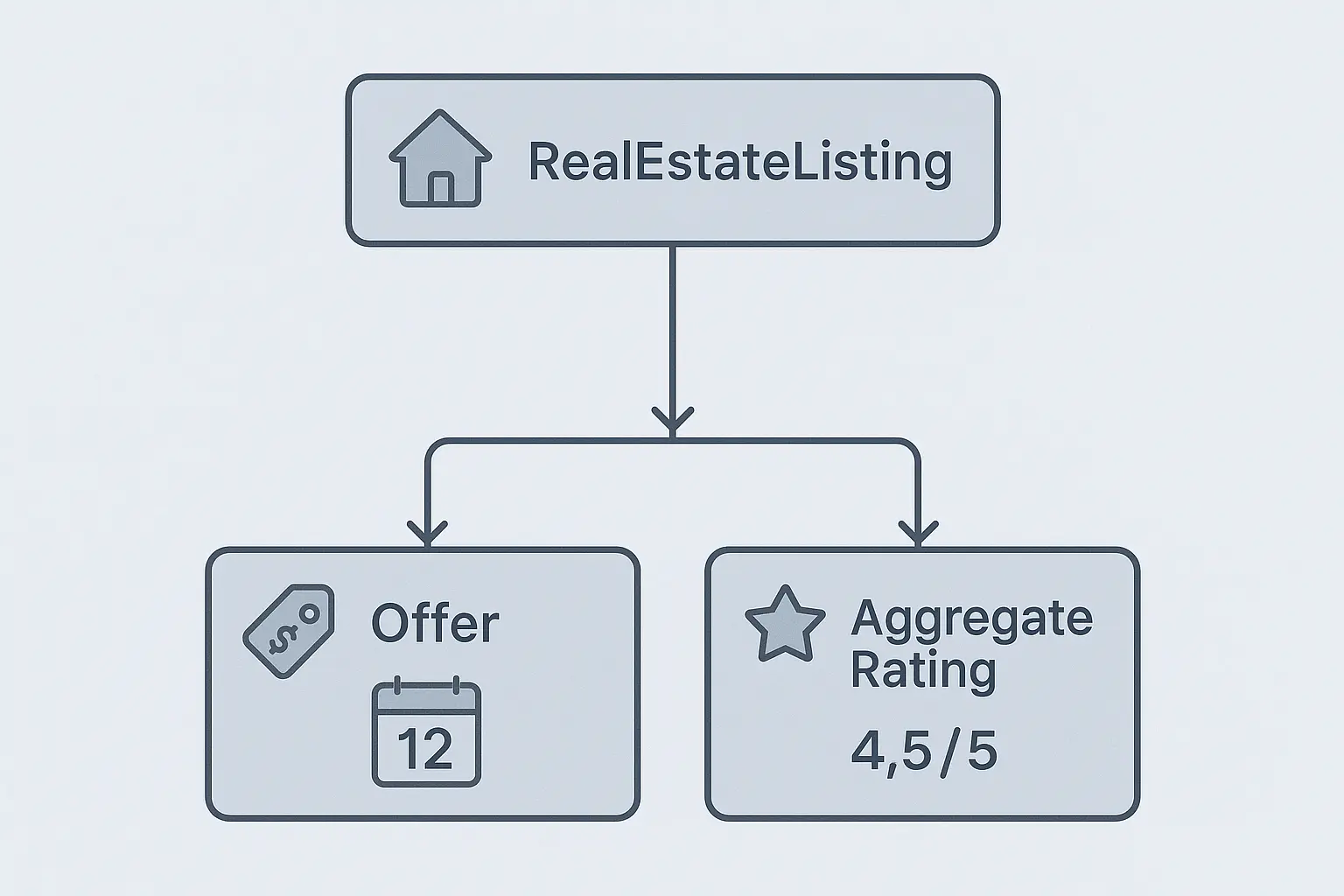
While many competitors handle the basics, the real advantage comes from using schema designed specifically for your client’s industry. For real estate, this means RealEstateListing markup.
The difference is stark. A standard result is functional; a rich snippet is magnetic. It answers user questions before they even click, building immediate trust and driving engagement. Websites with rich snippets can see their click-through rate (CTR) increase by up to 30%. That’s a massive lift without moving a single spot in the rankings.
Diving Deep: The Anatomy of a High-Impact Real Estate Listing
Implementing RealEstateListing schema is about detailing the specific attributes of a property. It’s your chance to showcase the most compelling information directly on the search engine results page (SERP).
The Essentials: Price, Availability, and Location
At a minimum, you need to mark up the core details a homebuyer is searching for. With searches for “real estate near me” growing by over 600% in recent years, location data is more critical than ever. You’re not just telling Google about a house; you’re telling it about a specific home, in a specific neighborhood, at a specific price, that is available right now.
Key properties include:
- name: The title of the listing (e.g., “Modern 3-Bedroom Home with City Views”).
- address: The physical location, clearly marked up.
- price: The asking price.
- availability: Is it for sale, for rent, or sold?
Bringing Listings to Life: Images and Virtual Tours
Why just tell when you can show? Schema allows you to highlight your best visual assets. That’s especially powerful in real estate, where visuals are everything.
Did you know that listings with virtual tours receive 87% more views? You can use the virtualTour property in your schema to signal this feature to Google, potentially earning you a special badge or callout in the SERPs. The photo property does the same for your high-quality images.
Building Trust Instantly: AggregateRating Markup
Now for the element that truly makes a listing stand out: the five gold stars. AggregateRating schema takes user reviews or ratings for a property or agent and displays them as a star rating in the search results.
It’s an undeniable beacon of social proof.
But do star ratings directly improve rankings? The answer is nuanced. As Google’s John Mueller has clarified, ratings themselves are not a direct ranking factor. However, their psychological impact is immense. They can significantly influence user click-through behavior. A 4.8-star listing looks far more credible and clickable than one with no rating at all, leading to more traffic, which is a positive signal to Google.
The Scalability Challenge: Managing Schema for Hundreds of Listings
This all sounds great for a single property page. But what about a brokerage with 500 active listings? Manually adding and updating schema for each one is not just inefficient; it’s impossible.
This is where a modern, scalable approach to SEO becomes crucial. The challenge isn’t just knowing what schema to implement, but how to deploy it across an entire website dynamically. Listings change, prices are updated, and properties are sold. Your structured data needs to reflect these changes in real-time. For agencies managing multiple clients, that’s where you can truly demonstrate your value: by providing efficient, scalable solutions. Leveraging scalable SEO services can transform this daunting task into a manageable, automated workflow, ensuring every listing has the best possible chance to shine.
Putting It All Together: A Mini-Checklist for Implementation
Ready to get started? Here’s a simplified path to implementing advanced schema for your real estate clients.
Step 1: Audit Your Foundation
Before adding advanced features, ensure the website’s technical health is solid. Structured data works best on a site that’s already well-optimized. If you’re unsure where to begin, understanding how to perform a technical SEO audit is the perfect starting point.
Step 2: Map Your Data
Identify all the key data points available for each listing on your client’s site. Do you have pricing, bed/bath counts, square footage, high-res photos, and virtual tour links? Map each of these data points to its corresponding schema property.
Step 3: Generate and Test
Use a tool like Google’s Rich Results Test to check your markup before deploying it. This free tool will show you if Google can understand your schema and whether your page is eligible for rich snippets.
Step 4: Deploy and Monitor
Once your markup is live, the job isn’t done. Monitor your performance in Google Search Console. Look for increases in CTR for pages with the new schema. Showcasing this data is key to proving your value and a core part of effective SEO reporting.
Frequently Asked Questions (FAQ)
What’s the difference between schema and structured data?
Think of structured data as the method and schema.org as the vocabulary. Structured data is the process of organizing and labeling your site’s information. Schema.org provides the specific tags and properties (like RealEstateListing) you use to do it.
Do I need to be a developer to implement this?
Not necessarily. Many WordPress plugins and website platforms have built-in features to add schema. However, for a custom, scalable solution across hundreds of listings, you may need development help or an SEO platform that can inject it dynamically.
Will this guarantee me a rich snippet?
No, implementation is not a guarantee. Google has the final say on whether to show a rich snippet. However, providing valid, comprehensive, and accurate structured data gives you the best possible chance.
Can I use this for rental properties too?
Absolutely. The RealEstateListing schema can be used for both sales and rentals. You simply specify the relevant properties, such as rentalPrice instead of price.
Beyond the Snippet: Becoming an Indispensable Partner
Implementing advanced schema isn’t just a box to check on your SEO to-do list. It’s a strategic shift from simply ranking to truly dominating the SERPs. It’s how you provide a tangible competitive advantage—one that clients can see and their customers will click on.
By moving beyond basic markup, you’re not just optimizing a website; you’re transforming your client’s digital storefront. You’re showing that you understand their industry, their customers, and the cutting edge of what’s possible in search. And in the world of agency SEO, that’s how you become an invaluable—and indispensable—partner.