

Imagine this: your agency just onboarded a new client, a fantastic local plumbing company. Their website is clean, their services are top-notch, and you’ve nailed the on-page SEO. Yet, they keep getting outranked in the Google Map Pack by a competitor with a clunky, decade-old website.
What’s the secret? How is the competition winning those critical “plumber near me” searches that drive immediate phone calls?
The answer often lies beyond keywords and backlinks in something quieter, more authentic, and incredibly powerful: hyperlocal brand signals. With “near me” searches growing by more than 500% in recent years, mastering these signals isn’t just an option for agencies with local clients—it’s the key to dominating the map.
Beyond Keywords: Why Google Cares About Your Client’s Neighborhood Reputation
For years, SEO has focused on proving expertise and authority on a topic. But for local businesses, Google has added another layer: proving you’re a legitimate, trusted, and active member of a specific community.
Think about it from Google’s perspective. When someone searches for “emergency roof repair,” Google doesn’t just want to show a list of websites with the right keywords. It wants to recommend a business that their neighbors actually trust. This is where hyperlocal signals come in. They are the digital equivalent of word-of-mouth, providing the proof Google needs.
Since 46% of all Google searches are for local information, agencies that overlook this neighborhood-level trust-building are leaving nearly half the opportunity on the table.
What Exactly Are Hyperlocal Brand Signals?
Hyperlocal brand signals are online clues that anchor a business to a specific geographic area—not just a city, but a particular neighborhood or district. They are a trail of digital breadcrumbs proving a business is physically present, actively engaged, and well-regarded by that community.
It’s the difference between a business that simply exists in a city and one that is part of its fabric. For your clients, this is how they stand out from larger, less-personal competitors and build a moat around their service area.
The Three Pillars of Hyperlocal Authority
Building a strong hyperlocal presence isn’t about a single tactic; it’s a strategy built on three core pillars. When these elements work together, they create a powerful narrative of local authority that both search engines and customers trust.
Pillar 1: Digital Footprint Consistency (NAP & Citations)
At its most basic, trust is built on consistency. The most fundamental hyperlocal signal is consistent Name, Address, and Phone number (NAP) information across the web.
Think of your client’s NAP as their digital business card. If every directory, social profile, and website lists the exact same information, it tells Google that this is a stable, legitimate business. Inconsistencies—like using “St.” on one site and “Street” on another, or having an old phone number on a forgotten Yelp profile—create confusion and erode trust.
This goes beyond the Google Business Profile to include:
- Local Directories: Yelp, Yellow Pages, etc.
- Industry-Specific Sites: Houzz for contractors, Zocdoc for doctors.
- Data Aggregators: Services that feed information to hundreds of other online listings.
A clean, consistent citation profile is the foundation upon which all other local efforts are built.
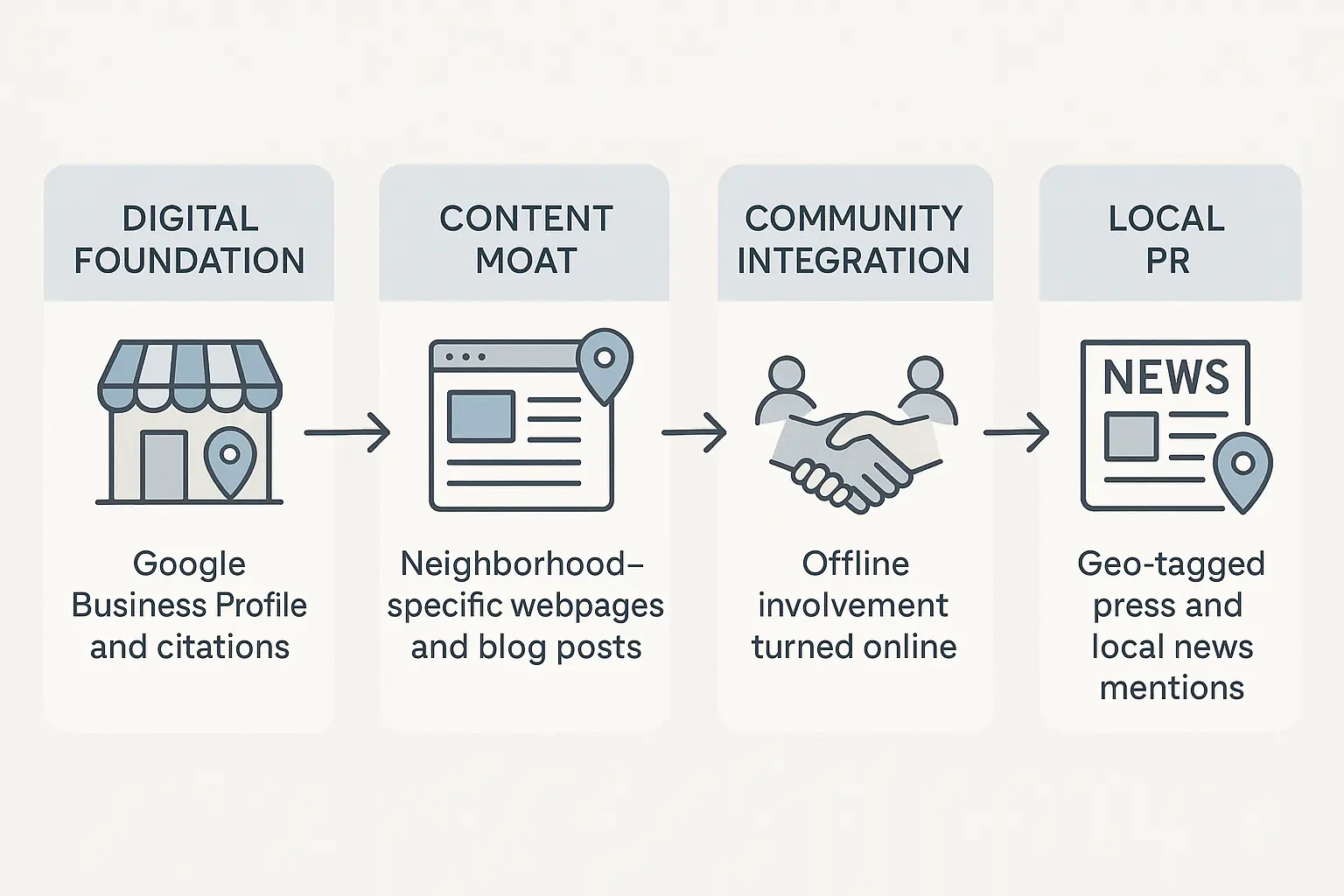
Pillar 2: Community Engagement & Unstructured Citations
This is where agencies can truly differentiate their clients. While competitors are busy with basic directory submissions, you can build authority through genuine community involvement.
An “unstructured citation” is a mention of a business’s name, address, or phone number online that doesn’t link back to its website. These are incredibly powerful because they appear natural and authentic.
Examples include:
- A local news site mentioning your client sponsored a high school sports team.
- A neighborhood blogger writing about a community event your client hosted.
- A local charity listing your client as a partner on its website.
These signals demonstrate that the business is more than just a commercial entity—it’s a contributing member of the community. This is a powerful form of social proof that Google’s algorithms increasingly recognize and reward.
Pillar 3: Geo-Tagged Proof & Local Content
The final pillar is all about creating content that proves your client does work in the specific areas they claim to serve.
Instead of generic blog posts, focus on creating content with a distinct local flavor:
- Neighborhood-Specific Case Studies: “Project Spotlight: A Complete Kitchen Remodel in the North Park Neighborhood.”
- Local Guides: “A Homeowner’s Guide to Preparing for Winter in Downtown Denver.”
- Geo-Tagged Photos: When uploading photos of completed jobs to your client’s website and Google Business Profile, ensure they contain geographic metadata. This attaches the photo to a specific latitude and longitude, giving Google undeniable proof that work was performed at that location.
- Local Press: Announce a new hire from the community or participation in a local trade show.
This type of content not only attracts local customers but also sends clear, undeniable signals to Google about your client’s geographic relevance and authority.
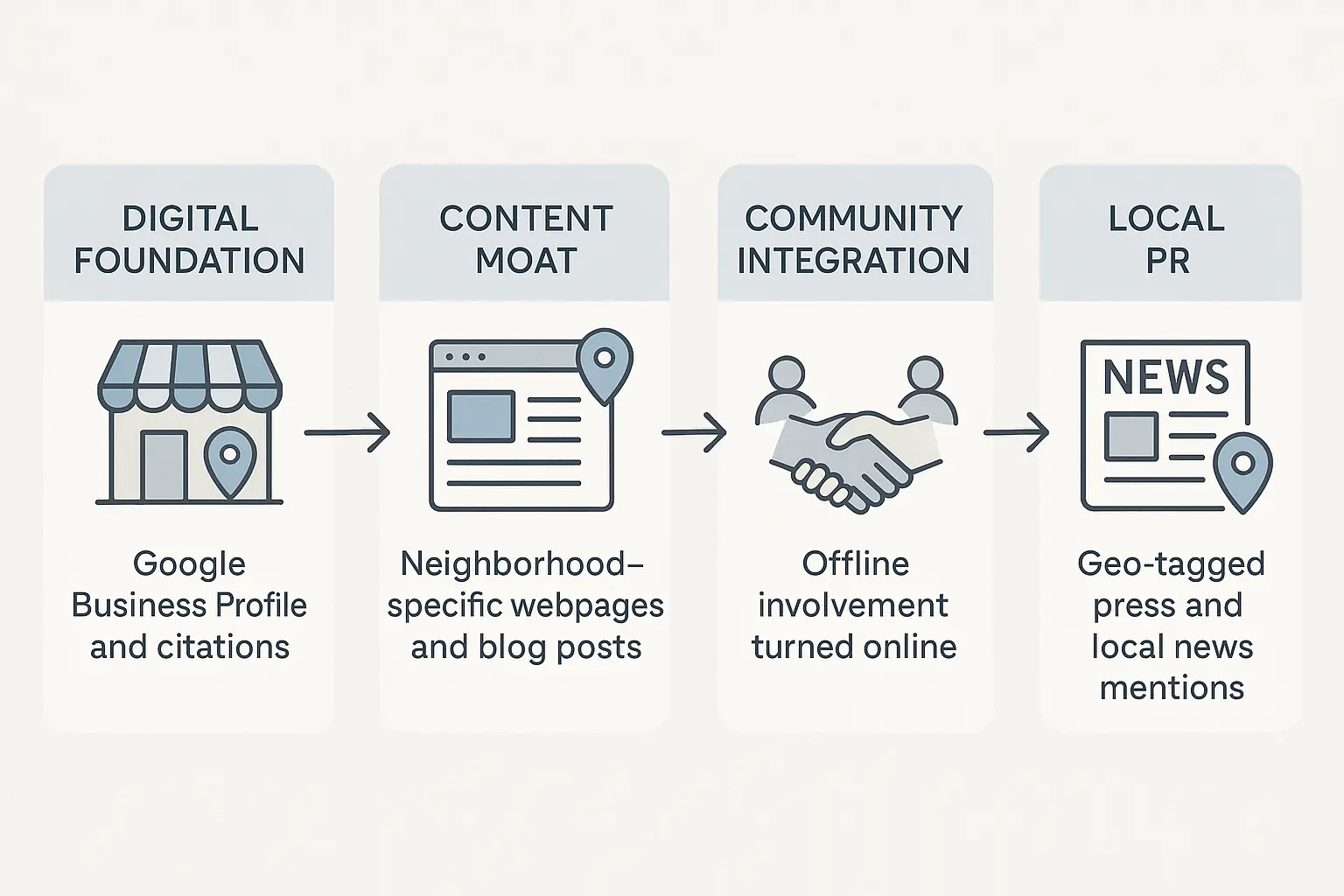
Putting It All Together: A Winning Strategy for Your Agency
Remember the outranked plumber from our example? Their competitor wasn’t winning with technical SEO. They were winning because their business was mentioned on the local little league website, they had dozens of consistent citations, and their Google Business Profile was full of geo-tagged photos from jobs in the neighborhood. They were winning on trust.
The opportunity for agencies is immense. With 78% of location-based mobile searches resulting in an offline purchase, connecting these hyperlocal signals directly to your client’s bottom line has never been easier.
The challenge, of course, is scale. Managing citation consistency, identifying community engagement opportunities, and creating geo-targeted content for one client is time-consuming. Doing it for ten, twenty, or fifty clients can quickly overwhelm an in-house team. This is often where partnering with specialized white-label SEO services provides the necessary horsepower, allowing your agency to focus on strategy and client relationships while ensuring these detailed tasks are completed flawlessly.
By focusing on these three pillars, you can build powerful, defensible rankings for your clients and deliver results that go far beyond a simple keyword report. These efforts become the foundation of comprehensive local SEO campaigns that drive real-world calls, leads, and sales.

Frequently Asked Questions (FAQ)
What’s the difference between local SEO and hyperlocal SEO?
Local SEO is broader, often targeting an entire city or metro area (e.g., “plumbers in Chicago”). Hyperlocal SEO is more granular, focusing on specific neighborhoods or districts (e.g., “plumbers in Lincoln Park, Chicago”). It’s about winning the search from a user standing on a specific street corner.
How long does it take to see results from building hyperlocal signals?
Building trust takes time. While cleaning up NAP citations can yield results in a few months, the benefits of community engagement and local content are cumulative. Think of it as a long-term strategy that builds a competitive moat, not a short-term tactic for a quick rankings boost.
Do online reviews count as a hyperlocal signal?
Absolutely. Online reviews are one of the most important hyperlocal signals. Research shows 86% of consumers read reviews for local businesses. Reviews that mention specific locations or services (e.g., “They fixed my leak in the Heights neighborhood quickly”) are particularly powerful.
Can I do this for a service-area business without a physical storefront?
Yes. For service-area businesses (SABs), the focus shifts from a single address to the entire service area. You can build signals by creating location-specific landing pages, getting mentioned in neighborhood blogs within the service area, and using geo-tagged photos from jobs completed in different towns or districts.
Your Next Step: From Awareness to Authority
Winning in local search is no longer just a technical challenge; it’s a community-building one. The agencies that succeed will be those who can prove their clients are not just in a neighborhood, but of it.
Start by auditing one of your local clients. How consistent is their NAP? Are they involved in their community online? Is their website content generic, or is it rooted in the places they serve?
Answering these questions is the first step toward building a dominant local presence. For agencies that want to build this capability without the massive overhead, exploring a partnership can be a powerful accelerator. As your agency grows, our enablement model is designed to help you transition from relying on a partner to building these expert services in-house, ensuring you’re always in control of your growth.