Imagine this: your SEO team spends months crafting the perfect blog post. They nail the keyword research, optimize every tag, and finally, after weeks of waiting, it hits page one. The traffic starts rolling in… but the conversions don’t. Crickets.
Across the virtual hallway, your paid media team is running a Google Ads campaign pointing to a simple landing page. They’ve tested five different headlines, three calls-to-action, and two versions of the body copy. They know exactly what message gets a user to click, engage, and convert.
What if you could take their hard-won, data-backed insights and apply them to your organic content?
That’s not a hypothetical. It’s a proven strategy for turning pages that rank into pages that actually generate business. You’ve already paid for the market research—it’s time for your SEO strategy to cash in.
The Great Divide: Why Paid and Organic Teams Don’t Talk
In most organizations, SEO and PPC (Pay-Per-Click) teams operate in separate orbits.
The SEO Team’s Goal: Earn long-term authority and visibility. They play the long game, knowing that only 5.7% of pages will rank in the top 10 search results within a year of publication. Their focus is on creating comprehensive, valuable content that satisfies search intent over time.
The PPC Team’s Goal: Drive immediate conversions at the lowest possible cost. They are masters of the A/B test, constantly iterating on ad copy and landing pages to find the perfect combination that compels a user to act right now.
This separation creates an invisible wall. The SEO team builds the library, hoping people will check out a book. The PPC team runs the storefront, meticulously testing every sign and display to make a sale.
The missed opportunity? The data from the storefront could tell the library exactly which book covers and titles will fly off the shelves.
Your Google Ads Data: A Cheat Sheet for High-Converting Content
Think of your Google Ads account as a real-time conversion laboratory. Every click is a vote, and every conversion is a confirmation of what works. While your SEO content waits for Google’s algorithm to reward it, your PPC landing pages are gathering concrete data on:
- Headlines that grab attention.
- Value propositions that resonate.
- Calls-to-action (CTAs) that inspire action.
- Page layouts that guide users seamlessly to the conversion goal.
Ignoring this data is like ignoring a focus group that’s telling you exactly what they want to see. Especially when you consider that a staggering 90.63% of content gets no traffic from Google at all. To join the successful minority, you need more than just good SEO; you need content that performs the moment a visitor lands on your page.
Here’s how to use your PPC data to reverse-engineer content that converts from the moment it’s published.
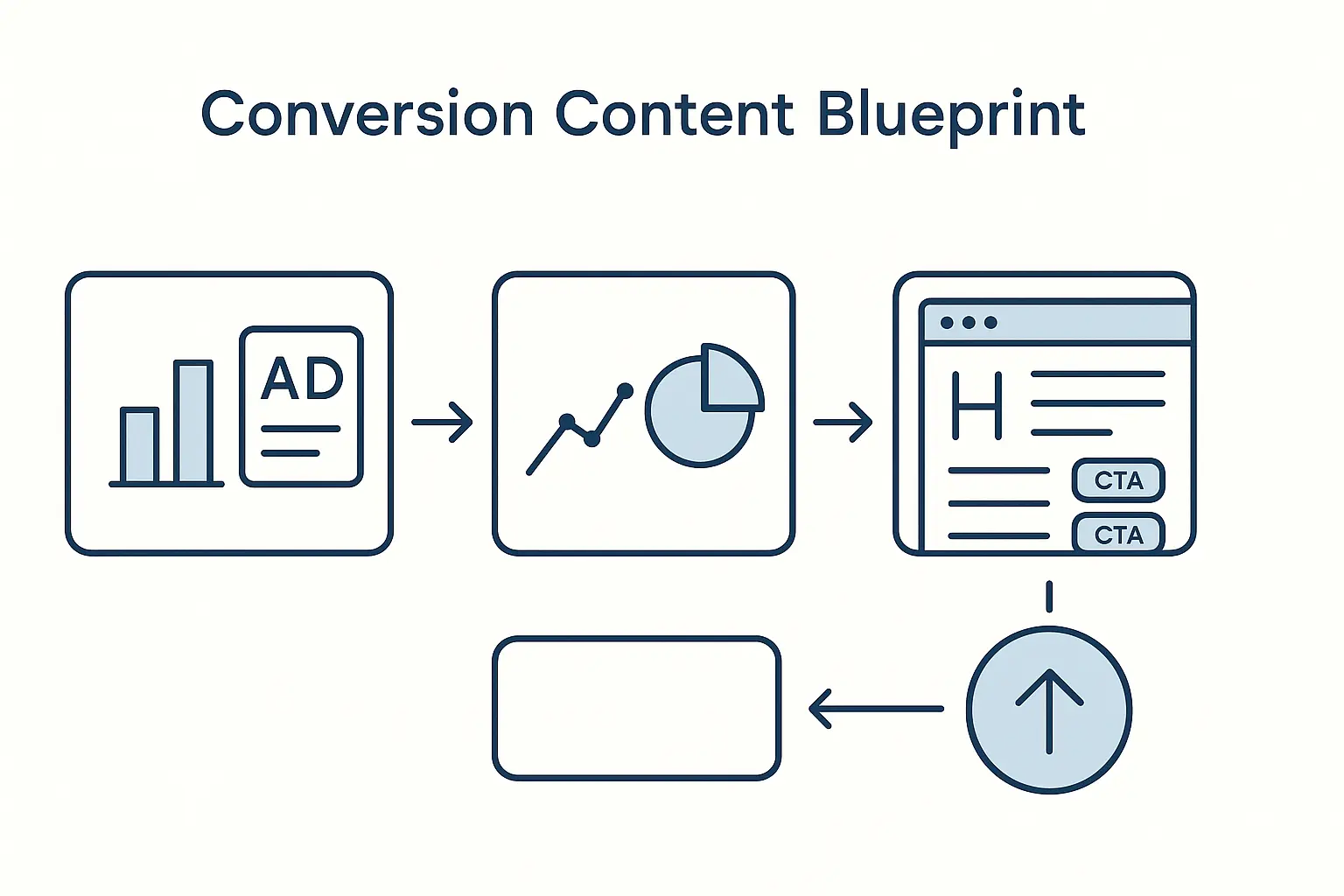
Step 1: Identify Your “PPC Champions”
Log in to your Google Ads account. Your first task is to find the landing pages that are consistently winning. Don’t just look at click-through rates; you want the pages that are driving meaningful business results.
Navigate to Landing Pages in the left-hand menu. Look for pages with:
- High Conversion Rates: This is the most obvious indicator of a successful page.
- Low Cost Per Conversion: This shows the page is efficiently turning ad spend into results.
- High “Time on Page” or Engagement Metrics (in Google Analytics): A high conversion rate paired with high engagement is the gold standard. It tells you the message is not only effective but also holds the user’s interest.
Create a shortlist of your top 2-3 “champion” landing pages. These are your blueprints for success.
Step 2: Deconstruct the Winning Formula
Now, put on your detective hat. Open up your champion landing pages and analyze them element by element. What makes them so effective?
-
The Headline and H1 Tag:
The average user spends less than 15 seconds on a webpage before deciding to stay or leave. Your headline is doing the heavy lifting.- What it says: Does it ask a question? State a clear benefit? Create a sense of urgency?
- What it promises: Does it promise to solve a specific problem or deliver a clear outcome?
Example: A PPC landing page for a project management tool might convert best with “End Project Chaos Today,” whereas the SEO blog post is titled “10 Tips for Better Project Management.” The PPC headline is active, urgent, and benefit-driven.
-
The Opening Copy and Value Proposition:
Immediately after the headline, how does the page hook the reader?- Pain Points: Does it directly address the user’s frustrations?
- Benefits vs. Features: Does it focus on what the user will achieve (benefit) rather than what the product does (feature)?
- Social Proof: Are there testimonials, logos, or case study snippets placed high on the page?
-
The Call-to-Action (CTA):
This is where the magic happens. Analyze the exact wording of the buttons and links that drive conversions.- The Verb: Is it generic like “Submit” or “Learn More,” or is it specific like “Get Your Free Quote,” “Start My Trial,” or “Download the Guide”?
- The Placement: Where are the CTAs located? At the top? After a key benefit? Is there a final one at the bottom?
-
The Page Flow and Layout:
How is the information organized? The structure of a high-converting page is never an accident.- Simplicity: Are there distractions, or is the page hyper-focused on a single goal?
- Visuals: What images or videos are used to support the message?

- Content Depth: Is it a short, punchy page or a longer, more detailed one? Research shows that pages with high conversion rates can have longer content, sometimes averaging over 2,000 words. If your long-form PPC page is converting well and has a high time-on-page, that’s a massive signal that users in your market crave in-depth information before converting.
Step 3: Apply the Blueprint to Your SEO Content
This is where you bridge the gap. Take your findings from Step 2 and use them to optimize your existing organic pages or shape new content.
-
For Existing Blog Posts: Find a high-traffic, low-conversion blog post. Can you rewrite the H1 and introduction using the principles from your champion PPC headline? Can you add the proven CTA from your landing page throughout the article?
-
For New Content: Don’t start with a blank page. Use the PPC landing page as your creative brief. Structure your next article around the same flow of pain points, benefits, and social proof that you know works.
-
For Service Pages: Your core service pages are prime candidates for this strategy. They often function similarly to landing pages and can benefit directly from proven messaging. Integrating these insights is a core part of a modern omnichannel SEO strategy.
This approach removes the guesswork. You’re applying a proven formula that dramatically increases the chances your SEO traffic will turn into tangible leads and sales. For agencies, this is a scalable way to drive results, often achieved by partnering with SEO outsourcing for agencies that understand this cross-channel synergy.
Step 4: Measure, Refine, and Repeat
Once you’ve updated your organic pages, the job isn’t done.
-
Set up Conversion Tracking in Google Analytics: Create goals to track the actions you want users to take (e.g., form submissions, demo requests).
-
Annotate Your Changes: Make a note in Google Analytics on the day you updated the page.
-
Monitor Performance: Over the next 30-60 days, compare the conversion rate of the updated page to the previous period.
You should see a lift in conversions. If you do, roll out these changes across more pages. If not, revisit your analysis. Did you miss a key element? Was the audience intent fundamentally different? It’s this cycle of continuous improvement that separates good SEO from great SEO.
Frequently Asked Questions (FAQ)
Q: What if my PPC landing pages are very different from my informational blog posts?
That’s common. You’re not looking to copy the page verbatim. Instead, you’re extracting the principles of persuasion. The headline on your landing page might be “Get a Free Marketing Audit,” which wouldn’t work for a blog post. But the underlying principle might be that your audience responds to free, tangible offers. So, for your blog post, a better CTA might be “Download Your Free Content Checklist.” It’s about adapting the why behind the conversion, not just the what.
Q: How much ad spend or data do I need for this to be reliable?
You don’t need a massive budget, but you do need statistical significance. A good rule of thumb is to look at landing pages that have at least 1,000 visits and 50+ conversions. This ensures the data isn’t just random noise and reflects real user behavior.
Q: Can changing my content based on PPC data hurt my SEO rankings?
Not if it’s done thoughtfully. Improving user engagement signals—like time on page, bounce rate, and conversion rate—is overwhelmingly positive for SEO. Google wants to rank pages that satisfy users. By making your page more engaging and effective, you’re aligning with Google’s goals. Just be sure not to remove valuable content or keywords that are responsible for your current rankings. The goal is to enhance, not replace.
Q: My agency doesn’t have the resources to manage both PPC and SEO analysis. How can we implement this?
This is a common challenge for growing agencies. It’s why many choose to partner with white-label SEO services that specialize in this kind of integrated, growth-focused SEO. A good partner can handle the execution and analysis, allowing your team to focus on client strategy and relationships.
Stop Guessing, Start Converting
Your SEO content doesn’t have to be a shot in the dark. You have a treasure trove of conversion data waiting for you in Google Ads. By breaking down the silos between your paid and organic teams, you can build a powerful feedback loop where every ad dollar spent makes your organic content smarter, stronger, and more profitable.
Start with one page. Find one winner in your Ads account, identify its core message, and apply it to one of your ranking blog posts. The results might just surprise you.