
You landed the client. A thriving specialty clinic with a brilliant team of physicians. The excitement in your agency is palpable—until the first content meeting. Suddenly, you’re discussing topics like “Laparoscopic Cholecystectomy Recovery” and “Non-Invasive Cardiovascular Imaging.”
The panic sets in. How can your team write with authority on subjects that take a decade of medical school to master? More importantly, how do you get the client’s busy, time-strapped physicians to review and approve your content without grinding the entire production schedule to a halt?
This isn’t just a content challenge; it’s an authority challenge. In healthcare marketing, accuracy isn’t just good practice—it’s the very foundation of trust, for both Google and your client’s future patients.
The Trust Gap: Why Doctor-Vetted Content is Non-Negotiable
Before we dive into the “how,” let’s establish the “why.” Your potential audience is actively searching for health information online, but they’re doing so with a healthy dose of skepticism.
Research from the Kaiser Family Foundation (KFF) paints a clear picture: while about half of U.S. adults turn to social media and search engines for health information, a staggering two-thirds say they trust information from their own doctor “a lot.” This leaves them searching for credible signals in a sea of noise.
This creates a massive opportunity. When your content is visibly co-created or vetted by a physician, you’re not just publishing another blog post. You’re bridging the digital trust gap, borrowing the authority that patients already place in their doctors and extending it to your client’s digital presence.
This concept is so critical that Google has built it into its quality standards, especially for what it calls “Your Money or Your Life” (YMYL) topics. For medical advice, Google’s guidelines state that high-quality content should be “written or produced by people or organizations with appropriate medical expertise or accreditation.”
In short: Google wants to see the expert. So do your readers. The challenge is making that collaboration efficient.
The AI Co-Pilot and the Human Expert: A Modern Partnership
Many agencies turn to AI to scale content creation, but in the medical field, this comes with a serious catch. A 2023 study published in Nature found that while AI-generated health content was often more readable and empathetic than physician-written content, it was also significantly less accurate.
This is where the modern workflow comes in. AI isn’t the author; it’s the co-pilot. It can help you draft, structure, and optimize content for readability, but it cannot replace the nuanced, critical eye of a medical professional. Your job is to build a system where technology provides speed and the physician provides truth. For agencies aiming to scale, mastering this blend is the key to an effective AI-driven SEO strategy.
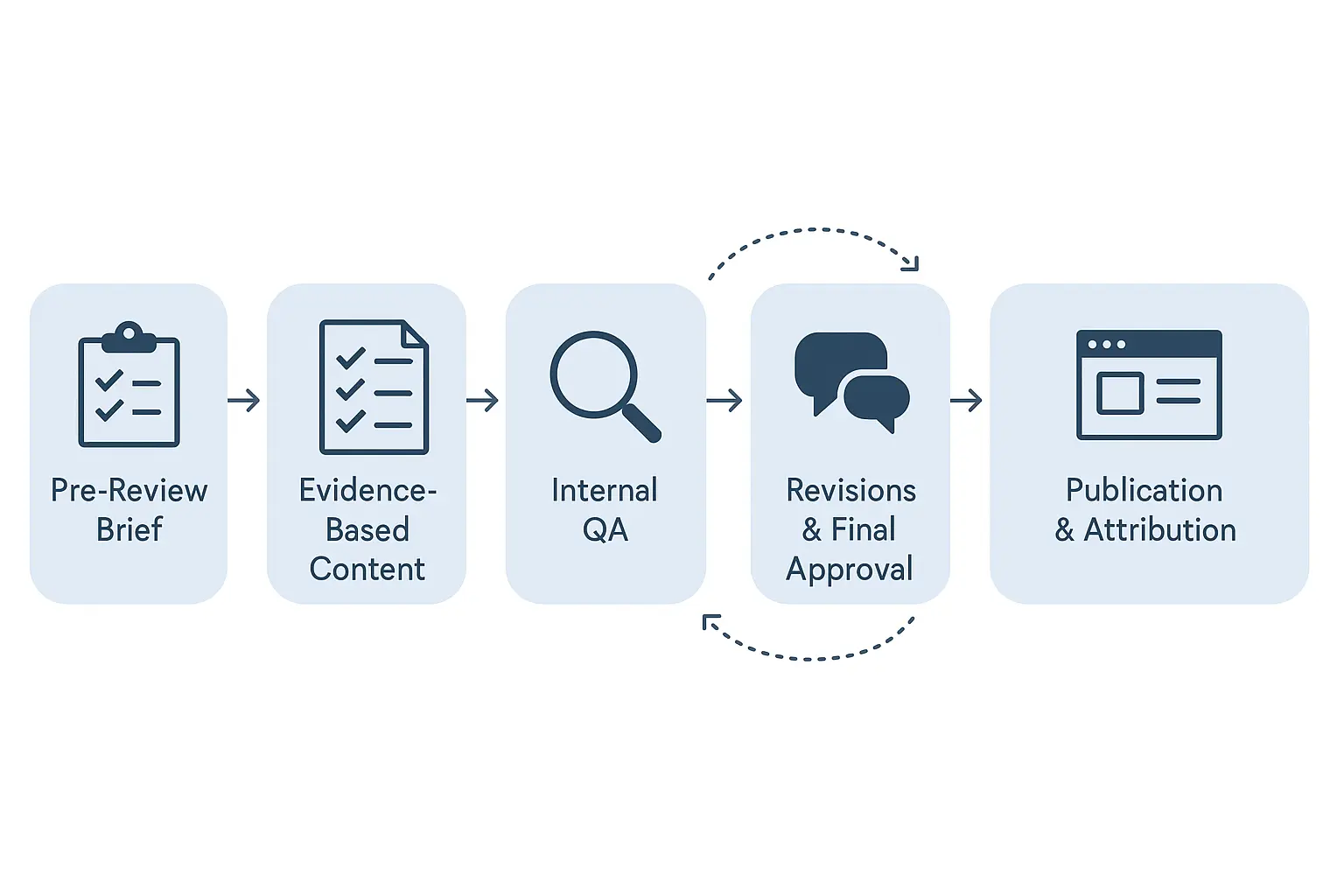
The Five-Step Workflow for Medically Accurate Content
Forget endless email chains and feedback lost in spreadsheets. A structured workflow turns potential chaos into a predictable process that respects everyone’s time and expertise.
Step 1: The Strategic Content Brief
Your role as the agency starts here. Before a single word is written, you create a brief that’s more than just a keyword—it’s the strategic blueprint for the article.
Your brief should include:
- Primary & Secondary Keywords: The SEO foundation.
- Target Audience & Search Intent: Who are we talking to, and what problem are they trying to solve? (e.g., A recently diagnosed patient versus a caregiver).
- Key Questions to Answer: Use insights from “People Also Ask” and competitor analysis to guide the structure.
- Core Angle & Talking Points: A high-level outline of the story you want to tell.
- Call to Action: What should the reader do next?
This brief ensures the physician is reviewing a strategic asset designed to achieve a specific goal, not just a random article.
Step 2: The AI-Assisted First Draft
With a solid brief in hand, use your preferred AI writing tool to generate a comprehensive first draft. The goal here isn’t perfection; it’s speed and structure. An AI can do the heavy lifting of organizing information, writing in a clear tone, and ensuring all points from your brief are covered.
Step 3: The Physician Review (The “Accuracy Pass”)
This is the most critical step and the one that often goes wrong. To make this seamless, your priority is to make it easy for the physician. Don’t just send a Google Doc link with the note, “Thoughts?”
Instead, frame their task clearly:
- Set Expectations: “Dr. Smith, we need you to review this for medical accuracy. Please ignore grammar or style for now. Your focus is ensuring the information is correct, safe, and complete.”
- Provide Specific Instructions: Use the comments feature in a shared document to ask direct questions. For example: “@Dr.Smith – Is this the most common symptom? Are there others we should mention?” or “@Dr.Smith – Could you add a sentence or two here explaining this in simpler terms for a patient?”
- Give a Deadline: Be respectful but firm. “We’d love to get your feedback by Friday to keep this piece on schedule.”

Step 4: The Agency Revision (The “Clarity & SEO Pass”)
The physician will return a document full of accurate, expert information—but it’s likely to be dense, technical, and not yet optimized for search. This is where your team’s expertise shines.
Your job is to:
- Translate, Don’t Dilute: Simplify complex medical terminology without losing meaning. Turn clinical language into patient-friendly advice.
- Re-integrate SEO: Weave keywords and related phrases back in naturally. Format the content with H2s, H3s, and bullet points for readability.
- Check for Brand Voice: Ensure the tone aligns with the client’s overall brand.
Step 5: Final Approval and Bylining
Send the revised draft back for a quick final look. This time, it’s a simple yes or no. Once approved, publish the content with a clear author byline, such as:
- Written by [Agency/Writer Name]
- Medically Reviewed by Dr. [Physician’s Name], [Credentials] on [Date]
This “Medically Reviewed by” line is a powerful E-E-A-T signal for both users and search engines.
Tools to Manage the Workflow
A good process needs good tools. You don’t need a complex, expensive system; simplicity is key.
- Shared Documents (Google Docs): Ideal for collaborative editing. The commenting and suggestion features are perfect for the back-and-forth between your team and the medical reviewer.
- Project Management Software (Asana, Trello, ClickUp): Use a project board to visualize the content pipeline. Create columns for each stage: “Briefing,” “Drafting,” “In Medical Review,” “Revising,” and “Approved.” This keeps everyone accountable and provides a clear overview of progress.
Systematizing the process transforms a potential bottleneck into a predictable part of your service delivery. For agencies needing to execute this at scale across multiple clients, it’s worth noting that robust white-label SEO services often have these proven workflows already built-in.

Frequently Asked Questions (FAQ)
Q1: How do I convince a busy physician to participate in this?
Frame it as a benefit to them and their practice. Explain that their expertise is the key ingredient for building trust online, attracting the right patients, and establishing their practice as a leader. Then, show them how your streamlined workflow respects their time by making the review process as efficient as possible.
Q2: What if the doctor’s feedback conflicts with SEO goals?
This is why the workflow has separate “Accuracy” and “Clarity/SEO” passes. The doctor’s job is to ensure the information is correct. Your job is to then skillfully integrate that correct information into a well-optimized, easy-to-read format. It’s a partnership. If their feedback removes a keyword, your team’s task is to find a new, creative way to work it back in without sacrificing accuracy.
Q3: Can’t we just add a “Medically Reviewed by” byline without the whole process?
Absolutely not. Authenticity is paramount. Taking shortcuts not only misleads readers but also violates Google’s guidelines around E-E-A-T. True authority comes from genuine collaboration, and both search engines and savvy readers can often spot the difference.
Q4: How often should we update medical content?
Google’s quality guidelines recommend that YMYL content be “edited, reviewed, and updated on a regular basis.” A good rule of thumb is to schedule an annual review for all your core medical content. Put it on the calendar and repeat the review workflow to ensure the information remains current.
From Bottleneck to Competitive Edge
Creating medically accurate content doesn’t have to be a roadblock for your agency. Implementing a structured workflow turns your client’s in-house experts from a potential bottleneck into your greatest content marketing asset.
You empower them to do what they do best—provide credible, trustworthy expertise—while your team does what it does best: crafting compelling narratives that rank, engage, and convert. It’s a win for the client, a win for their patients, and a powerful new capability for your agency.
Building these specialized processes takes time. For agencies looking to accelerate their ability to serve clients in the healthcare space, an experienced agency SEO partner can provide the proven systems and expertise to help you scale confidently.