
You see the notification and your stomach drops: a one-star review just popped up for your healthcare client.
The review is detailed, emotional, and very, very public. Your first instinct is to jump in, defend your client, and correct the record. You want to write, “We’re so sorry about your experience, Jane. We’ve reviewed your chart, and it seems there was a miscommunication about your billing…”
Stop. Typing that single sentence could ignite a bigger crisis than the review itself.
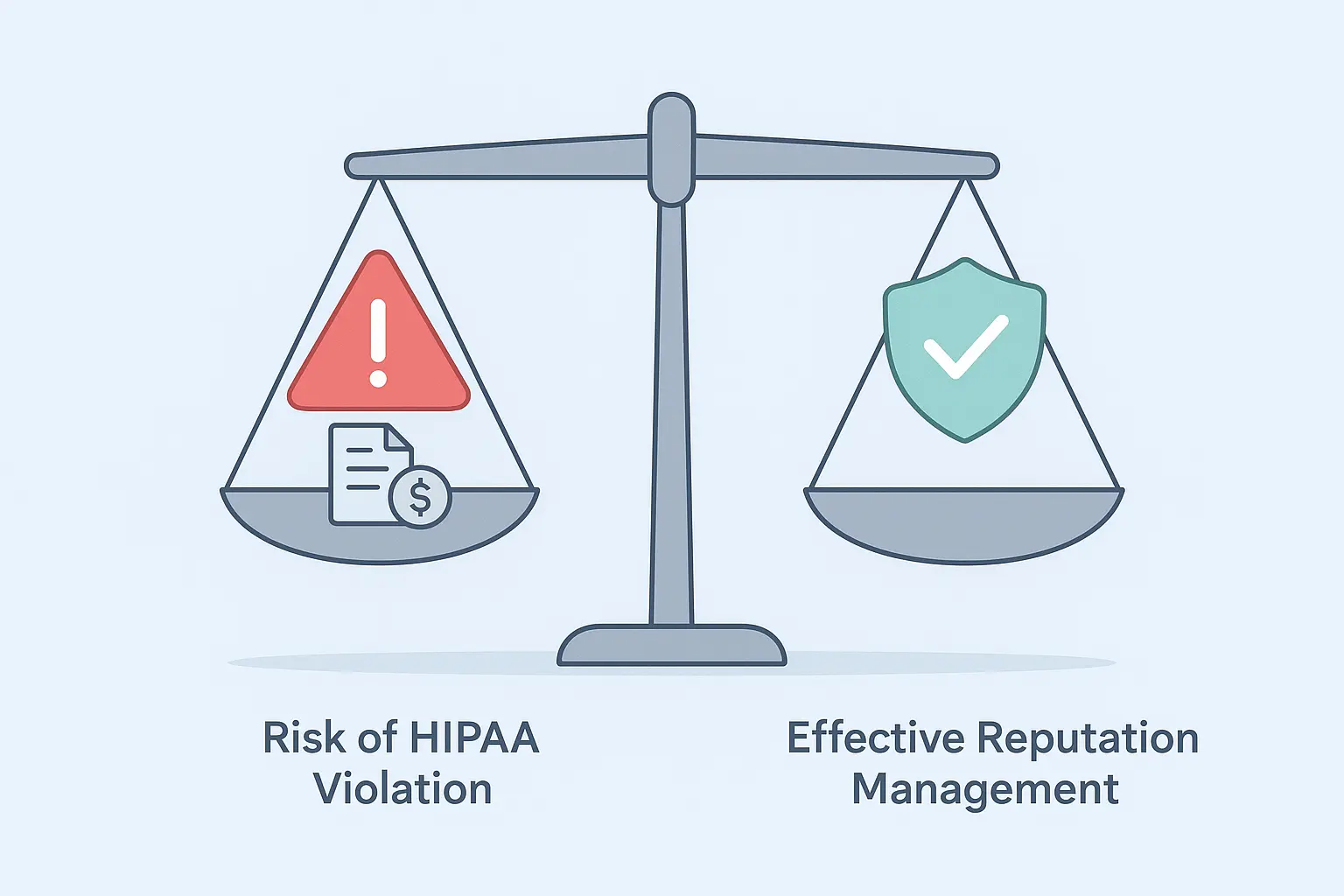
In most industries, reputation management is a straightforward game of customer service. But in healthcare, you’re navigating a minefield. One wrong move doesn’t just look unprofessional; it can trigger a HIPAA (Health Insurance Portability and Accountability Act) violation, leading to severe fines and lasting damage to your client’s practice.
This isn’t just about feelings—it’s about business. Research shows that 84% of consumers trust online reviews as much as a personal recommendation. For a potential patient choosing a new provider, a single unanswered negative review can be the deciding factor.
So how do you protect your client’s reputation without breaking the law? This guide provides the framework and scripts you need to respond with confidence and compliance.
The Unbreakable Rule of Healthcare Review Responses
Before we get to the scripts, let’s establish the single most important rule. Tattoo it on the inside of your eyelids.
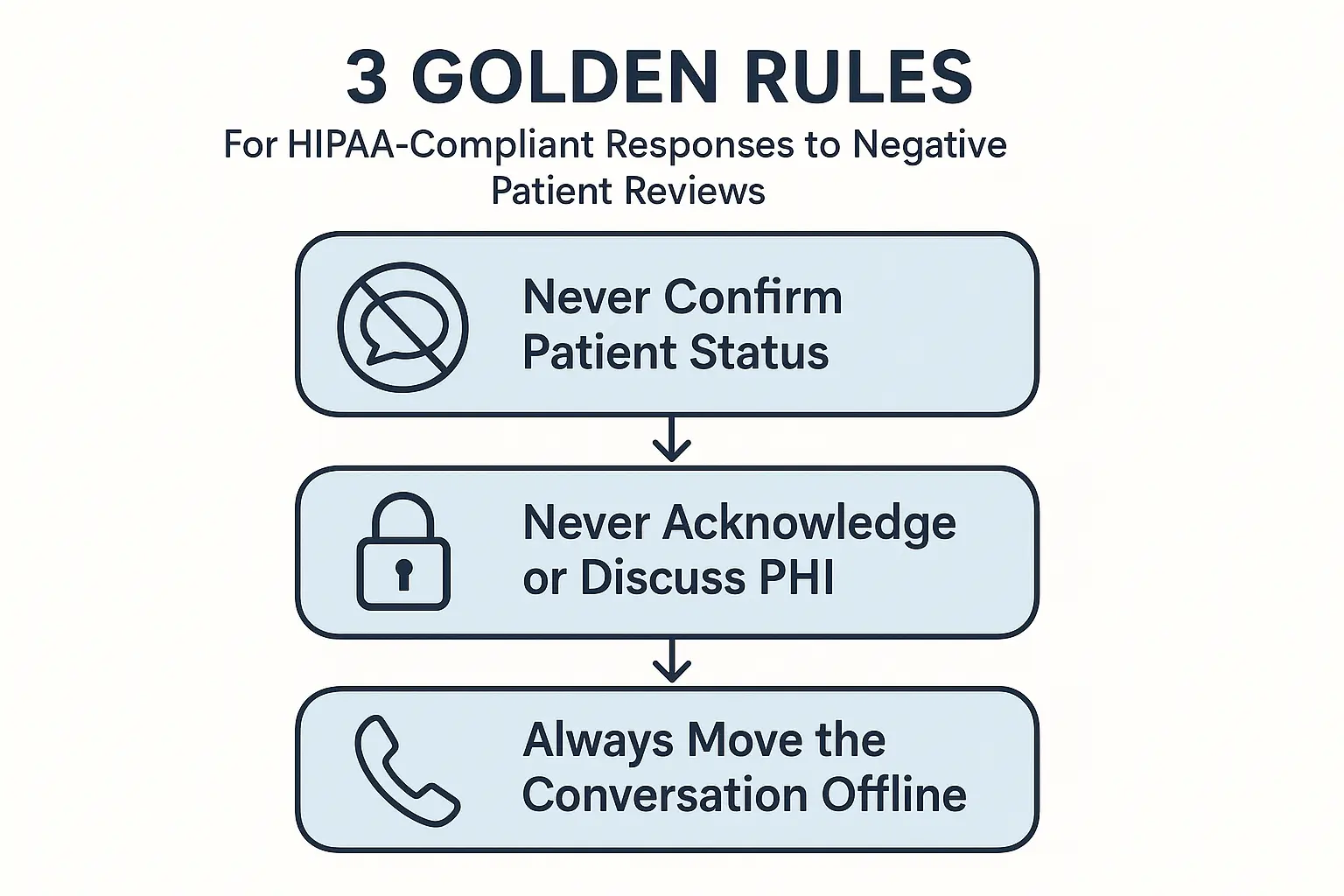
The Golden Rule: Never, ever confirm—or deny—that the reviewer was a patient.
Any response that acknowledges the reviewer’s status as a patient is a potential disclosure of Protected Health Information (PHI). This includes:
- Confirming their visit: “We’re sorry your appointment on Tuesday didn’t meet your expectations.”
- Discussing their care: “Dr. Evans has a different recollection of your conversation.”
- Referencing their records: “Our billing records show your insurance was processed correctly.”
- Denying they were a patient: “We have no record of you as a patient in our system.”
Even denying a patient relationship is a violation, because you are still disclosing information (or a lack thereof) from your private patient database. The moment you engage with the specifics of their claim, you’ve crossed the line.
Good vs. Bad: A Tale of Two Responses
Let’s see this in action. Imagine a negative review about a long wait time.
The Bad Response (HIPAA Violation):
“Hi Mark. We apologize for the long wait during your 2 p.m. visit yesterday. We had an unexpected emergency with another patient that caused a delay. We hope your son is feeling better after his check-up.”
Why is this so bad? It confirms the reviewer’s name, appointment time, and the nature of their visit (their son’s check-up)—a clear disclosure of PHI.
The Good Response (Compliant & Effective):
“Thank you for sharing your feedback. We are committed to providing a positive experience for everyone who walks through our doors, and we take comments about our wait times very seriously. To protect individual privacy, we cannot discuss specific situations in a public forum, but we invite the reviewer to contact our Practice Manager, Sarah, directly at 555-123-4567 to address their concerns.”
Here’s why this response works:
- It acknowledges the issue (wait times) without acknowledging the person.
- It shows the practice is listening and cares.
- It moves the conversation to a secure, private channel.
- It reinforces their commitment to privacy, building trust with everyone reading.
The A.C.T. Framework: Your 3-Step Plan for Every Response
When a negative review appears, don’t panic. Just A.C.T.
- A – Acknowledge: Acknowledge the topic of the feedback generally, without confirming any details.
- C – Channel: Channel the conversation to a private, offline channel like a phone call or a secure email address.
- T – Terminate: Terminate the public conversation politely. Do not get into a back-and-forth debate.
This simple framework ensures every response is professional, de-escalating, and, most importantly, compliant.
Your Plug-and-Play Compliant Response Scripts
Here are four customizable scripts built on the A.C.T. framework. Use them as a starting point to develop a response library for your healthcare clients. Remember, a swift and professional response is critical; 94% of consumers say a bad review has convinced them to avoid a business.
Script 1: The Standard De-Escalation (For General Complaints)
When to use it: General complaints about care, outcomes, or overall experience.
Script: “We appreciate you taking the time to share your feedback. Our practice is committed to providing a high standard of care and a positive patient experience, and we take all comments very seriously. Due to patient privacy regulations, we cannot address specific concerns in a public forum. We encourage the reviewer to contact our [Patient Advocate/Office Manager], [Name], at [Phone Number] or [Email Address] to discuss this matter privately.”
Script 2: For Service-Related Issues (Billing, Wait Times, Staff)
When to use it: Complaints about front desk staff, billing confusion, appointment scheduling, or long wait times.
Script: “Thank you for your feedback, as it helps us improve our services. We strive to make every aspect of our practice, from scheduling to billing, as smooth as possible. We sincerely regret that we fell short of this goal. We invite you to contact [Name], our [Practice Manager], at [Phone Number] so we can better understand the situation and work to resolve your concerns.”
Script 3: For Vague or Confusing Complaints
When to use it: 1- or 2-star reviews with no text, or reviews with comments that are difficult to understand.
Script: “[Practice Name] is dedicated to ensuring everyone in our community has a positive experience with our team. We regret that we did not meet your expectations. We would appreciate the opportunity to learn more about your experience directly. Please contact our office at [Phone Number] at your convenience.”
Script 4: For Reviews Mentioning Specific Staff by Name
When to use it: Any review that names a specific doctor, nurse, or staff member in a negative context.
Script: “We take feedback regarding our team members very seriously, as our goal is to provide compassionate and professional care at all times. We appreciate this being brought to our attention. To ensure this matter is handled with the appropriate level of privacy and care, please contact our [Practice Director], [Name], at [Phone Number] to share the details of your experience.”
What About Positive Reviews? The Same Rules Apply!
It’s tempting to celebrate a glowing 5-star review with a personal thank you, but be careful—the same privacy rules apply.
Don’t say: “Thanks, Sarah! We’re so glad you’re happy with your new dental implants!”
Do say: “Thank you for the kind words! We love hearing from our community and are so glad you had a positive experience with our team.”
The compliant response is just as warm but protects everyone’s privacy.
Frequently Asked Questions
Can we just ask the patient to take the review down?
It’s best to avoid this. Asking for a review to be removed can feel like an attempt to silence criticism and may even provoke the person into posting more negative content. Focus on resolving their issue offline. If they’re satisfied with the resolution, they might choose to update or remove the review on their own.
What if we’re 100% sure the review is fake?
This is frustrating, but the Golden Rule still applies. You cannot publicly state, “You were never a patient,” as this discloses information (or a lack thereof) from your patient list. Instead, use a modified version of the vague complaint script and report the review to the platform (Google, Yelp, etc.) for violating its terms of service.
Does HIPAA apply to every healthcare client?
HIPAA applies to “covered entities,” which includes most health plans, healthcare clearinghouses, and any healthcare provider who conducts business electronically. This means doctors, dentists, chiropractors, psychologists, clinics, hospitals, and more. If you’re managing marketing for a client who provides healthcare services, it’s safest to assume HIPAA applies and operate with maximum caution.
Who in the practice should be in charge of responding?
Designate one or two trained individuals—typically an Office Manager, Practice Director, or a dedicated Patient Advocate. They should work with your agency to use pre-approved, compliant scripts and be prepared to handle the follow-up calls or emails your responses generate.
Beyond Scripts: Building a Proactive Reputation Strategy
Responding to negative reviews is a crucial defensive measure, but the best strategies are proactive. The damage from one negative review can be immense; research shows it takes roughly 40 positive experiences to undo the harm of a single negative one.
A solid response plan is the foundation of your client’s healthcare reputation management. But to truly thrive, you need a system for encouraging happy patients to share their stories. This often ties into a broader local SEO approach for doctors, ensuring a steady stream of positive reviews boosts visibility in local search results. For a comprehensive plan that connects reputation with patient acquisition, agencies often rely on a white-label SEO partner to manage these complexities effectively and at scale.
By combining compliant responses with a proactive system for generating positive feedback, you can turn online reviews from a source of anxiety into a powerful engine for practice growth.