

Local SEO for Multi-Location Clinics: A Scalable GMB & Citation Strategy
Imagine you’re the marketing director for a rapidly growing dental group. You just opened your fifth clinic, and while the new location looks great, your online presence is a mess. The new clinic doesn’t show up on Google Maps, an old address for another location is still listed on Yelp, and two of your top dentists have patient reviews scattered across three different, unmanaged profiles.
This scenario is all too familiar to multi-location healthcare organizations, where rapid growth often creates digital chaos.
But getting it right is non-negotiable. With a staggering 93% of patients using online reviews to evaluate physicians, your online listings aren’t just data points; they’re the new front door to each of your clinics. This guide provides a scalable framework to turn that chaos into a powerful patient acquisition engine, one location at a time.
Why “Local” is the New Frontier for Healthcare Marketing
Not long ago, healthcare marketing relied on billboards and regional ads. Today, it’s about showing up when a patient searches “orthodontist near me” on their phone. And patients are searching: these “near me” queries for healthcare have skyrocketed by over 900% in recent years.
Patients expect immediate, accurate answers. 46% of all Google searches are for local information, and those searches show clear intent. Half of all local mobile searches are for something as simple as a business address, meaning if your clinic’s information is wrong, you’ve lost a potential patient before they’ve even left home.
For a multi-location brand, this means every clinic—and often every practitioner—needs its own perfectly managed digital presence.
The Core Challenge: Inconsistency is the Enemy of Trust
The biggest threat to a multi-location brand’s local SEO isn’t a competitor—it’s internal inconsistency. From a patient’s perspective, the experience is profoundly damaging: finding an old phone number on a health directory leads to frustration, Google Maps sending them to a previous address creates mistrust, and discovering two profiles for the same doctor with conflicting details causes confusion.
This isn’t just a poor user experience; it’s a signal to Google that your data is untrustworthy, which hurts your rankings. It also directly impacts patient choice: research shows that 33% of patients have chosen a new provider after finding negative or inconsistent information online.
The foundation of local SEO is NAP consistency: ensuring your Name, Address, and Phone number are identical across every online platform. For a multi-location business, this requires a centralized strategy.
The Scalable Solution: A Centralized GMB & Citation Framework
Managing dozens, or even hundreds, of listings manually is impossible. The solution is a scalable system built on a clear structure, standardized data, and smart automation.
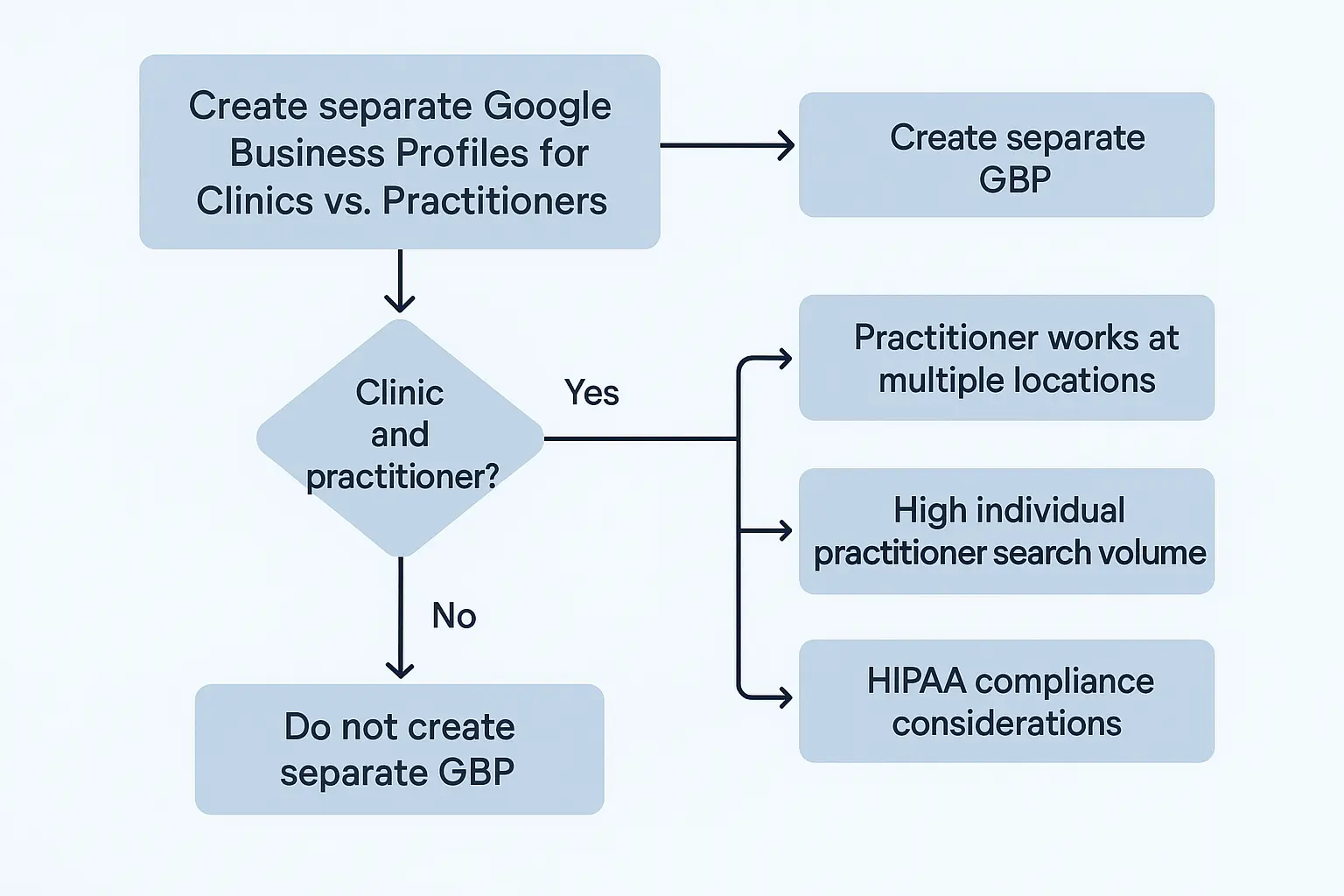
Step 1: Architect Your Google Business Profile (GMB) Structure
Your first priority is to create a blueprint for how your brand, clinics, and doctors appear on Google. Since 83% of consumers use Google Search to find information about doctors, getting this structure right is essential.
Brand Listing: This is the profile for your corporate headquarters. It’s less for patients and more for brand-level management.
Location Listings: These are the most important profiles. Each physical clinic must have its own dedicated, fully optimized GMB profile. This is what patients look for and what Google ranks in local search results.
Practitioner Listings: Each doctor, dentist, or key practitioner should also have their own GMB profile designated as a “practitioner,” listing the clinic address where they practice. This is crucial because 53% of patients find it important to see physician information on clinic websites and search engines. A dedicated profile allows them to attract their own reviews and build individual visibility.
This structure allows patients to find the specific clinic or doctor they’re looking for while ensuring Google understands the relationship between your parent brand and its individual locations.

Step 2: Standardize and Optimize Every Location Profile
Consistency starts with a “single source of truth.” Create a master spreadsheet with perfectly formatted, 100% correct information for every location and practitioner. This includes:
- Exact Clinic Name (e.g., “Evergreen Dental – Northwood”)
- Full Address (standardized, e.g., “Street” not “St.”)
- Local Phone Number (ideally a unique, trackable number for each location)
- Website URL (the specific location page, not the homepage)
- Primary and Secondary Categories (e.g., “Dental Clinic,” “Cosmetic Dentist”)
Once you have this master file, use it to optimize every GMB profile. Completeness is critical: businesses with fully optimized GMB profiles receive 7 times more clicks.
Your Optimization Checklist:
- Categories: Be specific.
- Services: List every service offered at that location.
- Photos: Add high-quality, recent photos of the clinic’s exterior, interior, and team.
- Google Posts: Share updates, health tips, or promotions.
- Q&A: Proactively ask and answer common questions.
Step 3: Master Citation Management at Scale
A “citation” is any online mention of your clinic’s NAP information. Google finds these citations across the web—on directories like Yelp, Healthgrades, Vitals, and Apple Maps—and uses them to verify your data’s accuracy.
The more consistent, high-quality citations you have, the more confidence Google has in your location’s legitimacy. The challenge is that manually updating dozens of listings across numerous directories for multiple locations is a recipe for errors and wasted hours.
This is where an AI-driven SEO approach is essential. Citation management tools can push your standardized NAP data from your “single source of truth” to hundreds of directories at once, find and fix incorrect listings, and suppress duplicate profiles. This automation is the only reliable way to maintain consistency at scale.
Putting It All Together: The Agency Flywheel
For marketing agencies that manage healthcare clients, this framework is the key to delivering scalable results. The process is a continuous loop:
- Audit: Identify all existing listings (correct, incorrect, and duplicate).
- Standardize: Create the “single source of truth” in partnership with the client.
- Automate: Use tools to clean up citations and push correct data everywhere.
- Monitor & Optimize: Track performance, manage reviews, and continually optimize GMB profiles with new photos and posts.
For agencies looking to expand their offerings without building a massive in-house team, a white-label SEO partner can provide the scale and expertise to execute such a complex project seamlessly.
Frequently Asked Questions (FAQ)
What’s the difference between a location GMB and a practitioner GMB?
A location profile represents the physical clinic (“Evergreen Dental”). A practitioner profile represents an individual professional who works there (“Dr. Jane Smith”). Patients often search for both, so having both is critical for maximum visibility.
How do we handle doctors who work at multiple locations?
A practitioner’s GMB profile should list their primary practice location as the main address. You can then mention the other clinics where they practice in the description and on their website bio.
Should we use a unique phone number for each location?
Yes, absolutely. Using unique, trackable phone numbers for each GMB profile allows you to measure how many calls each specific listing is generating, proving the ROI of your local SEO efforts.
How long does it take to see results from local SEO?
After a major cleanup, it can take Google 2-3 months to crawl and recognize the new, consistent information. However, you can see improvements in rankings and clicks from GMB optimizations within a few weeks.
What’s the most important thing to focus on first?
Your Google Business Profiles. Ensure every location has a claimed, verified, and fully optimized GMB profile with 100% accurate information. This is the biggest lever you can pull for immediate impact.
Your Next Step: From Overwhelmed to In Control
Winning local search as a multi-location healthcare brand isn’t about complicated tricks; it’s about building a system for consistency and accuracy at scale. By establishing a clear GMB architecture, standardizing your data, and leveraging automation, you can transform scattered online listings into a predictable source of new patients.
Start by auditing just one of your locations. Check how its information appears on Google, Apple Maps, and Healthgrades. The insights you gather will be the first step toward building a truly scalable strategy.
If you’re ready to build a comprehensive plan, dedicated local SEO services can help map out a clear path to growth and ensure each of your clinics becomes the go-to choice in its neighborhood.